


The best public schools in Montreal span both French and English systems, with standouts like Royal West Academy, École internationale de Montréal, Collège Saint-Louis, Westmount High School, FACE School, and Vincent Massey Collegiate regularly named by parents and local guides. Choosing among them depends less on rank and more on program fit, language eligibility, and your family’s admissions route.
TL;DR:
- Quebec’s 2025 report ranks 470 secondary schools by 2023 to 2024 exam results, so compare five year trends alongside program fit and school visits.
- English eligibility usually depends on a parent’s or sibling’s English schooling in Canada, not family fluency; ask your local school service center early.
- Families typically register for the next school year in January or February; late applicants may face fewer remaining seats, especially in selective programs.
- Specialized programs often require separate applications, auditions, or tryouts, while neighborhood enrollment usually follows catchment; check each school’s process before planning a commute.
- Out of catchment students may need to arrange transportation, and counseling or special education support varies by school; ask staff about services and waitlists.
Table of Contents
- A shortlist of notable public schools worth visiting
- What provincial rankings actually measure
- How to choose the right public school for your child
- Language eligibility and English enrolment rules you should know
- Enrolment timing and the documents you’ll need
- Support services: counselling, tutoring, and special education
- Getting to school: bus service and transportation
- Class sizes and teacher ratios parents should expect
- How targeted tutoring supports strong school outcomes
- Ready to prepare for entrance exams? Here’s how we help
- FAQ
- Sources
A shortlist of notable public schools worth visiting
Montreal’s public network includes a mix of neighbourhood schools and specialized programs that draw families from across the city. These six come up again and again in parent discussions and local school guides, and each one serves a different kind of learner.
- Royal West Academy: an English secondary school in Montreal West known for its International Baccalaureate program; admission to the IB stream runs through a separate application, while the regular program follows catchment.
- École internationale de Montréal: a French elementary school offering an international program with added languages and enrichment; spots in the international stream are assigned through an application process rather than straight catchment.
- Collège Saint-Louis: a French public secondary school recognized for its arts-focused options alongside a solid academic core; students apply directly for concentration programs such as music or visual arts.
- Westmount High School: an English secondary school with a long-standing academic reputation and a broad range of extracurriculars; most students enter through catchment, with some specialized electives requiring a short application.
- FACE School: a French and English bilingual elementary and secondary school built around the arts, including music, dance, and visual arts; admission to its arts concentration involves an audition rather than neighbourhood assignment.
- Vincent Massey Collegiate: an English secondary school with strong sports programs and a reputation for a tight-knit school culture; enrolment mainly follows catchment, with tryouts for specific athletic streams.
These schools cover elementary and secondary levels, both official languages, and a range of strengths from the IB to the arts to athletics. Commonly cited notable public schools in Montreal, including these six, show up consistently across local guides when parents compare options, which makes this shortlist a reasonable starting point before you book any visits. Treat it as a first pass: the right fit still depends on your child’s needs, your commute, and whether a program requires an application beyond your home address.
What provincial rankings actually measure
Quebec’s Report Card on Quebec’s Secondary Schools 2025 ranks 470 schools using provincewide exam results in French, English, science, and mathematics for the 2023 to 2024 year. The report tracks movement over time as much as a single snapshot: 58 schools showed a statistically significant improvement in their scores, while 43 declined.
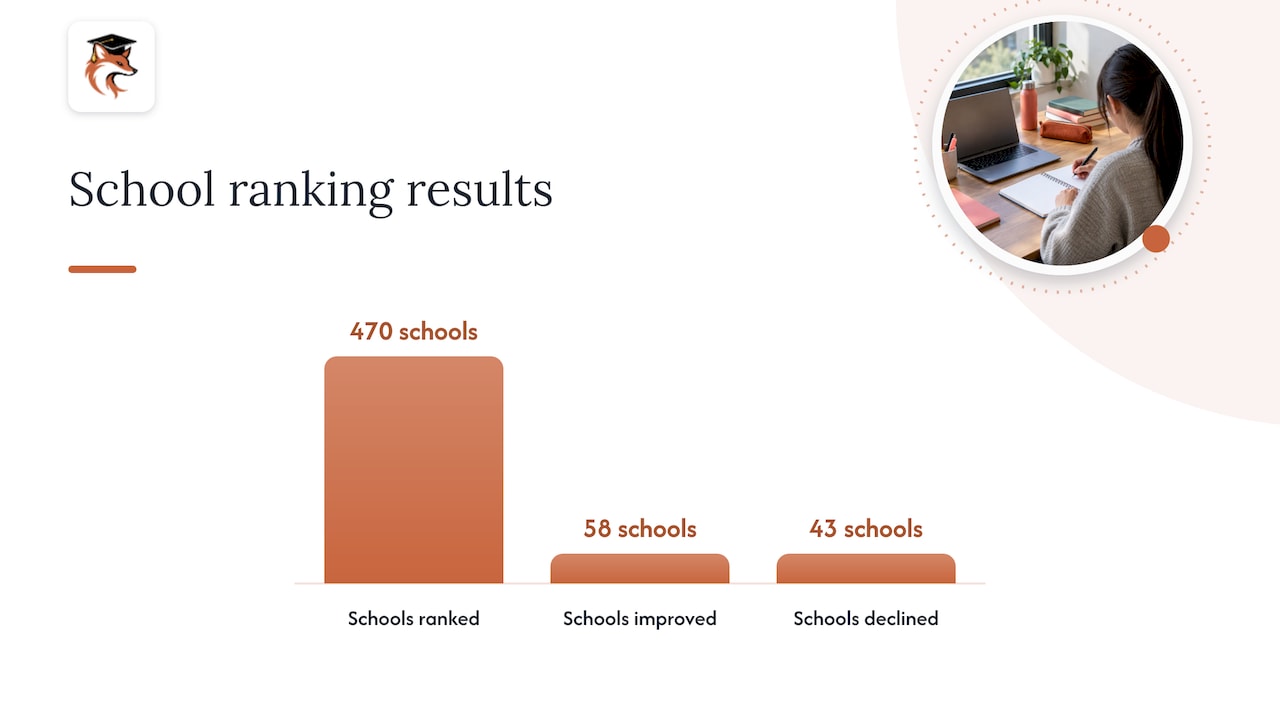
One example stands out: École secondaire des Lacs improved from a score of 3.7 to 7.7 between 2018 and 2024, one of the larger gains tracked in the report. A jump like that usually reflects sustained changes at the school level, whether in teaching practices, student supports, or both, rather than a one-year fluke.
Rankings like this are useful, but they have real limits. They measure exam performance, not the full experience of a school: a strong IB program, a specialized arts concentration, or a school’s approach to special education won’t show up in an exam-based score. Results are also shaped by the socio-economic makeup of a school’s student population, which rankings don’t fully control for. The practical move is to use the report as one input among several: check a school’s five-year trend, then weigh it against program fit, commute, and what you see on a visit. Our internal look at how to interpret these rankings walks through that balance in more detail.
How to choose the right public school for your child
Rankings tell you part of the story. The rest comes from matching a school’s day-to-day reality to your child’s needs and your family’s logistics. Walk through these questions in order when you visit or call a school.
- Academic fit: does the school’s pace and teaching style suit your child? Ask staff how they support students who are ahead of or behind grade level.
- Special programs: does the school offer IB, AP, arts, sports, or STEM concentrations that match your child’s interests? Ask what the application or audition process looks like and when it happens.
- Language and eligibility: is this an English or French school, and does your family qualify? Ask the school directly whether a Certificate of English Eligibility applies to your situation.
- Commute and catchment: is this school in your catchment zone, or does it require a separate application? Ask how transportation works for students outside walking distance.
- Extracurriculars: what clubs, teams, or arts activities run outside class time? Ask for a list of current offerings, since these can shift year to year.
- School culture and parent involvement: how does the school communicate with families, and is there an active parent committee? Ask to speak with a parent liaison or attend a governing board meeting.
Pro tip: A school ranked slightly lower on exam scores but a strong match for your child’s interests, like a dedicated arts or sports program, often serves them better than a higher-ranked school with no program fit. Picture two children: one thrives with structure and a traditional academic track, the other needs room to pursue music daily. The “best” school looks different for each of them.
Language eligibility and English enrolment rules you should know
Access to English public schools in Quebec is governed by the Charter of the French Language, which generally requires a Certificate of English Eligibility before a child can enrol in the English sector. That certificate is typically based on the schooling history of a parent or sibling who was educated in English in Canada, not simply on a family’s home language or preference.
Families run into a few common pitfalls here:
- Assuming that English fluency alone qualifies a child; the rule is based on prior schooling history, not language ability.
- Overlooking that eligibility is tied to Canadian schooling specifically, so education completed in another country usually doesn’t count.
- Waiting until registration week to check eligibility, which can delay placement if documents need to be gathered.
Verification happens through your local centre de services scolaire, which reviews documentation and issues the certificate. Families who recently arrived and don’t qualify for the English sector still have solid options: neighbourhood French schools paired with francization supports help children build French skills quickly while settling into the system.
Enrolment timing and the documents you’ll need
Montreal families typically register for the following school year during a January to February window, well before the school year actually starts. Missing that window doesn’t mean your child is shut out, but it often means settling for whatever seats remain rather than your first choice, especially for specialized programs with limited spots.
Have these ready before you register:
- Your child’s long-form birth certificate.
- Proof of residency in the school’s catchment area.
- Immunization records.
- A Certificate of English Eligibility, if applying to an English-sector school.
If you’ve missed the main window, contact the centre de services scolaire directly and as soon as possible. Registration windows are strict in practice, and the sooner you reach out, the better your chances of landing a workable placement for the coming year.
Support services: counselling, tutoring, and special education
Public schools in Montreal generally offer in-house counselling, resource teachers, and special education services, though the depth of support varies by school and by the specific needs involved. Larger secondary schools tend to have more dedicated staff, including guidance counsellors who help with course selection and post-secondary planning, while elementary schools often rely on itinerant specialists who split time across several locations.
For a child with a diagnosed learning difference, ask specifically how the school structures individualized education plans and how often those plans get reviewed. For a child who’s simply falling behind in one subject, in-school help is sometimes limited to occasional check-ins rather than regular one-on-one time, which is where outside support, including tutoring, often fills the gap. Ask at the open house or during registration what counselling hours look like, whether there’s a waitlist for special education assessments, and how the school communicates progress between formal report cards. Specifics here vary enough from school to school that a direct question to staff beats any general assumption.
Getting to school: bus service and transportation
Public school transportation in Montreal generally runs through the school bus network organized by each centre de services scolaire, with eligibility typically tied to how far a student lives from their assigned school. Students attending their catchment school usually qualify for busing if they live beyond a minimum distance, while those attending a school outside their catchment, including many specialized programs, may need to arrange their own transportation.
This distinction matters most for families considering a program like an IB stream or an arts concentration that falls outside their home catchment. Before committing to a program, ask the school directly whether busing is available for out-of-catchment students or whether you’ll need to rely on public transit, carpooling, or another arrangement. For families near a metro or bus line, that commute can still be manageable, but it’s worth mapping out before the school year starts rather than after.
Class sizes and teacher ratios parents should expect
Class sizes in Montreal’s public elementary and secondary schools follow provincial guidelines that set maximum numbers per grade level, though actual sizes can run close to those caps depending on the school and the neighbourhood’s enrolment pressure. Elementary classes tend to be smaller than secondary ones, and specialized programs sometimes cap enrolment lower than the standard maximum to preserve a particular teaching approach.
Rather than relying on a general number, ask each school directly what their current class sizes look like by grade, since this shifts year to year with enrolment. It’s also worth asking whether the school uses any additional support staff in the classroom, such as teaching assistants, particularly in the early grades where ratios matter most for building foundational skills.
How targeted tutoring supports strong school outcomes
Choosing the right school is one piece of the picture. Helping your child arrive ready for it, especially when a program involves an entrance exam, is another. We have built our approach around personalized instruction delivered by university-level tutors, with a focus on supporting students through secondary school entrance exam preparation.
A diagnostic session identifies exactly where a child’s gaps sit in math or French, which lets us target preparation instead of reviewing everything. From there, exam simulations build familiarity with the format and timing, which eases the nerves that often hurt performance more than knowledge gaps do. For a child aiming at a selective program, whether an IB stream, an arts concentration, or another entrance-exam school, a short diagnostic months ahead of the application deadline gives you a clear read on where to focus.
— Réussite A+
Ready to prepare for entrance exams? Here’s how we help
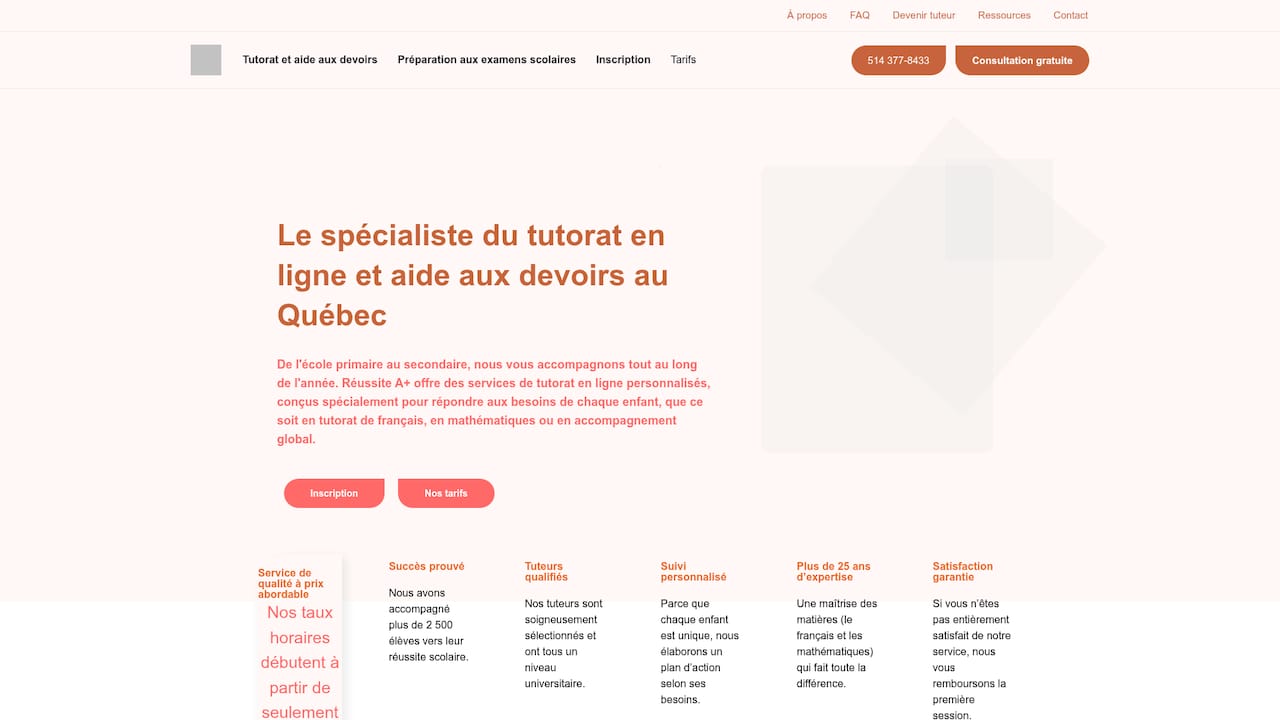
Getting into a program like the ones named above often comes down to how well a child is prepared for the entrance exam, and that’s exactly where we focus. Our exam preparation sessions build a study plan around your child’s specific strengths and gaps, led by university-level tutors who know what these exams actually test.
Here’s what comes with a tutoring plan built around your child:
- A personalized learning plan based on a real diagnostic, not a generic worksheet package.
- University-level tutors who specialize in French and mathematics, the two subjects most entrance exams lean on.
- Flexible online scheduling that fits around school, sports, and other commitments.
- Session régulière, summer intensives, and exam-prep sessions priced between $30 and $35 per hour, with a one-time $65 registration fee.
If your child has a selective program in their sights, our exam-preparation page is the place to start the conversation.
FAQ
What are the top 10 schools in Quebec?
Quebec’s top-ranked schools shift slightly each year based on provincewide exam results tracked in the Report Card on Quebec’s Secondary Schools 2025, which covers 470 schools across the province. Rather than a fixed list, the report tracks scores and year-over-year movement, so it’s worth checking the current tables directly for the most accurate standings.
What is the top 1 public school?
There’s no single school that holds a permanent top spot, since the Fraser Institute’s provincial report updates rankings each year based on provincewide exam results. A school’s rank can shift from year to year, which is part of why pairing the current ranking with program fit and a school visit gives a more reliable answer for your family.
Which English high school in Montreal ranks highly?
Westmount High School and Royal West Academy are both English secondary schools frequently named among Montreal’s strongest public options, with Royal West Academy particularly known for its International Baccalaureate program. Vincent Massey Collegiate also ranks well with families prioritizing sports programs and school culture.
What are the top 10 private schools in Montreal?
This article focuses on public school options rather than ranking private schools, since the two systems involve different admissions processes and funding models. For families weighing both paths, our guide to private schools in Montreal covers admission considerations for that sector specifically.
How do I know if my child qualifies for an English public school?
Eligibility for English public schools in Quebec depends on a Certificate of English Eligibility, which is generally based on whether a parent or sibling completed their own schooling in English in Canada. Your local centre de services scolaire can confirm your family’s eligibility and walk you through the certificate process.
Sources
- Report Card on Quebec’s Secondary Schools 2025
- Schooling in Quebec (McGill University family-care guide)
- Westernquebec
- Find public school in Montreal (The Custodian)