


A good study space at home is a steady, quiet spot with a proper work surface, good light, the supplies your child needs within reach and as few distractions as possible. It does not need its own room. A corner of the kitchen table with a study box can work very well, as long as your child uses it at the same time and in the same way each day.
This guide shows you how to set it up step by step, how to adapt it to your child’s age and personality, and how to add simple note-taking habits so that the time spent at the desk actually counts.
TL;DR
- Choose one regular spot with a table, a chair, good light and a place for supplies, and let your child help set it up.
- Remove the usual distractions: TV, phone notifications and the busiest part of the house.
- Short on space? Use a study box that holds only what your child needs for the task, so setup takes minutes.
- Match the space to your child: some work best in silence, others near the kitchen where they can talk things through.
- Pair the space with a routine and a simple note-taking method, such as Cornell notes for older students.
Table of Contents
- Why a dedicated study space helps
- The five essentials of a good home study space
- How to build a distraction-free study space
- Homework station ideas for small homes
- Adapting the space to your child
- Routine: the other half of the study space
- Note-taking strategies that make study time count
- Is it better to study at home or somewhere else?
- Perspective: what we see after 25 years of tutoring
- Make the space work with a tutor
- FAQ
- Sources
Why a dedicated study space helps
A study space sends a signal: when we sit here, we work. That cue matters more than the furniture. Children who have to hunt for a pencil, clear the dinner table and find a charger before starting often lose their motivation before the first question.
Research supports this. A qualitative study of 30 college students found that comfortable temperature, privacy, a quiet area, adequate space and good organization were what motivated students to study at home. Discouraging factors included disorganized space, noise, distracting devices such as the TV and the internet, and having no personal study space. The students were older than most readers’ children, but the pattern is familiar to many parents of school-age kids.
The Government of Alberta also notes in its Learning @ Home fact sheet that learning can happen in different places inside and outside the home. Its advice is to dedicate a quiet, safe place while leaving room for movement and creativity. In other words, the space should be calm, not rigid.
The five essentials of a good home study space
The same list keeps coming back in school board and university guidance. Here is how to apply it, one item at a time.
1. A work surface and a comfortable chair
A good space needs a desk or table, a chair, access to power and a good light source, plus an internet signal if the work requires one. A kitchen table is perfectly fine. What matters is that your child can sit with both feet supported and the screen or page at a comfortable height. A comfortable, ergonomic chair is on the University of Queensland’s list of what a good study environment includes.
Quick checks:
- Can your child’s feet rest flat on the floor or on a box?
- Is there room to spread out a notebook and a textbook at once?
- Is the outlet close enough for a laptop charger?
2. Light you do not have to think about
The Government of Alberta recommends natural and/or suitable lighting. Put the desk near a window if you can. In Quebec, where November afternoons turn dark early, add a desk lamp. The University of Queensland guide lists overly bright or dim lighting among the features of a poor study environment, so aim for even light that does not glare on the page or screen.
3. Comfortable temperature and fresh air
The same Queensland guide names fresh air and temperature control as part of a good space, and a room that is too warm as a problem. In a Quebec winter, overheated rooms are common. Crack a window for a few minutes before homework, or choose a spot away from the heater.
4. Supplies within arm’s reach
The Government of Alberta also recommends organized access to learning materials. A small kit does the job:
- pencils, pens, eraser, ruler, highlighters
- a French dictionary and a conjugation reference
- a calculator for older students
- a timer
- scrap paper and sticky notes
For a school-age child, one tray or one cup per type of item is enough. The aim is to avoid any reason to get up.
5. A clear boundary between study and play
The Queensland guide flags no clear distinction between study and recreation areas as a feature of a poor study environment. If your child’s desk is in the bedroom, do not let it become the gaming spot as well. If the table is shared, a simple ritual helps: place mat down, study box open, timer on. When the work is finished, everything goes back in the box.
How to build a distraction-free study space
Parents often ask for a distraction-free space and then discover that the space is fine and the phone is the problem. Work through the list below in this order.
- Turn off the screens you do not need. The Ontario Ministry of Education’s Parents Matter encourages parents to create a place for studying with a regular homework time and limited distractions, and to set appropriate times for phone calls and leisure time on computers and electronic games.
- Move the TV out of earshot. A TV nearby is listed among the features of a bad study environment, alongside a constantly buzzing phone.
- Park the phone. Put it in another room or in a basket, not face-down beside the notebook. If your child needs a device for the task, switch off notifications first.
- Clear the surface. Mess and clutter work against concentration. A two-minute tidy at the end of each session makes the next one easier.
- Choose the right location. The Vancouver School Board suggests a desk or table away from the bustle of family life, set up as a special place with your child’s involvement.
If focus is the main struggle, our three simple steps to start homework tonight pair well with this checklist.
A little noise is not always the enemy
Total silence is not the answer for every child. The University of Queensland guide notes that one teen may work best with gentle background noise while another needs complete silence. It also notes that a teen who likes to think aloud may do better in a communal space such as the kitchen. Ask your child what helps, then test it for a week.
Homework station ideas for small homes
Not every family has a spare room, and that is fine. Here are four set-ups that work in apartments, duplexes and busy houses.
The study box
The University of Southern Queensland’s study skills chapter describes a study box as the next best thing to a permanent space when the area is shared. It holds only what is needed for the current task, so your child can be set up and working within minutes instead of searching for a pen. Use a shoebox, a plastic bin or a caddy. Label it with your child’s name and decorate it together.

The kitchen table corner
Choose one end of the table and keep it the same every day. Add a placemat, a lamp that clips on, and the study box. You can supervise lightly while making dinner, and younger children often like having an adult close by.
The bedroom desk
This suits older students who want quiet. Face the desk toward a wall or window rather than the bed, keep the gaming console out of sight and set a rule: the desk is for work only.
The hallway or landing nook
A narrow table and a folding chair fit almost anywhere. Add a corkboard or a wall pocket for the week’s assignments. The Vancouver School Board guide encourages children to put assignments in a designated spot as soon as they come home and again once the work is finished. A wall pocket makes that habit easy.
| Set-up | Best for | Main advantage | Watch out for |
|---|---|---|---|
| Study box on the kitchen table | Elementary students | Adult nearby, no extra furniture | Household traffic during meal prep |
| Bedroom desk | Secondary students | Privacy and quiet | Gaming, phone and bed nearby |
| Hallway nook | Small apartments | Separate from daily life | Lighting, so add a lamp |
| Shared family desk | Two or more children | One routine for everyone | Different schedules and noise needs |
Adapting the space to your child
Younger children (elementary)
Children in the early grades need short, supported sessions. The Vancouver School Board suggests starting with 10 to 15 minutes of work and building up gradually, adding that it is better to stop too soon than too late. It also notes that extra play, screen time, game time or a treat can be used for motivation. Let your child choose the placemat colour or the pencil case. When children help create the space, they see it as theirs.
For a quick routine on organizing the work itself, see our guide to organizing primary school homework in 15 minutes.
Older children and teens (secondary)
The Halton District School Board’s transition guide for Grade 9 students suggests colour-coded binders, one per subject, a private and organized place without distractions, and a timer for a minimum amount of work each night, for example 20 minutes of work and then a 5-minute break. That structure is easy to build into a desk set-up: binders on a shelf, timer in view.
Children who struggle to concentrate
If your child has ADHD or a hard time starting, keep the space simple, with fewer items on the desk and a visible plan. Our article on how to motivate a child with ADHD to study goes deeper.
Different subjects, different needs
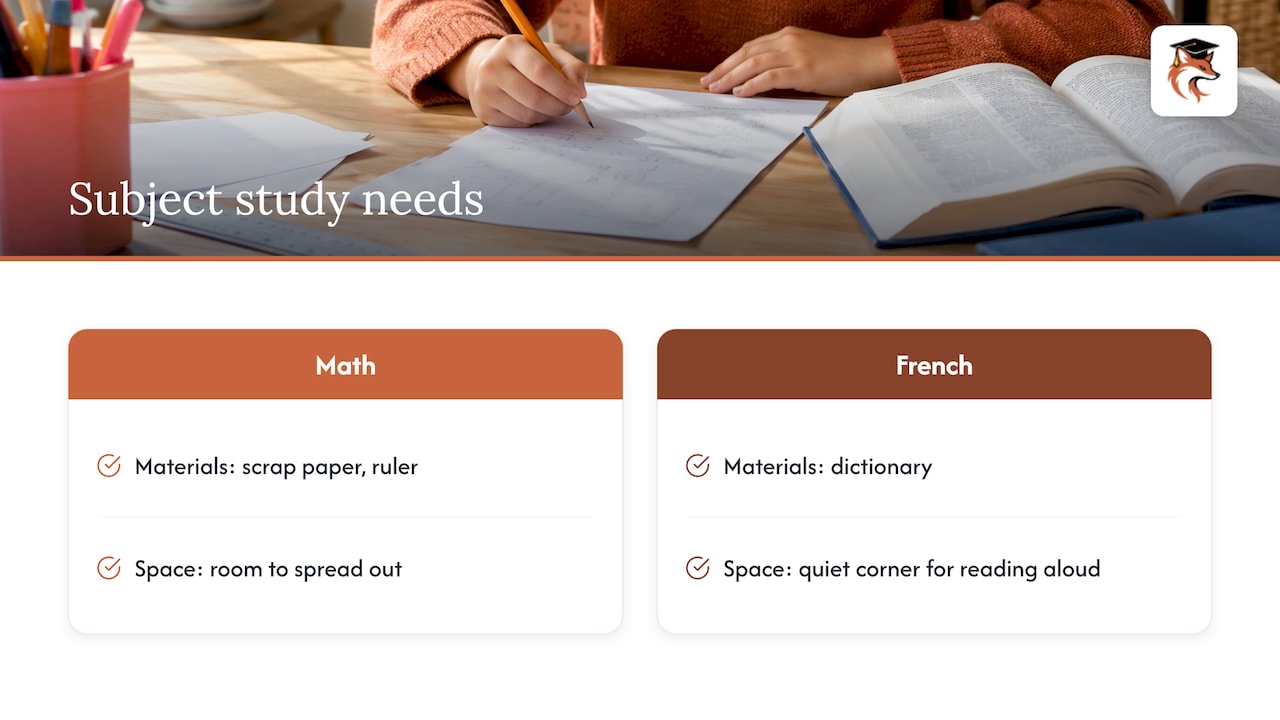
Math often needs scrap paper, a ruler and space to spread out. French needs a dictionary and a quiet corner for reading aloud. A small trolley or a set of two boxes, one per subject, keeps both ready.
Routine: the other half of the study space
A well-set desk does little if homework time shifts every day. The Government of Alberta advises familiar routines for sleep, meals, chores, learning and study time, with breaks for relaxation and unplugging, play, physical activity and social connection. It notes that routines reduce stress caused by change and maintain a sense of security and stability.
A simple weekday pattern:
- Snack and a short break after school.
- Walk to the study space, open the box, set the timer.
- Work in blocks, with a short break between them.
- Pack the school bag and put finished assignments in the designated spot.
- Put everything back and close the box.
For the full routine, see our guide to ending nightly homework battles in two weeks, and for ideas on balancing activities with school, our article on extracurriculars without burnout.
When is the best study time for kids?
There is no single best hour. The best time is the one your child can keep. Some children need to unwind first; others are better off getting started while they still have energy. Pick a window, keep it for two weeks, then adjust if your child is clearly tired or rushed. Regularity matters more than the exact time on the clock.
Note-taking strategies that make study time count
A good space gives your child the chance to focus. A good method makes that focus pay off. Note-taking is a skill that can be taught at home, and it starts earlier than most parents think.
Start with the basics
The New Brunswick Department of Education advises parents to make sure notes are complete, have children highlight or underline important points, and rewrite or type messy notes. It also says that for each subject, whether or not homework has been assigned, children should review their notes so they are prepared for tests, ready for the next lesson and ready to ask questions about what they do not understand. A five-minute review at the desk each evening is a habit worth building.
The Halton guide adds a useful tip for younger secondary students: always take notes, even brief jot notes when a handout is provided, to maintain focus and aid memory.
Five methods to know
The University of Toronto Scarborough describes five note-taking methods:
| Method | What it does |
|---|---|
| Cornell | Helps you actively understand material |
| Outlining | Identifies the important topics |
| Mapping | Shows concepts visually |
| Matrix | Re-organizes notes to show connections between topics |
| Column notes | Helps with organization and creates space |
The same page recommends choosing a style that is easy to use, helps understanding and is useful for reviewing later. It also points out that what works best may differ by subject: chemistry may call for molecular structures, while English literature notes are likely to be more verbal. For a child, that might mean a mind map for a history chapter and a numbered list for math steps.
The Cornell method for older students
A Quebec cégep, the Cégep de la Gaspésie et des Îles, offers a French-language guide to the Cornell method. The page is divided into zones. One holds the date, course, subject and page number. Another holds concise, well-spaced notes using abbreviations, lists and arrows. The guide also advises completing notes quickly after class, highlighting essential points and arranging them logically. Secondary students can start with a simplified version: a wide column for notes and a narrow one for key words and questions.
Teaching note-taking to younger kids
Start small and make it a game:
- Read a short paragraph aloud together.
- Ask your child to write three key words.
- Have them explain the paragraph in one sentence using those words.
- Next day, ask them to rebuild the idea from the notes alone.
The New Brunswick Department of Education says that finding the right study method is trial and error: some children rewrite notes, read them aloud, act them out or build something. Let your child experiment, and keep what works. For exam season, our revision strategies for secondary school exams turn good notes into a plan.
Is it better to study at home or somewhere else?
Home offers comfort, but comfort can invite distraction. A simple experiment answers the question for your child:
- For one week, do the same kind of task, such as math practice, at home.
- The next week, do it at the public library or another quiet spot.
- Compare: How long did the work take? How many times did your child get distracted? How did they feel afterwards?
- Try mixing: reading and review in one place, problem-solving in another.
A study space at home remains the base. Many families find that a change of scene is a useful reset before big exams, and the child’s own answer should guide the choice.
Perspective: what we see after 25 years of tutoring
We have worked with families for more than 25 years, and we have helped more than 3,500 students. One thing we see again and again is that children rarely struggle because they are not trying. They struggle because starting is hard.
A clear study space removes that barrier. When the desk, the supplies and the time are always the same, your child does not have to decide anything. They simply sit down and begin.
This is why our approach starts with a personalized learning plan built around each student’s strengths, challenges, pace and goals. The space, the routine and the method should all fit the child, not the other way around. Our university-level tutors follow progress week by week, so you can see what is working and adjust.
Our advice: set up the space together, keep it simple, and build in short, regular sessions. If you want a trained second pair of eyes on French or math, we are here to help.
Réussite A+
Make the space work with a tutor
Once the space is ready, your child can get even more from it with a tutor who works online. At Réussite A+, we offer personalized online tutoring and homework help for elementary and secondary students across Quebec, with a focus on French and math, summer catch-up sessions and preparation for secondary school entrance exams. Sessions take place at your child’s own study space, so the setting you have just built becomes the classroom.
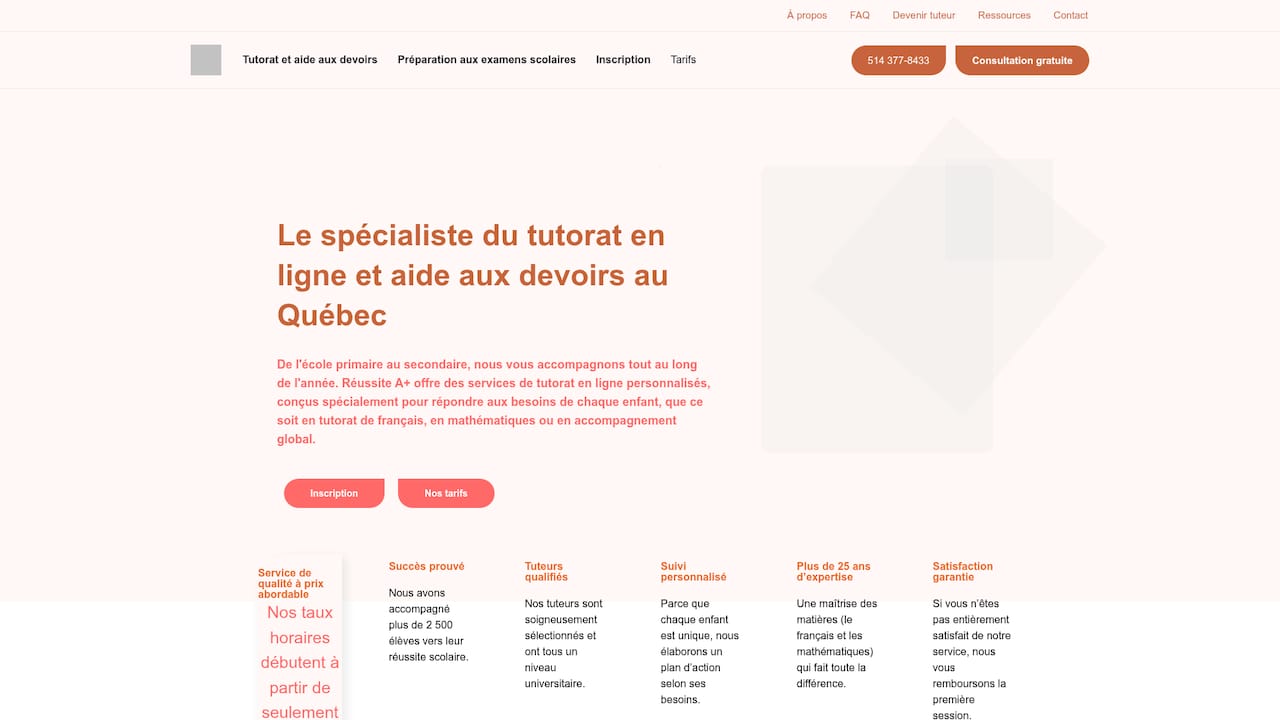
Our tutoring and homework help is priced at $30 to $35 per hour, and there is a one-time registration fee of $65, detailed on our pricing page. If your child is not satisfied, we refund the first session. When you are ready, you can register for tutoring or read more about online homework help.
FAQ
How much space does my child need to study at home?
Less than most parents expect. A table or desk with room for a notebook and a textbook, a chair, good light and a power outlet are enough. If space is tight, a study box lets your child set up in minutes on any shared surface.
Should my child study in their bedroom or in a common area?
It depends on the child. Younger children usually do better in a common area where an adult is nearby. Some teens prefer the quiet of a bedroom, while others concentrate better in the kitchen where they can think aloud. Ask your child and try one option for a week.
How do I keep my child away from their phone during homework?
Agree on a spot for the phone, such as a basket in another room, before homework starts. Set a clear window for calls and leisure screen time, as Ontario’s Parents Matter guidance suggests. If a device is needed for the task, switch off notifications first.
How long should a homework session last?
For younger children, start with 10 to 15 minutes and build up slowly. For teens, a timer with about 20 minutes of work followed by a 5-minute break is a practical starting point. Keep sessions regular, and stop before your child is exhausted.
What note-taking method should my child use?
The best one is the one your child finds easy to use and helpful for reviewing later. Younger children can start with highlighting and short key-word notes. Secondary students can try Cornell notes or mind maps, depending on the subject.
Sources
- The Perceived Effects of Home Environment on University Students (IAFOR)
- Learning @ Home (Government of Alberta)
- Study Space, Academic Success (USQ Pressbooks)
- How to create a positive study environment at home (University of Queensland)
- Parents Matter (Ontario Ministry of Education)
- Supporting Your Child’s Learning at Home (Vancouver School Board)
- Transition Guide to High School (Halton District School Board)
- Study Skills (New Brunswick Department of Education)
- Choosing a Note Taking Style (University of Toronto Scarborough)
- Guide to the Cornell method (Cégep de la Gaspésie et des Îles)