


According to Quebec Secondary School Report Card 2025 According to the Fraser Institute, the five highest-ranked schools provincially are the Saint-Louis College (Montreal), theInternational School of Montreal (Westmount), the Jean-de-Brébeuf College (Montreal), the Jean-Eudes College (Montreal) and the Collège Pasteur (Montreal). According to detailed data from the 2025 Report Card, the rating assigned to each school in the top 5 may vary slightly from one version of the ranking to another, but all generally obtain a rating above 9 out of 10. This data is based on the results of the provincial exams of the 2023-2024 school year.
What you need to do now, specifically:
- Check the open house dates of the school in question starting in 5th grade (often September-October).
- Register for the admission tests or the lottery according to the institution's procedures.
- Consider targeted support in French and mathematics if your child is aiming for a selective school.
To remember : The 2025 Report Card ranks 470 public and private secondary schools in Quebec based on the results of the 2023-2024 provincial exams, with an overall rating out of 10.
Key points
The Fraser Institute ranking is the reference ranking of secondary schools in Quebec, but it must be cross-referenced with a visit and the educational project to lead to a choice that is truly suited to your child.
| Point | Details |
|---|---|
| Source of the list of awards | The Fraser Institute's 2025 Report Card ranks 470 schools based on the 2023-2024 provincial exams. |
| Top 5 provincial | Collège Saint-Louis (9,8), École internationale de Montréal (9,7), Collège Jean-de-Brébeuf (9,7), Collège Jean-Eudes (9,7), Collège Pasteur (9,6). |
| Admissions Calendar | Open days are held in September-October of the 5th year; tests follow in the fall or spring. |
| Main limit | The ranking measures exam performance, not the suitability of the school to your child's profile. |
| Recommended preparation | Réussite A+ offers targeted support in French and mathematics for secondary school entrance exams. |
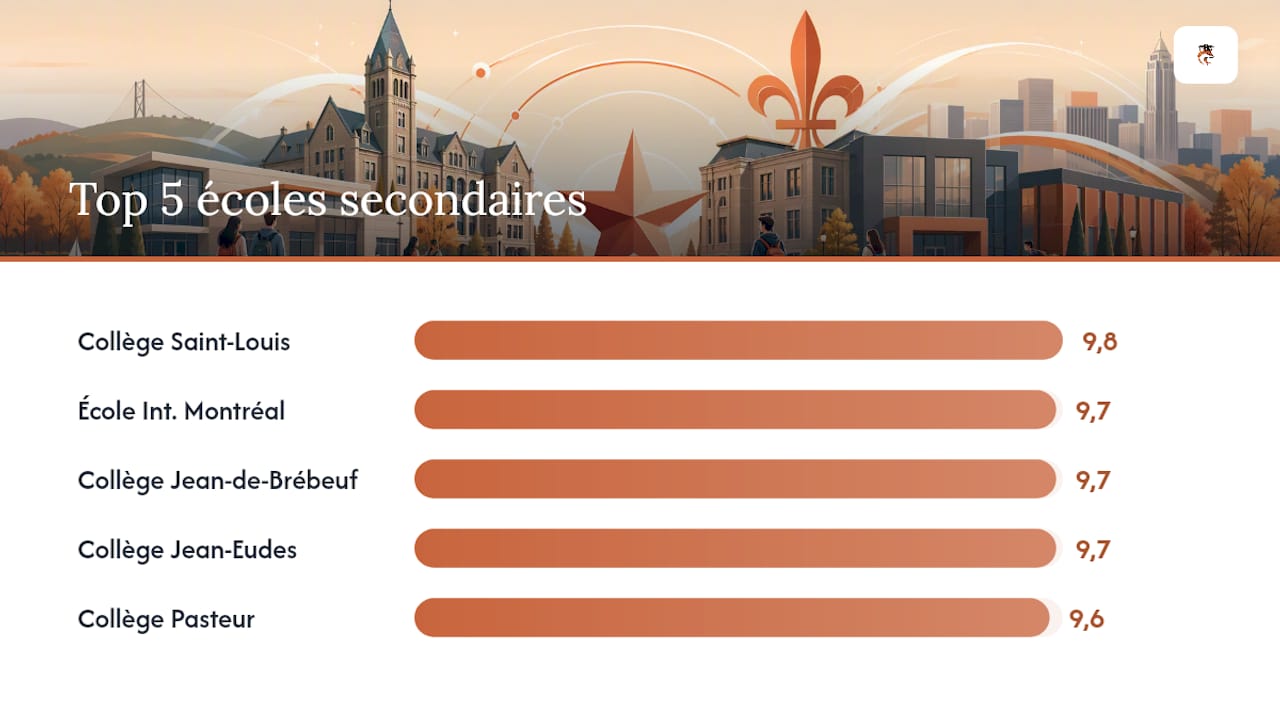
Table of contents
- What does the Fraser Institute's ranking cover?
- Which are the best secondary schools in Quebec according to the rankings?
- Which private schools are the most sought-after in Quebec?
- Which schools should you monitor in your region of Quebec?
- How is the ranking constructed, and what are its limitations?
- How can we use this ranking to truly choose a school?
- Admissions to private schools: timeline, steps and practical preparation
- Can support really make a difference during the admission process?
- What mistakes should you avoid when reading this ranking?
- Our perspective on the use of this ranking
- A+ Success: Preparing your child for secondary school entrance exams
- Sources
- F.A.Q
What does the Fraser Institute's ranking cover?
The 2025 Quebec Secondary School Report Card 470 secondary schools Public and private schools across the province. This is the most comprehensive ranking of the best schools in Quebec available, and it is based on a single source of data: the results of official provincial exams.
The indicators selected are:
- The results of the provincial exams in French, English, science et mathematics.
- A overall rating out of 10calculated from these aggregated results over several years.
- Five-year time series data, allowing us to observe trends in a school.
Certain categories of establishments are excluded from the ranking for reasons of statistical reliability:
- Schools with an insufficient number of students in the 5th year of secondary school.
- Adult education centers.
- Schools where the majority of students do not reside in the region.
These exclusions do not mean that these schools are of poor quality. They simply reflect an insufficient sample size to produce statistically reliable data. The 2025 Bulletin PDF report details all of these methodological criteria.
Which are the best secondary schools in Quebec according to the rankings?
The following table presents the top ten schools in the provincial rankings, based on 2023-2024 data from the Fraser Institute Report Card. Ratings are out of 10.
source: Quebec Secondary School Rankings 2025 (CompareSchoolRankings), data 2023-2024. The ratings are indicative and may vary slightly depending on the version consulted.
Some useful information about these establishments:
- Saint-Louis College : private co-educational school offering, in particular, a sports-studies program and an international section; admission by tests and interviews.
- International School of Montreal : public school with an international focus (IB program), accessible by selection based on application and placement test.
- Jean-de-Brébeuf College : renowned Jesuit institution, offering the International Baccalaureate (IB) program; very selective, high tuition fees.
- Jean-Eudes College : private Catholic co-educational school, enriched programs, strong extracurricular culture.
- Collège Pasteur : private secular co-educational school, sports-studies and arts-studies programs available.
- Saint-Alexandre College : the only school in the top 10 located in Outaouais, offering several enriched profiles.
- Collège Sainte-Anne de Lachine : private co-educational school with IB and sports-study programs.
- Laval College : reference on the North Shore, enriched programs and sports studies.
- Villa Sainte-Marcelline : private school for girls, offering the IB and an arts-studies program.
- Durocher College Saint-Lambert : private co-educational school in Montérégie, sports-study programs and international profile.
The regional data published by the Journal of Quebec confirm that the vast majority of the top 10 provincial establishments are concentrated in the Montreal metropolitan area.
Which private schools are the most sought-after in Quebec?
Beyond the provincial top 10, several private institutions regularly appear among the most sought-after by parents, particularly for their selectivity and the diversity of their programs.
- Miss Edgar’s & Miss Cramp’s (Westmount): private English-language school for girls, offering a rigorous bilingual curriculum; admission by tests and interviews, tuition fees among the highest in the province.
- West Island College (Dollard-des-Ormeaux): private English-language co-educational school, strong reputation in sports and arts; admission by application and interview.
- Durocher College Saint-Lambert : already mentioned in the top 10, it attracts families from all over the Montérégie region thanks to its sport-study programs.
- Jean-de-Brébeuf College : one of the most selective institutions in Quebec; places are limited and demand far exceeds supply each year.
- Collège Pasteur popular for its sports-study programs, particularly in hockey and soccer.
Admission requirements vary from one institution to another. Some schools operate on a [missing information - likely a specific system or model]. First come, first served others organize a draw among the eligible candidates; still others impose ranking tests and interviewsThe file opening fee is generally around $50, depending on the FEEPand then annual tuition fees are added, varying depending on the institution.
A high ranking for a private school primarily reflects performance on provincial exams, not necessarily the quality of its educational program or its suitability for your child. Highly selective schools attract high-achieving students, which naturally influences their overall results. Keep this in mind when comparing schools.
Which schools should you monitor in your region of Quebec?
The provincial rankings don't tell the whole story. Your region of residence often influences your choice as much as your ranking. Here are some key points by major region, drawn from the 2025 rankings and data from the Fraser Institute.
Montreal and Island of Montreal
The top-ranked institutions are concentrated here: Collège Saint-Louis, Collège Jean-de-Brébeuf, Collège Jean-Eudes, Collège Pasteur, Collège Sainte-Anne de Lachine, École internationale de Montréal, Villa Sainte-Marcelline, Miss Edgar's & Miss Cramp's, and West Island College. The selection is vast, and so is the competition for admission.
Laval
Collège Laval dominates the region with a rating of 9,5. Other private institutions such as Collège Montmorency (secondary sector) and some public schools with enriched profiles deserve to be explored.
Montérégie
Collège Durocher Saint-Lambert is the benchmark. Public schools with a specific focus (sports-studies, arts) in the South Shore school boards also offer solid options.
Outaouais
Collège Saint-Alexandre (Gatineau) stands out clearly in the region, with a rating of 9,6 which places it in the provincial top 10.
Quebec region
Several private institutions, such as the Marist Fathers Seminary and Saint-Charles-Garnier College, regularly appear in regional rankings. The region's public schools with an international focus also offer enriched programs.
Estrie, Saguenay–Lac-Saint-Jean, Abitibi-Témiscamingue
Private options are less numerous, but public schools with sports-study or arts-study programs exist in every region. The Report also shows that some schools in remote areas are making significant progress from one year to the next: École secondaire des Lacs, for example, went from a rating of 3,7 in 2018 to 7,7 in 2024.
Pro tip: Before relying solely on provincial rankings, check if your local school offers a specific program tailored to your child's interests (MYP, sports-study, arts, international profile). A program well-aligned with their strengths is often worth more than a slightly higher ranking in a less suitable school.
How is the ranking constructed, and what are its limitations?
The overall rating out of 10 given to each school is based on provincial exam results. French, English, science et mathematics, aggregated over several years to smooth out annual variations. The methodological report of the 2025 Bulletin specifies that only schools with at least 10 students in 5th year of secondary school are included, which guarantees a minimum statistical basis.
Exclusions to be aware of:
- Schools with fewer than 10 students in 5th year of secondary school (insufficient statistical reliability).
- Adult education centers (different population, not comparable).
- Establishments in majority of non-resident students (selection bias too significant).
These exclusions are methodological, not value judgments.
Important limitations to keep in mind:
- Selection effect : a highly selective school admits students who are already performing well, which mechanically inflates its rating without necessarily reflecting superior teaching.
- Annual variability A school's rating can fluctuate from year to year depending on the cohort, exam conditions, or program changes. A single year of data is insufficient to judge a school.
- What the rankings don't measure : the well-being of students, the quality of extracurricular supervision, school culture, support for students with special needs, or the suitability of the educational project to your child's profile.
To remember : The report card ranks 470 schools based on a single type of indicator (provincial exams). It is a useful, but incomplete, comparison tool.
How can we use this ranking to truly choose a school?
A high ranking is a good starting point, not a decision. Here's a concrete checklist to help you turn that number into an informed choice.
- Check the class sizes : a highly ranked school with classes of 32 students may offer less individual support than a lower-ranked school with groups of 24.
- Read the educational project Each school publishes its educational project on its website. It describes the values, educational priorities, and programs offered. This is often more revealing than a ranking.
- Identify the specific programs IB, sports studies, arts studies, international profile, enriched science program. Does your child have a strong interest in any of these areas?
- Assessing support for special needs : if your child has an intervention plan or specific learning needs, explicitly ask how the school addresses them.
- Calculate the actual costs For private schools, add up tuition fees, activity fees, outings, uniforms, and transportation. The actual annual budget may surprise you.
- Check the transport : an excellent school 45 minutes from your home without direct school transport can become a significant daily constraint.
- Attend the open house According to a survey cited by Le Soleil, visiting a school is a decisive factor for the vast majority of parents. Nothing replaces experiencing the school firsthand.
Questions to ask during the open house:
- What is the typical profile of a student who succeeds well here?
- What is the graduation rate over 5 years?
- How does the school support students with difficulties or special needs?
- What extracurricular activities are offered and at what cost?
Pro tip: A high ranking may be less relevant for an artistic, athletic, or special needs student. Always consider the ranking in light of your child's educational goals and profile before making a decision. Our school support checklist can help you structure this thinking.
Admissions to private schools: timeline, steps and practical preparation
The FEEP recommends starting the application process at the beginning of the admissions cycle. The tests generally assess skills acquired in the later years of elementary school, which means that preparation should begin well before the test date.
Here is the typical calendar:
- September-October (5th year) Open days are offered at most private schools. Visit several institutions to compare the atmosphere, programs, and expectations.
- October-November : opening of registration files. A file opening fee (usually around $50) is often required at this stage.
- November-January Placement tests and interviews vary by school. The tests cover French and mathematics at the Grade 5 level.
- January-March : results and admission offers. Some schools proceed by drawing lots among eligible candidates.
- March-April : confirmation of registration and payment of a deposit.
Documents to prepare:
- School reports from the last two years.
- Letter of motivation or portfolio (depending on the school).
- Evidence of extracurricular involvement (sports, arts, volunteering).
- Registration form duly completed.
Le Gouvernement du Québec Please note that registration is done directly with the school. There is no single provincial registration point for private schools.
Pro tip: Don't underestimate the importance of preparing for math tests. Mathematics plays a crucial role in secondary school admission. And basic calculation errors are among the most frequent in entrance exams. Targeted training for 6 to 8 weeks before the test makes a measurable difference.
Can support really make a difference during the admission process?
The short answer is yes, provided the support is targeted and well-planned. A student who has mastered Grade 5 French and math concepts approaches the entrance exam with much more confidence than a student who only discovers their weaknesses the week before.
The most useful types of support in this context:
- Targeted tutoring in French : review of grammar rules, agreements, text comprehension and short writing.
- Targeted tutoring in mathematics : fractions, percentages, problem solving, basic geometry.
- Simulations de tests : training in conditions close to the real test reduces stress and improves time management.
- Structured training plan : 6 to 8 weeks of regular work are better than a last-minute sprint.
A concrete example: a student with weaknesses in fractions and past participle agreement, receiving support over eight weeks with two targeted weekly sessions, can fill these specific gaps and approach the test with a solid foundation. It's not magic; it's deliberate practice.
The expected benefits of well-structured support:
- Mastery of the concepts specifically assessed during the entrance tests.
- Stress reduction on test day thanks to prior simulations.
- Increased confidence, which is also reflected in the interview if the school plans one.
- Greater autonomy in schoolwork from the start of secondary school.
Réussite A+ has been supporting students in this preparation for over 25 years, with more than 2,500 students helped and a 99% satisfaction rate. To learn more about the preparation for entrance exams to private schools, consult the dedicated guide.
What mistakes should you avoid when reading this ranking?
Rankings are a useful tool, but they are often misinterpreted. Here are the most common pitfalls.
- Confusing rank and suitability A school ranked number 1 is not necessarily the best for your child. If their profile does not align with the school's educational philosophy, the ranking will not change their daily experience.
- Ignoring methodological exclusions Some alternative or specialized schools are not included in the rankings simply because they do not meet the inclusion criteria (size, student residence). Their absence does not mean that they are of poor quality.
- Neglecting specialized programs : a school ranked 25th that offers exactly the sport-study program your child needs may be a better choice than a school ranked 5th without that program.
- Treating rank as a permanent truth : ratings vary from year to year. A school that progresses steadily can be more attractive than a school whose rating remains stagnant at the top.
- Forget the historical data A single year of results can be misleading. Consult the five-year time series available in the Fraser Institute report for a more accurate picture.
The FEEP states it clearly: the choice of a school must be based on the alignment between the educational project and the child's needs. Rankings are a starting point, not a conclusion.
Our perspective on the use of this ranking
The Fraser Institute's rankings are among the most reliable tools available for comparing secondary schools in Quebec. However, after years of supporting students in their admissions preparation, we have observed a worrying trend: families choosing a school solely based on its ranking, without having visited the institution or verified whether its educational program aligns with their child's profile.
A high ranking measures one specific thing: performance on provincial exams. This is valid and useful information. But a curious, creative, or athletic child who finds themselves in an environment too focused on pure academic performance can fall behind, even at the province's top-ranked school.
Our recommendation is simple: use the rankings to create a shortlist of candidate schools, then visit each one, read their educational project, and ask direct questions about the support provided. Preparing for entrance exams is important, but it doesn't replace this in-depth work to determine the right fit.
The Réussite A+ team is available for a personalized assessment if you wish to structure this process with your child.
A+ Success: Preparing your child for secondary school entrance exams

Is your child aiming for a top 10 provincial school? Preparation for the French and math entrance exams is often what makes the difference between an offer of admission and a waitlist. Réussite A+ offers a personalized online support specifically designed for 5th grade elementary school students preparing for their entry into private secondary school.
With over 25 years of experience, more than 2,500 students supported, and a 99% satisfaction rate, Réussite A+'s university tutors precisely target the concepts assessed in entrance exams: participle agreement, problem-solving, fractions, and reading comprehension. Sessions are flexible, online, and adapted to your child's pace.
To get started, consult the complete guide on private school entrance exams or contact the team for a free assessment of your child's level.
Sources
The following sources were used to create this article. They allow you to verify rankings, admission requirements, and official data directly from the source.
- Quebec Secondary School Report Card 2025 | Fraser Institute
- Admissions | Federation of Private Educational Institutions (FEEP)
- Private school registration | Government of Quebec
- Quebec Secondary School Rankings 2025 (CompareSchoolRankings)
- The 2025 Ranking of Quebec Secondary Schools | JDQ
F.A.Q
What are the 10 best high schools in Quebec?
According to the Fraser Institute's 2025 Bulletin (2023-2024 data), the top ten schools are Collège Saint-Louis, École internationale de Montréal, Collège Jean-de-Brébeuf, Collège Jean-Eudes, Collège Pasteur, Collège Saint-Alexandre, Collège Sainte-Anne de Lachine, Collège Laval, Villa Sainte-Marcelline and Collège Durocher Saint-Lambert.
How to enroll in a private secondary school in Quebec?
Registration is done directly with the school, generally starting in grade 5. The usual steps are: visiting the open house (September-October), opening a file with a fee (~$50), then placement tests or interviews depending on the school, as indicated by the FEEP.
What is the largest secondary school in Quebec?
The Fraser Institute Bulletin does not rank schools by student size. Large public comprehensive schools in metropolitan areas (Montreal, Quebec City, Laval) often have several hundred students per grade, but this information is not published in the rankings.
Is the ranking of schools in Montreal different from the provincial ranking?
The provincial rankings include all regions, but Montreal schools dominate the top of the list. Collège Saint-Louis, Collège Jean-de-Brébeuf, Collège Jean-Eudes, and Collège Pasteur all feature in the provincial top 5, making Montreal the most represented region among Quebec's best secondary schools.
How can I prepare my child for the entrance tests to private secondary schools?
Targeted training in French and mathematics over 6 to 8 weeks before the test is the most effective approach. Réussite A+ offers online entrance exam preparation tailored to the concepts assessed in the fifth grade of elementary school.