



In Canada, no single licence is required to tutor privately. In Quebec, there is no mandatory diploma either. That is why you, the parent, are the one who decides what “qualified” means. A strong tutor combines four things: solid knowledge of the subject, current university-level study or a degree, the ability to teach a child (not just know the material), and a clean, verifiable background. This guide explains each one and gives you a checklist you can use with any tutor or tutoring service.
TL;DR
- No provincial licence is needed to tutor privately in Canada. Employers and families look for related post-secondary study and proven expertise in the subject.
- For math, look for a tutor who knows the Quebec curriculum and can explain why a method works, not only give the answer.
- A vulnerable sector check is the usual background screening for people working with children. Ask whether it has been done.
- Ask for proof: a degree or student card, references and a short trial session.
- Teaching skills (patience, clear explanations, progress feedback) matter as much as grades.
Table of Contents
- What the law and official guidance say about tutors
- The four qualifications that matter most
- Background checks: what they are and what to ask
- Math tutor qualifications: what to look for
- French tutor qualifications
- A tutor qualifications checklist you can print
- Red flags and green lights
- Perspective: why we select tutors at university level
- How Réussite A+ puts these qualifications to work
- How to decide after the first session
- FAQ
- Sources
What the law and official guidance say about tutors
Tutoring is not a regulated profession in the way teaching is. Job Bank, the Government of Canada’s job information service, describes the tutor profession (secondary school subjects) in terms of post-secondary study in a related field and demonstrated expertise in the subject. It also notes that certification or licensing might be needed from a regulatory authority, depending on the setting.
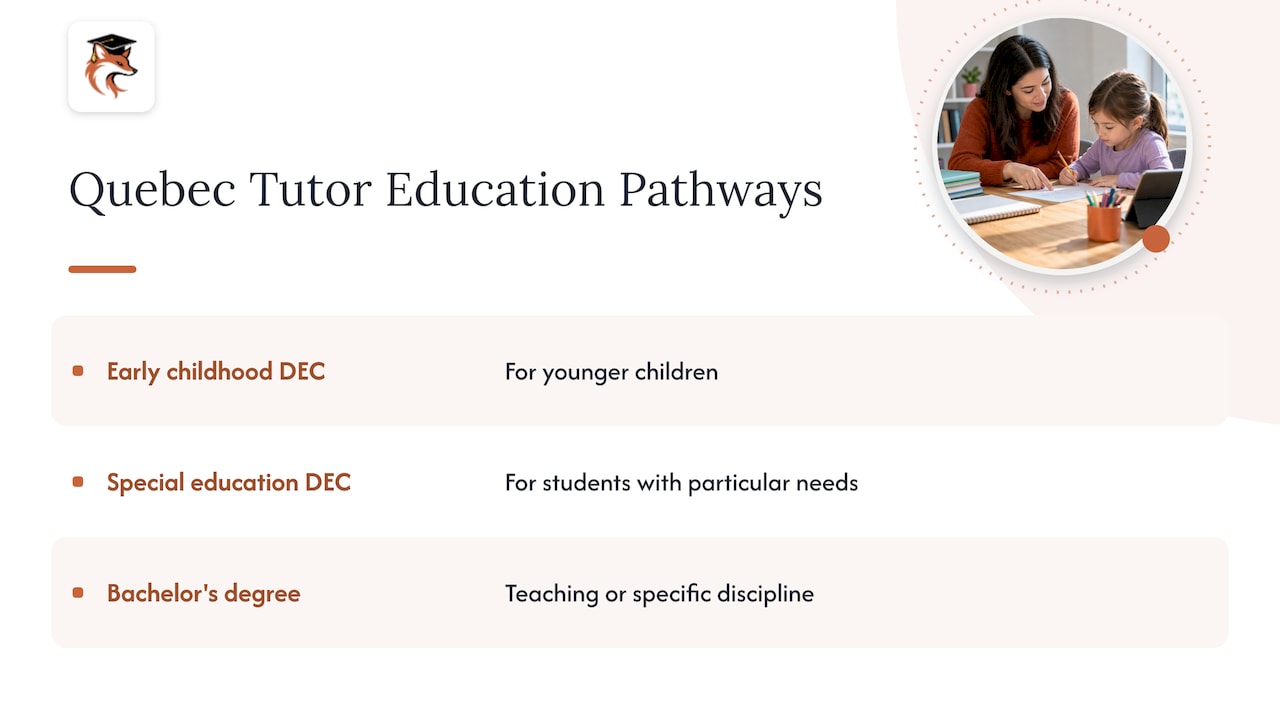
In Quebec, MétiersQuébec states that there is no mandatory diploma to work as a private tutor. It lists useful pathways instead: a DEC in early childhood education for younger children, a DEC in special education for students with particular needs, and a bachelor’s degree in teaching or in a specific discipline for higher-level tutoring.
What does this mean for you? Nobody is checking the tutor’s credentials on your behalf. A friendly profile and a confident voice do not prove anything. The good news is that a few simple checks, covered below, will tell you most of what you need.
There are also voluntary standards. The Canadian Tutor Standards, published in May 2023, offer guidelines for tutoring programs in post-secondary settings across Canada. They are not prescriptive and are not aimed at elementary or secondary tutoring, but they show what a well-run program pays attention to: training, ethics and ongoing development.
The four qualifications that matter most
1. Education: where the tutor is in their studies
For elementary and secondary students, a tutor does not need to be a certified teacher. What you want is evidence of academic strength beyond the level being taught. Look for:
- A university student or graduate in a related field (education, mathematics, sciences, French literature or linguistics)
- Strong results in the subject they will teach
- Willingness to show a degree, transcript or current student card
A tutor of a Secondary 2 student who is only one year ahead may struggle when a question goes off script. A university-level tutor has a wider margin: they have already used the concepts in more advanced contexts, and they can see where a gap in Grade 4 fractions is causing trouble in Secondary 3 algebra.
2. Subject knowledge that matches your child’s curriculum
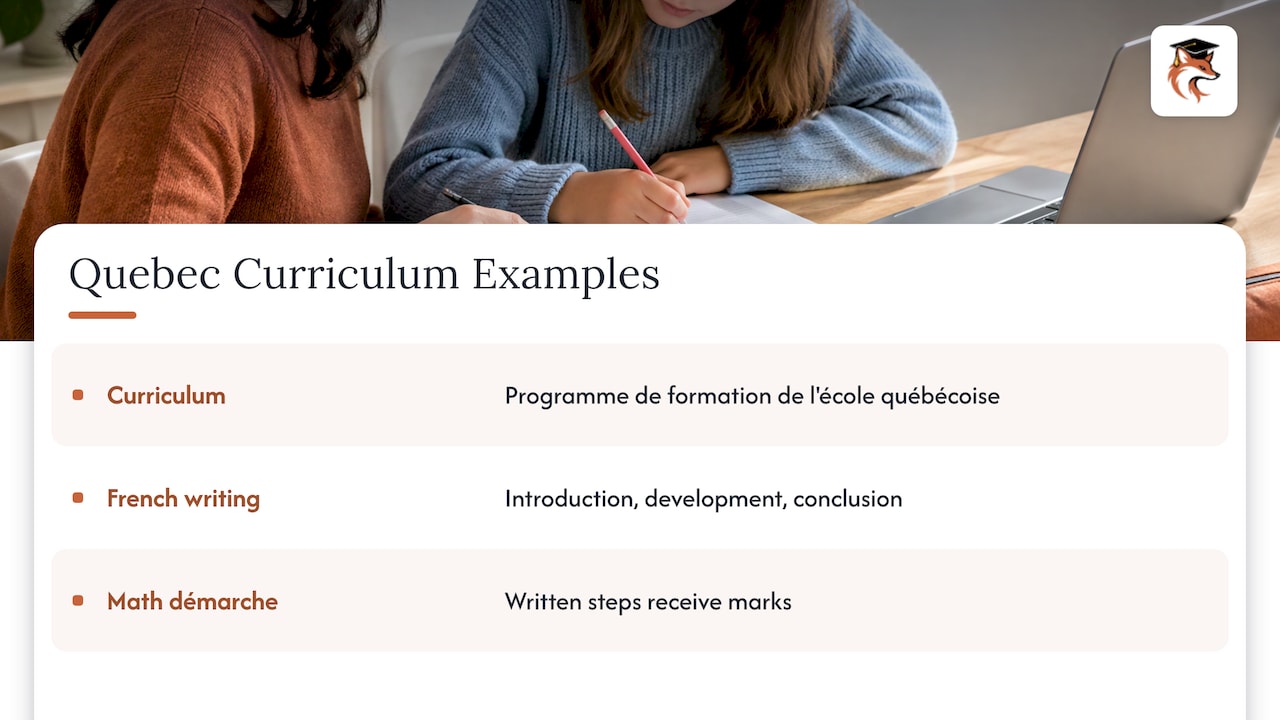
Quebec follows its own curriculum, the Programme de formation de l’école québécoise. MétiersQuébec lists knowledge of that curriculum among the hard skills of a private tutor, alongside subject mastery, digital competencies and formative assessment. A tutor trained elsewhere may know the math but not the vocabulary, the order of topics or the way your child’s school tests it.
This matters more in Quebec than people expect. French students write in a specific format (for example, a text with an introduction, development and conclusion, and grammar rules taught with particular terms). Math problems in Quebec often ask for the démarche, the written steps, and marks are given for them.
3. Teaching skills
Knowing is not teaching. A tutor who solves every exercise quickly can leave a child feeling more lost than before. The skills worth asking about are:
- Adapting the explanation. If method A does not work, the tutor tries method B.
- Building independence. The aim is that your child can do it alone next week.
- Clear communication. A learning centre training document at KPU lists adapting strategies to different learners, encouraging learner independence and committing to ongoing development of tutoring skills among its core objectives for peer tutors.
- Patience and empathy. MétiersQuébec also lists patience, listening, organization and reliability among the key soft skills of private tutors.
4. Trust and safety
You are letting an adult into your child’s learning space, even if the lesson is online. That is why a background check belongs on the list. We cover it in detail in the next section.
Background checks: what they are and what to ask
A background check for a tutor usually means one of two things. The first is a criminal record check. The second, more thorough for work with children, is a vulnerable sector check. The RCMP explains that this is a police information check plus a check to see whether a person has a record suspension for sexual offences. People in positions of trust or authority over children or vulnerable persons can be asked to obtain one, and the organization hiring them decides whether to request it.
Two points follow for parents:
- Rules differ by province. In British Columbia, for instance, the Criminal Records Review Act makes a criminal record check mandatory for people who work with or have unsupervised access to children, including teachers and school staff. That law applies in BC, not across Canada, and private tutors are not named in the summary. Do not assume that a tutor in another province has been checked.
- It is a question you can simply ask. In Montreal, the SPVM processes background checks for people working with vulnerable clients, with the consent form completed at the service counter or with the organization. A tutor who has done one will know the process, and a reputable tutoring organization will be able to tell you how it handles safety.
A simple way to ask: “Have you completed a vulnerable sector check, and can you tell me when?” A prepared tutor answers calmly. For online lessons, our guide on online tutoring safety steps for parents explains what to set up before the first session, such as a shared space at home, and what to look at during a lesson.
Math tutor qualifications: what to look for
Math is where parents most often ask “how qualified does the tutor need to be?” The honest answer depends on the level.
| Student level | What the tutor should be able to do | Typical profile |
|---|---|---|
| Elementary (Grades 1 to 6) | Explain number sense, fractions and problem-solving in plain words, use concrete examples, build confidence | University student in education or a related field |
| Secondary 1 and 2 | Teach ratios, algebra basics, geometry and word problems, and the written démarche | University student or graduate with strong math results |
| Secondary 3 to 5 | Handle functions, trigonometry, statistics and exam strategy | University student or graduate in math, science or engineering |
For all levels, a good math tutor will:
- Diagnose before teaching. They start with a short set of questions to find where the misunderstanding begins.
- Ask your child to explain. If the child says “I do this because the teacher said so,” the foundation is shaky.
- Use mistakes as information. A wrong answer shows which step to revisit.
- Connect to school. They look at your child’s notebook, recent tests and the teacher’s comments.
- Report progress in plain terms. For example, “fractions are now at 80 percent in practice quizzes; word problems are next.”
Teachers of academic subjects, by comparison, typically hold a bachelor’s degree in education, according to Job Bank. A tutor does not need that, but the comparison helps you see why pedagogical skills matter: the best tutors think like teachers even when they are not certified.
If you want a quick-start guide to what a first online session looks like, read how an online tutoring session works.
French tutor qualifications
The same logic applies to French, with a few specifics for Quebec families:
- Spelling and grammar accuracy. A tutor must write cleanly themselves. Ask for a short sample of their writing if you are unsure.
- Familiarity with school terminology. Terms such as groupe du verbe, mots-pièges (trap words) and accord du participe passé should be second nature.
- Method for writing and reading. Good tutors teach a step-by-step approach to a text: read the instructions, plan, write, then proofread against a checklist.
- Exam awareness. If your child is preparing for secondary school entrance exams, the tutor should know the format and the time limits.
A tutor qualifications checklist you can print
Memorial University’s academic success centre, in its tips for working with a private tutor, suggests asking about credentials and recent references, strategies, how progress is measured, how often and how the tutor communicates, and practical details such as cost, platform and cancellation or make-up policy. It also suggests requesting documentation, such as a copy of a degree or a student card, and searching the tutor’s name and company online. Here is that advice turned into a checklist for a parent:
Qualifications
- [ ] What are you studying or what did you graduate in?
- [ ] Can you show a degree, transcript or student card?
- [ ] Which level and subjects have you taught, and for how long?
- [ ] Can you give me a recent reference?
Teaching approach
- [ ] How do you find out where my child’s gaps are?
- [ ] What do you do when an explanation does not work?
- [ ] How do you make sure my child can work alone afterwards?
Safety
- [ ] Have you completed a vulnerable sector check?
- [ ] How are online sessions set up (platform, recording policy, parent access)?
Progress and communication
- [ ] How will I know my child is improving?
- [ ] How often will you send feedback?
- [ ] Who do I contact if the plan needs to change?
Practical details
- [ ] What is the hourly rate and is there a registration fee?
- [ ] What is the cancellation and make-up policy?
- [ ] What happens if the fit is not right after the first session?
For a longer version of the questions to ask at an initial consultation, see our printable tutoring consultation questions. To judge a service as a whole, the checklist for evaluating the quality of a tutoring service goes further.
Red flags and green lights
You do not need to be an education expert to spot the pattern. These contrasts show up again and again.
| Green light | Red flag |
|---|---|
| Describes a plan for your child’s specific gaps | Promises a grade jump with no plan |
| Shows documents or a clear profile without fuss | Avoids questions about studies or experience |
| Gives you regular feedback in plain words | Says “it’s going well” with no detail |
| Teaches the method and asks your child to try | Does the homework for your child |
| Explains the safety and session setup | Asks to move to private chat apps outside the agreed platform |
None of this requires suspicion. It is simply what a prepared tutor or tutoring service expects to be asked.
Perspective: why we select tutors at university level
We have spent more than 25 years working with students in Quebec, and one pattern holds every year: the tutor’s preparation shapes the child’s confidence as much as the child’s marks.
That is why every Réussite A+ tutor is selected from the university level, for academic excellence, teaching ability and commitment to student success. A tutor who is comfortable with the material can slow down, rephrase and see the real source of a mistake, which is rarely the one on the page.
Qualifications are only the starting point. Each student receives a customised learning plan built around their strengths, challenges, pace and goals, and we monitor progress continuously so that parents see what is changing. Our work with more than 3,500 students has taught us that a calm, structured method lets children enjoy learning again, often like a game rather than a chore.
We encourage every parent to ask the questions in this article, of us and of anyone else. Good questions lead to the right fit, and the right fit is what leads to lasting success.
Réussite A+
How Réussite A+ puts these qualifications to work
If you are looking for online support for an elementary or secondary student in Quebec, our approach starts with a plan, not a script. Tutors work with your child in French and mathematics, in regular sessions, homework help, summer catch-up or preparation for secondary school entrance exams. Sessions are published at $30-35 per hour, with a one-off registration fee of $65 listed on our rates page. We also offer a satisfaction guarantee: if you are not satisfied after the first session, we refund it.
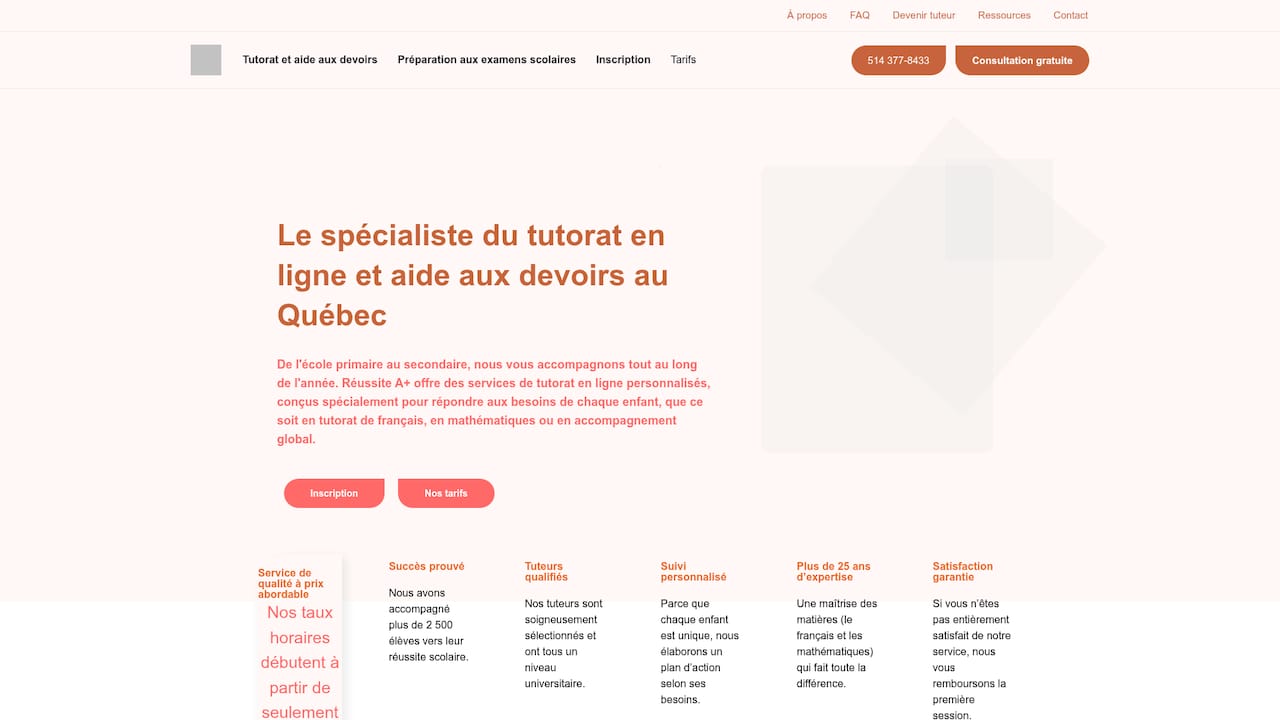
You can start with a regular tutoring session, look at our tutoring and homework help, or go straight to registration for tutoring and academic support. If you want to understand how experience shapes results, read why the tutor’s experience is key.
How to decide after the first session
A first session is the best qualification test, because it shows how the tutor teaches in practice. Afterwards, ask your child and yourself:
- Did my child understand something new, even a small thing?
- Did the tutor ask questions and listen, or mostly talk?
- Did I receive a clear note on what was covered and what comes next?
- Does my child feel comfortable returning?
- Does the plan match our goal, whether that is catching up, keeping pace or an entrance exam?
If the answer to most is yes, you have a good fit. If your child is shy, give it two or three sessions, since the relationship needs a little time. If the plan feels vague, ask for a written outline of the next four weeks. For help weighing costs and benefits, our article Is tutoring worth it? shares Canadian insights, and tutoring in Quebec explains where to begin.
FAQ
Does a tutor need to be a certified teacher?
No. In Canada there is no single licence for private tutors, and in Quebec no diploma is mandatory. Families usually look for related university study, proven subject knowledge and teaching ability. A teaching degree is a plus, not a requirement.
How do I check a tutor’s qualifications?
Ask to see a degree, transcript or student card, request a recent reference and search the tutor’s name or company online. Then watch a first session closely. How a tutor explains a concept tells you more than a résumé.
Should my child’s tutor have a background check?
For anyone working alone with children, a vulnerable sector check is the standard screening, and the hiring organization decides whether to request one. It is reasonable to ask whether the tutor has completed one and when. Rules vary by province, so ask rather than assume.
What qualifications should a math tutor have?
A math tutor should be a university student or graduate with strong results in math, know the Quebec curriculum and be able to explain methods step by step. For higher secondary levels, a background in math, science or engineering helps. Teaching skills matter as much as grades.
Is an online tutor as qualified as one at home?
Qualifications do not depend on location. The same checks apply: studies, experience, teaching approach and safety. Online sessions add digital skills and flexible scheduling. Our comparison of home and online tutoring explains the differences.
Sources
- Job Bank: Tutor, secondary school subjects in Canada
- Job Bank: Mathematics teacher, secondary school in Canada
- MétiersQuébec: Devenir tuteur(trice) privé(e)
- Canadian Tutor Standards, May 2023
- KPU Learning Centre: Peer tutor training objectives
- MUNUP: Tips for working with a private tutor
- RCMP: Vulnerable sector checks
- SPVM: Background checks