


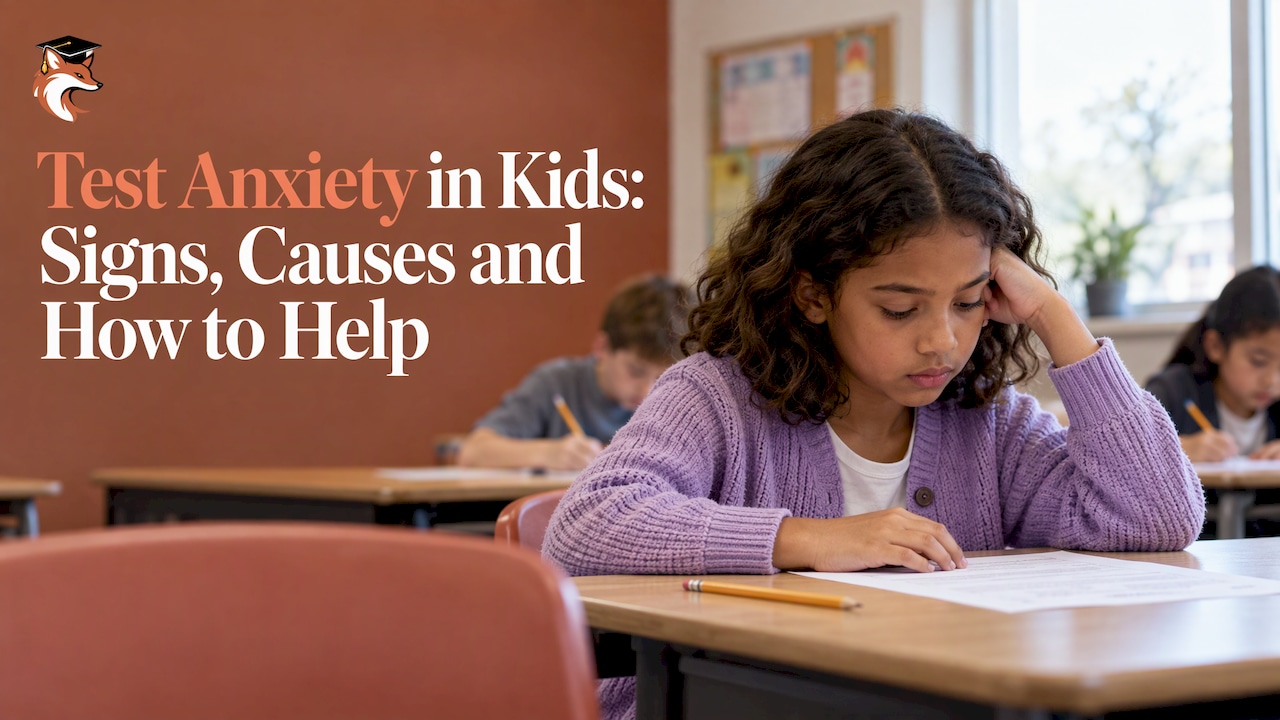
If your child freezes, panics or gets a stomachache before every test, you are not alone, and it can be turned around. Test anxiety is a stress response that gets in the way of what your child already knows. It responds well to a simple combination: spotting the signs early, a calm routine at home, and preparation that rebuilds confidence one small step at a time. A personalised learning plan with a patient tutor is one of the most direct ways to deliver that last part.
This guide is for parents of elementary and secondary students in Quebec. It explains what test anxiety looks like, why it happens, what to do the week before a test and on the day itself, and when to ask for extra help.
TL;DR
- Test anxiety is excessive worry about tests that can interfere with studying, memory and performance. Some nervousness is normal.
- Signs range from stomachaches and poor sleep to avoidance, blanking and negative self-talk. They can start days or weeks before a test.
- Listen first, keep sleep, meals and morning routines steady, and prepare in short, repeated sessions rather than cramming.
- Confidence grows when your child practises in small steps with a plan built around their own strengths and pace.
- Ask for school or health support if the anxiety lasts, gets stronger, or affects sleep, relationships, daily life or attendance.
Table of Contents
- What test anxiety is (and what it is not)
- Signs of test anxiety before, during and after a test
- Why some children are more affected than others
- Step 1: Start with a conversation, not a pep talk
- Step 2: Steady the basics at home
- Step 3: Prepare in small, repeated steps
- Step 4: Teach three calming tools for test day
- Step 5: Work with the school
- When to ask for more help
- Why a personalised tutoring plan makes a difference
- Our perspective
- Support for your child, from first session to exam day
- A quick checklist for parents
- FAQ
- Sources
What test anxiety is (and what it is not)
A few butterflies before a test are normal. Test anxiety is something more: excessive anxiety about tests or other evaluative situations that can interfere with studying, remembering material and showing what a child knows. The child understands the lesson at the kitchen table, then the page goes blank in the classroom.
There is a physical reason for this. A child-anxiety specialist quoted by UCLA Health explains that the fight-flight-freeze response can bring a racing heart, shorter breaths and narrowed attention, which makes memory harder to reach during an exam. In other words, your child is not being lazy or careless. Their body is reacting to the test as if it were a threat.
That is good news for parents. If the problem is a stress loop rather than a gap in intelligence, you can work on the loop.
Signs of test anxiety before, during and after a test
Symptoms vary from child to child in kind and intensity. According to Here to Help, a Canadian mental health resource, they can include:
- tension, sweating, a rapid heartbeat, headaches or stomachaches
- sleep loss
- fear or panic, fidgeting, racing thoughts
- blanking and difficulty concentrating
- avoidance and negative self-talk
The Kids Mental Health Foundation adds nausea, shakiness, trouble recalling information and study procrastination to the list.
Before the test
Test anxiety can begin days or weeks before an assessment and can disrupt studying and other schoolwork. At home, you might notice:
- irritability or tears when a test is mentioned
- putting off study, or suddenly needing to tidy a room instead
- asking to stay home on test day
- trouble falling asleep
- comments like “I’m going to fail anyway”
These clues are also listed by Understood. Avoidance is the one parents most often misread. A child who “won’t study” may be a child who is afraid of finding out what they do not know.
During the test
You will not see this part, but your child may tell you about it afterwards: a mind that went blank, a heart that pounded, a sudden urge to leave the room, or a rush through the paper just to be done. Fidgeting, rereading the same question and giving up on hard items are all common.
After the test
Some children collapse into self-criticism even when the result is fine. Others hide the result. How your child talks about a test after it is over tells you a lot about how big the fear is.
Why some children are more affected than others
Anxiety tends to rise when a child sees the test as high stakes, or believes the situation is beyond what they can handle, and thoughts about failing make the test harder to face. Children may also worry about being judged or embarrassed, a point made by McMaster Children’s Hospital in its school anxiety guidance.
Several factors can raise a child’s risk. The Kids Mental Health Foundation names learning challenges, conditions such as ADHD or anxiety, high expectations and perfectionism. Understood notes that test anxiety can occur in any child, and is common among children who learn and think differently, for example with ADHD, dyslexia or slower processing speed.
For Quebec families there is one more pressure point: the big, visible tests. Secondary school entrance exams, end-of-cycle exams and ministry exams feel high stakes to a ten- or twelve-year-old. If your child is heading toward those, our guide to managing stress during high school entrance exams goes deeper on that specific situation.
If you suspect ADHD is part of the picture, how to motivate a child with ADHD to study offers practical routines.
Step 1: Start with a conversation, not a pep talk
The first move is to listen. Canadian health guidance from Fraser Health, published on September 3, 2026, recommends open-ended questions about a child’s hopes and worries, and validating feelings rather than dismissing them. McMaster Children’s Hospital likewise advises caregivers to stay calm, listen and show understanding.
Try questions like these:
- “What part of the test feels hardest to think about?”
- “What goes through your head when you open the paper?”
- “What helped the last time you felt nervous?”
- “Who at school could you go to if you got stuck?”
Avoid “Don’t worry, it will be fine” and “You studied, so there is nothing to be afraid of.” They are kind, but a child hears that the feeling is wrong. Try “That sounds stressful. Let’s look at it together.”
The third question matters most. Fraser Health suggests helping children recall challenges and strategies they have used before and identify trusted people at home and school. Reminding your child of a hard moment they already got through is more convincing than any reassurance from you.
Step 2: Steady the basics at home
Stress is harder to manage on a tired body. Both Fraser Health and McMaster Children’s Hospital point to restoring sleep, meal and morning routines as part of helping an anxious child. McMaster specifically suggests returning to predictable bedtime and morning routines.
A simple test-week checklist:
- a regular bedtime for the whole week, not only the night before
- a real breakfast on test day
- bag packed and clothes chosen the evening before
- a calm, unhurried morning, with no last-minute review at the door
- something to look forward to after the test, however small
The goal is to lower the number of things that can go wrong, so the test is the only challenge of the day.
Step 3: Prepare in small, repeated steps
The most reliable way to reduce fear is to reduce uncertainty. School Mental Health Ontario’s guidance on test and exam stress, last updated on March 4, 2025, recommends:
- gathering course expectations, test dates and requirements first
- building a study plan that puts difficult material early
- reviewing in short repeated sessions rather than cramming
- using active recall and practice questions
- taking breaks
A worked example: a Grade 5 French test in ten days
Say your daughter has a verb conjugation and reading comprehension test in ten days, and she has been dreading it.
- Day 1: Sit together and write down what the test covers. Circle the topic she likes least, for instance the passé composé with être.
- Days 2 to 7: Fifteen to twenty minutes a day, not an hour on the weekend. Start each session with something she already does well, then move to the hard topic. Have her quiz herself with blank cards rather than rereading notes.
- Day 8: A practice test with the same format as the real one, under calm, timed conditions.
- Day 9: Review only what she missed. Stop early.
- Day 10: Light review, early bedtime.
The practice test on day 8 does a lot of work. Once the format has been faced, it stops being a threat. We cover this in detail in why exam simulations play a key role in preparation.
Start small when your child is stuck
When a child is too anxious to begin, UCLA Health’s specialist recommends starting with a manageable action and breaking the task into smaller sections. The specialist describes a loop: physical arousal narrows attention and blocks memory, while one simple first step helps restart action. “Do three questions” is more doable than “study maths.”
Afterwards, talk about what went well, what was difficult and what to change next time. The same source recommends this review, and it turns every test into information instead of a verdict.
Step 4: Teach three calming tools for test day
Give your child tools they can use silently at a desk. School Mental Health Ontario suggests pausing for slow breaths, surveying the test and pacing time, reading directions carefully, beginning with questions you know and marking difficult ones to return to.
In child-sized language, that becomes a three-part routine:
- Breathe. Five slow breaths in and out before turning the page.
- Survey. Look through the whole test, then decide how much time each part gets.
- Start where you are strong. Answer what you know first, put a star next to the hard ones and come back.
The star trick is the one children remember. It gives permission to leave a question without failing it, which is what stops the spiral of staring at one problem while the clock runs. Our companion articles on 10 techniques to calm pre-exam anxiety and managing time during exams give more practice ideas, and exam stress management for children aged 5 to 13 adapts them to younger ages.
Practise these at home, before they are needed. A breathing exercise tried for the first time in the exam room rarely works. One practised for a week becomes a habit.
Step 5: Work with the school
Teachers can often tell you things you cannot see: whether your child freezes at a particular type of question, how they behave in class tests, and what supports exist. The School Mental Health Ontario resource includes asking teachers for help and using learning-plan accommodations where they are in place. Rules and plan names differ between provinces and school service centres, so ask your child’s teacher or school administration what applies to your child in Quebec.
A short, specific message works best: “Marie gets very anxious before written tests and sometimes blanks. Could we talk about what might help her feel more comfortable?”
When to ask for more help
Some worry is part of growing up. Seek additional support if anxiety continues, becomes more intense, or interferes with sleep, relationships, daily activities or school attendance. Fraser Health adds that families do not have to wait for a crisis.
In practice, that means talking to your family doctor, or to the psychologist or other professional at your child’s school, if:
- your child regularly refuses to go to school on test days
- stomachaches or headaches keep returning around tests
- sleep is badly disrupted for days at a time
- fear is spreading beyond tests to other parts of school or home life
Tutoring supports the academic side of the problem. It does not replace a health professional when anxiety is affecting your child’s daily life.
Why a personalised tutoring plan makes a difference
Much test anxiety comes down to one thought: “I might not know this.” The most direct response is to make sure your child does know it, and knows that they know it.
That is difficult to do in a class of many students, and it is hard for a worried parent to do at the kitchen table without the tension rising. A tutor brings a calm third voice, a structure and a way to see progress.
At Réussite A+, every student receives a learning plan designed around their strengths, challenges, learning pace and academic goals. Our tutors are selected from the university level for their academic excellence, their teaching abilities and their commitment to students’ success, and progress is monitored continuously so that you and your child can see what is improving. For a child who dreads tests, that means three things:
- Gaps get closed one at a time. Practice starts where your child actually is, in French or mathematics, instead of where the class happens to be.
- Wins are visible. Progress tracking turns “I’m bad at this” into “I could not do these last month, and now I can.”
- The test format becomes familiar. For entrance exams and school exams, preparation sessions include practice that mirrors what your child will face.
See also our article on study skills tutoring and the guide on how parents can support academic success. If homework is where the tension starts each evening, helping your child manage homework is a good place to begin.
Our perspective
After more than 25 years in education and more than 3,500 students supported, we have found that a child’s fear of a test is rarely about the test itself. It is about uncertainty: not knowing which parts they have mastered, which they have not, and what will be asked.
That is why we build every program around one student at a time. A customised learning plan looks at strengths, challenges, pace and goals, so the work feels doable. Our university-level tutors keep sessions encouraging, we monitor progress continuously, and we celebrate the small wins, because for an anxious child, small wins are what rebuild trust in themselves.
We also believe parents should not have to be the exam coach. When a tutor handles the practice, you can go back to being the person who listens, reassures and keeps the evening routine calm. That is the support children tell us, through their results and their parents’ feedback, makes the difference.
Réussite A+
Support for your child, from first session to exam day
Our online tutoring covers elementary and secondary students across Quebec, including Montreal, Laval, Longueuil, Brossard and Gatineau, with flexible scheduling that fits around school and family life. Sessions are one-on-one or in groups, in French and mathematics, and include exam preparation for secondary school entrance exams, regular weekly sessions and summer catch-up.
Rates are $30–35 per hour, with a one-time registration fee of $65 (see our pricing page). We offer a satisfaction guarantee: if you are not satisfied after the first session, it is refunded.
If your child has a school exam or entrance exam coming up, start with our school exam preparation program. If the main need is steady weekly support, our regular session is the place to begin, and you can register for tutoring whenever you are ready.
A quick checklist for parents
- Ask open questions and listen before offering solutions.
- Keep sleep, meals and mornings predictable, especially in test week.
- Study in short sessions over several days, not the night before.
- Include one practice test in the real format.
- Teach three calming steps: breathe, survey, start with what you know.
- Talk with the teacher if the worry keeps coming back.
- Review each test afterwards: what went well, what was hard, what to change.
- Seek help from your doctor or the school if anxiety affects sleep, daily life or attendance.
FAQ
Is test anxiety normal in children?
Some nervousness before a test is common and can even help children pay attention. It becomes a concern when it interferes with studying, memory or performance, or leads a child to avoid tests or school. Test anxiety can occur in any child, and it is especially common in children who learn and think differently, according to Understood.
How can I tell test anxiety from simple laziness?
Look at the pattern. A child with test anxiety often avoids studying, becomes irritable or tearful, has stomachaches or headaches around tests, or says negative things about themselves. These are common clues listed by Understood. Start with a calm conversation about what feels hard rather than a consequence.
What can my child do in the middle of a test when panic hits?
Take a few slow breaths, then go back to the directions. Skip to a question they know, and put a mark next to the ones that are hard so they can return later. These are steps from School Mental Health Ontario. Practise them at home first so they feel automatic.
Can tutoring help with test anxiety?
Yes, because much of the fear comes from not feeling sure of the material or the format. Regular sessions built around your child’s own gaps, with visible progress and practice in the exam format, help them feel prepared. Our tutors design a learning plan around each student’s strengths, challenges and pace. If the anxiety also affects sleep, mood or attendance, speak to your family doctor or your child’s school as well.
When should I talk to a professional?
Talk to your family doctor or a school professional if the anxiety continues, gets stronger, or interferes with sleep, relationships, daily activities or school attendance. Fraser Health says families do not need to wait for a crisis.
Sources
- Test Anxiety | Here to Help
- Back-to-school: What are the signs of a child’s test anxiety? | UCLA Health
- Helping Kids with Test Anxiety | Kids Mental Health Foundation
- What is test anxiety? | Understood
- Managing school-related anxiety | McMaster Children’s Hospital
- Back to school anxiety: Helping kids feel ready | Fraser Health
- Test your best: Tips for managing test and exam stress | School Mental Health Ontario