



The right tutor in Laval is the one who matches your child’s subject, grade and goal, then turns that into a written plan with regular progress updates. Start with what your child needs, check the tutor against that need, and agree on how you will both know it is working. At Réussite A+, we build every program this way: a customised learning plan, university-level tutors and online sessions that fit your family’s schedule.
This guide walks you through the choice step by step, with questions to ask and examples to use. It is written for parents of elementary and secondary students in Laval, Montreal and Longueuil who want maths or French support.
TL;DR
- Name the need first: catching up, keeping pace, exam preparation or going beyond grade level. It decides everything else.
- Look for a tutor who knows the Quebec curriculum, your child’s grade and the language your child studies in.
- Ask for a plan, not just hours: goals, a starting point, and a way to measure progress.
- Online tutoring suits Laval’s busy schedules and removes travel. Compare the price per hour and the one-off fees before you commit.
- Get the terms in writing, including the cancellation rules, and review progress after the first few weeks.
Table of Contents
- Step 1: Define what your child needs
- Step 2: Check the tutor’s profile
- Step 3: Ask for a plan, not just hours
- Step 4: Decide between online and in-person
- Step 5: Understand the price and the contract
- Step 6: Plan how you will measure progress
- Matching the tutor to common situations in Laval
- What to ask in a first conversation
- Our offer for Laval families
- Our perspective
- FAQ
- Sources
Step 1: Define what your child needs
Before you contact anyone, write down three things: the subject, the grade, and the reason you are looking. Parents who do this get better matches and shorter searches.
Most families fall into one of these situations:
- Catching up. A gap has built up, for example in fractions, verb agreement or problem solving. The goal is to rebuild the foundations calmly.
- Keeping pace. Grades are fine, but homework takes too long or confidence is low. Regular weekly support works well.
- Exam preparation. A school exam, a ministry exam or a secondary school entrance exam is coming.
- Going further. Your child is comfortable and wants enrichment beyond the classroom.
- A summer reset. You want to close gaps before September.
Then add one sentence on how your child learns. “Understands when shown an example, loses focus after 30 minutes, gets anxious before tests” tells a tutor far more than “needs help in maths”.
Why the exact grade matters
Quebec’s mandatory ministry exams fall in specific years. According to the Ministry’s guide on exam requirements, these are in French in the 4th and 6th years of primary and the 2nd and 4th years of secondary, and in mathematics in the 6th year of primary and the 2nd and 4th years of secondary. The same guide notes that parent guides describe the exam format, sample questions and grading grids.
If your child is in one of those years, tell the tutor at the start. A tutor who knows the format can practise with the right types of questions and the right timing. We cover this in more detail in our Quebec ministry exam dates page and our ministerial exam study guide.
Step 2: Check the tutor’s profile
Tutor quality is not about a long list of credentials. It is about whether this person can explain the content of your child’s grade clearly. Here is what to look at.
Subject and level
A good maths tutor for Secondary 2 is not automatically the right fit for Grade 3 arithmetic. Ask which grades the tutor works with most often. For French, ask whether they are comfortable teaching the way the school does: grammar rules, text analysis and writing tasks.
Training and selection
Ask how tutors are selected. At Réussite A+, every tutor is chosen from the university level for academic excellence, teaching ability and commitment to student success. Those three qualities matter together: a strong student is not always a strong explainer.
Language of instruction
Your child should be tutored in the language they study in. If your child is in a French-language school, the tutor must handle the vocabulary of the French curriculum, such as verbe d’action, groupe du nom or démarche in problem solving.
Experience with your child’s profile
Some children need patience and small steps. Others need pace and challenge. Ask the provider how it matches a tutor to a student, and what happens if the match does not feel right after the first session.
Step 3: Ask for a plan, not just hours
Hourly rates are easy to compare. Results are not. The difference between a good tutoring experience and a frustrating one is usually the plan behind the hours.
A solid plan has four parts:
- A starting point. A short assessment of what your child already knows and where the gaps are.
- Clear goals. For instance: “Reach 70% on the next maths test” or “stop losing points on agreement of past participles”.
- Tailored material. Exercises built around your child’s gaps, not a generic workbook.
- Progress checks. A regular summary of what was covered and what comes next.
This is how we work. Every student receives a customised learning plan designed around their strengths, challenges, learning pace and academic goals, and progress is monitored continuously. Our approach builds on more than 25 years of educational experience.
A quick example
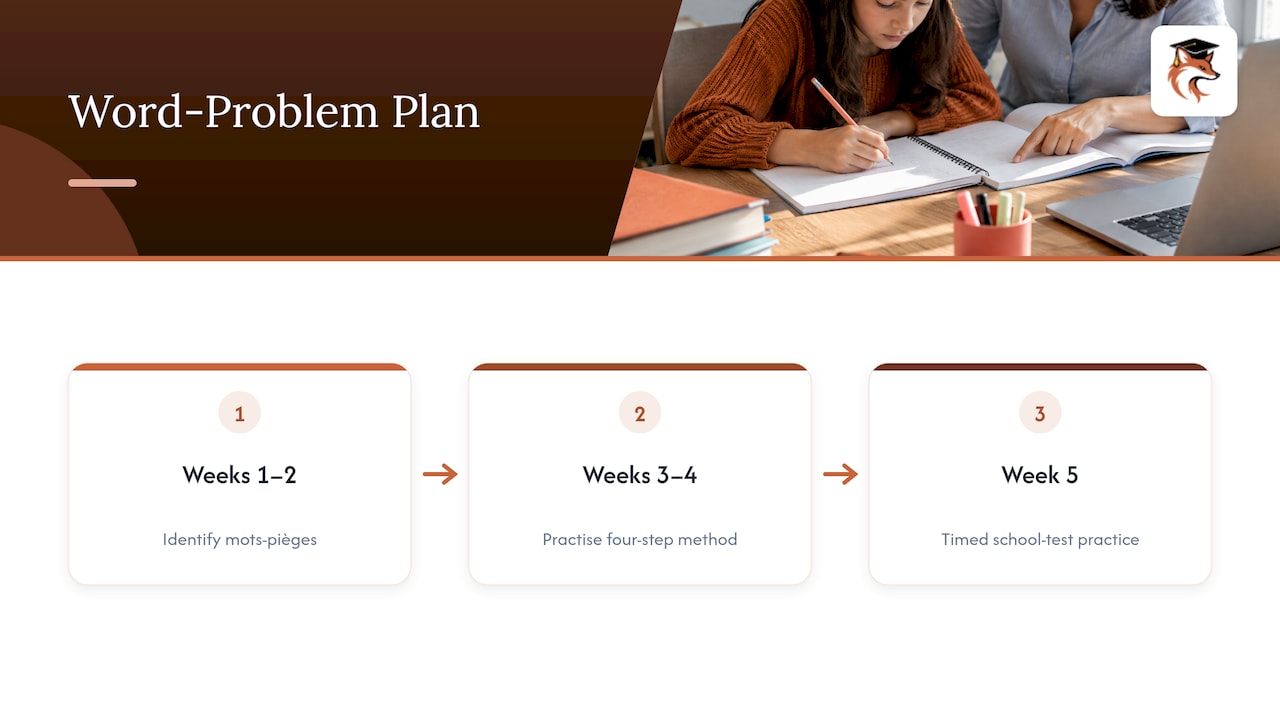
Imagine a Grade 5 student in Laval who understands multiplication but freezes on word problems. A weak plan says “two hours of maths a week”. A strong plan says: weeks 1 to 2, identify the type of problem (the mots-pièges that change the operation); weeks 3 to 4, practise a four-step method; week 5, timed practice similar to school tests. The student sees where they are going, and so do you.
Step 4: Decide between online and in-person
In Laval, the real question is often logistics. Between work, traffic on the 15 or 440, and after-school activities, travel time can use up the energy a child needs for learning.
| Criterion | Online tutoring | In-person tutoring |
|---|---|---|
| Travel | None | Drive or transit to a centre, or a tutor comes home |
| Schedule | Flexible, evenings and weekends easier to fit | Tied to location and availability |
| Tutor choice | Any tutor in Quebec, matched to the need | Limited to those nearby |
| Parent follow-up | Easy to sit in, share notes and materials | Depends on the arrangement |
| Distraction at home | Needs a quiet spot and a good screen | Dedicated setting |
Online sessions work especially well for children who are comfortable with a tablet or computer, and for families across Laval, Montreal and Longueuil who want the same quality of support wherever they live. Our sessions are delivered online with custom educational material and flexible scheduling, so the tutor can adapt in real time. If you want to compare formats in more depth, read our page on home tutoring versus online tutoring.
For younger children, plan a quiet table, a charged device and a short snack before the session. For teenagers, agree on a regular time and let them take charge of preparing their questions.
Step 5: Understand the price and the contract
Before you commit, you should know the hourly rate, any registration fee, how sessions are billed and how you can stop.
At Réussite A+, our regular sessions, homework help, French programs, summer sessions and exam preparation are priced at $30-35 per hour. There is a one-off registration fee of $65. You will find the details on our pricing page.
Whatever provider you choose, ask these questions:
- What is the hourly rate, and does it change with the tutor, grade or format?
- Are there registration or material fees?
- Is the price per hour of a one-to-one session, or for a group?
- What is the cancellation and absence policy?
- Is there a satisfaction guarantee?
Our satisfaction guarantee is simple: if you are not satisfied after the first session, we refund it.
Get the terms in writing
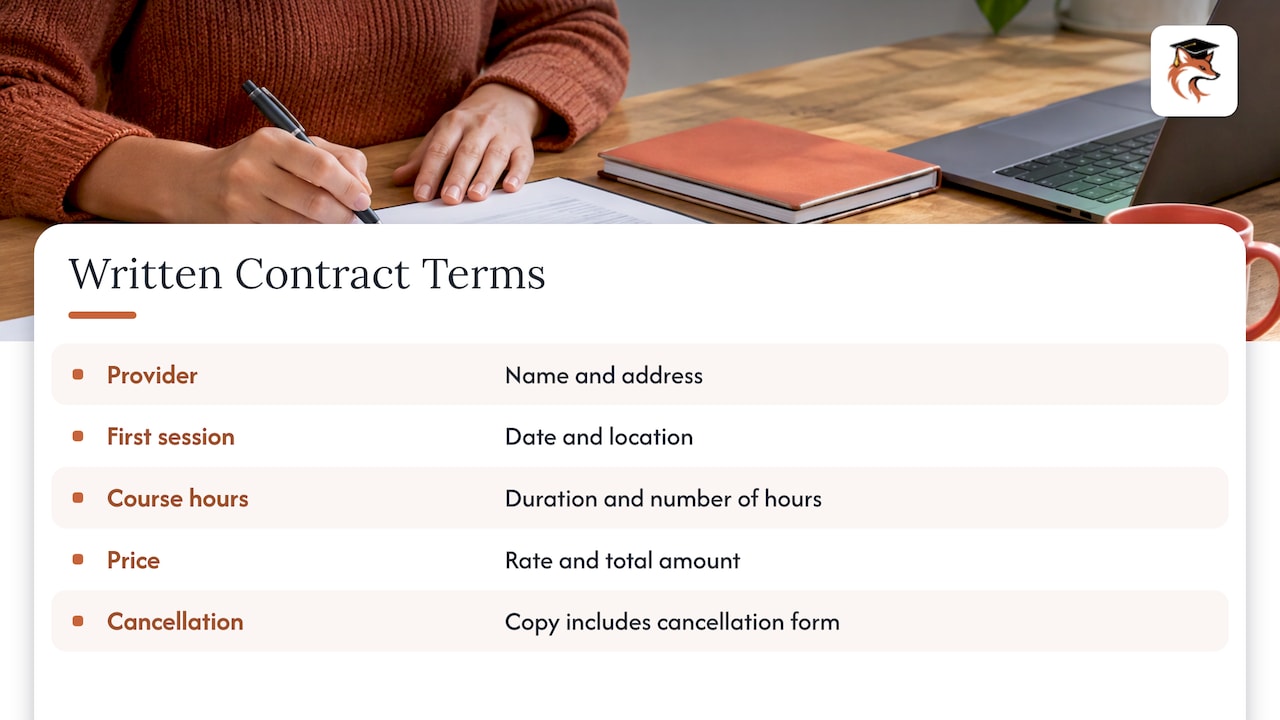
Éducaloi, a Quebec legal information organization, explains that for the recreational courses covered by consumer rules, the contract must state the provider’s name and address, the date of the first session, location, duration and number of hours, the rate and the total amount. You should also receive a copy with a cancellation form, according to Éducaloi’s guide to course contracts. It adds that, once the course has started, cancelling means paying for the sessions attended plus the lesser of $50 or 10% of the price of the sessions not attended, with any refund due within 10 days.
Even where those rules do not apply to your arrangement, they give you a good checklist of what a clear agreement looks like: who, when, how many hours, how much, and how to cancel. If you have a legal question about a specific contract, speak with a lawyer or the Office de la protection du consommateur.
Step 6: Plan how you will measure progress
Progress is not just a better grade. It shows up earlier in smaller signs. Agree on these markers in the first week:
- Homework time. Does it get shorter and calmer?
- Confidence. Does your child volunteer answers or ask for help sooner?
- Quality of errors. Fewer repeated mistakes of the same type is a good sign.
- Test results. Compare the next two or three tests with the baseline.
- Tutor updates. You should get a short summary of each session or each week.
Give it a reasonable window. Most students need several weeks of regular sessions before the results show up in school work. After four to six weeks, hold a short review with the tutor: what has been covered, what has improved, what is next. If you are preparing for an exam, add a practice test under real conditions. We explain why in our article on exam simulations.
If you like to follow along, our piece on how online tutoring helps parents follow progress shows what to look for.
Matching the tutor to common situations in Laval
Secondary school entrance exams
If your child is in Grade 6 and aiming for a private secondary school, the entrance exam tests French and maths under time pressure. Choose a tutor who works from the exam format and builds timed practice into the plan. Our page on the Laval secondary school entrance exam explains dates, format and preparation, and our school exam preparation service covers Montreal, Laval and Brossard.
French difficulties
For French, the most common sticking points are verb conjugation, agreement and writing structure. A good tutor explains the rule, shows the pattern, and has your child practise on their own sentences. Our French tutoring programs follow that logic.
Maths gaps
In maths, gaps pile up. A child who is shaky on fractions in Grade 5 struggles with proportions in Secondary 1. Ask the tutor to go back to the missing foundation first, even if it feels like a step backwards. It is the quickest way forward.
Summer catch-up
Summer is a good time to rebuild confidence without the pressure of daily homework. Our summer session offers intensive online courses to close gaps before the new school year.
What to ask in a first conversation
Use this mini-checklist when you speak with a provider:
- Which grades and subjects does the tutor teach most often?
- How will you assess my child’s level at the start?
- What will the plan look like, and how often will I get updates?
- How are sessions delivered, and what do we need at home?
- What is the hourly rate, and what other fees apply?
- What happens if my child and the tutor are not a good match?
- What is the cancellation policy?
A clear, calm answer to each is a good sign. You are looking for a team that treats your child as an individual and your questions as normal.
Our offer for Laval families
We support elementary and secondary students in Laval, including Laval-des-Rapides and Fabreville, as well as Montreal and Longueuil. Your child gets a customised plan, a university-level tutor, custom educational material and progress tracking, with flexible online scheduling. Sessions are $30-35 per hour, with a one-off registration fee of $65. We have helped more than 3,500 students and maintain a 99% client satisfaction rate.

To get started, see our Laval tutoring page or go directly to registration. If you want a broader overview first, our guide to choosing academic support in Laval is a good companion.
Our perspective
After more than 25 years in education, we have learned that children rarely struggle because they cannot learn. They struggle because the explanation did not fit them, or because a small gap went unnoticed and grew.
That is why we start with a plan built around the student: strengths, challenges, pace and goals. A tutor from the university level, chosen for academic excellence and teaching ability, can then adapt the explanation in real time, using material made for that child.
We also believe parents should never have to guess whether it is working. Continuous progress monitoring gives you something concrete to look at, session after session. And because sessions are online, learning fits your week instead of taking it over.
This approach has helped more than 3,500 students, and our guarantee reflects our confidence in it: if you are not satisfied after the first session, we refund it.
Réussite A+
FAQ
How much does a tutor cost in Laval?
Prices depend on the provider, the format and the subject. Our sessions are $30-35 per hour, plus a one-off registration fee of $65. Ask every provider for the hourly rate and any additional fees in writing before you start.
How many sessions per week does my child need?
It depends on the goal. Weekly sessions suit steady support and homework, while a more intensive schedule is common before an exam or during the summer. Your tutor will recommend a rhythm after assessing your child’s level.
Is online tutoring as effective as in-person tutoring?
Online tutoring works well when the tutor uses tailored material and the child has a quiet space and a reliable device. Many families in Laval choose it because it saves travel time and makes regular sessions easier to keep.
When should I start looking for a tutor?
As soon as you notice a gap, rather than waiting for a poor report card. For exams, start several weeks ahead so that the plan, the practice and the review fit comfortably.
Sources
- Guide on exam requirements, Quebec Ministry of Education
- Recreational Courses and Workshops, Éducaloi