


If your child needs to catch up in math this summer, the most reliable path is targeted tutoring or a short structured programme that starts with a baseline assessment and delivers frequent corrective feedback. A parent-led home plan can work too, but only if it includes real diagnosis, two or three clear priorities and short, regular sessions rather than random worksheets.
TL;DR:
- Short, targeted sessions with progress tracking and adaptive feedback outperform volume-based practice and support real skill development.
- A baseline assessment and focusing on two or three specific skills are essential before starting any summer math plan.
- Tutors and structured programmes that monitor progress and adjust instruction are more effective than independent workbook work.
- Consistency over eight to ten weeks and embedding math into real-life tasks help prevent burnout and boost engagement.
- A quick weekly quiz to measure transfer of skills is crucial for adjusting the plan and ensuring real progress.
Table of Contents
- What does summer catch up math actually involve?
- Why does summer catch-up math work? The research behind it
- How do you diagnose which math skills your child needs to catch up on?
- What are the best summer math options: tutoring, programmes, or DIY?
- How do you choose the right math tutor or summer programme?
- What does a realistic 4-week summer math plan look like?
- How Réussite A+ builds a personalised summer math plan
- Can games and real-life tasks make summer math less of a fight?
- How can parents support summer math learning without a tutor?
- How do you balance math practice with summer fun?
- What usually derails a summer math catch-up plan?
- What this summer actually calls for
- Ready to start? Booking a summer session with Réussite A+
- Sources
- FAQ
What does summer catch up math actually involve?
Summer catch up math means identifying exactly where your child’s understanding breaks down, then closing that gap with structured, feedback-rich practice before September. It is not the same as generic summer math review, which often just recycles last year’s worksheets. Real catch-up work targets specific skills, checks progress weekly, and adjusts course when a strategy isn’t landing.
The distinction matters because time is short. A family has roughly eight to ten weeks. Spend them on the wrong skills, or on drills without feedback, and a child can practise all summer and still stall out in September.
Why does summer catch-up math work? The research behind it
The number that matters: In a multi-site quasi-experiment across Ontario, children in voluntary summer numeracy programmes gained roughly 1.5 months more numeracy learning than similar kids who did not attend, based on outcomes for 569 attendees compared against 2,193 peers.
That effect (Cohen’s d of .19) is modest in statistical terms, but it is real, and it came from voluntary community programmes, not intensive one-on-one tutoring. Kids who already struggled academically were the most likely to attend, and the gains held up even after adjusting for that.
Without any intervention, summer learning loss can run deeper. Some Canadian modelling built on Ontario cohorts estimates losses of about 3.5 months for typical students and up to 6.5 months for lower-performing students under certain post-closure scenarios. Set against that backdrop, a summer plan isn’t about heroic recovery. It’s about preventing the gap from widening and, where possible, nudging it closed.
Tutoring specifically has a stronger track record. A meta-analysis covering 87 studies found elementary math tutoring programmes produced positive average effects, with an effect size near +0.20 across the tutoring subset. The common thread across effective programmes: someone watches how a child solves a problem, spots exactly where the reasoning goes sideways, and corrects it immediately.
How do you diagnose which math skills your child needs to catch up on?
Start with paperwork you already have. Report cards, recent tests, and teacher comments usually point to one or two weak strands, whether that’s fractions, multi-step word problems, or basic fact recall. Don’t skip this step and jump straight to a workbook labelled for your child’s grade. Generic materials waste time on things your child already knows.
Run a short baseline yourself before booking anything:
- Grades K to 2: Ask your child to count backward from 20, solve two simple addition and subtraction problems, and explain their thinking out loud.
- Grades 3 to 5: Give one multiplication fact quiz, one multi-step word problem, and one fraction comparison task.
- Grades 6 to 8: Try one ratio or percentage problem, one multi-step algebraic equation, and one problem requiring a written explanation of the method used.
This whole check should take 10 to 15 minutes. What you’re watching for isn’t just right or wrong answers. It’s where the process breaks down.
Once you see the pattern, resist the urge to fix everything at once. Pick two or three priority skills, not seven. Québec’s elementary mathematics program builds instruction around three connected competencies: solving situational problems, reasoning, and mathematical communication. That means your priorities should include at least one problem-solving or reasoning goal, not just fact fluency. Our guide on what to do when your child is failing math walks through this same triage process in more detail.
Once priorities are set, track them with a five-minute low-stakes quiz once a week using problems that are similar to, but not identical to, ones already practised. That distinction is what separates genuine progress from a child simply memorizing the specific numbers you used in practice.
Pro Tip: Don’t drill speed before understanding is solid. Research on tutoring and fluency interventions shows non-speeded practice with modelling and feedback builds number sense and word-problem skills better in the early stage; save timed drills for after the concept clicks.
What are the best summer math options: tutoring, programmes, or DIY?
The right format depends on how deep the gap runs and how much structure your child needs to stay on task.
- One-to-one tutoring works best for persistent or concept-specific gaps. A tutor runs a diagnostic, sequences lessons adaptively, and gives immediate corrective feedback the moment a misunderstanding shows up. Typical hourly rates for online tutoring in Quebec sit around $30 to $35.
- Structured summer programmes suit motivated learners who need external structure more than deep remediation. These run multiple weeks, follow a set curriculum, and often mix instructor-led practice with peer work.
- Self-guided home plans are the lowest-cost option and work fine for mild gaps or pure prevention, provided a parent actually enforces the schedule and checks the work.
- Game-based or app practice keeps engagement high but rarely replaces feedback on reasoning. Use it to supplement, not to carry the whole plan.
Whichever format you choose, the feature that predicts results isn’t hours logged. It’s whether the programme records progress and changes tack when the same mistake keeps happening. Programmes that track outcomes and adapt instruction consistently outperform those that just add more volume.
How do you choose the right math tutor or summer programme?
Before you commit money or time, run through a short checklist on any provider’s website or during an intro call.
- Does the programme start with a real baseline assessment, not just a placement quiz based on grade level alone?
- Can they name two or three priority skills for your child within the first session or two?
- Do they define what progress looks like in a way you can measure, such as a specific fact-fluency target or problem type mastered?
- Will you see a sample lesson or lesson plan before committing to a full package?
- How often will you get a progress report, and what does it include?
- What are the tutor’s qualifications, and how large is the group if it isn’t one-on-one?
On the call, ask directly: “How will you know if this is working after two weeks?” A strong answer names a specific check, like a short retrieval quiz or a repeated word-problem type. A vague answer like “we’ll just see how it goes” is a red flag.
Watch for programmes that emphasize hours or worksheet volume without ever mentioning a diagnostic or a feedback loop. Adaptive, feedback-driven instruction beats extra hours fairly consistently, so more time without correction is not the same as more learning.
Pro Tip: Ask to see what happens when your child gets something wrong three times in a row. A good tutor changes the explanation or the representation, not just the problem number.
What does a realistic 4-week summer math plan look like?
Every session, regardless of grade, should follow the same rough shape: a 5 to 10 minute warm-up of retrieval practice, 15 to 25 minutes of focused concept work, 10 to 15 minutes of guided problem solving, and a 5 minute reflection where your child explains what they did out loud.
- Grades K to 2: Week 1, counting and number sense using coins or snack items. Week 2, addition and subtraction stories built from real errands. Week 3, shapes and measurement using kitchen tools. Week 4, mixed review plus a short retest.
- Grades 3 to 5: Week 1, multiplication facts and arrays. Week 2, fractions using measuring cups while baking. Week 3, multi-step word problems tied to allowance or a grocery budget. Week 4, mixed review and retest.
- Grades 6 to 8: Week 1, ratios and percentages using sale prices. Week 2, one and two-step equations. Week 3, data and graphing using a real summer activity log. Week 4, mixed review and retest.
For a busier household, compress each session to 20 minutes and cut the reflection step to a single sentence. For a bigger gap, add a weekly tutoring session on top of this structure so the adaptive feedback layer is there when a concept doesn’t stick. Our full 20 minute summer math review plan breaks these grade bands down week by week if you want a printable version.
How Réussite A+ builds a personalised summer math plan
Réussite A+ has spent more than 25 years refining how diagnosis turns into real progress, working with over 3,500 students and maintaining a 99% client satisfaction rate. Every tutor is selected at the university level, not because a title looks good on a page, but because subject mastery and the ability to explain a stuck concept clearly are two different skills.
A Session d’été starts the same way the checklist above recommends: a baseline assessment, a small set of priority skills, and a custom learning plan built around them. From there, lessons adapt session by session based on what actually happened in the last one, and parents receive regular progress updates rather than a single report at the end of eight weeks. That mirrors exactly what the research on adaptive, feedback-driven programmes points to as the strongest predictor of real gains.
Can games and real-life tasks make summer math less of a fight?
Yes, and the research backs this up directly. Ontario’s own curriculum guidance recommends connecting math to everyday activities like shopping, cooking, and handling money, specifically to support both understanding and engagement.
Turn grocery shopping into a running estimate game: have your child predict the total before you reach the checkout. Baking is a fraction lesson disguised as a snack. Planning a road trip or a bus route becomes a distance, time, and rate problem without ever opening a workbook.

Technology has a place too, but be selective. Apps that adapt difficulty based on performance and show why an answer was wrong are worth the screen time. Apps that just reward speed and correct answers with points, without explanation, teach guessing more than reasoning. If your child uses an app, sit with them once a week and ask them to explain one problem out loud. That single habit catches the gap between “got the right answer” and “understands why.”
Framing matters more than most parents expect. Positive, curiosity-driven language around math tasks increases how willingly kids engage with them, according to the same provincial guidance. Calling it “math practice” every day gets stale fast. Calling it “figuring out if we have enough money for ice cream” rarely does.
How can parents support summer math learning without a tutor?
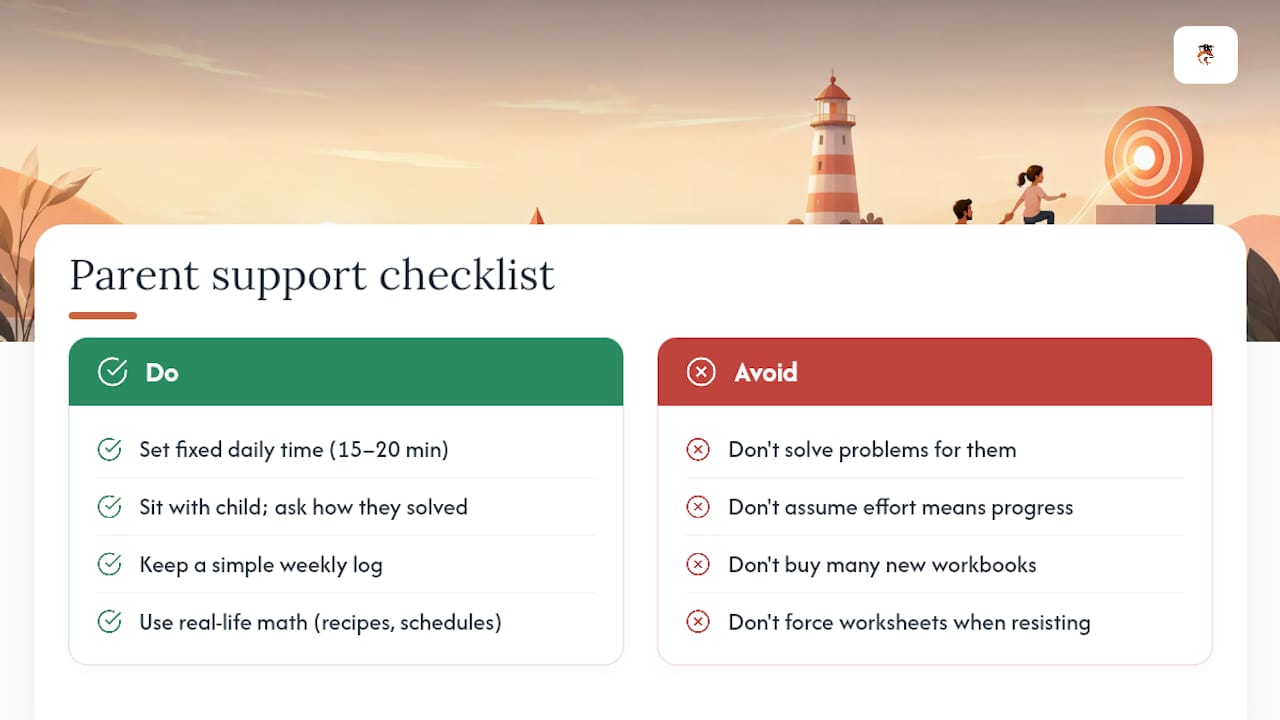
You don’t need a teaching degree to run an effective home plan, but you do need consistency. Set a fixed time each day, even just 15 to 20 minutes, and protect it the same way you’d protect a swimming lesson or a music practice slot.
Sit beside your child during the harder tasks, not to solve the problem for them, but to ask “how did you get that?” when an answer looks off. That question alone surfaces more misunderstandings than checking the final answer ever will. When your child explains their reasoning out loud, you’re doing informally what a good tutor does formally: watching the process, not just the result.
Keep a simple log, even a single notebook page per week, of what was practised and how the retest went. This matters more than it sounds. Without a record, it’s easy to assume progress is happening because effort is happening. They aren’t always the same thing.
Lean on real materials instead of buying a stack of new workbooks. Recipes, flyers, sports stats, and bus schedules all contain genuine math problems your child already has some interest in. If your child resists a formal lesson outright, that’s a signal to switch to an embedded activity, like planning a family outing budget, rather than pushing through resistance with more worksheets.
If a specific skill keeps stalling despite consistent home practice, that’s the moment to bring in outside support rather than more repetition. Our piece on word problem strategies that work for every student is a useful next stop if reasoning tasks are the sticking point.
How do you balance math practice with summer fun?
The families who stick with a summer plan tend to treat math as one item on the day’s list, not the theme of the whole summer. A 20 minute session before lunch, done five days a week, beats a two-hour Sunday cram session almost every time, both for retention and for keeping the peace at home.
Protect the fun stuff on purpose. If your child has camp, swimming, or a standing playdate, schedule math around those, not the other way around. Treating math practice as the fixed point and everything else as flexible is a fast way to make your child resent both.
Build in a visible reward system tied to consistency rather than performance. A sticker for finishing the session, not for getting every answer right, keeps the pressure off the outcome and on the habit. Kids who fear getting something wrong tend to guess rather than reason, which defeats the purpose of the whole exercise.
Watch for burnout signs specific to summer: rushing through problems to “get it over with,” complaining more on day 12 than day 2, or suddenly forgetting things they clearly knew a week earlier. These usually mean the daily dose is too long, not that your child has hit a wall. Cutting a 30 minute session down to 20 minutes often fixes the attitude problem faster than any pep talk.
One light week midway through the summer, with review games instead of new material, tends to refresh motivation without breaking the habit loop you’ve built.
What usually derails a summer math catch-up plan?
Inconsistency is the most common failure point. A plan that runs hard for ten days and then disappears for two weeks doesn’t build the retrieval habit that makes facts stick. Short and steady beats long and sporadic almost every time.
Working on the wrong skill is a close second. Parents often default to whatever workbook matches the grade level printed on the cover, rather than the specific gap identified in the baseline check. A child strong in computation but weak in word problems doesn’t need forty more multiplication sheets.
Motivation dips are predictable, usually around the two to three week mark once the novelty wears off. This is where switching one session per week to a game-based or real-life task, rather than pushing through with more worksheets, tends to restore engagement.
Some children resist any activity that feels like “school” during vacation. In that case, embedding the skill into a chore or outing, as covered above, works better than insisting on formal practice.
Finally, families sometimes stop too early because they see a good week and assume the gap is closed. A single strong quiz doesn’t confirm mastery. The fix is the same one used throughout this plan: a comparable but not identical retest at the end of the four weeks, so you’re measuring real understanding rather than memory of the exact problems already practised.
What this summer actually calls for
The conventional advice on summer math catch-up leans too hard on volume: more worksheets, more hours, more apps. The research doesn’t support that framing. A modest effect size from a voluntary Ontario numeracy programme and a similarly modest tutoring effect size both point the same direction: what moves the needle is diagnosis followed by correction, not raw exposure.
Most families overcorrect by trying to fix everything at once instead of picking two or three skills and tracking them properly. That’s the piece worth prioritizing first, before booking anything or buying a single workbook. A baseline assessment costs nothing but twenty minutes, and it tells you more than a summer’s worth of undirected practice.
Where a parent-led plan runs out of road is the feedback loop. You can watch your child’s reasoning and ask good questions, but you can’t always spot a subtle misconception the way someone trained to look for it can. That’s the point where structured support, whether a short programme or one-on-one tutoring, earns its place. Not as a replacement for parent involvement, but as the layer that catches what a busy household reasonably misses.
— Réussite A+
Ready to start? Booking a summer session with Réussite A+
Réussite A+ is the alternative to a generic summer workbook stack: instead of guessing which pages to assign, a tutor runs the same baseline diagnostic covered above and builds a custom plan around your child’s actual gaps, not a grade-level average.

A Session d’été starts with that assessment, then moves into short, focused sessions with progress updates so you know within weeks, not in September, whether the plan is working. Session pricing generally falls within a moderate hourly range with an additional registration fee, and scheduling aims to accommodate typical summer activities like camp and family trips.
If your child’s gap is broad or the motivation to sit through it is low, a trial session is a low-risk way to see how the diagnostic and feedback approach feels in practice before committing to a full summer plan. Book a baseline assessment through the Session d’été page to get a specific plan built around your child’s actual skills rather than a generic grade-level assumption.
Sources
The Ontario quasi-experiment on summer numeracy programmes provides the clearest Canadian evidence on realistic summer gains. Québec’s elementary mathematics program defines the competencies any solid catch-up plan should target. Ontario’s parent-facing curriculum guidance grounds the everyday-application strategies covered above. The meta-analysis on elementary math programmes supports the emphasis on tutoring and adaptive feedback over raw practice hours.
- Estimating causal effects of summer programmes on early numeracy: A Canadian, multi-site, quasi-experiment
- Effective programs in elementary mathematics: A meta-analysis
- Elementary Mathematics Program | Gouvernement du Québec
- Ontario
FAQ
How many weeks does summer catch-up math need to show results?
About eight to ten weeks of consistent, short sessions is typically enough to see measurable movement on two or three targeted skills. The Ontario numeracy programme study tracked gains over a single summer season, so meaningful progress in that window is realistic, not exceptional.
Is tutoring or a workbook better for summer math review?
Tutoring tends to outperform unsupervised workbook practice because a tutor catches and corrects reasoning errors in real time, which a meta-analysis of 87 studies links to stronger average effects. A workbook can support a mild gap or reinforce a tutor’s plan, but it rarely replaces the feedback loop on its own.
How much does a summer math tutoring session cost?
Réussite A+ prices online Session d’été tutoring at $30 to $35 per hour, plus a one-time $65 registration fee. Exact scheduling and package options are confirmed during the initial booking conversation.
What if my child refuses to do math over the summer?
Switch from formal lessons to embedded tasks, like budgeting for an outing or measuring ingredients while cooking, since provincial guidance links real-life framing to higher engagement. If resistance continues past a week or two, a tutor can often re-engage a child faster than a parent can, simply by changing the format entirely.
How do I know if my child’s summer math plan is actually working?
Use a comparable but not identical quiz at the end of each week to check whether skills transfer beyond the exact problems practised. If two consecutive weekly checks show no movement on a targeted skill, that is the signal to adjust the approach, not to add more of the same practice.