

The Socratic tutoring method is a way of teaching through questions. Instead of handing your child the answer or walking through the steps for them, the tutor asks short, well-chosen questions that lead your child to find the reasoning on their own. The tutor offers hints rather than immediate answers, and your child does the thinking. Done well, it builds understanding that lasts beyond tonight’s homework.
If you are a parent in Quebec wondering what this looks like in a real session, and whether it suits a child who is stuck, shy or simply tired after school, this guide walks you through it step by step. You will see the types of questions, a worked maths example, a French example, and the moments when a good tutor stops asking and simply explains.
TL;DR
- The Socratic method uses guiding questions and hints so your child reaches the answer through their own reasoning.
- A good session moves from an open question to a hint, then to a check of understanding, always leaving time to think.
- Wrong answers are treated as stepping stones, which keeps a hesitant child talking.
- It works in maths and in French, but a skilled tutor mixes in direct explanations, modelling and practice when they serve the goal.
- Ask any tutor how they use questions, how long they wait for answers and how they track progress.
Table of Contents
- What the Socratic method means in plain words
- How a Socratic tutoring session works
- The questions a tutor asks
- A worked maths example
- A French example
- Three habits that make questioning work
- What your child gains
- When a good tutor explains directly
- How to tell whether a tutor really uses guided questioning
- How parents can support the method at home
- Try it with Réussite A+
- FAQ
- Sources
What the Socratic method means in plain words
The name comes from the ancient Greek philosopher Socrates, who taught by asking questions rather than lecturing. In a tutoring context, the idea is simple: the approach draws out a student’s thinking with questions instead of directions, and the tutor gives hints instead of immediate answers.
Compare two ways of helping with the same problem.
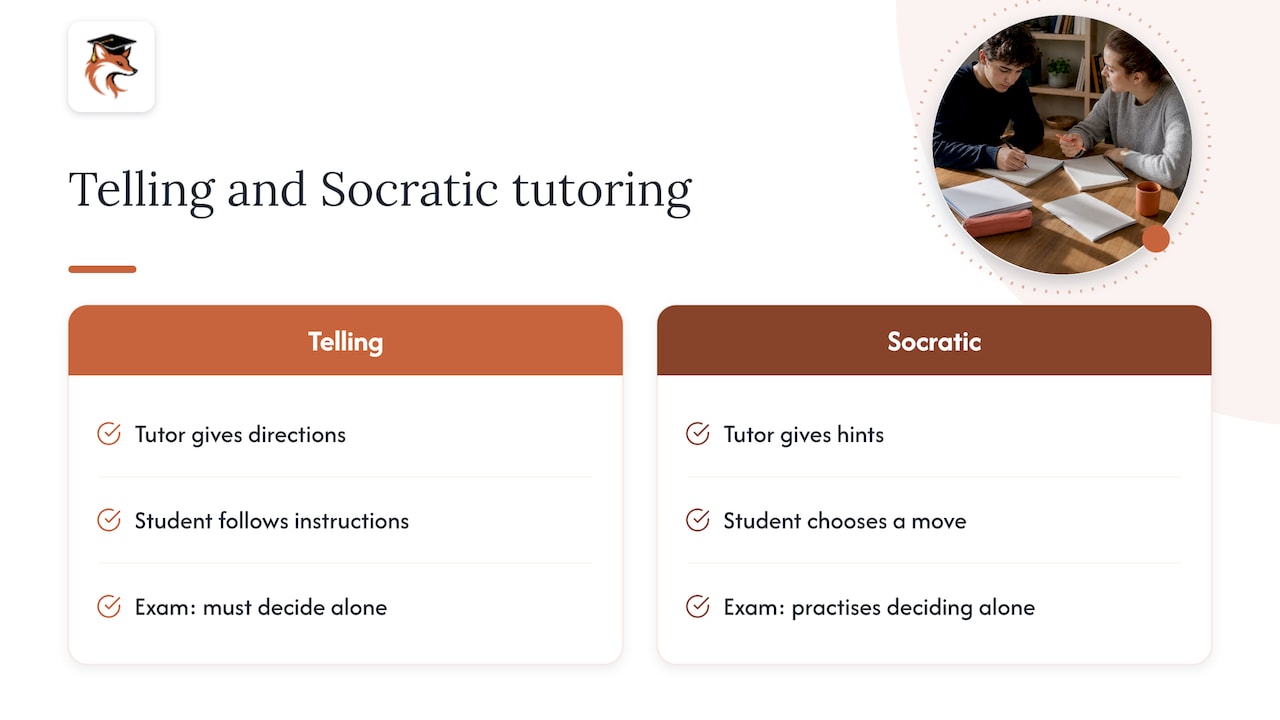
Telling: “Move the 7 to the other side and change its sign. Now divide by 3.”
Asking: “What are we trying to get alone on one side? What could we do to the equation to move the 7 away?”
In the first case your child follows instructions. In the second, your child has to decide what the goal is and choose a move. That decision is where the learning happens, and it is also what your child will have to do alone during an exam.
Socratic tutoring is not an interrogation, and it is not about making a child feel tested. It is a calm, friendly conversation in which the tutor stays one step behind your child, nudging only when needed.
How a Socratic tutoring session works
Every tutor has their own style, but a Socratic session usually follows a rhythm you can recognise. Here is a typical sequence for a 60-minute online session.
- Start from what your child already knows. The tutor opens with a light question: “Tell me what this exercise is asking you to do.” This reveals whether the difficulty lies in understanding the instructions, the concept or the calculation.
- Let your child attempt the task. The tutor watches the work on the shared screen and resists the urge to correct right away.
- Ask a question about the thinking, not just the result. “How did you decide to start there?” or “What would happen if the number were negative?”
- Give a hint, not the answer. If your child stalls, the tutor narrows the question: “Look at the second word of the sentence. Who is doing the action?”
- Check the understanding. Once your child finds the answer, the tutor asks them to explain it back, or to try a similar problem with different numbers or words.
- Wrap up with a short summary in your child’s own words. This is the mini-checklist your child can reuse next time.
Because online sessions happen on a shared screen, the tutor can see each step your child writes and ask about it in the moment. If you want a full picture of the format, our guide on how an online tutoring session works covers the technical and practical side.
The questions a tutor asks
Not all questions are equal. “Do you understand?” invites a quick “yes” and teaches the tutor nothing. Better questions are specific and open.
A Canadian example shows what a rich questioning repertoire looks like. Innovation, Science and Economic Development Canada describes one award-winning teacher’s Socratic questioning as a way to uncover assumptions, analyse concepts, separate what is known from what is not, and follow logical consequences, paired with a trusting, safe and inclusive environment. That last part matters as much as the questions themselves.
For elementary and secondary students, those categories translate into everyday prompts:
- Clarify: “Can you say that in your own words?”
- Probe assumptions: “Why did you think we add here rather than multiply?”
- Ask for evidence: “Which part of the text tells you that?”
- Explore consequences: “If this is true, what must be true about the next step?”
- Look at the question itself: “What is this problem really asking?”
- Know what you know: “Which part do you feel sure about, and which part is fuzzy?”
Authentic questions versus checking questions
Researchers who study questioning in higher education distinguish between “inauthentic” questions, used to check basic comprehension, and “authentic” questions that are needed to reach higher-order thinking such as analysis and evaluation. Both have a place. “What is the plural of cheval?” checks recall. “Why do you think this word changes in the plural and that one does not?” invites your child to look for a pattern.
In mathematics, an Ontario resource on effective questioning notes that good questions offer a challenge within the learner’s zone of proximal development and are open enough to allow different strategies and answers. In plain terms: not so easy that it is boring, not so hard that your child shuts down, and with more than one way in.
A worked maths example
Imagine a Secondary 1 student working on this problem: “A tablet costs $240 after a 20% discount. What was the original price?” The student writes 240 + 20% = 288.
A telling tutor would say: “No, the 240 is 80% of the original. Divide 240 by 0.8.”
A Socratic tutor might go like this:
- Tutor: “Walk me through what you did.”
- Student: “I added 20% to 240.”
- Tutor: “Good, that is a clear method. 20% of what number did you add?”
- Student: “Of 240.”
- Tutor: “The store took 20% off. Off which price: the one before the discount or the one after?”
- Student: “Before… so it’s the original price.”
- Tutor: “So is 240 the original price, or the price after taking 20% off?”
- Student: “After. So 240 is not 100%. It’s… 80%?”
- Tutor: “Nice. How could you use that to find 100%?”
The student reaches the answer in a few steps. Notice what the tutor did: affirmed the effort, located the misunderstanding (which price the percentage applies to) and asked a question that exposed it. The mistake became useful.
A few weeks later, a similar problem about a sale on running shoes will feel familiar, because your child owns the reasoning rather than a memorised trick.
For younger children, the same logic applies to mental arithmetic. Our article on quick and fun mental calculation methods shows how short, playful questions can build number sense for 7 to 9 year olds.
A French example
Questions work just as well in French, where students often feel they must simply memorise rules. Take a Secondary 2 student who writes: “Les enfants que j’ai vu hier sont partis.” (the past participle vu should agree with enfants).
A Socratic tutor avoids announcing the rule and asks:
- “Which verb is in the past tense here, and which auxiliary does it use?” (avoir)
- “What is que replacing in this sentence?” (les enfants)
- “Does that word come before or after the verb?” (before)
- “What does the rule say about the direct object when it comes before avoir?”
- “So what should happen to vu?”
Each step is a small decision, and together they form a démarche your child can apply to any participle. We often turn that sequence into a mini-checklist the student keeps. Calling the tricky bits mots-pièges (trap words) and treating the exercise like a detective game also lowers the stress.
Questioning is equally useful for reading. When a child reads a passage and says “I don’t get it”, a tutor can ask: “Which sentence made sense? Which word stopped you? What do you think the author wants us to feel here?” Our guide to exercises to improve reading comprehension pairs well with this kind of dialogue.
There is also Canadian research on the link between speaking and learning. A University of Alberta action-research study in a Grade 4 French immersion mathematics class found that having students put their reasoning into words in the target language, with teacher support, led to more independent dialogue and better mathematics and vocabulary. For a child learning in French, explaining out loud is practice in both the subject and the language.
Three habits that make questioning work
1. Give think time
Firing question after question rarely helps. Teaching research advises leaving adequate “think time” after a question, which encourages better and more complex answers. If your child is silent for ten seconds, that is usually thinking, not failure. Parents sitting in the room can help by staying quiet too.
2. Treat wrong answers as stepping stones
The same source stresses that using an incorrect answer as a stepping stone, rather than labelling it “wrong” helps keep students taking part. A tutor might say, “That tells me how you are thinking. Let’s see where it leads.” For a child who has started to believe they are “bad at maths”, this changes everything.
3. Build a safe climate
Research from a Malaysian classroom study found that effective use of Socratic questioning needs a supportive climate in which students feel safe enough to take the risks of thinking critically. The same study reported that repeated Socratic questioning improved student responses and writing, while weak reading ability, language proficiency and anxiety affected performance. That is why, in one-on-one online tutoring, the relationship comes first: a child who is afraid of being wrong will not risk an answer.
What your child gains
When questioning is well planned, the benefits go beyond one assignment. Work on structured Socratic discussion in secondary science classes describes gains in metacognition, interest in learning, critical thinking and understanding. The same research describes students moving from simple opinion to well-justified reasoning based on evidence.
In practical terms for your family:
- Better exam habits. Your child learns to reread the question, spot what is being asked and check their own work.
- More independence. Homework becomes less of a nightly negotiation.
- More confidence. Finding the answer yourself feels very different from being given it.
- Stronger explanations. Being able to explain a step is a good sign that it is understood.
If you want to see how these gains show up over months, read about how tutoring raises your child’s grades and confidence.
When a good tutor explains directly
The best tutors are not purists. Expert tutoring guidance recommends varying methods, since questioning one student at a time is not the best tool for every learning goal. Using questions well means knowing when to switch tools. Here are common moments when a tutor will model, explain or demonstrate.
- A brand-new concept. If your child has never seen long division or the passé composé, a clear first explanation with a worked example gives them something to reason about. Questions then deepen it.
- A missing fact or vocabulary item. No amount of questioning produces the spelling of a word the child has never met. The tutor supplies it, then practises it.
- A frustrated or tired child. When patience runs low, a short direct explanation, followed by a question to confirm, protects motivation.
- Exam time pressure. Before an entrance exam, the tutor may teach timing strategies and standard solution formats directly, and use questions to check that your child can apply them.
The research supports this flexibility: the Malaysian study confirms that consistent practice improves responses and writing provided the teacher adapts to individual student needs. Adapting is part of the method, not a departure from it.
For children preparing for secondary school entrance exams, this blend matters. Direct teaching of content, simulated exams and guided questioning each play a part. Our piece on exam simulations in preparation explains how practice papers fit in, and our stress management strategies for entrance exams help your child stay calm on the day.
How to tell whether a tutor really uses guided questioning
Many tutors say they are “interactive”. Here is a short checklist you can use in a first session or consultation.
- Does the tutor ask your child to explain why, not only to give an answer?
- Does the tutor pause long enough for your child to think?
- When your child errs, does the tutor respond with curiosity rather than a correction?
- Does your child talk more than the tutor during most of the session?
- Does the tutor sometimes explain clearly and briefly when your child needs it?
- At the end, can your child say what they learned in one or two sentences?
- Does the tutor share progress notes with you?
For more prompts to bring to a first call, use our printable tutoring consultation questions and our checklist for evaluating the quality of a tutoring service.
How parents can support the method at home
You do not need to be a maths or French expert. Borrow the tutor’s tools in small ways:
- Replace “Is it right?” with “How did you get that?” Your child practises explaining, and you learn where they are.
- Wait. Count slowly to ten before offering help.
- Offer a hint, not the answer. “Look at the first line of the problem again.”
- Praise the strategy. “I like how you drew the diagram” teaches more than “Good job”.
- Ask for a teach-back. Five minutes of your child explaining a lesson to you is a powerful review.
These habits take a few weeks to settle, and some evenings will go better than others. That is normal.
Our perspective
After more than 25 years in education, we have seen the same pattern many times: a child who is told the answer nods, then makes the same mistake next week. A child who finds the answer, even with a hint, remembers it.
That is why our tutors, selected from university level for their academic excellence and teaching ability, build each session around the student’s own thinking. Every child receives a customised learning plan based on their strengths, challenges, pace and goals. Questions are one of the main tools we use to carry out that plan, alongside clear explanations, custom educational material and continuous progress monitoring.
We do not believe in questions for their own sake. A struggling child needs a clear model first, and an advanced child needs harder questions than the school provides. Our approach is to adjust: more guidance when confidence is low, more challenge when it is high, and always a calm, encouraging tone that makes it safe to be wrong.
We want parents to leave a session knowing exactly what their child worked on, what they now understand and what comes next.
Réussite A+
Try it with Réussite A+
At Réussite A+, we offer online tutoring and homework help for elementary and secondary students across Quebec, with a focus on maths and French. Our university-level tutors follow a personalised plan for your child, including regular sessions, summer catch-up and secondary school entrance exam preparation. Sessions are priced at $30 to $35 per hour, with a one-off registration fee of $65, as published on our site. We also offer a satisfaction guarantee: if you are not satisfied, the first session is refunded.
You can explore our regular sessions, our French tutoring programs or our entrance exam preparation, and see the current rates and registration fee before you decide.
FAQ
What is another name for the Socratic method of teaching?
It is often called the Socratic questioning method, guided questioning or dialogic teaching. All describe teaching that relies on questions and discussion rather than lecturing. In tutoring, you may also hear “guided discovery”, where the tutor gives hints and the student reaches the answer.
Is the Socratic method suitable for young children?
Yes, when the questions are short, concrete and matched to your child’s level. For a seven-year-old, it might be “What do you notice about these numbers?” For a teenager, it can be “What assumption are you making here?” The tutor adjusts the wording, the pace and the amount of support.
What if my child gets frustrated by all the questions?
This is a signal to adapt, not to stop. A good tutor will shorten the questions, add a hint, or explain the step directly before asking your child to try. Tell the tutor what you see, and the plan can be adjusted to your child’s pace.
Does the Socratic method work for French as well as maths?
Yes. In French, questions help children discover grammar patterns, check agreements and understand texts. In maths, they help children choose strategies and spot errors. In both subjects, putting reasoning into words also strengthens language skills.
How do I know if it is working?
Look for signs: your child explains their steps more clearly, asks fewer “just tell me” questions, makes fewer repeated errors and approaches homework with more confidence. A tutor who tracks progress should be able to show you concrete examples after a few weeks.
Sources
- Facilitate Office Hours, Teaching + Learning Lab, MIT
- 2023 Recipient biographies, Teaching Excellence, Innovation, Science and Economic Development Canada
- L’art de questionner de façon efficace
- Do You Ask “Authentic” Questions?, NYU School of Law
- Socratic method: questions and answers, University of Antwerp
- Developing critical thinking through Socratic Questioning
- Socratic seminars in science class
- L’utilisation du discours dialogique dans la construction, University of Alberta