



Your child probably needs tutoring if the same difficulty keeps coming back despite real effort, if marks no longer match how hard they work, or if school has started to cause worry, avoidance or tears. One bad test is not a signal. A pattern over several weeks is. The good news is that most of these patterns can be turned around with calm, structured support, and you do not need to wait for a diagnosis or a report card to start.
This guide helps you sort what you are seeing at home into three groups: normal bumps, gaps that tutoring can fill, and situations where another professional should be involved first.
TL;DR
- Look for patterns that last several weeks: marks that do not match effort, homework battles, avoidance, or worry about school.
- Struggles that persist despite help at school are a reason to act early, and support does not have to wait for a diagnosis.
- Talk to the teacher first. Ask for specific examples, then decide together whether extra support makes sense.
- Tutoring fills skill gaps and rebuilds confidence. Ongoing, distressing difficulties may call for a health professional or an assessment as well.
- A short trial with a clear goal is the simplest way to find out whether tutoring helps your child.
Table of Contents
- Signs in marks and schoolwork
- Signs in behaviour and emotions
- Is it a rough patch or a real gap?
- At what age can a child benefit from tutoring?
- Talk to the teacher before you decide
- When tutoring is the right tool, and when it is not
- A five-minute checklist for parents
- Our perspective
- How Réussite A+ can help
- What to expect in the first weeks
- FAQ
- Sources
Signs in marks and schoolwork
Academic signals are the easiest to see, so start there. Ask yourself whether these are true over a month or more, not just this week.
- Marks that do not reflect effort. Your child studies, yet results stay low or keep dropping. Psychologists list this as a common early sign that something specific is getting in the way, according to a Canadian clinic’s overview of academic support.
- Reading or math that feels harder than it should. Your child guesses at words, avoids reading aloud, or freezes when a math problem looks unfamiliar.
- Trouble with organization and focus. Lost assignments, unfinished work and long homework sessions are all clues.
- Gaps that build on each other. In math, a missed idea such as fractions makes the next unit harder. In French, shaky verb endings or spelling rules show up in every text your child writes.
- Homework that takes far longer than the teacher expects. If a 20-minute task regularly takes an hour and ends in frustration, the problem is rarely laziness.
If math is the main worry, our guide on what to do when your child is failing math walks through the first steps.
Signs in behaviour and emotions
Children often cannot say “I don’t understand.” They show it in other ways. The same clinic overview mentions avoidance of schoolwork, anxiety or frustration about academics, and physical complaints such as headaches or stomach aches before school as common markers (Kingsway Psychological & Behavioural Services, 2024).
Watch for:
- “I’m just bad at math” or “I’m stupid” type comments.
- Stalling at homework time, or sudden tears and anger over small tasks.
- Reluctance to take part in class or to ask the teacher questions.
- A child who used to like school and now dreads it.
- Stomach aches or headaches on school mornings with no medical cause.
A drop in confidence is often the first thing to appear and the last thing to recover. That is one reason not to wait: a small gap fixed in October is much easier than a large gap and a discouraged child in March.
Physical complaints deserve a call to your family doctor first, to rule out a medical reason.
Is it a rough patch or a real gap?
Every child has weeks that go badly: a new teacher, a new unit, a rough sleep stretch, a friendship problem. Here is a simple way to tell the difference.
| Likely a rough patch | Likely a gap worth supporting |
|---|---|
| Started with a clear change (new class, move, illness) | No clear trigger, or it has been building for months |
| Improves after a few weeks and some extra attention | Continues even when you or the teacher step in |
| Limited to one test or one chapter | Shows up across assignments or several terms |
| Your child is still confident | Your child avoids, hides or gives up |
The Canadian Paediatric Society’s 2024 position paper says that learning problems that persist despite intervention may warrant an assessment, and that support should begin as soon as a delay is noticed, without waiting for a diagnosis (Canadian Paediatric Society). It also describes a move away from waiting for a big gap between ability and results, toward giving help early and watching how the child responds.
In practice, that means a simple rule: if you have tried a few weeks of extra support and nothing shifts, do not keep waiting. Change something.
At what age can a child benefit from tutoring?
There is no single magic age. Some top-ranking pages argue that most young children do not need a tutor at all, and for a child who is thriving, that is fair. The better question is whether your child has a specific gap, not how old they are.
What we can say from the evidence:
- Early reading. The Canadian Paediatric Society says children who struggle with foundational reading skills in kindergarten or grade 1 need early intervention so they do not fall further behind (CPS literacy guidance, 2024). The same guidance notes that systematic phonics instruction, often delivered one-on-one or in small groups, is effective for reading gains.
- Math. Ontario’s Ministry of Education notes that spatial thinking can be improved with practice and that early identification of spatial difficulties is essential (Ontario Ministry of Education). The lesson applies well beyond Ontario: early, targeted practice pays off.
- Upper elementary and high school. This is when tutoring is most often requested. Content gets heavier, French grammar and math concepts pile up, and exams such as secondary school entrance tests add pressure.
For very young children, the first step is usually play-based reading at home and a conversation with the teacher, not a weekly tutor. For a child in grade 3 or above with a clear gap, tutoring is a reasonable and effective choice.
Talk to the teacher before you decide
The teacher sees your child in a group, next to peers, and knows the curriculum expectations. That view is valuable. Pediatric guidance recommends treating this conversation as a partnership: ask for specific examples of the difficulty, discuss how the classroom can adapt, and agree on a plan for follow-up (HealthyChildren.org, 2023).
Questions worth bringing:
- In which skills or units is my child behind, and by how much?
- Is this new, or has it been happening all year?
- What does my child do well? What helps them focus?
- What support is already available at school?
- How will we know in six weeks whether things are improving?
Write down the answers. They become the goals you share with a tutor, which makes the first sessions far more useful.
When tutoring is the right tool, and when it is not
Tutoring is very good at closing skill gaps, rebuilding routines, preparing for exams and restoring confidence. The Government of Quebec describes tutoring as flexible, personalized support that adapts to students’ changing needs and is distinct from homework help (Programme de tutorat, Gouvernement du Québec). That distinction matters: homework help gets tonight’s work done, while tutoring targets the underlying skill.
But tutoring is not always the whole answer. Consider a wider look if:
- Your child has struggled with reading, writing or math for a long time despite good teaching and practice.
- The difficulties are causing real distress or affecting friendships and family life.
- You notice attention, memory or organization problems that show up everywhere, not just in school.
The Canadian Paediatric Society says persistent struggles may call for a psychoeducational assessment, and complex situations may call for a referral to a developmental paediatrician, while tutoring and other supports remain recommended in the meantime (CPS, 2024). An assessment can describe your child’s learning profile and give recommendations you can share with the school (Kingsway, 2024). Your family doctor is a good first call.
What about ADHD?
The Government of Quebec advises consulting a health professional when attention or hyperactivity signs cause distress, interfere with functioning or relationships, and have lasted more than six months (Quebec.ca). It also notes that children can get help managing symptoms that affect home and school life even without a formal diagnosis. The Canadian Paediatric Society lists behavioural training for parents and teachers and academic supports among the standard first-line interventions (CPS, ADHD guidance).
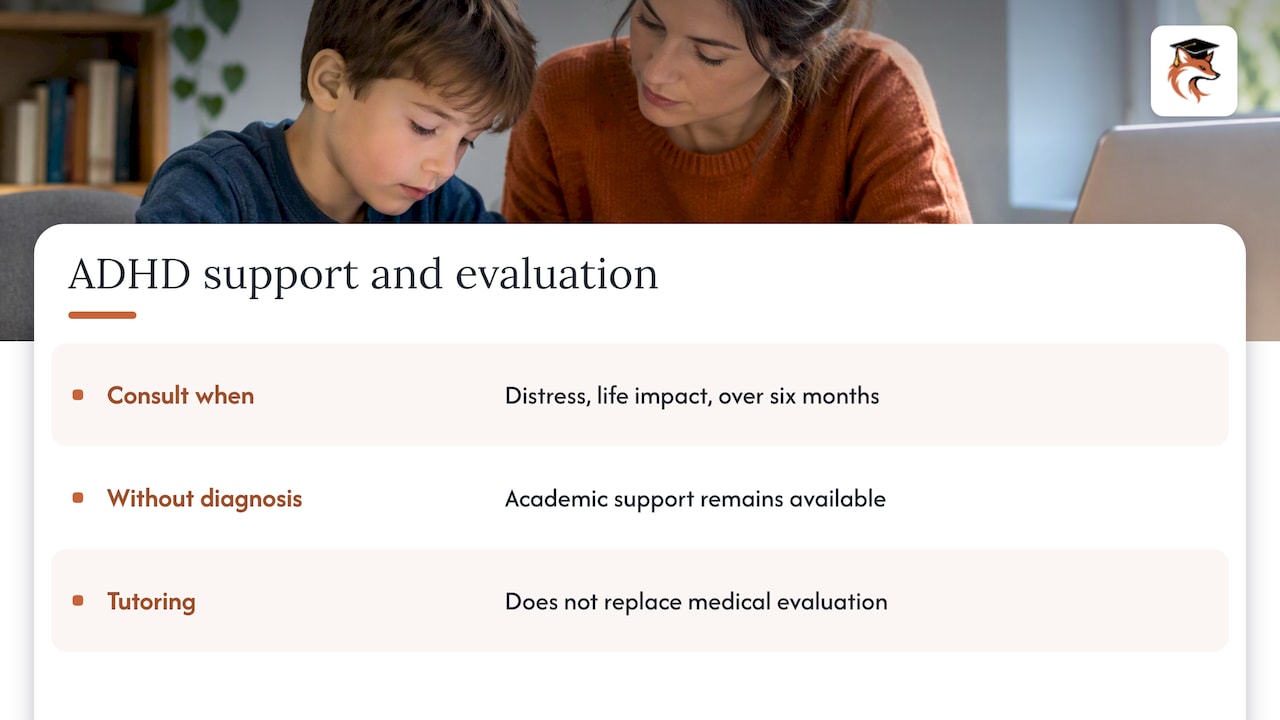
Tutoring can be one of those academic supports, especially when sessions are short, structured and predictable. If that is your situation, our articles on children with ADHD and online tutoring and ADHD in Quebec schools give practical guidance. Tutoring does not replace a medical evaluation.
A five-minute checklist for parents
Tick what applies to your child over the past four to six weeks:
- [ ] Marks are lower than their effort suggests
- [ ] Homework regularly ends in frustration or tears
- [ ] They avoid reading, writing or math tasks
- [ ] They say things like “I’m bad at this”
- [ ] Teacher comments mention the same weakness more than once
- [ ] They are missing basics from earlier grades (times tables, verb endings, fractions)
- [ ] A big exam or a school change is coming
- [ ] You have tried helping and it is not working, or you no longer have the time
0 to 2 ticks: keep watching and talk to the teacher. 3 to 5: book a conversation with the teacher and consider a short tutoring trial. 6 or more, or any distress that worries you: act now, and involve your doctor if the difficulty feels broader than school.
Our perspective
After more than 25 years in education and more than 3,500 students supported, we have seen the same thing again and again: parents wait too long because they fear that asking for help means their child is failing. It does not. It means your child has a specific gap, and specific gaps can be closed.

We also believe tutoring should never be one-size-fits-all. A child who is behind in French verb forms, a child who understands math but panics at exams, and a child who is bored and ready for more all need different plans. That is why every student at Réussite A+ starts with a learning plan built around their strengths, challenges, pace and goals, and why we monitor progress continuously so you can see what is changing.
Our advice to parents is simple. Do not try to diagnose everything yourself. Notice the pattern, talk to the teacher, and try a short, well-defined period of support with clear goals. If it helps, continue. If it does not, change the approach.
— Réussite A+
How Réussite A+ can help
We offer online tutoring for elementary and secondary students across Quebec, including Montreal, Laval, Longueuil and Brossard, in French and math. Our tutors are selected from university students for their academic results and teaching ability. Sessions are online, so scheduling is flexible, and every child gets a personalized plan.
Rates are $30 to $35 per hour, with a one-time registration fee of $65 (see our rates). If you are not satisfied after the first session, we refund it. You can start with a regular session for steady weekly support, or read about online homework help if evenings at the kitchen table are the main struggle.

If a secondary school entrance exam is on the horizon, our exam preparation sessions focus on the skills and exam strategies your child will need. For a fresh start before the next school year, the summer session is a calm way to catch up. When you are ready, you can register for tutoring.
What to expect in the first weeks
A good tutoring start is predictable, and it should feel light for your child. Here is what a well-run start looks like.
- A conversation about goals. You share what you noticed and what the teacher said. The goal should be concrete: for example, “write a paragraph in French without agreement errors” rather than “do better.”
- A quick look at the basics. The tutor finds exactly where the gap begins, which is often a grade or two earlier than the current unit.
- A plan with small steps. Short, regular sessions beat one long weekly marathon for most children. A weekly rhythm works for steady support, and an intensive rhythm suits exam preparation or summer.
- Visible progress. You should be able to see what was worked on and what improved. Our article on how online tutoring helps parents follow progress explains how that works.
- A review after four to six weeks. Compare with the teacher’s feedback and with your child’s own confidence. Both matter.
Some parents also wonder whether online sessions work as well as in-person ones. We compare the two in online versus in-person tutoring.
How to make tutoring feel like a win
How you introduce it shapes how your child receives it.
- Present it as a boost, not a punishment. Athletes have coaches; this is the same idea.
- Celebrate effort and small steps, not only marks.
- Keep sessions at a consistent time so it becomes routine.
- Ask your child what they want to get better at. Their answer is often more precise than ours.
- Avoid comparisons with siblings or classmates.
To help your child define what success means to them, see what academic success means for your child.
FAQ
Should I wait for a diagnosis before starting tutoring?
No. The Canadian Paediatric Society recommends starting support as soon as a learning delay is noticed, without waiting for a formal diagnosis (CPS, 2024). If the difficulties are persistent or distressing, ask your doctor or the school about an assessment in parallel.
How long will my child need tutoring?
It depends on the size of the gap and the goal. A specific skill, such as verb agreement, may take weeks. A larger foundation gap or an exam goal takes longer. Set a goal, review after four to six weeks, and adjust with your tutor and the teacher.
Is tutoring the same as homework help?
Not quite. Homework help supports tonight’s assignments, while tutoring works on the underlying skills and adapts to your child’s needs over time, as the Government of Quebec describes it. Many families use both, depending on whether the problem is a specific assignment or a repeated pattern.
Can tutoring help a child with ADHD?
It can, as one academic support among others. Short, structured sessions with clear routines tend to work best, and the Government of Quebec notes that supports are available even without a formal diagnosis (Quebec.ca). If signs have lasted more than six months and cause distress, see a health professional.
My child is doing fine at school. Could tutoring still help?
Yes, if your child is bored, wants to go beyond the grade-level material, or has a big exam coming. In that case, tutoring is about enrichment and exam strategy rather than catching up, and the plan looks quite different.
Sources
- Optimizing Academic Development: The Power of Psychoeducational Assessments, Kingsway Psychological & Behavioural Services
- Evaluating and caring for children with a suspected learning disorder, Canadian Paediatric Society
- Literacy in school-aged children: A paediatric approach, Canadian Paediatric Society
- ADHD in children and youth, Canadian Paediatric Society
- Mettre l’accent sur le raisonnement spatial, Ontario Ministry of Education
- Trouble du déficit de l’attention avec ou sans hyperactivité, Gouvernement du Québec
- Programme de tutorat, Gouvernement du Québec
- Dealing with Problems at School: How to Talk With Your Child’s Teacher, HealthyChildren.org