



Tutoring services pair students with qualified instructors, in person or online, for personalized help in math, French, science, and English. The right choice depends on tutor credentials and a clear plan for measuring progress. Your first move: book a short assessment or ask any prospective tutor for proof of qualifications and a sample learning plan before you commit to a package. Some tutoring services offer vetted, structured entry points for families seeking tutoring in Quebec.
TL;DR:
- Choosing a tutor requires verifying certification, curriculum familiarity, and clear progress measurement methods to ensure long-term effectiveness.
- Structured programs follow a cycle of assessment, planning, practice, and review, with progress typically noticeable within six to eight weeks.
- Costs vary based on format, credentials, and session packages, with online tutoring generally being more affordable than in-person options.
- Combining free community resources with paid tutoring can optimize support while managing expenses, especially for routine homework help.
- Expect noticeable improvements in homework routines within weeks, but significant academic gains or test score increases usually take multiple months and consistent effort.
Table of Contents
- What does a tutoring service actually offer?
- Who provides tutoring, and which credentials actually matter?
- How much does tutoring cost, and what drives the price?
- How do you actually choose the right tutoring service?
- What does a well-run tutoring programme look like?
- Free and low-cost tutoring options worth checking first
- How often should sessions run, and how is progress tracked?
- What will tutoring actually cost over a semester or a package?
- How long before tutoring actually shows results?
- How do you know if a tutor is actually working, and what are the red flags?
- Réussite A+ perspective: why structure beats intensity
- Ready to start? Here’s how Réussite A+ programs work
- Sources
- FAQ
What does a tutoring service actually offer?
A tutoring service matches a student with an instructor for structured academic support, distinct from generic homework help, which focuses on finishing tonight’s assignment rather than closing long-term learning gaps. Quebec’s own tutoring guidance frames good tutoring as personalized one-to-one or very small-group instruction that adapts continuously to a student’s strengths and weaknesses, not a fixed script applied to every child.
Formats and coverage typically include:
- One-on-one sessions for students who need focused attention on a specific weakness, such as fractions or verb conjugation.
- Small-group sessions (under four students), which lower the per-student cost while keeping much of the individual attention.
- Subject coverage spanning math, science, English, and French, plus exam preparation for secondary entrance exams and end-of-year finals.
- Grade range from elementary through secondary, with programs adjusted for learning pace rather than age alone.
Homework help and true tutoring often get bundled together, but the 211 Grand Montréal resource guide draws a useful line: homework help gets today’s task done, while tutoring builds skills that prevent tomorrow’s struggle.
Who provides tutoring, and which credentials actually matter?
Not every tutor is equally qualified, and the label “tutor” covers everyone from a certified classroom teacher to a well-meaning high schooler. Quebec’s programme guidance links stronger long-term outcomes to certified teachers and structured progress monitoring, not casual, unstructured help.
Before you hire anyone, verify:
- Whether the tutor is a certified teacher or a university-level student with subject expertise.
- References or a screening process the company can describe specifically, not vaguely.
- Familiarity with the Quebec curriculum, including the vocabulary teachers use in report cards and exams.
- A concrete answer when you ask how progress gets measured and reported.
Pro Tip: During your first call, ask the tutor to explain one concept your child struggles with, on the spot. A qualified tutor adjusts their explanation in real time; a weak one recites a script.
How much does tutoring cost, and what drives the price?
Tutoring rates in Canada vary widely by subject, grade level, format, and tutor qualifications. Many sources place typical rates roughly between $40 and $60 per hour, with certified teachers and specialized exam prep often landing at the higher end. Réussite A+ prices its regular sessions, homework help, and exam preparation between $30 and $35 per hour, with a one-time $65 registration fee.
What actually moves the price:
- Format: in-person tutoring generally costs more than online due to travel time and overhead.
- Tutor credentials: certified teachers charge more than university students, though both can be effective for different needs.
- Session structure: hourly billing, prepaid packages, and intensive exam-prep blocks each carry different total costs and cancellation terms.
Before signing anything, ask what happens if you need to cancel or reschedule a session. Some providers charge fees for late cancellations; others build flexibility into the package price.
How do you actually choose the right tutoring service?
Pick based on fit, not marketing copy. A tutor with an impressive résumé who cannot explain how they will track your child’s progress is a worse bet than a less decorated tutor with a clear, documented plan.
Work through this checklist in order:
- Curriculum match: does the tutor know the exact material your child’s school or exam board uses?
- Tutor fit: does your child respond well to this person’s teaching style during a trial session?
- Measurable goals: can you name one specific outcome (raise a test average by a set amount, pass an entrance exam) that the plan targets?
- Scheduling: does the format (weekly, biweekly, intensive) match your family’s actual availability?
- Reporting: will you receive written or verbal updates on progress, not just a vague “things are going well”?
Ask these questions on your first call:
- What is your process for assessing a student before building a learning plan?
- How often will I receive updates on my child’s progress?
- What happens if my child and the tutor are not a good match after the first session?
- Can I see a sample lesson plan or progress report template?
- What is your cancellation and rescheduling policy?
Watch for red flags: vague answers about qualifications, no willingness to discuss progress tracking, pressure to prepay for a large package before a trial session, or a tutor who cannot explain the specific concept your child is stuck on. If any of these show up early, keep looking.
What does a well-run tutoring programme look like?
A solid programme follows a repeatable rhythm: assess, plan, practise, review. This assessment→plan→practice→review cycle, with reassessments roughly every six to eight weeks, gives parents a much clearer signal of whether the sessions are working than ad-hoc, unstructured help ever can.
What to expect session by session:
- Initial assessment: the tutor identifies specific gaps rather than guessing based on grade level alone.
- A written learning plan: targets, timeline, and the subjects or skills involved.
- Regular practice sessions: structured around the plan, not improvised week to week.
- Progress check-ins: quizzes, sample problems, or teacher feedback used to confirm real improvement, not just effort.
Families typically see the first measurable signs, a smoother homework routine, fewer tears over math, within the first few weeks. Real grade movement usually takes longer, which the next section covers directly.
Free and low-cost tutoring options worth checking first
Before paying for private tutoring, check what is already available at no cost. LEARN Tutoring provides free online tutoring from qualified Quebec teachers, but eligibility and weekly appointment limits apply, and sessions run within defined fall, winter, and spring booking windows rather than year-round.
Community organizations fill a different gap. Not-for-profits like Pathways to Education combine tutoring with mentoring and financial support, and evaluations link the program to improved graduation rates. Libraries and youth centres also run free or low-cost homework help, though scope and eligibility vary by location.
| Option | Cost | Best for |
|---|---|---|
| LEARN Tutoring | Free | Ongoing school subjects, limited weekly sessions |
| Library/community programs | Free or low-cost | Homework completion, general support |
| Pathways to Education | Free (eligibility-based) | Students facing broader academic or social barriers |
| Private tutoring services | Paid, hourly or package | Targeted gaps, exam prep, faster pace |
Many families combine both: free supports for routine homework help, paid tutoring like Réussite A+’s programs for a specific, time-sensitive goal such as an entrance exam.
How often should sessions run, and how is progress tracked?
Session frequency should match the size of the gap, not a generic default. A student who is mildly behind in one topic might need one 60-minute session a week; a student preparing for a secondary entrance exam under a tight timeline often needs two or three sessions weekly during the final stretch.
Most structured programs run sessions in 45 to 60-minute blocks, since shorter sessions rarely leave enough time for the tutor to reteach a concept and let the student practise it independently. Longer sessions, beyond 90 minutes, tend to lose effectiveness for younger students due to fatigue.
Progress tracking should be visible, not assumed. Look for:
- Written summaries after each session noting what was covered and what still needs work.
- Periodic mini-assessments, quizzes, or sample problems that mirror what the school or exam actually tests.
- A scheduled check-in, ideally every six to eight weeks, where the tutor and parent revisit the original goals and adjust the plan if needed.
If a provider cannot describe how they will show you progress before you even start, that is worth asking about directly. A tutor should be able to say, in plain terms, “here is how you will know it’s working” during the first conversation, not after three months of sessions with no clear signal either way.
Online formats make this tracking easier in some ways: recorded notes, shared documents, and digital progress logs travel with the student regardless of scheduling changes. In-person tutoring can still track progress well, but it depends more on the individual tutor’s habits than the format itself.
What will tutoring actually cost over a semester or a package?
Hourly rates only tell part of the story. A single $30 to $35 per hour session feels manageable, but the total adds up quickly across a school term, especially if your child needs more than one session weekly.
Rough math helps set expectations. At Réussite A+’s regular hourly rate, one weekly 60-minute session across a 15-week semester lands in the $450 to $525 range before the one-time $65 registration fee. Two sessions weekly over the same period roughly doubles that. Intensive exam-prep blocks, often concentrated into a few weeks before a secondary entrance exam, cost less in total but more per week since sessions run more frequently in a shorter window.
Packages change the math again. Some families prepay a block of sessions to lock in a schedule and avoid last-minute cancellations breaking momentum. Others prefer paying week to week for flexibility, especially early on, before they know how many sessions their child will actually need.
Three cost-saving approaches worth considering:
- Small-group sessions instead of one-on-one, which can meaningfully reduce the per-student rate while still delivering personalized attention.
- Targeted, time-limited packages built around a specific goal (one exam, one report card cycle) rather than an open-ended commitment.
- Combining free resources like LEARN Tutoring for routine subjects with paid sessions reserved for the subject or exam that actually needs specialist help.
Whatever the format, ask upfront how the provider handles cancellations and rescheduling within a package. A prepaid package with rigid, no-exception cancellation terms can end up costing more per usable session than it looks like on paper.
How long before tutoring actually shows results?
Parents often expect a fast turnaround, and some things do move quickly. A more confident homework routine, less resistance to sitting down and working, and fewer arguments over unfinished assignments often show up within the first two to three weeks. That is a real signal, but it is not the same as a grade change.
Actual academic improvement, a stronger test score, a clearer grasp of a previously confusing topic, typically takes longer. The assessment to plan to practice to review cycle that structured programs follow usually needs six to eight weeks before the first real reassessment makes sense. Trying to judge effectiveness after two sessions almost always leads to a false conclusion, either premature disappointment or premature confidence.
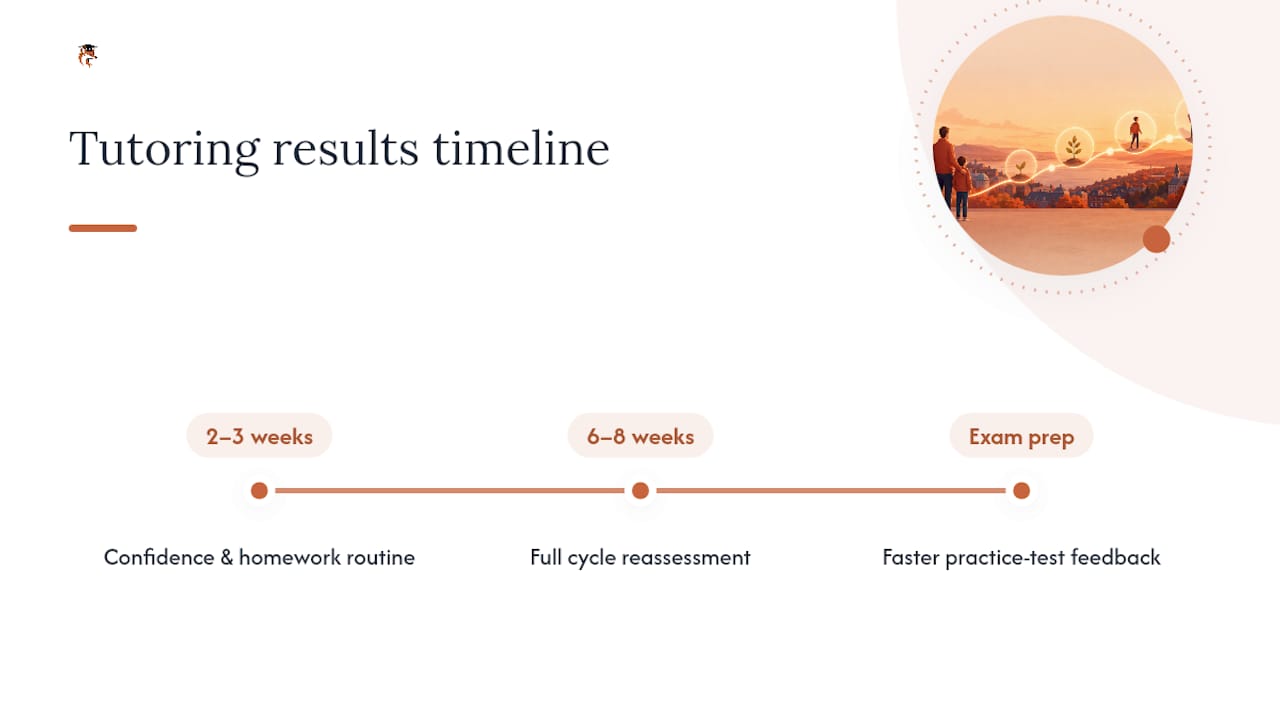
Exam preparation compresses this timeline out of necessity. A student preparing for a secondary school entrance exam a few months out will see progress measured in practice test scores rather than report card grades, and that feedback loop can move faster since practice exams happen more frequently than school assessments.

The honest answer: give any tutoring arrangement at least six weeks and one formal reassessment before deciding whether it is working. If nothing has moved, even slightly, by that point, the plan needs adjusting, not necessarily abandoning entirely.
How do you know if a tutor is actually working, and what are the red flags?
Effectiveness shows up in specifics, not vibes. A tutor doing their job well can point to concrete evidence: a practice test score that improved, a concept your child could not explain last month that they can now explain clearly, homework getting finished with less parental intervention.
Ask yourself these questions after four to six sessions:
- Can my child explain, in their own words, something they learned recently?
- Has the tutor shared any written notes, plans, or progress markers, or only verbal reassurance?
- Is my child’s attitude toward the subject improving, even slightly, or has it stayed flat or worsened?
- Does the tutor adjust their approach when something clearly is not working, or repeat the same method regardless of results?
Red flags worth taking seriously include a tutor who cannot answer basic questions about your child’s specific weaknesses after several sessions, resistance to any form of progress reporting, sessions that consistently run short or get rescheduled without a clear reason, and a teaching style that never adapts even when your child is visibly struggling with it.
If two or more of these show up consistently, it is reasonable to switch providers rather than hoping things improve on their own. A brief mismatch in the first session is normal and not a red flag by itself. A pattern across four to six sessions is different, and it is the kind of pattern a good provider will actually welcome you naming, since it means adjustments happen sooner rather than after a semester is already lost.
Réussite A+ perspective: why structure beats intensity
More sessions do not fix a mismatched plan. The decision checklist above (curriculum match, measurable goals, real reporting) is recommended as best practice for tutoring structured around clear goals and progress tracking.
Ready to start? Here’s how Réussite A+ programs work
Réussite A+ builds each plan around one student, not a generic curriculum template, which matters most when your child needs a specific fix rather than a broad refresher. Session régulière covers ongoing weekly support in math and French. Exam preparation targets secondary entrance exams and finals with a compressed, focused timeline. Session d’été catches students up or keeps skills sharp over the summer, and French-specific programs address language gaps directly.

Every tutor is selected at the university level for subject mastery and teaching ability, and every plan starts with a short assessment so you know exactly what you are paying for before committing to a full package. Regular sessions, exam prep, and homework help all run between $30 and $35 per hour, with a one-time $65 registration fee covering your child’s file setup and initial plan. If the first session is not the right fit, Réussite A+ refunds it, no hard feelings. Book an assessment through the main Réussite A+ page to get matched with a tutor and see a sample learning plan before your child’s first full session.
Sources
- Programme de tutorat | Gouvernement du Québec
- LEARN Tutoring – Students
- Homework help and tutoring | 211 Grand Montréal
FAQ
How much do private tutors charge in Canada?
Private tutoring rates in Canada typically fall between $40 and $60 per hour, with certified teachers and in-person sessions often at the higher end. Réussite A+ prices its regular sessions and exam prep between $30 and $35 per hour, plus a one-time $65 registration fee.
What type of service is tutoring?
Tutoring is a personalized academic support service, distinct from general homework help, that focuses on identifying and closing specific learning gaps over time. It typically follows a structured cycle of assessment, planning, practice, and review rather than one-off help sessions.
What are the different types of tutoring?
Tutoring formats include one-on-one sessions, small-group sessions with a handful of students, and subject-specific or exam-prep blocks, delivered either in person or online. Coverage usually spans core subjects like math, science, English, and French across elementary and secondary grade levels.
How is the hourly rate for a tutor determined?
Hourly rates depend on subject difficulty, grade level, tutor credentials, and whether sessions happen in person or online, with certified teachers generally commanding higher rates than university-level tutors. Most Canadian families can expect rates in the $40 to $60 range, though some providers like Réussite A+ price lower at $30 to $35 per hour.