



Every added hour of daily screen time in early childhood links to roughly 9 to 10% lower odds of hitting a higher achievement level on standardized reading and math tests. That figure comes from an Ontario cohort study, and it’s the clearest signal we have. The fix isn’t panic. It’s protecting sleep, prioritizing offline learning time, and building a family media plan you can actually stick to.
TL;DR:
- Consuming an additional hour of screen time daily can decrease a child’s odds of reaching higher academic achievement levels by about 9 to 10 percent, based on longitudinal data.
- Screen use during the hour before bedtime significantly disrupts sleep, impairing memory consolidation and attention, which are critical for learning.
- Heavy recreational screen time, especially beyond two hours daily, correlates with weaker literacy, math skills, and attention spans, particularly in young children.
- Risks vary by device and content, with passive TV watching being most harmful, while interactive educational apps can support learning when used purposefully.
- Family routines, socioeconomic factors, and cultural attitudes influence screen time patterns, and effective management requires adaptable strategies aligned with age-specific guidelines.
Table of Contents
- What the research says about screen time and learning
- How screen time can affect learning: sleep, displacement, and focus
- Age-based screen time limits for kids that actually hold up
- Practical strategies for balancing screen time and study
- Warning signs that screen habits are hurting learning or wellbeing
- Different screens, different risks to learning
- Beyond grades: screen time and cognitive development
- Why screen time patterns differ across families
- Where the conventional wisdom on screen time gets it wrong
- Getting learning back on track when screens have taken a toll
- Sources
- FAQ
What the research says about screen time and learning
The strongest evidence linking screen time and learning comes from a prospective cohort study following children through the TARGet Kids! research network, later published in a peer-reviewed academic journal. Researchers tracked total daily screen time in early childhood and matched it against Grade 3 and Grade 6 standardized reading and math results. Each additional hour of screen time corresponded to about 9 to 10% lower odds of a child reaching a higher achievement band. That’s not a one-off finding buried in a single dataset. It lines up with a broader pattern documented across systematic reviews of child development and screen exposure, which consistently find that heavier recreational use, often defined as two hours or more per day, tracks with weaker cognitive and academic scores.
The pattern shows up most clearly in two places: younger children, whose brains are still building foundational attention and language skills, and specific academic domains like reading fluency and early math. That’s worth knowing because it tells you where to focus limits first, rather than treating every screen minute as equally risky at every age.
None of this proves screens directly cause lower grades, and any honest summary has to say so. A few limitations show up across nearly every study in this space:
- Most rely on parent-reported screen time, which tends to be imprecise and sometimes underestimates actual use.
- Confounding is a real problem. Families with less time for reading or structured activities may also have less capacity to limit screens, so both patterns could stem from the same root cause.
- Reverse causality is plausible too. Kids who already struggle academically may retreat to screens as an easier, lower-pressure activity, rather than screens causing the struggle.
The core statistic worth remembering: in the Ontario cohort, one extra hour of daily screen time was tied to a 9 to 10% drop in the odds of higher academic achievement on Grade 3 and Grade 6 assessments. That’s a strong enough association, replicated across enough independent reviews, to justify acting on it now rather than waiting for perfect causal proof.
How screen time can affect learning: sleep, displacement, and focus
Screens don’t damage learning through some mysterious digital effect. They work through a handful of very ordinary mechanisms, and once you see them, the fixes become obvious.
Sleep disruption is the most consistent one. Blue light exposure and stimulating content before bed delay sleep onset and reduce sleep quality, and sleep is when the brain consolidates what it learned that day. A child who loses 30 to 45 minutes of sleep to a tablet isn’t just tired the next morning; they’re storing less of yesterday’s lesson and paying less attention to today’s.
Displacement is simpler to picture. Every hour spent on a screen is an hour not spent reading, building something, having an unstructured conversation, or doing homework with a parent nearby to catch mistakes early. Time is finite, so screen time and learning time are often in direct competition for the same slot in a child’s afternoon.
Media multitasking is the one parents most underestimate. Doing homework with a phone buzzing nearby, or a show playing in the background, measurably reduces the quality of that homework and slows reading comprehension, even when the child insists they’re “still paying attention.” The brain doesn’t actually multitask, it switches rapidly, and each switch costs focus.
Not all screen use carries the same risk. Interactive, high-quality educational content, especially when a parent or teacher co-views and asks questions, can genuinely support literacy and problem solving. Passive consumption, scrolling short videos or watching without engagement, offers little of that benefit.
Pro Tip: Before you cut screen time, ask what it’s replacing. A show watched together with discussion afterward is a different activity than the same show watched alone at 9 p.m. instead of sleeping.
Age-based screen time limits for kids that actually hold up
Guidance from the Canadian Paediatric Society gives parents and educators a workable, age-staged framework rather than a single number to apply to every child.
- Under 2 years old. Avoid screen time entirely, with the exception of video-chatting with a grandparent or caregiver. Brain development at this stage depends heavily on face-to-face interaction that screens can’t replicate.
- Ages 2 to 5. Keep routine screen use under one hour a day. When screens are on, co-view with your child and choose high-quality, age-appropriate content over passive background viewing. Early habits tend to stick, so what gets normalized now often carries into the school years.
- School-aged children. Shift the focus from total minutes to content quality and timing. Keep the hour before bed screen-free, and treat homework as single-task time, no phone, no background show.
- Adolescents. Some screen use at this age supports social connection and skill-building, so blanket bans tend to backfire. The priority is protecting sleep, watching for heavy recreational use that crowds out study time, and coaching teens away from multitasking between social media and coursework.
The thread running through all four stages is the same: content quality and timing matter as much as the raw hour count, and sleep protection is non-negotiable at every age. A family guide to sleep and screens for teens can help translate this into an evening routine that doesn’t turn into a nightly argument.
Practical strategies for balancing screen time and study
The Canadian Paediatric Society frames healthy screen management around four actions, often called the 4 Ms: Minimise, Mitigate, Be mindful, and Model. It’s a useful structure because it treats screen management as active stewardship, not just a list of bans.
- Minimise unstructured recreational screen time, especially on school nights.
- Mitigate risk by choosing quality content and avoiding screens during meals and the hour before bed.
- Be mindful of what the screen is replacing: sleep, reading, physical play, or homework.
- Model the behaviour you want. Kids notice when a parent asks them to put a phone away while checking their own.
Turn that framework into house rules that are specific enough to follow: device-free meals, a one-hour pre-bed buffer, and a labelled homework block where phones go in another room. Keep a short list of pre-approved educational content so “screen time” doesn’t default to whatever autoplay serves up next. A structured homework routine built around single-tasking removes the daily negotiation over when devices come out.
Schools can apply the same logic at a classroom level: restrict social apps during instructional blocks, structure any device use around a specific learning task rather than open browsing, and directly coach students on why single-tasking outperforms multitasking. Teachers who limit unnecessary phone use during class often see fewer attention problems and more on-task behaviour within weeks.
Pro Tip: Don’t cut screen time cold. Replace one 20 minute block of passive screen use per day with reading or active play, and let the reduction happen gradually over two to three weeks. Sudden withdrawal tends to trigger pushback that undoes the plan by day three.
Warning signs that screen habits are hurting learning or wellbeing
A few patterns suggest it’s time to tighten the family media plan rather than wait it out:
- Grades slipping in a subject that was previously stable
- Persistent trouble falling or staying asleep
- Avoiding offline activities the child used to enjoy
- Emotional distress or irritability after online interactions, particularly on social media
If two or more of these show up together, start with a direct conversation and a revised family media plan. Loop in the classroom teacher so home and school routines reinforce each other, and if academic gaps have already opened up, consider a focused assessment rather than a generic catch-up plan.
Different screens, different risks to learning
Not every screen carries the same weight for learning outcomes, and lumping a tablet reading app in with three hours of short-form video misses the point entirely.
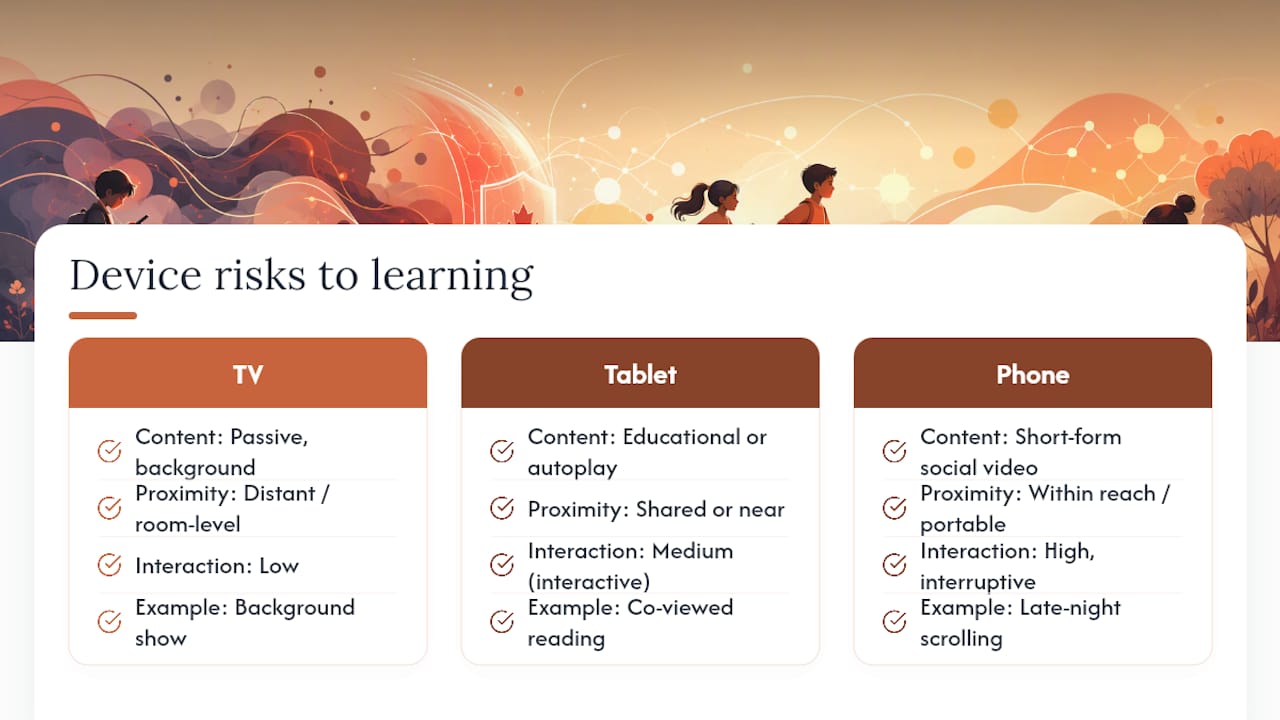
Television tends to be the most passive format, especially with background viewing where a show plays while a child does something else nearby. That kind of ambient exposure has been linked to weaker language development in young children, largely because it interrupts parent-child talk rather than replacing it directly.
Tablets and educational apps sit in the middle. Used with intention, interactive apps that require a response, an answer, a drag-and-drop solution, can reinforce specific skills like letter recognition or basic arithmetic. Used as a babysitting tool with autoplay video, they function more like television.
Smartphones carry the highest risk profile for school-aged kids and teens, mainly because of proximity and notifications. A phone within reach during homework invites the media multitasking that measurably degrades focus, and its portability makes it the hardest device to confine to a single room or time block.
The practical takeaway isn’t “avoid tablets” or “ban phones.” It’s matching the device and the content to the task. A tablet running a co-viewed reading app before dinner is a different exposure than a smartphone scrolling social video at 10 p.m., even if the daily total looks identical on paper. When you evaluate your child’s screen time and learning routine, break it down by device and purpose rather than a single combined number.
Beyond grades: screen time and cognitive development
Academic scores are the easiest thing to measure, but they’re not the whole story. Screen time and cognitive development research also looks at executive function, the mental skills behind planning, impulse control, and working memory, and the picture there is just as relevant to classroom performance.
Heavy recreational screen use, particularly content with rapid scene changes and constant novelty, has been associated with shorter attention spans and weaker impulse control in observational studies. That matters for learning because executive function underlies a child’s ability to sit through a lesson, resist the urge to check a device mid-task, and hold instructions in mind while working through a math problem. Weaker executive function doesn’t always show up as a grade drop right away. It often shows up first as a teacher noting a child “gets distracted easily” or “struggles to finish tasks independently.”
Memory is affected too, largely through the sleep pathway already covered: less consolidated sleep means less durable memory formation, regardless of how good the underlying lesson was. High screen time has also been linked to broader markers of wellbeing, including psychological distress and lower school connectedness in Canadian youth samples, independent of physical activity levels. A child who feels disconnected from school is less likely to engage with learning even when the academic support is there.
None of this means every hour of screen time chips away at cognitive skills. It means the type, timing, and total volume all interact, and a single grade average can hide problems that show up first in attention and self-regulation.
Why screen time patterns differ across families
Screen time and learning outcomes don’t play out identically in every household, and pretending otherwise ignores a real driver of the variation researchers see.
Access matters first. Families with more disposable income often have more devices per child, but they may also have more capacity to pay for structured after-school activities, tutoring, or supervised programming that limits unstructured screen time by default. Lower-income families may rely more on a single shared device or on screens as affordable childcare during work hours, which can push total daily use higher even when parents are actively trying to manage it.
Parental work schedules play a role too. A household where both parents work irregular or long hours has fewer windows for co-viewing or enforcing a consistent pre-bed buffer, not from lack of concern but from lack of time. Cultural attitudes toward screens vary as well. Some communities treat educational apps as a legitimate substitute for structured tutoring, while others treat any screen exposure with more caution, and both stances shape what “normal” screen time looks like in a given home.
None of this changes the underlying evidence. It does mean that blanket advice like “just limit it to two hours” lands very differently depending on a family’s schedule, resources, and existing routines. The CPS framework works partly because Minimise, Mitigate, Be mindful, and Model can be scaled to fit different circumstances rather than demanding an identical rulebook for every household.
Where the conventional wisdom on screen time gets it wrong
Most advice on screen time and learning still fixates on a single number, two hours a day, as if every screen minute were interchangeable. The evidence doesn’t support that framing. An hour of co-viewed educational content and an hour of solo scrolling produce different outcomes, and treating them the same wastes a parent’s limited enforcement energy on the wrong battles.
The bigger miss is sleep. Parents will negotiate hard over daytime screen limits and barely touch the pre-bed hour, even though the sleep pathway shows up again and again as the mechanism doing the real damage to memory and next-day attention. If we had to pick one lever to pull first, it’s the hour before bed, not the total daily count.
We’d also push back on treating this as purely a willpower problem. Media multitasking during homework isn’t a discipline failure; it’s a design failure in how homework time is structured. Put the phone in another room before the negotiation starts, and you remove the temptation instead of relying on a tired kid’s self-control at 7 p.m.
— Réussite A+
Getting learning back on track when screens have taken a toll
If screen habits have already chipped away at reading fluency or math confidence, the fix usually isn’t a broad catch-up curriculum. It’s a short diagnostic to find the one or two specific gaps, fractions, decoding, reading comprehension, and then targeted, frequent practice to rebuild momentum.
At Réussite A+, that typically looks like an initial assessment, a personalized learning plan built around what the assessment actually finds, and short, regular tutoring sessions in French or math with a university-level tutor. Families often seek support for situations like a child who has fallen behind after a stretch of heavy recreational screen use, homework routines that have broken down, or students preparing for important exams who need a structured plan rather than more screen-based drilling.
If your child’s grades have started slipping or homework has turned into a nightly standoff, the next step is a tutoring and homework help session to see exactly where the gaps are and build a plan around them.
This article is general information, not a substitute for advice from a qualified doctor. Consult a qualified healthcare professional about your own circumstances before acting on anything here.
FAQ
What is the 3-6-9-12 rule for screen time?
It’s a popular parenting guideline suggesting no screens before age 3, no personal devices before age 6, no unsupervised internet before age 9, and no social media before age 9. It’s not an official Canadian Paediatric Society standard, but it aligns broadly with CPS guidance to delay and gradually introduce screen access with adult supervision.
Is it ADHD or just too much screen time?
The two can look similar because heavy screen use is linked to shorter attention spans and weaker impulse control, but only a qualified clinician can distinguish a developmental attention disorder from screen-related habits. If attention problems persist after reducing screen time and protecting sleep for several weeks, that’s a reason to seek a professional assessment.
What are five positive effects of screen time?
Well-chosen screen use can support literacy through interactive reading apps, reinforce math skills through guided practice software, maintain social connection for teens, offer safe video-chat contact with distant family, and give access to instructional content unavailable locally, particularly when an adult co-views and engages with the material.
What do 10 hours of screen time do to a child’s brain?
That level of daily use far exceeds any age-based guideline and is associated in observational research with disrupted sleep, reduced attention span, and lower academic performance, largely through displacing sleep, reading, and homework time. No single study proves a fixed “brain effect” at exactly 10 hours, but the direction of the evidence is consistently negative at that volume.
Does screen time really affect grades, or is it mostly correlation?
The Ontario cohort data shows a clear association, roughly 9 to 10% lower odds of higher achievement per added hour, but researchers acknowledge confounding and reverse causality as real limitations. The safest conclusion is that reducing recreational screen time and protecting sleep is a reasonable, low-risk step regardless of how the causal question eventually resolves.