



Quebec French and the French spoken in France are the same language. Both share the same grammar and the same standard written form. The differences are in the accent, in everyday vocabulary and in the informal spoken register. If your child is learning French in a Quebec school, nothing here should worry you. With a few clear examples, you can see which differences matter at the kitchen table and which ones only matter on a trip to Paris.
This guide is written for Quebec parents, including those who did not grow up speaking French. It explains where the differences come from, gives concrete examples, and shows how to help your child switch between everyday speech and the French that school work calls for.
TL;DR
- Quebec French and France French are mutually understandable. Government language experts describe claims of “incomprehensibility” as exaggerated.
- The biggest gaps are accent, informal spoken expressions and a set of everyday words (for example déjeuner, fin de semaine, magasiner).
- Written, standard French is largely shared, so your child is not learning a “lesser” French in Quebec.
- The real skill is register: knowing when to use casual speech and when to use careful, standard French in homework and exams.
- A short, regular routine of reading and speaking out loud does more than memorizing lists of differences.
Table of Contents
- One language, two histories
- How different are they, really?
- Accent and pronunciation
- Everyday vocabulary: words that change meaning
- Informal speech: contractions and little particles
- Tu or vous? A matter of social habit
- Register: the real skill behind the comparison
- What this means for your child’s schoolwork
- French in Montreal, Laval and Longueuil
- Our perspective
- Help for your child with French
- A quick reference for parents
- FAQ
- Sources
One language, two histories
The split is a story of distance. In 1763, France lost its territory of Canada to England, and the Treaty of Paris put an end to French rule. After that, contact between Quebec and mainland France was limited for a long time. French in Quebec kept developing on its own, in contact with English and with the realities of a North American climate and way of life.
Two things followed. Quebec French kept some pronunciations and words that go back to 17th-century French, and it created new words of its own. Tuque, the word for a winter hat, is a classic example of an older word that stayed in use. Meanwhile, French in France also kept changing, so the two varieties drifted apart in different directions.
That is why you cannot say that one of them is the “real” French. Both are living varieties of the same language.
How different are they, really?
The Government of Canada’s language portal addresses this question directly. In its blog, it notes that some people in France may claim the differences are so numerous that Canadian French is incomprehensible to them. The experts’ answer is that accents and informal expressions do differ, but the underlying grammar and standard vocabulary are largely the same, so people understand each other.
A useful way to picture it:
| Area | How big is the gap? | What it looks like |
|---|---|---|
| Standard grammar and spelling | Small | Same rules, same verb tables, same written French |
| Formal vocabulary (news, school, work) | Small | Mostly shared, with some local terms |
| Everyday vocabulary | Medium | Different words for common things and actions |
| Informal spoken grammar | Medium to large | Contractions and particles specific to Quebec speech |
| Accent and pronunciation | Large | The first thing a visitor notices |
The gap grows as you move from the page to the playground. That matters for parents, because homework lives mostly on the “small gap” side of the table.
Accent and pronunciation
Accent is the difference people notice within seconds. Quebec French retains some pronunciations that have disappeared in France, and the rhythm and vowel sounds are distinct. A child who hears Quebec French all day will naturally speak with a Quebec accent, and that is entirely fine.
There is nothing to fix here. An accent is not a mistake. Where pronunciation does matter is when your child needs to spell. Some words sound different from how they are written, and dictation can reveal this. If your child hesitates on spelling, saying the word slowly, syllable by syllable, helps connect sound and writing. Our guide to oral French practice offers short drills that build this link with no pressure.
Everyday vocabulary: words that change meaning
This is where most of the surprises happen. Some words are the same in form but not in meaning, and some things simply have different names.
The meal names
In Quebec, the first meal of the day is le déjeuner. In France, déjeuner means lunch, and breakfast is le petit-déjeuner. Quebec usage is so established that Health Canada’s own nutrition video uses déjeuner for the morning meal. In Quebec, the meals then go déjeuner, dîner, souper, where in France they go petit-déjeuner, déjeuner, dîner.
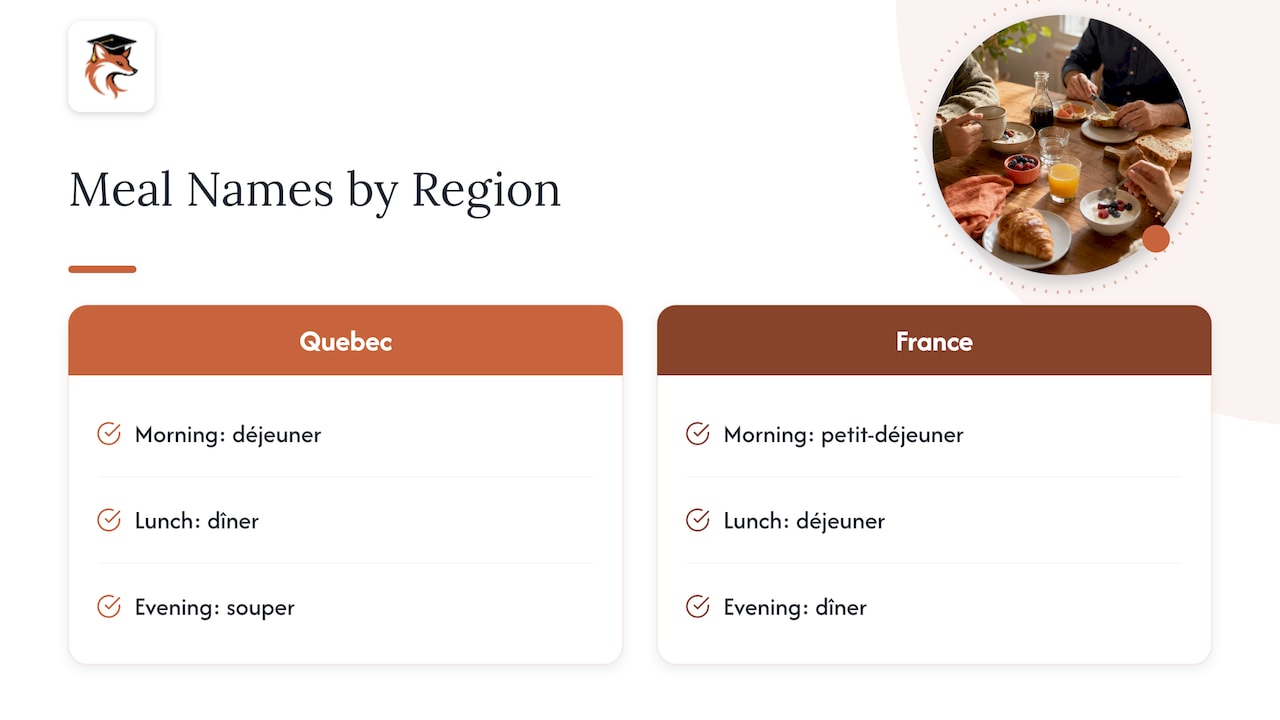
This one is worth knowing if your child reads a French textbook, a story from France or an exercise written by a European author. A character who “déjeune” at noon is not skipping breakfast.
Words with Quebec-specific forms
The language portal’s writing aids define a québécisme as a word or expression specific to Quebec French, with magasiner as an example. A canadianisme is the broader category of words specific to French in Canada, with examples such as motoneige and débarbouillette.
Here are some pairs you are likely to meet:
| In Quebec | In France | Meaning |
|---|---|---|
| déjeuner | petit-déjeuner | breakfast |
| fin de semaine | week-end | weekend |
| magasiner | faire du shopping | to shop |
| tuque | bonnet | winter hat |
| bienvenue (in reply to thanks) | de rien | you’re welcome |
The first four rows come from the government language portal’s account of a move from France to Quebec and from its comparison of the two varieties. They show a pattern: Quebec tends to prefer an established French word where France has taken on an English one.
The anglicism paradox
You may hear that Quebec French is full of English. In reality, the picture is more nuanced. Quebec French is known for resisting some anglicisms, using fin de semaine where France uses week-end, and magasiner where France says faire du shopping. But some daily expressions are literal translations from English. Bienvenue as an answer to “thank you” is the best-known case, and a speaker from France would say de rien.
So each variety borrows from English, just in different places. Neither is more “pure”.
Informal speech: contractions and little particles
The widest gap is in casual spoken French, and it is the part that is least likely to show up in a school text. Two examples from the language portal:
- Contractions. In fast speech, je suis can become chus.
- The question particle -tu. A Quebecer might ask Ça va-tu? where a speaker from France would not use this particle at all.
These forms are natural between friends and family. They are not wrong in context, but they do not belong in a written paragraph, a dictation or an exam answer. This is where a child needs help: not in learning “another French”, but in knowing which French fits the moment.
Tu or vous? A matter of social habit
A difference that surprises newcomers from Europe is how widely tu is used in Quebec, even with teachers. Educators at Université Laval’s international student pages note that informality is part of Quebec society and that vous is kept up more strictly in Europe. Their advice is to be respectful and adapt to the person in front of you.
For a parent, the practical lesson is simple. If your child says tu to a teacher in Quebec, that is often normal. In a formal letter or an email to someone your child does not know, vous is the safer choice.
Register: the real skill behind the comparison
The most useful idea in this whole topic is register. Quebec speakers move between a standard, international French used in formal settings such as news and professional life, and a popular or family French. Université Laval describes this as a coexistence of norms and a choice of register, not a failure to speak correct French.
Sociolinguist Lionel Meney describes Quebec as a place where two norms, standard international French and Quebec-specific French, compete and coexist. He treats the preference for one over the other as often ideological rather than strictly linguistic. You do not need to take a side in that debate to help your child. You only need to help them see that:
- Casual French is for friends, family and the playground.
- Standard French is for written work, presentations, exams and formal messages.
- A strong student can move between the two without confusion.
What this means for your child’s schoolwork
Here is the reassuring part. Written Quebec French and written French from France are very close, as the grammar and spelling are shared. That means your child’s grammar lessons, verb conjugations and reading comprehension are all built on the same foundation as French anywhere else.
Where differences can trip a child up:
- Dictation and spelling. Sounds and written forms may not match, especially for words heard in casual speech.
- Texts from France. A reading passage may use petit-déjeuner or week-end, which may feel unfamiliar.
- Writing as you speak. Phrases like chus or a -tu question have no place in a formal paragraph.
- Mixing registers. A good idea written in a very casual tone can lose marks for style.
A five-minute check you can do at home
- Ask your child to read a short paragraph aloud, in a clear voice.
- Choose two words they said in a casual way and ask how they are written.
- Have them rewrite one spoken sentence in a more formal way.
- Celebrate what they got right before correcting anything.
- Repeat two or three times a week.
This is a game, not a test. Children who see it as a game are less stressed, and they remember more. For more ideas, see our French reading guide for Québec students and our French speaking practice ideas.
French in Montreal, Laval and Longueuil
If you live in the Montreal area, your child grows up surrounded by both languages. According to the 2021 Census, over one million people in the Montreal census metropolitan area have French as their first official language. About 33.8% of the population speaks only French, and 56.4% are bilingual in English and French. Across the province, a bit more than 80% of Quebecers have French as their mother tongue.
For a child in an English-speaking or multilingual home, this means that school French can feel different from the French heard in shops, on the bus and from friends. That is normal. It simply shows why a clear distinction between formal and casual French helps so much.
Our perspective
After more than 25 years in education, we have seen the same worry come up again and again: “Is my child learning the right French?” Our answer is always yes. The French taught in Quebec schools is real, standard French, and it opens every door. What children need is not a different French, but confidence and a clear method.

We do not ask students to drop their Quebec expressions or their accent. We ask them to know their options. With each student, we build a personalised learning plan around strengths, challenges, pace and goals. In French, that often means practising the move from spoken idea to well-written sentence, step by step, with trap words (mots-pièges), action verbs and short, regular exercises. Our tutors, selected from university level, track progress along the way so that parents can see where things stand.
If your child is hesitating, the issue is almost never “Quebec French” itself. It is usually a gap in foundations that can be closed with simple, structured practice.
— Réussite A+
Help for your child with French
If you would like a tutor to guide your child, our French tutoring programs are designed for elementary and secondary students across Quebec. Sessions are online, so scheduling is flexible, and each plan starts from your child’s needs. Rates are 30-35 $ per hour, with a one-off registration fee of 65 $, and all details are on our pricing page. If we are not the right fit, you can ask for a refund for the first session.
Preparing for a secondary school entrance exam? See our exam preparation sessions or our guide to passing your French entrance exam in Quebec. If you do not speak French at home, our guide for non-French-speaking parents shows how to support homework without being fluent.
A quick reference for parents
Keep in mind
- Accent is not an error. Spelling and register are what school evaluates.
- Déjeuner means breakfast in Quebec, lunch in France.
- Texts from France may use words your child does not hear at home. Explain them calmly.
- Informal forms like chus or -tu questions stay in speech, not in written work.
- Tu is common in Quebec classrooms, but formal writing calls for vous.
Do this week
- Read aloud together for ten minutes.
- Pick three words from the text and look at how they are spelled.
- Ask your child to explain one word in their own words.
FAQ
Can a Quebec speaker and a French speaker understand each other?
Yes. The Government of Canada’s language experts say that claims of incomprehensibility are exaggerated. Accents and informal expressions differ, but the standard grammar and vocabulary are largely shared. A few words may need an explanation, like déjeuner or bienvenue.
Is Quebec French “incorrect” French?
No. Quebec French is a variety of French with its own history, and speakers move between a standard register and a more familiar one. Université Laval presents this as a choice of register, not a failure to speak correct French. For school work, the standard written norm applies.
Will my child be disadvantaged in school if they speak with a Quebec accent?
An accent is not a mistake, so it is not a disadvantage in itself. What helps is careful spelling, a good grasp of grammar and the ability to write in a formal register. Those skills can all be built with regular practice.
Should my child learn France French instead?
For a child in a Quebec school, the better focus is solid standard French, which is shared by both varieties. Your child will hear Quebec expressions in daily life and can learn the European equivalents over time as they read and travel. There is no need to choose one.
Sources
- Le français du Canada et le français de France, Portail linguistique du Canada
- De la France au Québec : mon intégration linguistique, Portail linguistique du Canada
- Difficultés et particularités du français, Clés de la rédaction
- Le français, Vie et culture au Québec, Université Laval
- Le français québécois entre réalité et idéologie, Université Laval
- Déjeuners sains avec l’assiette du guide alimentaire canadien, Santé Canada
- Census 2021, Montreal census metropolitan area, Statistics Canada
- Fonctions des gouverneurs coloniaux britanniques, Parcs Canada