



Good academic goals for a student are specific, measurable, tied to actions the child controls, realistic for the current term and given a deadline. “Do better in math” is a wish. “Raise my fractions quiz mark from 60% to 75% by the end of November by doing 15 minutes of practice, four days a week” is a goal. This guide shows you how to build the second kind with your child, with examples for elementary and secondary school and a routine you can start this week.
If your child feels behind, or the report card has you worried, take a breath. Goals are a calm, structured way to turn that worry into a plan. Small steps, checked regularly, do most of the work.
TL;DR
- A useful academic goal names a result, an action and a date. Vague words like “better” or “understand” do not count.
- Use the SMART framework (Specific, Measurable, Action-oriented or Achievable, Realistic, Time-bound), then cut every goal into weekly steps.
- Write goals down and keep them where your child sees them. Review them every week or two.
- If a goal keeps being missed, the goal needs adjusting, not the child.
- A tutor can help set the starting point, break goals into steps and track progress, especially in French and math.
Table of Contents
- What academic goals are, and why they help
- Three kinds of goals to separate
- The SMART method, step by step
- Examples of academic goals by age
- Start from where your child is
- A simple weekly routine
- Make goals feel like a game, not a sentence
- What to do when your child misses a goal
- Goals for exam seasons
- Our perspective: goals work best when they are personal
- When a tutor helps with goal setting
- A one-page goal plan you can copy
- Common mistakes to avoid
- FAQ
- Sources
What academic goals are, and why they help
An academic goal is a statement of an educational outcome you want: a change in knowledge, a skill or a habit. According to Canada.ca guidance on writing SMART objectives, the clearest goals describe a specific action or result, can be measured, and come with a deadline.
Why bother with them? The University of Toronto Scarborough’s advising centre lists what goals do for students: they give direction, increase attention and focus, raise motivation and effort, and reduce anxiety while building confidence. That last point matters for children. A student who knows exactly what this week’s target is feels less overwhelmed than one facing “the whole math program”.
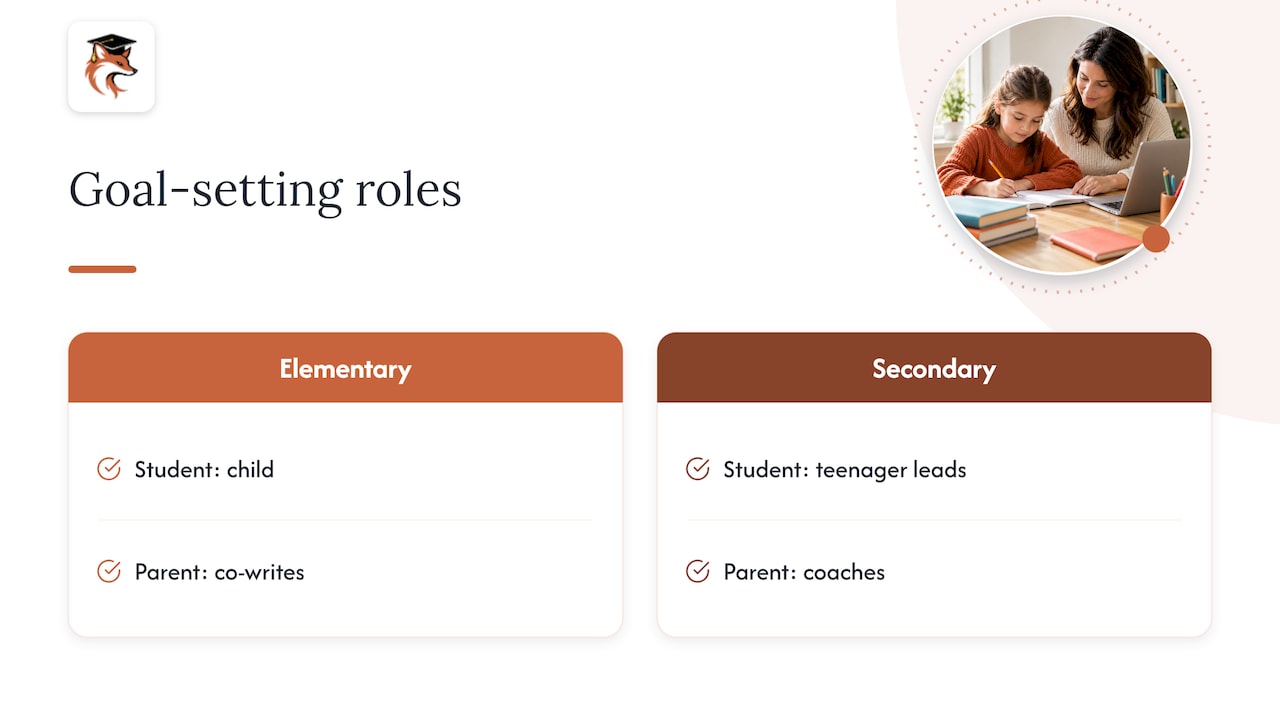
These sources are written for university students, but the logic carries down to younger learners. The difference is who holds the pen. In elementary school, you and your child write the goal together. In secondary school, your teenager should lead and you act as the coach.
Three kinds of goals to separate
Most families mix these up, which is why goals feel fuzzy. Keep them apart.
- Outcome goals: a result, such as a mark or a passed exam. “Reach 80% in the French dictation by December.”
- Skill goals: something your child can do that they could not before. “Identify the subject and the verb in every sentence of a short text.”
- Habit goals: a behaviour repeated on a schedule. “Read for 15 minutes after supper, five days a week.”
Habit goals are the easiest to control, so start there. The University of Toronto’s advisors suggest focusing on behaviour and not only on outcomes, and enjoying the process of working toward a goal. A child cannot decide to get 85% on a test, but they can decide to do ten practice problems a day.
The SMART method, step by step
The University of Toronto’s SMART worksheet is a good model. Here is how to apply it at the kitchen table.
1. Specific
Replace vague words with something you could see or count. The Canada.ca guidance notes that terms like “good”, “well” or “understand” should give way to precise, observable outcomes. “Be good at French” becomes “write a paragraph of six sentences with correct verb agreement”.
2. Measurable
Decide in advance what counts as proof: a mark on a quiz, the number of correct answers out of ten, the time it takes to finish a worksheet. If you cannot measure it, you cannot celebrate it.
3. Achievable and action-oriented
Ask what your child will actually do. The Toronto worksheet reminds students that being ambitious is fine, but part of goal setting is learning what is realistic in their current situation. A child who finishes 40% of the math homework today will not complete 100% next week. Aim for 60%, then 80%.
4. Realistic
Check time, energy and resources. If your child has hockey on Tuesday and Thursday, do not plan 45 minutes of study on those evenings. Plan 15, or move it to another day.
5. Time-bound
Give each goal an end date and a check-in date. A goal without a date drifts. A good rhythm is a long goal for the term, a medium goal for the month and a small step for the week.
Examples of academic goals by age
Use these as starting points and change the numbers to fit your child’s real situation.
| Level | Weak version | SMART version |
|---|---|---|
| Grade 2-3, reading | Read more | Read aloud for 10 minutes each evening, Monday to Friday, and retell the story in two sentences, for the next four weeks |
| Grade 4-5, math | Learn the multiplication tables | Answer 20 multiplication facts in under three minutes with at most two mistakes by mid-November |
| Grade 6, entrance exam prep | Prepare for the exam | Complete one timed practice text in French and one set of math problems every Saturday morning until the exam date, then review every mistake |
| Secondary 1-2, French | Improve spelling | Reduce past participle agreement errors in weekly 10-line texts from six to three by the end of the term |
| Secondary 3-4, math | Pass algebra | Raise the average on weekly equation quizzes from 60% to 75% by the next report card, with three 20-minute practice sessions a week |
| Any level, homework | Be more organized | Write every assignment in the agenda before leaving class and pack the bag the night before, five days a week |
For younger children, our guide to SMART micro-objectives for primary school breaks goals into steps small enough for a seven-year-old to finish in one sitting.
Start from where your child is
A goal is only realistic if you know the starting point. Before you pick a target, gather three things:
- the last two report cards or term results, and any teacher comments
- two or three recent graded tests or dictations, to see which types of mistakes repeat
- your child’s own view: what feels easy, what feels hard, what feels boring
Sort the mistakes into groups. In French, they may be agreement, verb endings or reading comprehension. In math, they may be fractions, word problems or careless errors. One or two groups will account for most of the lost marks. Those are your first goals.
If your child is struggling more broadly, our strategies to help struggling students succeed can help you decide where to begin without piling on pressure.
A simple weekly routine
Goals fail when nobody looks at them. Try this 15-minute routine, once a week, on a day that is not a school night crunch.
- Look back (3 minutes). What did we plan? What did we actually do? No blame, just facts.
- Count (3 minutes). Check the measure: the quiz mark, the number of days of practice, the number of errors.
- Celebrate one thing (2 minutes). Name a real improvement, however small.
- Fix one thing (4 minutes). Choose a single obstacle and a single change. “Practice was skipped on Wednesday, so we will do it before supper.”
- Set next week’s step (3 minutes). Write it down.
The University of Toronto’s advisors recommend writing goals down and posting them somewhere visible, because abstract goals kept in the head tend to drift when a student feels discouraged. A sheet on the fridge or above the desk works well. A simple tracker also helps, and our academic progress tracker guide shows how to set one up.
Make goals feel like a game, not a sentence
Children resist goals when they sound like punishment. A few ways to keep the tone light:
- Let your child choose between two options for the goal. Ownership matters more than perfection.
- Use a visual: colour in a square for each day of practice, or move a marker along a line toward the date.
- Treat tricky content as a puzzle. In French, we call confusing words “mots-pièges” (trap words), and spotting them becomes a game of detection.
- Celebrate effort and process, not only marks. A family movie night after four weeks of steady practice beats a gift for a single good grade.
When the issue is attention on homework, try the three simple steps in our homework focus guide before adding more study time.
What to do when your child misses a goal
It will happen. The Toronto advisors’ view is helpful here: missing a goal repeatedly is not a failure of character. It is a sign the goal was unrealistic and needs adjusting in scope, timeline or resources.
Run through these questions:
- Scope: Was the goal too big? Cut it in half.
- Timeline: Was the deadline too tight? Add two weeks.
- Resources: Did your child have what they needed: quiet space, the right material, time, someone to explain a concept?
- Understanding: Is the real problem a gap from an earlier year? If so, the goal belongs a step or two further back.
That last point is common in math, where each topic depends on the one before. Going back to rebuild a foundation is not a step backward. It is the fastest route forward.
Goals for exam seasons
Around Grade 6, many Quebec families prepare for private secondary school admission. According to Independent Schools Quebec, entrance steps can include an interview or a placement test, and the tests generally assess Grade 5 skills, particularly in languages and math. That gives you a clear target for goals: the skills your child needs to master are the ones in the Grade 5 program.
A workable exam plan looks like this:
- Identify the date of each test you are preparing for, using each school’s own admissions page.
- Work backward and set a monthly goal per subject, for example “finish the review of fractions by the end of November”.
- Add one timed practice a week, in exam conditions.
- Review every error and sort it: knowledge gap, misread question or rushing.
Timed practice teaches pacing as well as content. Our article on why exam simulations matter explains how to run one at home, and our high school entrance exam plan for parents and students gives a full calendar. Nerves are normal too, so keep our stress management strategies for entrance exams nearby.
Our perspective: goals work best when they are personal
After more than 25 years in education and more than 3,500 students helped, we have noticed one pattern. Goals fail less often because a child lacks motivation, and more often because the goal belongs to someone else. A target copied from a worksheet, or a mark chosen by a worried adult, rarely survives week three.
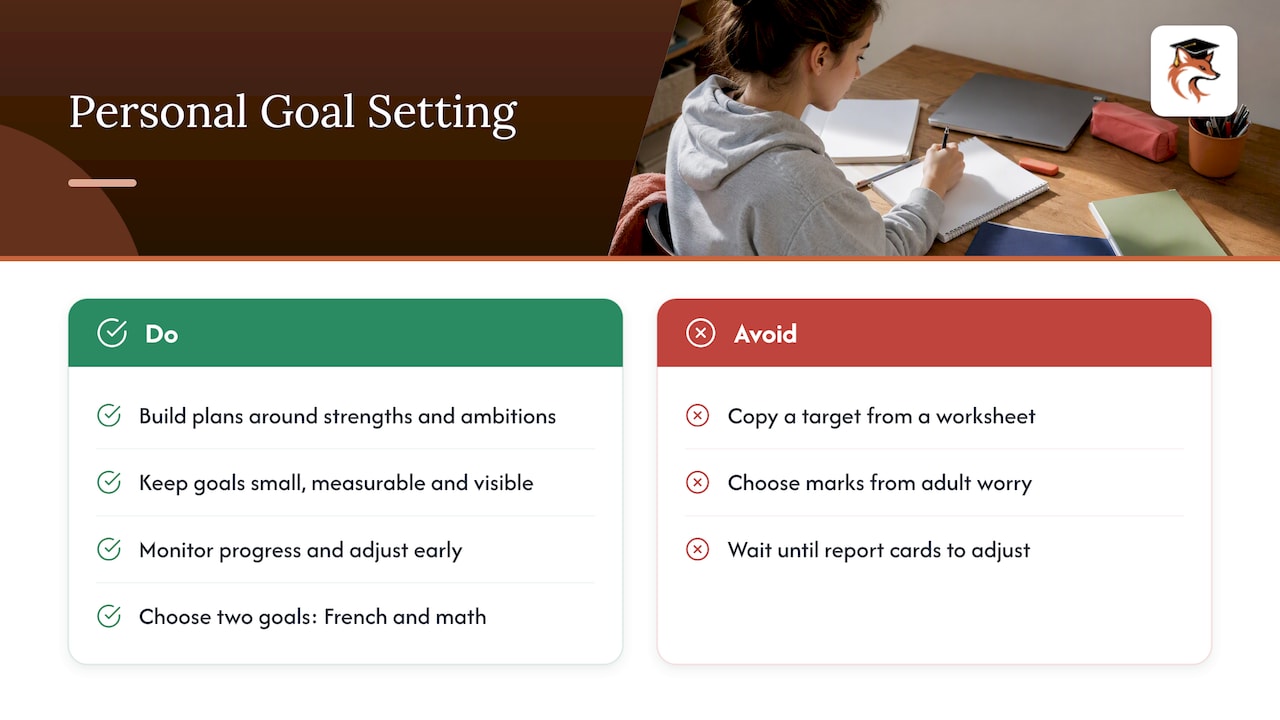
That is why every program at Réussite A+ starts with a customised learning plan built around the student’s strengths, challenges, pace and ambitions. A child catching up in fractions and a child aiming to excel beyond grade level need different goals, different steps and different check-in dates. We keep the goals small, measurable and visible, and we monitor progress continuously so we can adjust early instead of waiting for the next report card.
Our advice to parents: choose fewer goals than you think you need. Two goals, one in French and one in math, tracked well, will do more than ten goals tracked badly. And when your child hits one, say so out loud.
— Réussite A+
When a tutor helps with goal setting
You do not need a tutor to set goals. But a tutor can help when:
- you cannot tell which skills are actually behind
- goals keep getting missed and you are not sure why
- homework evenings have become a battle, and a neutral voice would help
- an exam or a school transition is approaching and time is short
- your child is ahead and needs enrichment, not just review
Our tutors are university-level students selected for academic excellence and teaching ability. Sessions are online, so you can fit them around activities, whether you live in Montreal, Laval, Longueuil, Brossard, Gatineau or elsewhere in Quebec. Each plan includes custom educational material and progress tracking, so you can see the goals move. Our guide on how online tutoring helps parents follow progress describes what that looks like in practice.
Sessions with one-on-one or group formats are $30-35 per hour, and there is a one-time registration fee of $65 (see our rates page). We offer regular sessions through the school year, exam preparation, summer sessions and French tutoring programs. If you are not satisfied after the first session, you are refunded for it. To begin, you can register for tutoring and academic support.
A one-page goal plan you can copy
Take a sheet of paper and write these lines. Fill in one per subject.
- Where we are now: (latest mark, typical mistakes)
- Goal for the term: (result, number, date)
- Goal for the month: (skill)
- This week’s step: (action, how often, how long)
- How we will measure it: (quiz, dictation, count)
- Check-in day: (day and time)
- Reward for effort: (something small, shared)
Example for a Secondary 2 student:
- Where we are now: 62% on the last two math tests, most errors in negative numbers
- Goal for the term: 75% on the December test
- Goal for the month: solve 8 out of 10 integer operations correctly, by November 20
- This week’s step: 15 minutes of practice, four evenings, with one worked example reviewed
- Measure: Friday mini-quiz of 10 questions
- Check-in: Sunday after supper
- Reward: choose the Saturday family activity
That is all it takes. Simple, written, visible.
Common mistakes to avoid
- Too many goals at once. Two or three at a time is plenty.
- Only outcome goals. Add a habit goal for every mark goal.
- Goals set by the parent alone. Ask your child for their input, even a little.
- No review date. If no one looks, nothing changes.
- Comparing with siblings or classmates. The comparison is with your child’s own last result.
- Ignoring wellbeing. Sleep, breaks and downtime are part of the plan, not a reward at the end of it.
If you want a broader view of what success can mean beyond marks, read what academic success means for your child, and for more on our goal-setting approach see strategies for setting and achieving academic goals. Older students can also look at 15 proven ways to improve grades.
FAQ
What are examples of academic goals for students?
Good examples combine a result, an action and a date: “Raise my math quiz average from 60% to 75% by the December report card by practicing three times a week”, or “Write a six-sentence paragraph in French with correct agreement by the end of the month”. Habit goals, such as reading 15 minutes every evening, are also strong examples.
How many goals should a child have at once?
Two or three. One for each priority subject, plus perhaps one habit goal such as organizing the school bag. Too many goals dilute attention and make it hard to see progress.
What are SMART goals for students?
SMART is a framework for writing clear goals. They are Specific, Measurable, Action-oriented or Achievable, Realistic and Time-bound, as described in Canada.ca guidance on SMART objectives. Each letter is a question you ask before writing the goal down.
How often should we review academic goals?
Once a week for a short check-in, and once a month for a larger review of the goal itself. If your child misses a goal two weeks in a row, adjust its size or deadline instead of pushing harder.
Can a tutor help with goal setting?
Yes. A tutor can assess the starting point, pick realistic targets, break them into weekly steps and track results. At Réussite A+, every student receives a customised learning plan with progress monitoring, so goals are set and adjusted around their strengths, pace and objectives.
Sources
- Writing SMART objectives, Canada.ca
- 8 Steps to Academic Success, University of Toronto Scarborough
- Goal Setting, University of Toronto Scarborough Academic Advising & Career Centre
- SMART Goal Worksheet, University of Toronto Student Life
- Admission Process, Independent Schools Quebec