


Start now. Pick one two-minute audio clip and shadow it (repeat right after the speaker, matching rhythm, not just words). Then set a timer for five minutes and talk out loud about your day, alone, without stopping to fix mistakes. Finally, record one sentence on your phone and listen back once. That’s the whole warm-up, and it takes under ten minutes.
Here’s the part most learners skip: the goal of oral French practice isn’t perfection in the moment. It’s repetition your mouth and ear can build on. A single ten-minute session won’t transform your accent, but a short session done daily beats one long session done weekly, every time.
Three things to do in the next ten minutes:
- Shadow a 60 to 90 second clip from a podcast, show, or YouTube video, three times through.
- Talk for five minutes, unscripted, on a topic like your weekend or a recent frustration.
- Record and replay one sentence, listening specifically for where your mouth hesitated.
The single best weekly routine is to aim for regular speaking practice most days each week and track your comfort rating for each session. That’s it. Consistency beats intensity here, and a rating you track weekly shows you drift upward even on days that feel clumsy.
Pro Tip: End every session by saying one sentence you’re proud of, out loud, twice. Your brain remembers the last rep more than the first, so finish on something that felt good, not on a stumble.
Table of Contents
- Solo oral French practice drills you can do without a partner
- How to find French conversation partners and structure sessions that work
- Pronunciation and fluency drills that fix common problems fast
- How to track your progress and know when to level up
- Curated resources for shadowing, native media, and structured practice
- Why formulaic phrases speed up oral French practice
- An educator’s take on where oral French practice actually breaks down
- Get personalized help building your oral French skills
- Your one-week oral French practice checklist
- Where to keep learning after this guide
- Sources
- FAQ
Solo oral French practice drills you can do without a partner
You don’t need a conversation partner to make real gains in spoken French, at least not at first. Solo drills train the mechanical parts of speech, your mouth muscles, retrieval speed, sentence assembly, that partner conversations depend on but rarely isolate. Think of it like a hockey player doing stickhandling drills alone before a scrimmage: the game needs both, but the solo reps build the base.
Shadowing is the highest-leverage solo drill available. Choose audio with a transcript (native-media clips work well), play a short segment at normal speed, and speak simultaneously or a half-second behind the speaker, matching their intonation and pace rather than translating in your head. Ten minutes of daily shadowing does more for your accent than an hour of grammar drills.

Timed monologues train fluency under mild pressure. Set a timer for two minutes, pick a topic (describe your commute, argue for your favourite meal, explain a rule of a game you like), and talk without stopping. Don’t restart when you make a mistake, push through it, the way you would in a real conversation. Afterward, ask yourself three questions: Did I finish the thought? Did I use any English words? Would a stranger have understood me?

Chunking breaks long sentences into repeatable phrases so your mouth learns them as single units rather than word-by-word constructions. Take a sentence like “Je ne sais pas encore ce que je vais faire ce week-end” and drill it in pieces: “je ne sais pas”, then “je ne sais pas encore”, then the full sentence. This is how native speakers actually produce fluent speech, in chunks, not word-by-word, and it’s why fluent talkers sound faster without actually speaking more quickly.
Scripted roleplay, solo-style, works better than it sounds. Write a short dialogue (ordering at a café, a job interview, a phone call to a clinic), record yourself reading both parts in different tones, then play it back and respond live to your own recorded questions. It simulates the back-and-forth timing of real conversation without needing anyone else in the room.
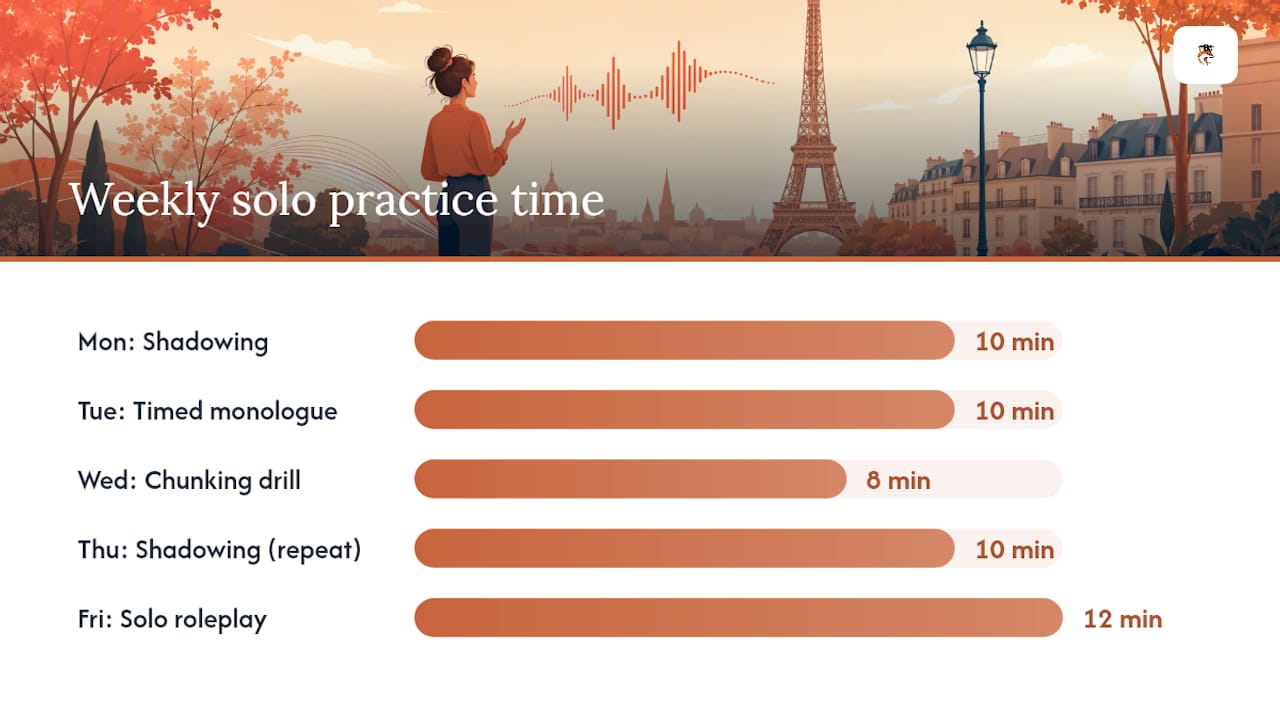
A simple weekly solo practice plan:
| Day | Focus | Time |
|---|---|---|
| Monday | Shadowing (new clip) | 10 minutes |
| Tuesday | Timed monologue | 10 minutes |
| Wednesday | Chunking drill | 8 minutes |
| Thursday | Shadowing (repeat clip) | 10 minutes |
| Friday | Solo roleplay script | 12 minutes |
Pro Tip: Reuse the same shadowing clip for a full week instead of switching daily. By day four, you’ll notice you’ve stopped thinking about the words and started producing them, which is exactly the shift that transfers to real conversation.
How to find French conversation partners and structure sessions that work
Finding someone to talk to matters, but showing up unprepared to a conversation exchange wastes both people’s time. The fix is knowing where to look and walking in with a plan.
Good places to find French conversation partners include:
- University conversation circles, like the one run through Université de Saint-Boniface’s oral French program, which pair structured classroom instruction with informal group conversation.
- Language exchange meetups and Alliance française events, which remain a dependable way to find in-person practice partners in many cities.
- Mauril’s community features, built around the platform’s native CBC and Radio-Canada audio and video collections, useful for learners who want media-anchored discussion topics.
- Targeted tutor platforms, where you pay for structured, feedback-driven sessions rather than casual exchange.
Vetting a partner or tutor quickly comes down to three questions: Do they correct you mid-sentence or wait until you finish a thought? Do they speak at a natural pace or slow down permanently for you? Do they give you a specific correction (“you dropped the liaison in les amis”) rather than a vague one (“that wasn’t quite right”)? A tutor who models full sentence structures instead of only flagging vocabulary errors will move you faster, since replacing fragmented speech patterns with complete syntactic frames is one of the more reliable levers for oral progress.
Here’s how to structure a session by length:
- 10-minute session: two minutes warm-up chat, five minutes on one focused skill (a pronunciation issue or a grammar pattern), three minutes free talk.
- 20-minute session: three minutes warm-up, eight minutes drilling a scaffold or scripted exchange, seven minutes free conversation, two minutes feedback.
- 30-minute session: five minutes warm-up, ten minutes targeted drill, ten minutes extended free conversation, five minutes feedback and note-taking.
The extended free-conversation block matters more than it looks. Classroom research on serve-and-return exchanges shows that pushing a conversation past three quick back-and-forth turns produces noticeably richer, more complex language than a string of short question-answer exchanges. Ask a follow-up question instead of moving to a new topic, and you’ll stretch your own output further than you’d expect.
One recurring pattern among learners who use conversation circles: fluency erodes quickly without regular practice, which is why several institutions require recent prior coursework before admitting new participants into ongoing groups. Skipping even a few weeks shows up fast in hesitations and lost vocabulary.
Pro Tip: If tutoring fees aren’t in the budget yet, pair with a French speaker learning your language and split the session, ten minutes in French, ten minutes in your language. It costs nothing and gives you a real, motivated conversation partner.
Pronunciation and fluency drills that fix common problems fast
Most non-native French speakers stumble on the same handful of sounds and patterns, and each one has a drill that targets it directly rather than vaguely.
- Nasal vowels (the in, an, on sounds) confuse English speakers most often. The fix: minimal pairs practice.
- Liaison (linking word-final consonants to the next word’s vowel) gets skipped by nervous speakers. The fix: marked-text reading.
- The French “r” trips people up because it’s produced further back in the throat than English. The fix: isolated repetition against a native model.
- Flat sentence stress (importing English word-stress patterns into French) makes fluent speakers sound foreign even with correct grammar. The fix: shadowing for prosody, not just words.
Minimal pairs drills train your ear and mouth together. Practise pairs like dessus/dessous, pain/pin, bon/banc, saying each word aloud and noting the mouth shape difference. Practicing a reasonable number of pairs daily, spoken multiple times, can help build real discrimination within a few weeks.
Liaison drills work best with a marked-up text. Take a paragraph, underline every place a liaison should occur (les amis becomes le‑za‑mi), and read it aloud slowly, then at normal speed. Do this with the same paragraph for three days before moving to a new one, since automating liaison takes repetition, not just awareness.
Rhythm and prosody drills rely on shadowing again, but with a specific listening target: match the rise and fall of the speaker’s voice, not just their words. French sentence stress typically falls on the last syllable of a phrase rather than scattering across syllables the way English does. Shadow a two-sentence clip ten times in a row, focusing only on the melody, and you’ll hear your own speech start to lose its flat English cadence.
Vocabulary depth backs this up: oral instruction that explicitly targets vocabulary, syntax, and listening comprehension together produces stronger speaking gains than drilling any one component in isolation, which is why a rhythm drill paired with a vocabulary chunking exercise outperforms either done alone.
Pro Tip: Watch the same three-minute clip of native French media five days running, shadowing once daily. By day five, try shadowing without looking at any transcript. You’ll be surprised how much prosody you’ve absorbed without memorizing a single word list.
How to track your progress and know when to level up
The clearest sign you’re improving is a recording you can compare against last month’s, judged against the same short checklist every time. Vague impressions (“I feel better”) aren’t reliable. A dated audio file is.
Use a simple four-part self-check, borrowed loosely from CEFR-style speaking criteria:
- Fluency: did you finish thoughts without long pauses or restarts?
- Accuracy: how many grammar or gender errors did you notice on playback?
- Range: did you use varied vocabulary, or lean on the same ten words?
- Coherence: did your ideas connect logically, or jump around?
Record yourself weekly, same day, same rough topic difficulty, and store the files in one folder labelled by date. Listen back within 24 hours while the context is fresh, score yourself on the four criteria above out of 4 each, and note one specific fix for next week rather than a general goal.
A realistic milestone timeline for consistent practice looks like this:
If you want an external checkpoint rather than relying only on self-review, government guidance in Canada recommends testing to identify your current skill level before enrolling in structured courses, and points to certificates like TEF and DELF as recognized benchmarks. A placement test every few months tells you objectively whether your self-assessment matches reality.
Pro Tip: Book a one-off tutor session specifically to validate your self-scoring. A trained ear catches errors you’ve stopped hearing in your own speech, and one outside checkpoint every couple of months keeps your self-review honest.
Curated resources for shadowing, native media, and structured practice
A short, well-chosen resource list beats a long bookmark folder nobody opens twice. Here’s what to actually use, and what each one is best for.
- Mauril: native CBC and Radio-Canada audio and video, including a lower-stress “Cozy” collection, ideal for shadowing and natural-speed listening practice.
- francais-enligne.quebec (via Quebec’s language tools portal): free self-assessments, audiovisual glossaries, and modules suited to placement checks and pronunciation drills.
- Université de Saint-Boniface’s oral French program: structured coursework paired with conversation circles, useful for readers who want both instruction and regular speaking practice in one place.
- YouTube shadowing playlists: search for channels offering slowed and normal-speed native clips with transcripts, a low-cost way to build a rotating shadowing library.
- Kwiziq and ThePerfectFrench: commonly recommended by learners for targeted grammar drills and pronunciation-focused exercises that complement shadowing work.
- Level-filtered exercise hubs, such as McGill University’s French learning resource list, for levelled audio and video when you outgrow beginner clips.
Combine two resources per week for variety: pair a Mauril “Cozy” clip for relaxed listening with a Kwiziq or ThePerfectFrench grammar drill for the specific pattern you flubbed on playback. That mix covers both natural exposure and targeted correction without turning your week into a research project. For readers just starting from zero, a short list of beginner-friendly French books can also supply simple dialogue you can read aloud and shadow.
Why formulaic phrases speed up oral French practice
Learners who memorize a small set of formulaic phrases and sentence frames organize their spoken French faster than learners who try to build every sentence from scratch. This isn’t a shortcut, it’s how fluent speech actually gets produced, in prefabricated chunks strung together, not word-by-word construction under time pressure.
Researchers studying English-language learners found that teaching formulaic expressions and sequenced phrases helps students move from fragmented, single-word responses toward organized, multi-clause speech. The same logic transfers directly to French: a learner who has memorized “Ce qui me frappe, c’est que…” or “D’un côté… d’un autre côté…” has a ready-made frame to hang new content on, rather than searching for grammar mid-sentence.
A short list of high-utility frames worth memorizing:
- “Ce qui est intéressant, c’est que…” (what’s interesting is that…) for introducing an opinion.
- “D’un côté… d’un autre côté…” (on one hand… on the other hand…) for comparing ideas.
- “Je dirais que…” (I’d say that…) as a softer opinion opener than a flat statement.
- “Ça dépend de…” (it depends on…) for hedging without stalling.
- “Pour revenir à…” (to come back to…) for redirecting a conversation smoothly.
Implementation is straightforward: pick two frames per week, use them deliberately in your timed monologues until they feel automatic, then bring them into your next partner session. A tutor or partner will notice the shift immediately, your responses will sound less like translated English and more like organized French, because the scaffold is doing the structural work your brain used to do from scratch under pressure.
An educator’s take on where oral French practice actually breaks down
At Réussite A+, we see the same pattern across most students who plateau in spoken French: they practise vocabulary and grammar in isolation but almost never rehearse speaking under mild time pressure, and that gap shows up the moment a real conversation moves faster than a worksheet.
Our tutoring approach treats oral practice as a skill with its own drills, not a byproduct of grammar review. Every tutor at Réussite A+ is selected at the university level for academic strength and teaching ability, and part of that selection process specifically evaluates how well a candidate models complete spoken sentences rather than just correcting isolated errors, since that modelling is what actually rewires a learner’s habits. Across more than 3,500 students supported, the students who progress fastest in oral French are consistently the ones doing short, frequent speaking reps between sessions, not the ones cramming grammar the night before.
One thing we tell every anxious speaker: your tutor would rather hear you finish a flawed sentence than watch you stop mid-thought to search for the perfect word.
Get personalized help building your oral French skills
Solo drills and free resources take you far, but a personalized tutor closes gaps that self-practice can’t catch, the errors you’ve stopped hearing, the grammar pattern you keep avoiding because it feels safer to talk around it. Réussite A+ builds a custom learning plan around your specific speaking weaknesses rather than running you through a generic curriculum, so your sessions target exactly what’s holding your fluency back.
Two easy next steps if you want outside support: book a trial lesson to see how a tutor structures a spoken-French session in real time, or request a quick placement check to find out exactly where your speaking level sits before committing to a plan. Both give you a concrete read on your progress without any long-term commitment. Réussite A+ serves students across Quebec online, with flexible scheduling built around school and family routines, and pricing designed to keep quality tutoring accessible. If you’re ready to move past solo practice, visit the French tutoring services page to see program options, or head straight to registration to lock in a placement check this week.
Your one-week oral French practice checklist
The most effective way to improve spoken French combines daily solo drills, regular partner conversation, and weekly recorded self-review, sustained for at least four to twelve weeks.
This week, aim to complete:
- Five daily micro-drills (shadowing, timed monologue, or chunking), 10 minutes each.
- Two partner or tutor sessions, using the 10 or 20-minute templates.
- One recording review, scored against the fluency, accuracy, range, and coherence checklist.
- One new formulaic phrase, practised until it feels automatic in a monologue.
A copy-ready weekly schedule:
- Monday: Shadowing (10 min)
- Tuesday: Timed monologue + partner session (20 min)
- Wednesday: Chunking drill (10 min)
- Thursday: Liaison drill + recording review (15 min)
- Friday: Partner or tutor session (20 min)
- Weekend: One native-media listening session (Mauril or a shadowing playlist), no pressure, just exposure.
| Point | Details |
|---|---|
| Start within 10 minutes | Shadow a short clip, deliver a timed monologue, then record and replay one sentence. |
| Solo drills build the base | Shadowing, chunking, and timed monologues train fluency before partner conversation ever begins. |
| Extended turns beat quick exchanges | Pushing conversations past three quick back-and-forth turns produces richer, more complex speech. |
| Track progress with recordings | Score weekly recordings on fluency, accuracy, range, and coherence rather than relying on gut feeling. |
| Réussite A+ personalizes the gaps | Tutors model complete sentence structures and target each student’s specific speaking weaknesses. |
Where to keep learning after this guide
- Mauril: best for native-speed audio and video shadowing material, including lower-stress listening collections.
- Quebec’s language tools portal, home to francais-enligne.quebec: best for free self-assessments and pronunciation modules.
- Université de Saint-Boniface’s oral French program: best for structured coursework combined with conversation circles.
- Canada’s language skills guidance: best for understanding placement testing and funded course options like TEF and DELF prep.
- McGill University’s French learning resource list: best for levelled exercise libraries once you outgrow beginner material.
Sources
- Meaningful Classroom Talk: Supporting English Learners’ Oral Language Development – WestEd
- How explicit oral language instruction strengthens structured literacy – Great Minds
- Meet Mauril | Mauril
- Canada
- Quebec
FAQ
What is the best way to practise speaking French?
Combine daily short solo drills, shadowing, timed monologues, chunking, with regular conversation practice through a partner or tutor. Solo work builds the mechanics; partner sessions test them under real conversational pressure.
How can I practise speaking French without a partner?
Shadow native audio clips, record timed monologues on a timer, and read scripted dialogues aloud playing both roles, then replay your own recording and respond live. These solo drills train fluency, pronunciation, and retrieval speed on their own.
What is the 80/20 rule in French?
Applied to spoken French, it means roughly 20% of vocabulary and sentence structures, high-frequency frames and common verbs, cover a large portion of everyday conversation. That’s why memorizing formulaic phrases and sentence frames delivers outsized gains compared to chasing rare vocabulary.
Do French speakers actually say “je ne sais quoi”?
Yes, though it functions more as a borrowed expression in English than as everyday spoken French. Native French speakers use it occasionally to describe an indefinable quality, but it isn’t a common conversational phrase the way learners sometimes assume from its use in English.
How long does it take to see real improvement in spoken French?
With 15 to 20 minutes of daily practice, most learners notice fewer long pauses and hesitations by week four, clearer liaison and rhythm by week eight, and the ability to sustain a five-minute free conversation with fewer restarts by week twelve. A tutor checkpoint or placement test can confirm progress objectively along the way.