



The single most useful thing you can do before booking a tutor is walk into the consultation with a focused list of questions covering qualifications, teaching approach, progress measurement, safety, and price. That checklist alone separates a confident hiring decision from an expensive guess.
Here are the eight questions every parent should ask first:
- What subjects and grade levels do you specialise in?
- How do you adapt your approach for students with learning differences or an IEP?
- How will you measure my child’s progress, and how often will you share updates?
- Can I observe or sit in on a trial session before committing?
- Do you have a vulnerable-sector background check I can review?
- What are your rates, cancellation terms, and make-up session policy?
- Can you provide two professional references I can contact?
- What does a typical session plan look like for a student at my child’s level?
Key takeaways
A focused checklist of tutoring consultation questions covering qualifications, teaching approach, progress measurement, safety, and price gives parents the information they need to choose the right tutor before committing to a single session.
| Point | Details |
|---|---|
| Use a themed checklist | Group questions by qualifications, approach, progress, logistics, safety, and fees to cover every decision factor. |
| Prioritise the trial lesson | A trial session reveals more about a tutor’s real approach than any credential or profile claim. |
| Request written progress reports | Ask for skill checklists, work samples, or rubric scores on a monthly or every-four-session cadence. |
| Know the three key red flags | Guaranteed grade gains, pressure to pre-buy packages, and refusal to provide references are reasons to walk away. |
| Réussite A+ | Offers a structured consultation-to-trial flow with university-level tutors, personalised plans, and clear progress tracking. |
Table of Contents
- Tutoring consultation questions: your printable checklist by theme
- What a good trial lesson looks like
- How tutors should measure progress and what to ask for in writing
- Red flags during a consultation that should make you pause
- A 10-minute phone-screen script and 12 essential questions
- How Réussite A+ handles consultations and what to expect
- Questions to ask about cancellations and emergency plans
- How tutors tailor sessions to your child’s learning style
- How tutors build student motivation and confidence
- What the consultation process taught us
- Réussite A+ makes the first step easy
- Sources
- FAQ
Tutoring consultation questions: your printable checklist by theme
Understood into five practical groups: qualifications, tutoring strategy, collaboration, availability, and costs. Use the same structure below to work through every call or meeting.
Pro Tip: Print this checklist or keep it open on your phone. Check off each question as you go so nothing slips through in the moment.
Qualifications and experience
- What is your educational background and highest level of training?
- How many years have you worked with students at my child’s grade level?
- Which subjects do you tutor most frequently, and what is your weakest area?
- Are you familiar with the provincial curriculum my child follows?
- Have you prepared students for secondary school entrance exams before?
Teaching approach and learning differences
- How do you explain a concept when a student does not understand your first explanation?
- Do you have experience supporting students with IEPs, ADHD, dyslexia, or other learning differences?
- How do you keep a student engaged when they are frustrated or losing confidence?
- Do you use multiple representations (diagrams, examples, verbal explanation) or mainly one method?
Progress measurement and reporting
- What does a written session plan look like, and will you share one with me?
- How will you track my child’s progress between sessions?
- How often will you send me a written update, and what will it include?
- At what point would you tell me the tutoring is not working?
Scheduling, format, and technology
- Are sessions online, in-person, or both, and which do you recommend for my child?
- What platform do you use for online sessions, and what does my child need to participate?
- How long is each session, and how many sessions per week do you suggest to start?
Fees, billing, and policies
- What is your hourly rate, and do you charge differently for group versus one-on-one sessions?
- Is there a registration fee, and what does it cover?
- What is your cancellation policy, and how much notice do you require?
- Do you offer make-up sessions if you cancel?
- Are there any extra fees for materials, assessments, or reports?
References and safety
- Can you provide two references I can contact, preferably parents of former students?
- Do you have a current vulnerable-sector background check?
- What is your policy if a session needs to be recorded or if I want to observe?
What a good trial lesson looks like
A trial lesson is the single most useful step in the hiring process. It shows you how a tutor actually behaves with your child, not just how they present themselves on a call.
Effective tutors ask follow-up questions that probe student thinking, allow mistakes to become learning moments, and resist doing the thinking for the student. Watch for these signals during the first 10 minutes:
- The tutor asks your child a diagnostic question before teaching anything (“Tell me what you already know about fractions”).
- The tutor listens more than they lecture in the opening minutes.
- When your child makes an error, the tutor asks a follow-up question rather than simply correcting the answer.
Mid-session, look for:
- Explanations delivered in more than one way when the first does not land.
- The tutor asking your child to explain a step back to them (“Can you walk me through how you got that?”).
- A calm, encouraging tone even when your child is stuck.
After the session, ask your child two things: Did you understand more by the end? Did you feel comfortable asking questions? Those two answers tell you more than any credential.
Pro Tip: For online trials, sit nearby but off-camera. You will hear the tutor’s tone and questioning style without disrupting the dynamic. For in-person sessions, ask to observe from a corner of the room for the first 10 minutes.

A good tutor makes sessions something a student looks forward to, not something they dread. Rapport is not a bonus — it is a prerequisite for learning.
How tutors should measure progress and what to ask for in writing
Meaningful progress measurement uses concrete evidence, not impressions. Ask any tutor you are seriously considering to describe at least two of the following:
- Pre- and post-task comparisons on the same skill (e.g., a short math problem set before and after a unit)
- Work samples with written feedback showing change over time
- A skill checklist tied to the curriculum your child follows
- Short rubric scores on specific competencies (reading fluency, written expression, problem-solving steps)
Top practitioners recommend task-based evidence over vague anecdotes. “Your child is doing better” is not a progress report. A marked sample with a rubric score is.
For realistic timelines, short-term wins (improved confidence, completing homework independently, fewer careless errors) often appear within four to six weeks of consistent sessions. Competency-building in a subject like mathematics or written French typically takes three to six months of weekly work. Online tutoring supports parental oversight best when the reporting cadence is agreed in writing from the start.
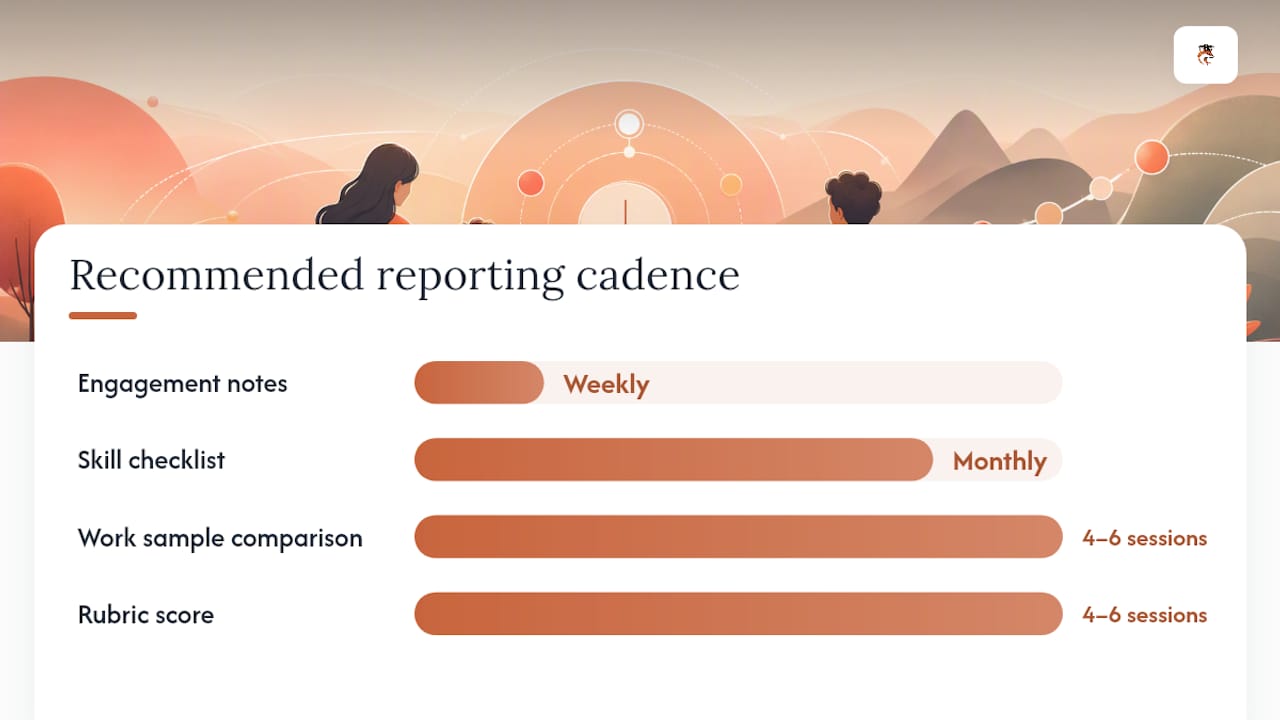
| Progress metric | Recommended reporting frequency | Example evidence |
|---|---|---|
| Skill checklist | Monthly | Curriculum checklist with dates |
| Work sample comparison | Every 4–6 sessions | Marked before/after task |
| Rubric score | Every 4–6 sessions | Written rubric with score |
| Engagement notes | Weekly | Brief session summary email |
Request a written session plan before the second session. It should name the learning goal, the method, and the success indicator for that session.
Red flags during a consultation that should make you pause
Experts warn parents to watch for these behaviours and walk away if they appear:
- Guaranteed grade improvements — no tutor can promise a specific grade; learning depends on many factors outside the session.
- Pressure to buy a long package before a trial — a confident tutor welcomes a trial first.
- Vague answers about progress measurement — “I’ll keep you updated” is not a plan.
- Refusal to provide references or a background check — non-negotiable for any tutor working with children.
- Frequent last-minute cancellations in early conversations — a pattern that will continue once booked.
- Dismissiveness about your child’s learning differences — a tutor who minimises an IEP or diagnosis is not equipped to support your child.
If you spot one red flag, ask a direct follow-up question. If you spot two, request a trial-only commitment with no package purchase. Three or more: end the conversation politely and move on.
A 10-minute phone-screen script and 12 essential questions
A short phone screen is often enough to filter out poor matches before you invest time in a full consultation. Here is a timed structure:
Minutes 0–2: Introduce yourself and your child’s situation in three sentences: grade, subject, specific challenge, and goal.
Minutes 2–7: Ask these five screening questions and listen for specificity in the replies:
- What experience do you have with students at this grade level in this subject?
- How would you approach a student who shuts down when they feel stuck?
- What does your first session with a new student typically look like?
- How do you communicate progress to parents?
- Are you available for a trial session before we commit to a schedule?
Minutes 7–10: Cover logistics: rate, availability, platform, and cancellation policy.
A tutor who asks diagnostic questions in early correspondence signals the right mindset. If they probe before they sell, that is a green flag.
For the full consultation, use these 12 essential questions:
- What are your qualifications and subject specialisations?
- How do you adapt sessions for students with learning differences or IEPs?
- How do you diagnose where a student is struggling before you start teaching?
- What does a written session plan look like?
- How do you measure progress, and how often will you report to me?
- Can I observe a trial session?
- What is your cancellation and make-up session policy?
- What platform do you use, and what does my child need to participate?
- What is your hourly rate and billing cycle?
- Do you have a current vulnerable-sector background check?
- Can you provide two references I can contact?
- What would tell you that a different tutor might be a better fit for my child?
How Réussite A+ handles consultations and what to expect
Réussite A+ has supported a large number of students over many years, maintaining a high client satisfaction rate. Every tutor is recruited at the university level for academic excellence and teaching ability, and every student receives a customised learning plan before regular sessions begin.
What to bring to your consultation:
- Your child’s most recent report card or progress report.
- A sample of recent homework or a test where they struggled.
- A note on your child’s availability and any learning-difference documentation (IEP, assessment report).
- Your own availability for weekly parent updates.
Pro Tip: Ask Réussite A+ specifically about exam preparation if your child is targeting a Quebec secondary school entrance exam. The programme includes structured prep with measurable milestones.
Questions to ask about cancellations and emergency plans
Cancellations happen. What matters is whether the tutor has a clear, fair protocol before one occurs. Ask these questions directly:
- How much notice do you give for a cancellation, and how do you communicate it?
- Do you offer a make-up session, a credit, or a refund for a cancelled session?
- What happens if you are ill for an extended period — do you have a substitute or a referral?
- If a technical issue interrupts an online session, how do you handle the remaining time?
- What is your policy if my child needs to cancel on short notice?
A tutor without clear answers to these questions will create frustration later. The policy should be in writing before you book a recurring schedule.
How tutors tailor sessions to your child’s learning style
Personalisation is not a buzzword — it is the difference between a session that clicks and one that does not. Ask any tutor how they find out what works for a specific child. Strong answers include:
- An intake questionnaire or diagnostic task completed before the first session.
- Questions in the first session about how the student prefers to learn (visual examples, step-by-step written notes, verbal explanation, practice problems).
- Adjusting pacing based on how quickly the student responds, not on a fixed lesson plan.
- Connecting examples to the student’s interests (sports, gaming, music) to make abstract concepts concrete.
A tutor who uses the same script for every student is not personalising. Ask: “Can you give me an example of how you changed your approach for a student who was not responding to your usual method?” The answer reveals whether adaptation is real or theoretical.
How tutors build student motivation and confidence
Confidence is built session by session through small, visible wins. Ask prospective tutors how they handle a student who has decided they are “just bad at math” or “not a reader.” Look for these strategies:
- Breaking tasks into steps small enough that the student succeeds at each one before moving forward.
- Naming progress explicitly (“You got that step right — you couldn’t do that two weeks ago”).
- Letting the student set one small goal per session so they feel ownership.
- Avoiding comparisons to classmates or siblings.
A tutor who relies on praise alone (“Great job!”) without connecting it to a specific skill is not building durable confidence. The goal is for the student to attribute success to their own effort and strategy, not to luck or the tutor’s help.
What the consultation process taught us
The consultation is not a formality. It is a diagnostic tool for parents. The tutors who ask the most questions in the first conversation — about your child’s specific struggles, their learning history, their emotional relationship with the subject — are almost always the ones who deliver the best results. A tutor who jumps straight to selling a package without asking a single question about your child has already told you something important.
After a first session, do not wait for the tutor to reach out. Ask directly: “What did you notice about where my child is stuck, and what is your plan for the next session?” That one question separates tutors who are paying attention from those who are going through the motions.
Réussite A+ makes the first step easy
Most parents spend more time researching a restaurant than vetting a tutor. Réussite A+ removes that friction. With personalised online tutoring in French and mathematics for elementary and secondary students across Quebec, every match starts with a structured consultation, a trial session, and a written learning plan — so you know exactly what your child is getting before you commit to a schedule.
That is the standard every session is held to. Before your first session, gather your child’s recent report card, a sample of their work, and a note on their schedule. Then book your consultation and let the process do the rest.
Sources
- Questions to ask when hiring a tutor
- 5 things to consider before you hire a tutor for your child
- How to choose a tutor: trials & red flags
- Questions to ask before hiring a tutor
FAQ
What are the most important tutoring consultation questions to ask first?
Ask about qualifications, how the tutor adapts for learning differences, how progress is measured, and whether a trial session is available before any package commitment.
How do I know if a tutor is right for my child after one session?
Watch for diagnostic questions, explanations delivered in more than one way, and a calm response to errors. Ask your child whether they felt comfortable asking questions.
Should I ask for a background check before hiring a tutor?
Yes. Request a vulnerable-sector background check issued within the past 12 months, along with two professional references and proof of qualifications, before booking regular sessions.
What red flags should I watch for during a tutoring consultation?
Guaranteed grade improvements, pressure to buy a long package before a trial, and refusal to provide references are the three clearest signals to walk away.
How does Réussite A+ handle the consultation and matching process?
Réussite A+ starts with a structured screening conversation, follows with a trial session, and provides a written learning plan and reporting cadence before any long-term schedule is confirmed.