


In Quebec, newcomer children are assessed at school registration and placed either in a regular class with language supports or in a welcoming class, called classe d’accueil. Parents should prepare documents, attend the intake interview, ask directly about available supports, and consider targeted tutoring, such as Réussite A+, if progress feels slow. Some waiting is normal, but you have more control over the process than it might seem at first.
TL;DR:
- The length of time children stay in a welcoming class varies based on their progress, with some moving to regular classes within a year and others taking longer depending on the child’s starting level.
- The school placement depends on intake interviews that assess French skills, prior schooling, and learning needs, with preparation of documents and verbal accounts improving placement accuracy.
- Community and government programs like Francisation Québec and settlement services offer additional French instruction and support, but waitlists and limited resources can cause delays.
- Parental involvement at home through daily French speaking practices and early language activities can accelerate language acquisition and reduce reliance on waiting for formal programs.
- For children in transition, tutors specializing in French and math provide personalized, supplementary support aligned with school curricula, especially during wait times or support gaps.
Table of Contents
- How schools assess and place newcomer children at first registration
- What is a classe d’accueil and what support comes with it
- Provincial and federal programs and community supports for newcomer families
- What to do at registration and the intake interview
- How to support your child’s French learning at home and when to consider tutoring
- Réussite A+ perspective: supporting newcomer children alongside school programs
- What actually matters most for newcomer families
- How Réussite A+ fits into your child’s French journey
- Sources
- FAQ
How schools assess and place newcomer children at first registration
When you register your child at a Quebec school, staff will conduct an intake interview before deciding where your child belongs. This step matters more than most parents realize: it shapes the entire school year.
During the interview, staff typically evaluate oral French skills, ask about your child’s prior schooling, and run basic checks in math and literacy. The goal isn’t to test your child harshly. It’s to understand where they’re starting from, so the school can build the right plan around them. School intake interviews are described as a critical moment where staff form their first impression of a child’s needs, which is exactly why preparation on your end pays off.
The people running this assessment are usually classroom teachers, resource teachers, or staff trained specifically in welcoming newcomer families. Some schools use structured checklists; others rely more on conversation and observation, especially with younger children who may be too nervous to perform well on a formal test.
Based on what they learn, the school places your child in one of two paths: a regular classroom with added language support, or a welcoming class designed for children who need more intensive French instruction before joining the regular stream. This decision follows the province’s protocol of accueil, which requires school networks to support the linguistic, academic, and social integration of immigrant students.
Bring what you can to make this process smoother:
- Previous school report cards or transcripts, translated if possible.
- Your child’s birth certificate or passport for identity confirmation.
- Immunization records, if available.
- Any documentation of special needs, allergies, or prior diagnoses.
If records are missing, don’t panic and don’t skip the interview. A detailed verbal account of your child’s education, including subjects studied, grade level, and even samples of schoolwork if you have them, gives staff enough to work with. Staying calm and cooperative during this conversation helps them place your child appropriately, even without a full paper trail. If your child previously attended school abroad, our guide on private school admissions in Montreal covers similar assessment steps that apply broadly across the province.
What is a classe d’accueil and what support comes with it
A classe d’accueil, or welcoming class, is a dedicated classroom setting for children who need concentrated French instruction before they can follow the regular curriculum comfortably. It’s not a punishment or a setback. Think of it as a running start rather than a detour.
These classes combine several things at once, since language alone isn’t the whole picture:
- Intensive oral and written French instruction adjusted to the child’s age and starting level.
- Bridging support in core subjects like math and science, so the child doesn’t fall behind while learning the language.
- Social and emotional support to help the child adjust to a new school culture, new routines, and new friendships.
Duration varies quite a bit. Some children move to a regular class within a school year; others take longer, depending on their starting point and how much support the specific school offers. Transition usually happens once a child demonstrates enough oral and written comfort to follow regular lessons, though the exact bar differs across centres de services scolaires.
That variability is worth asking about directly. Not every school runs its welcoming class the same way, and program depth can differ from one centre de services scolaires to another.

Pro Tip: Ask the school directly how long children typically stay in the welcoming class at that specific location, and what signs they look for before recommending a transition. The answer at one school won’t always match another.
Provincial and federal programs and community supports for newcomer families
Beyond the school itself, a few government programs and community groups exist specifically to help newcomer families settle in and learn French. Knowing which one to call first saves you time.
Francisation Québec, run through the Ministry of Immigration, Francization and Integration, offers French classes for newcomers of all ages, including programs that connect with school-age children’s needs. It’s worth consulting when your child needs structured French learning outside the classroom, or when you as a parent want to build your own French skills alongside your child.
Federally, Immigration, Refugees and Citizenship Canada funds settlement services across the country that can help with school registration steps, language evaluation referrals, and connections to local francisation offerings, depending on your immigration status. These services are often free and are a strong first stop if you’re unsure where to begin.
Community organisations fill in the gaps that government programs don’t always cover:
- Local not-for-profits such as CAI Québec offer settlement guidance, cultural orientation, and francisation support tailored to specific communities.
- Public libraries frequently run free French conversation groups and homework help sessions open to all ages.
- School-based parent liaison staff can connect you to other families going through the same adjustment.
Here’s the honest part: demand for francisation classes has outpaced supply in recent years. Protecteur du citoyen reports have flagged real gaps between how many families need francisation services and how many spots are actually available, with wait times and class closures affecting access. If you hit a wait, it doesn’t mean anything is happening. Pursue library programs, community groups, or tutoring in parallel rather than pausing everything until a formal placement opens up.
What to do at registration and the intake interview
Walking into registration prepared makes a real difference in how smoothly this whole process goes. Here’s a simple sequence to follow.
- Gather documents ahead of time: birth certificate, prior report cards, immunization records, and any relevant medical or learning assessments.
- If records are missing, write down what you remember about your child’s schooling: grade level, subjects, and approximate reading level in their first language.
- At the interview, ask specifically what placement your child received and why, what supports come with it, and when the school plans to reassess progress.
- Request a copy of the classe d’accueil transition criteria if your child is placed there, so you know what to watch for at home.
- If supports feel insufficient or delayed, ask who to contact next within the centre de services scolaire, and escalate to the Protecteur du citoyen if the response stalls.
- Keep brief written notes after each meeting: date, who you spoke with, and what was promised.
Pro Tip: Ask for a rough timeline in writing, even informally by email, right after the intake meeting. It gives you something concrete to reference if follow-up takes longer than expected.
Following up matters as much as the first meeting. Mark a reminder to check in after a few weeks if you haven’t heard about reassessment or support scheduling, and keep community resources in your back pocket in case school-based help is slow to start.
How to support your child’s French learning at home and when to consider tutoring
School carries most of the weight, but a bit of daily practice at home reinforces what your child is learning and helps them feel less alone in the process.
Small daily habits go a long way:
- Read aloud together in French for even ten minutes a day, choosing books slightly below your child’s current level to build confidence rather than frustration.
- Label household items in French, turning the home itself into a low-pressure vocabulary lesson.
- Play simple speaking games, like naming objects during a car ride or describing what’s happening on a walk.
- Alternate storytime between your child’s first language and French so neither gets left behind.
When it comes to homework, ask your child’s teacher what vocabulary or grammar points they’re covering that week, so what you do at home lines up with the classroom rather than working against it. Our guide on helping your child with French when you’re not a French speaker yourself covers this in more detail, including how to communicate with teachers even with limited French.
Watch for a few signs that your child might need more than home practice alone can offer: stalled progress over several months, dropping marks in subjects taught in French, or visible anxiety around school and homework. These aren’t failures on your part. They’re just signals that a more structured, one-on-one approach might help. Building stronger reading habits specifically can also close gaps faster than general practice alone.
If you’re considering tutoring, look for a provider that aligns lessons with what your child is actually learning in school, uses tutors with real academic training, and tracks progress over time rather than offering generic worksheets. A provider that adjusts to your child’s specific classroom curriculum, rather than teaching French in a vacuum, tends to produce faster, more visible gains.
Réussite A+ perspective: supporting newcomer children alongside school programs
Réussite A+ provides tutoring services in French and math for Quebec students. We build a personalized learning plan around each child’s starting point, whether that is a welcoming class transition or steady catch-up in a regular classroom.
Réussite A+ aims to provide a student-centred approach instead of a fixed curriculum applied to everyone equally. Tutors are selected for their academic and teaching abilities to provide quality lessons approachable for newcomer children. Initial sessions usually begin by discussing the child’s current situation and school feedback, aiming for tutoring to complement classroom learning.
What actually matters most for newcomer families
Government guidance and school protocols are genuinely helpful, but they assume a level of system familiarity that most newcomer parents simply don’t have yet. That gap, not a lack of information, is what trips families up most often.
The conventional advice tends to stop at “attend the intake interview and wait for placement.” That’s incomplete. Wait times for francisation services are real, and treating the school’s timeline as the only path forward leaves gaps that can stretch across a full school year. The families who adjust fastest are the ones who treat school placement as one piece of a broader plan, not the whole plan.
If there’s one priority to take from all this, it’s this: don’t wait passively during gaps in service. Keep asking questions, use community resources while you wait, and consider structured support at home if progress stalls. Confidence in French often builds faster from consistent, low-pressure practice than from any single classroom placement decision.
— Réussite A+
How Réussite A+ fits into your child’s French journey
School supports and government programs handle the foundation, but a personalized push at home can shorten the distance between where your child is and where you want them to be, without waiting for the next available spot in a francisation class.
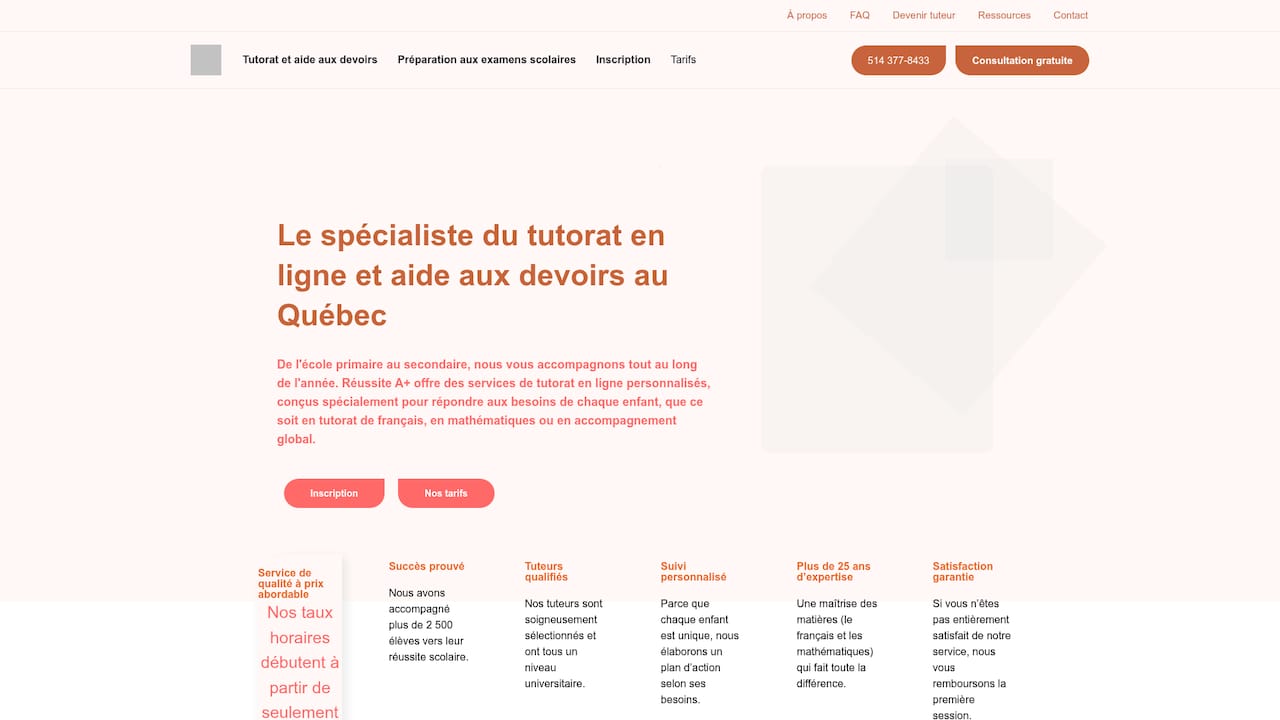
Our Programmes de tutorat en français are built specifically around individual gaps, whether your child is fresh out of a welcoming class or working through a regular classroom with extra support. If school performance is slipping while French catches up, Tutorat et aide aux devoirs helps stabilize other subjects in the meantime. Families facing a summer wait for francisation openings often use our Session d’été to keep progress moving rather than pausing over the break.
A few things to know before booking:
- Sessions run online with flexible scheduling to accommodate families in various locations.
- Tutors are selected and matched to your child’s specific needs.
- Registration involves a one-time 65 $ fee, and sessions are billed hourly.
Book a first session through our Session régulière page and let us know your child’s current placement and school goals so we can build the plan around them from day one.
Sources
- Integrating into school | EspaceParents
- Accueil et intégration des élèves issus de l’immigration | Gouvernement du Québec
- Trouvez des services gratuits pour nouveaux arrivants près de chez vous | IRCC
- Protecteur du citoyen — letter on Bill 84 and francisation service gaps
FAQ
Can I learn French for free in Quebec?
Yes, Francisation Québec offers French classes to newcomers at no cost for eligible participants, and IRCC-funded settlement services can help connect families to local French learning resources. Public libraries and community organisations also run free conversation and homework support programs.
Does the Quebec government pay to learn French?
Yes, through Francisation Québec, run by the Ministry of Immigration, Francization and Integration, which funds French classes for eligible newcomers across the province. Availability and wait times vary by region and demand.
What is the 80/20 rule for learning French?
There’s no official government-defined “80/20 rule” for learning French in Quebec’s school or francisation programs. If you’ve seen this phrase used informally, it typically refers to prioritizing speaking and listening practice over grammar study, though this isn’t a standard applied by Quebec’s education system.
Can I learn French for free as a Canadian citizen?
Canadian citizens can access some free French learning resources through community organisations, public libraries, and certain provincial programs, though eligibility for Francisation Québec specifically depends on immigration status and program rules. Checking directly with Francisation Québec or a local settlement organisation is the most reliable way to confirm what applies to your situation.