


Math confidence tutoring works by changing how a child feels about math while it builds the skills they are missing. A tutor works one-on-one, starts where your child is comfortable, makes mistakes safe and raises the difficulty in small steps. Over a few weeks, “I can’t do this” becomes “let me try.” If your child freezes at homework, says “I’m just bad at math” or avoids tests, this guide explains why that happens, what helps and how to start.
TL;DR
- Low confidence and weak skills feed each other. Anxiety makes it harder to think, so results drop, and the drop confirms the belief “I’m bad at math.”
- One-on-one tutoring can break that cycle. A Stanford study found eight weeks of tutoring reduced math anxiety in children who started with high anxiety.
- Good confidence tutoring uses small wins, safe mistakes, and a plan built around your child’s pace and gaps.
- At home, listen more than you correct, and praise good reasoning, even when the answer is wrong.
- Our online sessions cost $30 to $35 per hour, plus a one-off $65 registration fee.
Table of Contents
- What low math confidence looks like
- Why confidence and skills grow together
- How tutoring rebuilds confidence
- What a confidence-first session looks like
- What you can do at home
- How to know if tutoring is the right next step
- Choosing a tutor who builds confidence
- Our perspective
- Start with a plan built around your child
- FAQ
- Sources
What low math confidence looks like
Low confidence rarely announces itself. It tends to look like something else, and you may spot it in your child before a teacher mentions it.
- Avoidance. Homework is “finished” suspiciously fast, or it never starts.
- Self-talk. Phrases such as “I’m stupid at math” or “I’ll fail anyway.”
- Freezing. Your child knows the method at the kitchen table, then blanks on a test.
- Perfectionism or guessing. Some children erase everything. Others write any number to be done.
- Stomach aches or tears before a math class or exam.
None of this means your child lacks ability. It usually means a gap appeared at some point, such as fractions, times tables or word problems, and each new topic stacked on top of it. Confidence dropped because the child kept feeling lost, not because the child cannot learn.
If you recognize several of these signs, a good first step is to name the exact part of math your child finds hard, talk with your child about what they think the problem is, then raise your concerns with their teacher, as the Australian Association of Mathematics Teachers suggests. Our guide on what to do when your child is failing math goes deeper on that first conversation.
Why confidence and skills grow together
It helps to know what is happening in your child’s head, because it removes the blame from everyone, including your child.
Anxiety makes it harder to pay attention, remember facts and solve problems calmly. According to the Child Mind Institute, anxious thoughts can make working memory harder to reach, which creates a loop: your child underperforms, then believes they are not a math person, which raises the anxiety next time.
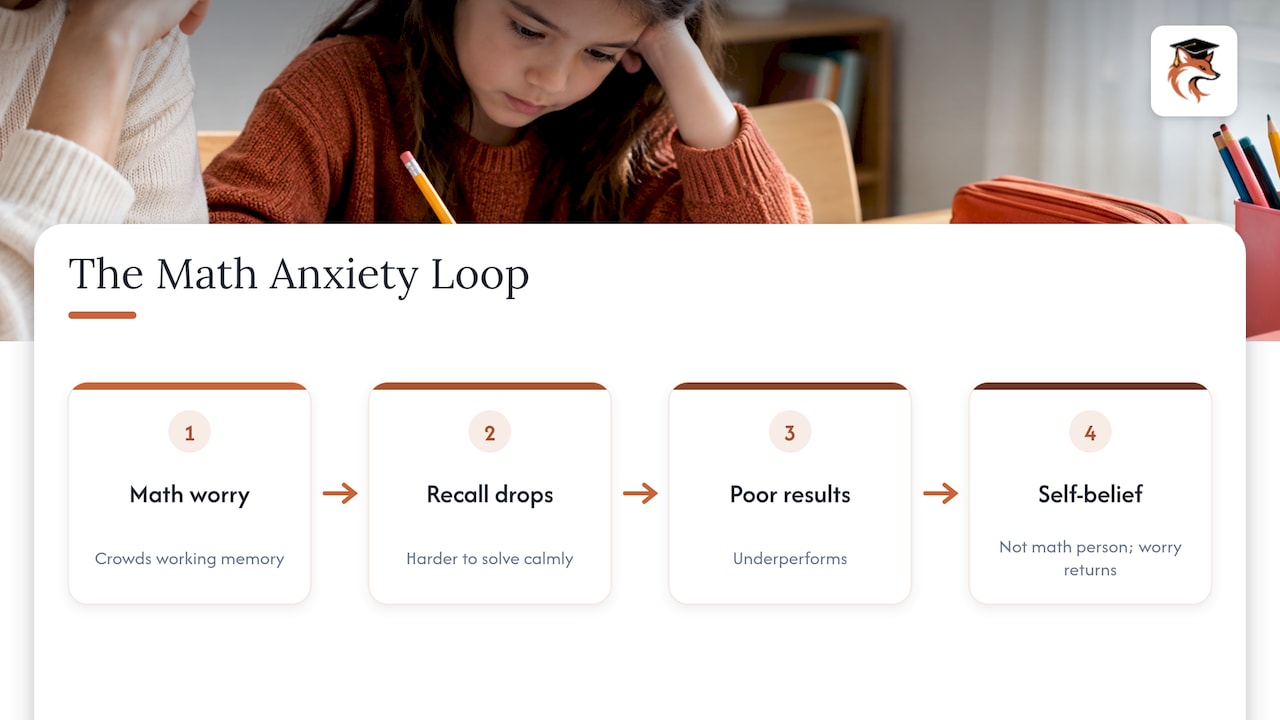
This effect appears to be specific to math. A 2001 study by Ashcraft and Kirk, cited in the same Child Mind Institute article, found that people with math anxiety showed a pronounced drop in working memory on a computation task but no drop on a verbal task. In plain words, your child’s brain is not “worse.” It is being crowded out by worry at the exact moment numbers appear.
A lack of fluency adds to the load. Michelle Tiu of EF+Math explains in Education Week that without basic fact fluency, every step of a problem carries extra cognitive load. When those facts become automatic, a child has room to think about the bigger ideas. That is why confidence tutoring is never only about feelings: building fluency is part of building calm. Our practical guide to math facts mastery shows how to practise this in short, low-pressure bursts.
The same Education Week article reports that once math anxiety is ingrained, symptoms can appear before a child even starts a hard problem or test. It also describes a downward spiral of reluctance to practise, further loss of confidence and stalled skill growth.
Researchers also look at self-efficacy, a child’s belief that they can succeed at a specific task. A 2024 scoping review in ZDM Mathematics Education found that math self-efficacy is related to motivation, effort, perseverance, self-regulation, lower anxiety and performance. So belief and results move together, and you can work on both at once.
How tutoring rebuilds confidence
The strongest evidence for tutoring and anxiety comes from a 2015 Stanford University School of Medicine study. An intensive eight-week one-on-one program of 22 lessons on addition and subtraction reduced math anxiety in children who began with high levels of it. Brain scans also showed that the fear responses linked to math had normalized, which the researchers described as more than a coping trick.
The researchers pointed to two features that matter for any parent choosing a tutor:
- One-on-one attention. Your child does not have to compare themselves with classmates, so there is less to fear about performing worse than peers.
- Personalized, encouraging help. The tutor follows a clear structure but gets the child past their specific sticking point in a non-negative way.
The Australian Association of Mathematics Teachers adds that a tutor can help a child cope in class, have a go, ask the teacher for help and develop strategies to work on problems independently. Notice that last point. Good tutoring aims to make your child less dependent over time, not more.
The Stanford study was about young children and arithmetic, and no study can promise the same result for every child. What it shows is the mechanism: patient, personal, success-oriented practice can change how a child responds to math. That is the same mechanism we design our sessions around.
What a confidence-first session looks like
Every tutor and every child is different, but confidence-focused sessions tend to follow the same rhythm. Here is how we approach it at Réussite A+.
- Find the real gap. We begin by identifying which skills are solid and which are shaky. A Grade 6 child struggling with fractions may actually be missing multiplication facts from Grade 3.
- Start with a win. The first activity sits comfortably inside what your child already knows. It sounds small, but it changes the mood of the whole hour.
- Climb in small steps. Each new idea is only slightly harder than the last. This incremental approach is also central to the Canadian charity JUMP Math, which describes its method as building confidence and resilience through incrementally more challenging concepts rather than rote memorization.
- Treat mistakes as information. When an answer is wrong, we ask the child to explain their thinking. The error shows exactly where to teach next. Quebec’s own secondary mathematics program encourages treating error as a lever for learning and turning its anxiety-inducing effect into motivation.
- Let your child do the talking. Children explain their method out loud, so the tutor hears the reasoning and the child hears themselves being right.
- End by naming progress. Before we close, your child sees what they could not do last week and can do now.
Between sessions, we track progress so the plan keeps matching your child’s pace. The point is that your child can see the evidence of improvement, which is what quietly replaces the old belief.
Why mistakes need to feel safe
A 2025 multiple case study of six Grade 5 to 7 classrooms in British Columbia looked at a math curriculum that builds social and emotional learning into the lessons. It described classrooms where mistakes were normalized, and reported that teachers felt more confident and saw less math anxiety, while students showed more engagement, cooperation and resilience in problem-solving. A tutoring session is a small room, which makes it easier still to create that atmosphere.
What you can do at home
You have more influence than you may think. The Ontario Catholic Teachers’ Association guide Encouraging Math Learning at Home says parents’ most significant influence comes from creating a positive mindset about math by believing in their child’s ability to learn and succeed. It suggests using math language in everyday conversation, letting children explain their reasoning, rewarding wrong answers that came from good reasoning and listening rather than over-assisting.
Here is a short checklist you can use this week:
- Drop “I was bad at math too.” It can sound like permission to give up. Try “This is tricky, and we can work it out.”
- Ask before you tell. “How did you get that?” gives you information and gives your child a voice.
- Praise the process. “I like how you drew the problem” works better than “You’re so smart.”
- Keep practice short. Ten calm minutes beat an hour of tears. Our quick mental arithmetic methods fit into a car ride.
- Find math in daily life. Cooking, shopping, hockey scores and bus schedules are all good practice.
- Treat the game like a game. Light challenges, such as beating yesterday’s time, take the pressure off.
If worry shows up around tests, our article on managing exam stress for children aged 5 to 13 offers calming routines. For a deeper look at the anxiety itself, read our plan to reduce your child’s math anxiety in 4 to 8 weeks.
How to know if tutoring is the right next step
Tutoring is worth considering when:
- your child’s confidence has stayed low for more than a few weeks;
- you notice the same type of mistake across different topics, which suggests a missing foundation;
- homework regularly ends in frustration or avoidance;
- an important exam is coming, such as the secondary school entrance exams;
- your child is doing fine but wants to go beyond the grade-level work and feel more sure of themselves.
Start with a conversation: ask your child which part of math feels worst, then talk to the teacher. The teacher sees how your child works in class, and a tutor can then target exactly what the teacher describes. If you want a structured approach, our action plan for parents of children struggling with math walks through each step. We also explain how tutoring raises grades and confidence in more detail.
Choosing a tutor who builds confidence
When you compare options, such as a school-based program, a private tutor or an online service, look at how the tutoring is run rather than only at its price. These questions matter most:
| Question | What a good answer sounds like |
|---|---|
| How do you decide where to start? | A review of your child’s strengths, gaps, pace and goals, then a written plan |
| How do you handle wrong answers? | The tutor asks the child to explain and uses the error to teach |
| Who are the tutors? | Qualified, university-level tutors chosen for teaching ability, not only grades |
| How will I see progress? | Regular, concrete updates tied to the plan |
| Can my child learn at home? | Flexible online scheduling that fits your family’s week |
On the last point, many Quebec families find online sessions easier to keep up week after week, since there is no travel. Our comparison of home tutoring and online tutoring explains the differences, and our guide to tutoring in Montreal covers what to expect locally.
Our perspective
We have been working in education for more than 25 years, and one thing has not changed: a child who believes they cannot do math will not show you what they know.
That is why we never start with a worksheet. We start with a conversation about your child’s strengths, the topics that feel heavy, their pace and the goals you share. From there we build a customized learning plan. A child who needs to catch up gets a different plan from one preparing for a secondary school entrance exam or one who wants to go beyond the grade level.
Our university-level tutors are chosen for academic excellence, but also for how they teach: patiently, clearly and with encouragement. We monitor progress continuously, so we can adjust before a small gap becomes a big one, and so your child can see the proof of their own growth.
We have supported more than 3,500 students, and our clients report a 99% satisfaction rate. We stand behind the process: if you are not satisfied after the first session, we refund it.
Réussite A+
Start with a plan built around your child
Our online tutoring covers elementary and secondary students across Quebec, including Montreal, Laval, Longueuil and Brossard. Sessions are $30 to $35 per hour, whether you choose a regular session, homework help or exam preparation. There is a one-off registration fee of $65, listed on our pricing page. You pick the schedule that fits your week, and your child works with a university-level tutor on a plan made for them.

If your child needs a boost before school restarts, our summer session is a calm way to close gaps without the pressure of homework and tests. To see all of our programs, visit Réussite A+.
FAQ
How long does it take for a child to feel more confident in math?
It varies from child to child, so no tutor can promise an exact timeline. In the Stanford study, the program ran for eight weeks with 22 lessons, and anxiety dropped in the children who began with high levels. Many parents notice a change in attitude, such as less avoidance at homework time, before they see a change in marks.
Is math anxiety the same as being bad at math?
No. Anxiety can interfere with attention and working memory, so a child may know the method and still blank under pressure. That is why we work on the skills and the feelings together, starting from what your child already does well.
Should I help my child with math homework myself?
Yes, in the right way. Ask your child to explain their thinking, listen, and praise good reasoning even if the answer is wrong. If homework turns into a nightly argument, a tutor can take over the teaching so your time together stays positive.
What does online math tutoring cost with Réussite A+?
Sessions cost $30 to $35 per hour, with a one-off registration fee of $65. We also offer a satisfaction guarantee: if you are not satisfied with the first session, we refund it.
Can tutoring help a child who is already doing well?
Yes. Some children get good marks but feel unsure of themselves, or want to go further than the class does. A customized plan can add challenge at a pace that feels safe and builds lasting self-belief.
Sources
- Tips for Helping Kids Overcome Math Anxiety, Child Mind Institute
- Why So Many Students Struggle With Math Anxiety, Education Week
- Students’ mathematics self-efficacy: a scoping review, ZDM Mathematics Education
- Tutoring relieves math anxiety, changes fear circuits in children, Stanford Medicine Children’s Health
- Tutoring, Australian Association of Mathematics Teachers
- About JUMP Math Canada
- Programmes de mathématique au secondaire, Gouvernement du Québec
- Integrating Social and Emotional Learning into Mathematics, PMC
- Encouraging Math Learning at Home: A Guide for Parents, OECTA