



The best time to start tutoring is as soon as you see a difficulty that keeps coming back, before it becomes a habit or a source of stress. You don’t need a failing report card, a formal diagnosis or a specific birthday. You need a pattern: your child is struggling in the same area for several weeks, and the usual help at home and in class isn’t enough to turn it around.
This guide walks you through the signs worth watching, how age and readiness fit in, what to do when your child changes schools, and how to plan the first weeks so that catching up feels calm and doable.
TL;DR
- Start when a difficulty persists and occasional help isn’t closing the gap. Quebec’s Ministère de l’Éducation says to refer a student as soon as difficulties appear and sporadic support is not enough to stop them from setting in.
- There is no perfect age. Look at your child’s needs and readiness: shorter, more playful sessions for younger children, longer and more focused ones as they grow.
- Don’t wait for a crisis. Arranging extra help takes time, so begin when you feel worried or lost, not after an exam goes badly.
- After a school change, give your child a few weeks to settle, then target the specific gaps in French or math that the new curriculum exposes.
- Aim for regular, short sessions rather than occasional long ones, and ask for progress updates.
Table of Contents
- The short answer: start at the first persistent signal
- Signs it may be time to start
- Is there a right age to start?
- How to time it across the school year
- When your child changes schools
- How to catch up without a crisis
- Perspective: why we say start early and keep it simple
- What to look for in a tutor and a first session
- Our tutoring options and rates
- Common worries, answered
- FAQ
- Sources
The short answer: start at the first persistent signal
Parents often ask whether tutoring is “too early” or “too late”. The more useful question is: has this difficulty lasted long enough that it won’t fix itself?
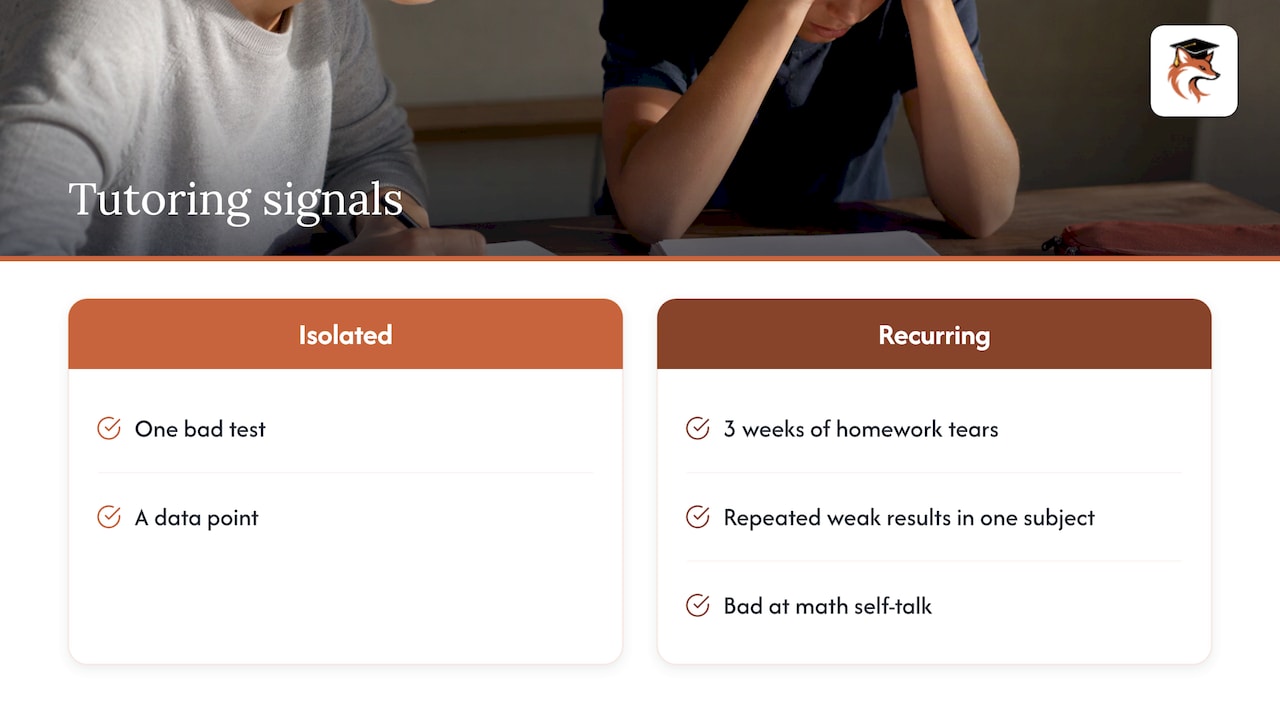
Quebec’s education ministry describes tutoring as a response to difficulties that are observed early, when occasional help is not enough to keep them from becoming entrenched. That is a helpful rule of thumb for any family. One bad test is a data point. Three weeks of homework tears, a string of weak results in the same subject, or a child who suddenly says “I’m just bad at math” is a pattern.
A second voice agrees. The Lower Canada Education Mental Health resource says there is no perfect time to seek outside help: the right moment is when you are very worried or feel lost, and you should not wait for a crisis because setting up extra support can take time.
And the Canadian Paediatric Society, in its guidance on suspected learning disorders, says support should begin as soon as a delay is observed, rather than waiting for test results or a formal diagnosis.
Put together, the message is reassuring: acting early is not overreacting. It is the simplest way to keep a small gap small.
Signs it may be time to start
No single sign decides it. Look for several, lasting more than a few weeks.
In school work
- Grades in French or math slide over two or three evaluations, not just one.
- Your child understands the lesson in class but can’t redo the exercises alone at home.
- Homework takes much longer than the teacher suggests, or ends in frustration.
- Reading aloud is hesitant, or written work has the same spelling and grammar mistakes repeating.
- Word problems in math are left blank, because your child isn’t sure which operation the question is asking for.
In attitude and confidence
- Your child avoids homework, or says they feel “stupid” or “behind”.
- Stomach aches or tears appear on school mornings, or before a test.
- A child who used to enjoy school now shrugs when you ask about it.
The Quebec ministry notes that tutoring can be adapted to a student’s cognitive, social, psychological and affective dimensions, built on a relationship of trust. That matters here: confidence is often the first thing to slip, and a good tutor works on it alongside the subject.
Persistence is the key word
The Canadian Paediatric Society describes a suspected learning disorder as significant difficulty retaining and applying academic skills over time, despite intervention. You don’t need to diagnose anything yourself. But “over time, despite effort” is the signal to take seriously, and it is a good reason to talk with your child’s teacher as well as to arrange tutoring. If difficulties continue even with targeted support, the same guidance recommends considering screening and a psychoeducational assessment through the school or your doctor. Tutoring and that kind of assessment work well side by side: the tutor helps your child move forward while the school identifies any additional needs.
Is there a right age to start?
The pages that rank for this question tend to give age brackets, and many are written for exam systems from other countries. In Quebec, the picture is simpler: age matters less than readiness and need.
| Stage | What tutoring usually looks like | Common reasons to start |
|---|---|---|
| Early elementary (Grades 1 to 2) | Short, playful sessions, lots of reading aloud and counting games | Trouble with letter sounds, early reading, number sense |
| Mid elementary (Grades 3 to 4) | Short structured sessions, routines for homework | Spelling and grammar rules, multiplication, confidence |
| Upper elementary (Grades 5 to 6) | Regular sessions, practice with longer texts and word problems | Reading comprehension, fractions, entrance exam preparation |
| Secondary | Focused sessions linked to class content and exam dates | Algebra, writing, ministerial exams, a drop in marks |
This table is a general guide, not a rule. Some Grade 1 children do very well with a few playful sessions, and some Grade 8 students only need a short burst before an exam.
What the ministry says about age and session length
The Quebec ministry recommends adapting session length to the student’s age and, where possible, pairing the student with someone they know or who can quickly build trust. Its programme describes sessions of 20 to 90 minutes, with shorter, closely spaced sessions for younger students.
In practice, that means a six-year-old does better with a brief, lively session than with an hour at a screen. For an older child, 45 to 60 minutes can work well if the plan is clear. If you’d like numbers by age, see our guide on how many hours of tutoring to expect depending on your child’s age.
Readiness checklist
Before you begin, ask yourself:
- Can my child stay focused for the length of a short session, with a break if needed?
- Does my child know why we are doing this? (“To make homework easier” works better than “because you’re behind.”)
- Is there a calm place and a regular time that fits our week?
- Have I spoken to the teacher so the tutor can aim at the right skills?
If you can answer yes to most of these, your child is ready.
How to time it across the school year
The calendar can help you choose a start date. Here are the moments when families most often begin.
- After the first report card. The fall report gives you a clear picture of where your child stands. If a subject is weak, starting then leaves most of the year to build momentum.
- When a new topic is about to arrive. Fractions, algebra, verb tenses and the agreement of the past participle are common stumbling blocks. A few sessions before the topic starts can make a real difference.
- Before exams. For ministerial exams or private-school entrance exams, begin well ahead so your child can practise without panic. Our high school entrance exam preparation plan and our guide to entrance exams for private schools in Quebec lay out the steps, and the stress management strategies help keep it light.
- In summer. Without the pressure of homework and tests, summer is a gentle time to rebuild foundations before the next grade begins.
If you are unsure, start sooner. A few weeks of light support cost less in time and worry than a full semester of catching up.
When your child changes schools
A new school means a new teacher, new routines, sometimes a new programme or a different pace in French or math. Even confident children can wobble.
The Viamonde school board’s parent guide identifies moving between schools as a transition that may need a plan covering the student’s goals, support needs, measures, responsibilities and timelines. British Columbia’s special-education policy manual likewise recommends careful planning for school transitions, including an early introduction to the new environment, information about schedules and how the school is organized, and a school buddy where appropriate. Both documents were written for students who need extra support, but the logic applies to any child: a move goes better when it is prepared.
Here is a simple sequence for parents.
- Before the move. Visit the school if you can. Ask the new teacher what the class is covering in French and math.
- First two weeks. Focus on routine and friendships. Don’t add pressure yet, but note which subjects feel harder.
- Weeks three to six. Compare your child’s work with what the class expects. If there are gaps, such as missing grammar rules or a math unit your child never saw, this is the moment to start tutoring.
- After the first evaluation. Adjust the plan using the results.
A tutor can bridge what your child learned at the old school and what the new school expects, with sessions that target specific missing skills. Because the support is personalized, your child isn’t asked to repeat what they already know.
How to catch up without a crisis
Catching up is less about long hours and more about a clear plan. Here is a method you can follow at home or with a tutor.
- Name the gap. “Math” is too broad. “Subtracting with borrowing” or “agreeing the verb with its subject” is something a tutor can work on.
- Start small. Two short sessions a week on one skill build confidence faster than one long session on everything.
- Practise a little every day. Ten minutes of reading or five practice questions keeps the learning alive between sessions.
- Track progress. Review a short checklist every couple of weeks: what’s easier now, what still needs work?
- Celebrate effort. Praise the method (“you checked your verb ending”) rather than only the result.
How often should sessions happen?
Quebec ministry guidance says frequency can vary with the student’s profile and that regularity is essential. Its own programme considers at least three sessions a week to be optimal, with sessions kept shorter for younger students. For a family tutoring privately, the right rhythm depends on your child’s age, energy and schedule. Many parents begin with one or two sessions a week and adjust once they see how their child responds. The ministry also notes that tutoring can be done one-on-one or in very small groups of four students or fewer with similar needs, a format that suits children who enjoy working with peers.
Perspective: why we say start early and keep it simple
After more than 25 years in education, we have seen the same story many times. A parent waits because they hope it will pass, and a small gap becomes a big one. A child who could have been helped with three weeks of focused work now needs a whole semester.
That is why we encourage families to reach out at the first persistent signal. We build a customized learning plan around each student’s strengths, challenges, pace and goals, mainly in French and math. Our tutors are selected from university level for their academic excellence and their ability to teach, and we monitor progress continuously so that you can see what’s changing.
We have helped more than 3,500 students, and we aim for sessions that feel encouraging rather than stressful. Children learn best when they feel safe to make mistakes. Starting early, with a tutor who builds trust, protects that feeling.
If you aren’t sure whether it is time, a short conversation about your child’s situation is a good first step.
Réussite A+
What to look for in a tutor and a first session
Timing matters, but so does fit. A well-chosen tutor can make a modest start feel like progress.
- A clear plan. The tutor should ask about your child’s strengths, difficulties, pace and goals, and then set out what the first weeks will cover.
- Experience at the right level. Read about why the tutor’s experience is key to effective tutoring.
- Ways to follow progress. You should be able to see what was covered and what comes next. Our article on online tutoring as a way to follow your child’s progress explains how.
- A safe setup. Before the first lesson, read our online tutoring safety steps.
- A format that suits your child. Online sessions save travel time and let you pick flexible slots. See online tutoring versus in-person tutoring to compare, and how an online session works to know what to expect.
If you want to prepare your questions, our printable tutoring consultation checklist covers the essentials.
A realistic first month
Here is what a calm first month often looks like.
- Week 1: a conversation about goals, a look at recent work and a light first session so your child meets the tutor.
- Week 2: regular sessions begin on one or two priority skills, with short practice between sessions.
- Week 3: your child starts to recognize patterns and make fewer repeat mistakes. Homework feels a little less heavy.
- Week 4: review together. What has improved, what is next, and is the rhythm right?
Progress is rarely a straight line. A good week followed by a harder one is normal. What matters is that your child keeps showing up and keeps trying.
Our tutoring options and rates
We offer online tutoring for elementary and secondary students across Quebec, including Montreal, Laval, Longueuil, Brossard and Gatineau. Sessions are delivered by university-level tutors and shaped around a personalized plan.
Hourly rates are $30 to $35 per hour for our regular sessions, summer sessions, homework help and tutoring, French programmes and exam preparation, with a one-off registration fee of $65. We back our service with a satisfaction guarantee: if you are not satisfied after the first session, we refund it.

Choose the option that matches your child’s situation:
- Regular sessions for steady support throughout the school year.
- Tutoring and homework help when evenings at the kitchen table have become a struggle.
- French tutoring programmes for reading, writing and grammar.
- Exam preparation for school exams and secondary school entrance exams.
- Summer sessions to catch up before the next grade.
You can see the full details and register for tutoring when you’re ready. If you’d like to understand the wider value first, read about the benefits of tutoring.
Common worries, answered
“Will tutoring make my child feel there’s something wrong with them?” It doesn’t have to. Present it as a coach who helps with a specific skill, the way a child might have a swimming or music coach. Children who see tutoring as a tool tend to engage more.
“What if the school says to wait?” Teachers know your child at school, and their input is valuable. If you still see a persistent pattern at home, you can talk with the teacher about what support the school or community offers, and add tutoring for regular practice. If the difficulty continues, ask the school or your doctor about an assessment.
“What if my child has been away from school for a while?” A long absence calls for a gradual plan involving the child, the family and the school. A guide for health professionals on school avoidance and refusal recommends a multimodal approach with gradual reintegration and, when needed, mental health services. A tutor can support the academic side of that return, in step with the plan.
“Is it too late in Grade 6 or secondary 5?” No. Focused work before an exam can raise confidence and fill the most important gaps. The earlier you begin, the less rushed it feels.
FAQ
What age should you start tutoring?
There is no single right age. Many families begin in elementary school, once a child is reading and doing basic math and shows a persistent difficulty. For younger children, sessions should be short and playful, as the Quebec ministry recommends adapting session length to age. Readiness and need matter more than the birthday.
Should a 5-year-old have a tutor?
Only if there is a specific need, such as early reading difficulty, and then with brief, game-like sessions. Most five-year-olds learn a great deal through play, stories and everyday counting at home. If you’re worried, start by talking with the teacher about what you’ve noticed.
Is one hour of tutoring a week enough?
For many children, one hour a week is a good starting point, especially for a single skill or to maintain progress. Quebec ministry guidance stresses regularity and finds more frequent, shorter sessions optimal in its programme, so some students benefit from two or three shorter sessions. Review after a month and adjust.
How soon after changing schools should we start?
Give your child a few weeks to settle, then compare their work with what the new class expects. If you spot gaps in French or math, begin tutoring then, targeting only the missing skills. If your child is clearly anxious about school, speak to the teacher about a transition plan first.
Do we need a diagnosis before starting?
No. The Canadian Paediatric Society advises starting support as soon as a delay is observed, without waiting for test results. If difficulties continue despite support, talk to the school or your doctor about an assessment.
Sources
- Programme de tutorat, Ministère de l’Éducation du Québec
- Parenting Resilient Children, Lower Canada Education Mental Health
- Evaluating and caring for children with a suspected learning disorder, Canadian Paediatric Society
- Guide des parents, Éducation de l’enfance en difficulté, Conseil scolaire Viamonde
- School Avoidance and Refusal: Information for Health Professionals