




Three steps drive real progress in French writing: read purposefully at your CEFR level, practise with targeted drills, and review with a checklist and feedback loop. Skip any one of them and you plateau. Learners who improve fastest treat writing as a cycle, not a single event: they read something slightly above their comfort zone, borrow its sentence patterns, draft something short and imperfect, then hunt down the same two or three error types every single time.
You don’t need hours. Fifteen to twenty minutes a day, done consistently, beats a single weekend cram session. Pick reading material that matches your CEFR level so you’re absorbing structures you can actually reuse, not just words you’ll forget by Thursday. Réussite A+ builds its tutoring programs around this same logic, and the Conseil supérieur de la langue française frames strong written French as a genuine lever for social and economic participation, not just a school requirement.
- Read 10 to 15 minutes of level-appropriate French daily and note one reusable phrase.
- Write one short paragraph daily using a timer, then stop, no matter how it looks.
- Track a single recurring error for two weeks before moving to the next one.
Pro Tip: Keep a single notebook page titled “My Three Errors.” Every correction you get, from a tool or a tutor, gets sorted into one of three recurring categories. Fixing three patterns beats chasing fifty random mistakes.
Key Takeaways
Consistent, targeted practice, reading purposefully, drilling one error at a time, and reviewing in stages, improves French writing faster than sporadic long sessions.
| Point | Details |
|---|---|
| Read at your level | Match material to your CEFR level and extract reusable phrases, not just vocabulary. |
| Dictate two to three times weekly | Short audio transcriptions lock in accents, homophones, and natural sentence rhythm. |
| Separate plan, draft, and review | Fix content first, grammar second, and style last to avoid wasted effort. |
| Target one error for two weeks | Focused drills on a single recurring mistake beat scattered general practice. |
| Consider tutor-led feedback | Réussite A+ diagnoses your specific error patterns and builds drills around them directly. |
Table of Contents
- How to improve French writing by reading with purpose
- Dictation and transcription exercises for orthography and flow
- Building a plan, draft, review workflow that actually works
- Drills for connectors, vocabulary, idioms, and orthography
- What does a realistic weekly French writing schedule look like?
- What should you practise at each CEFR level?
- A prompt bank you can start using today
- How tutoring accelerates progress beyond self-study
- Small, focused changes compound faster than you expect
- Getting personalised support when you’re ready for it
- Where to find exercises, dictations, and CEFR-graded practice
- Sources
- FAQ
How to improve French writing by reading with purpose
Reading trains writing only when you read actively. Passive reading, the kind where your eyes slide over a page and nothing sticks, builds recognition vocabulary but rarely transfers into sentences you can produce yourself. Active reading extracts sentence patterns, connectives, and idioms you can lift almost directly into your own drafts.
Match your material to your level and your goal. A beginner chasing vocabulary needs different text than an intermediate learner chasing register or an advanced learner refining nuance.
- A1 to A2: graded readers and short dialogues train basic sentence order and high-frequency vocabulary.
- B1 to B2: newspaper articles and blog posts train transition words, paragraph logic, and everyday idioms.
- C1 and above: short stories and opinion columns train register shifts, subordination, and stylistic variety.
Once you’ve picked something, work it. Back-translation, where you translate a French passage into English and then retranslate it into French without peeking, exposes exactly where your instincts diverge from the original. Phrase extraction means pulling out five connectives or expressions per article and filing them for reuse. Pastiche, imitating an author’s sentence structure with your own content, is one of the fastest ways to internalize rhythm.
Pro Tip: When you extract a phrase, write the sentence it came from, not just the phrase. Context is what makes it stick when you try to reuse it three weeks later.
| Reading task | What it trains |
|---|---|
| Back-translation | Sentence structure and word choice instincts |
| Phrase extraction | Reusable connectives and idioms |
| Pastiche | Rhythm, sentence variety, author’s voice |
| Connective tracking | Logical flow between ideas |

Dictation and transcription exercises for orthography and flow
Dictation trains something reading alone can’t touch: the muscle memory that connects sound to correct spelling, accents, and punctuation. Isolated grammar drills teach you rules; dictation forces you to apply them in real time, under the mild pressure of a moving voice.
The workflow is simple and repeatable.
- Choose a short audio clip, 60 to 90 seconds, at or just above your CEFR level.
- Listen once straight through without writing anything.
- Replay in short segments, transcribing exactly what you hear.
- Compare your transcription against the original script.
- Correct using a checklist: accents, silent letters, agreement, punctuation.
Two or three short dictations a week is enough to see accents and homophones (ça/sa, ou/où, a/à) stop tripping you up. Longer sessions aren’t more effective; they just invite fatigue-driven errors near the end.
- Use podcasts, audiobooks, or teacher-recorded passages as source material.
- Repeat the same passage a second time after correcting it, aiming for zero new errors.
- Keep a running list of homophones you consistently miss.
Pro Tip: Read your corrected transcription aloud afterward. Errors that look fine on the page often sound wrong once you hear the rhythm break.
Building a plan, draft, review workflow that actually works
Spontaneous writing, sitting down and typing until you run out of ideas, produces uneven results because you’re solving three problems at once: what to say, how to say it, and whether it’s correct. Separating those three problems into stages is what makes a structured cycle of reading, planning, drafting, and reviewing outperform improvised practice.
- Plan: jot a three-point outline and a short vocabulary list of words or connectives you intend to use.
- Draft: write against a timer, one idea per sentence, without stopping to fix anything.
- Review: check content first, then grammar, then style, in that order.
Reviewing in stages matters more than most learners realize. If you hunt for typos before your ideas are even organized, you waste effort polishing a paragraph you’ll cut anyway.
An editing checklist keeps review focused on what actually costs you marks:
- Subject-verb and adjective agreement
- Verb tense consistency across the paragraph
- Punctuation: comma splices, missing accents, apostrophe use
- Register: does the vocabulary match a formal email or an informal note?
- Repetition: swap a repeated noun for a synonym or pronoun
A short essay plan might look like: introduction (one sentence stating your position), two body points with one supporting example each, and a conclusion that echoes the introduction without repeating it word for word. This structured approach to introduction, development, and conclusion is a staple of formal French writing guides, and it works just as well for a two-paragraph email as a five-paragraph essay.
Pro Tip: Never fix grammar and content in the same pass. Read once for whether your argument makes sense, then read again purely hunting verbs and agreement.
Drills for connectors, vocabulary, idioms, and orthography
Small, repeatable drills targeting one micro-skill at a time move the needle faster than generic “practise more” advice. Four drills consistently pay off.
- Connectors ladder: rewrite a paragraph using a different connective in each sentence (d’abord, ensuite, cependant, par conséquent, enfin) to break the habit of relying on “et” and “mais” for everything.
- Synonym swap: take a sentence and replace one word with two alternatives of different registers. “Il est content” becomes “il est ravi” (more formal) or “il est content comme tout” (colloquial).
- Idiom insertion: rewrite a plain sentence using an idiomatic expression. “Il a beaucoup travaillé” becomes “il a mis les bouchées doubles.”
- Accent and diacritic practice: take a passage with accents stripped out and restore them from memory, then check against the original.
Orthography traps deserve their own attention. Compound numbers need hyphens (vingt-trois), guillemets («») rather than straight quotation marks are standard for dialogue and citation, and spacing rules around punctuation (a space before a colon or semicolon) differ from English conventions. It’s worth knowing that in many official Canadian contexts, both traditional and rectified spellings of the nouvelle orthographe are accepted, which takes some pressure off minor spelling variants.
- Self-score a five-sentence connector drill and flag anything reused twice.
- Circle every guillemet and hyphen in a paragraph and verify each one against a style guide.
- Turn your most frequent error into a two-week daily micro-drill: five sentences, same rule, every day.
Pro Tip: Pick one error type and hammer it for two weeks straight before switching. Splitting focus across five error types at once means you fix none of them properly.
What does a realistic weekly French writing schedule look like?

Consistency beats intensity. A short daily session, done five or six days a week, builds retention that a single three-hour Sunday block never will. The goal isn’t to exhaust yourself; it’s to keep French writing present in your week without it becoming a chore you dread.
A sample weekly structure that balances the techniques above:
| Day | Focus | Time |
|---|---|---|
| Monday | Active reading + phrase extraction | 15 min |
| Tuesday | Dictation | 20 min |
| Wednesday | Connector or vocabulary drill | 15 min |
| Thursday | Timed writing (draft only) | 20 min |
| Friday | Review previous draft (checklist) | 15 min |
| Saturday | Dictation or idiom drill | 15 min |
| Sunday | Rest or light reading | 10 min |
Track your own patterns in a simple log: date, error type, time spent, and whether the error recurred. A three-column table like that reveals within two or three weeks whether a drill is working or whether you need a different angle on the same rule.
- Keep sessions capped at 20 minutes; longer sessions invite fatigue errors, not progress.
- Rotate which skill gets Friday’s review slot so no single weakness gets ignored for a month.
- Reassess your weekly plan every two weeks and swap out whatever drill has stopped feeling hard.
Pro Tip: Try a Pomodoro-style structure: 20 minutes of focused writing, five minutes off. It keeps sessions from feeling like a chore and makes daily practice easier to sustain long term.
What should you practise at each CEFR level?
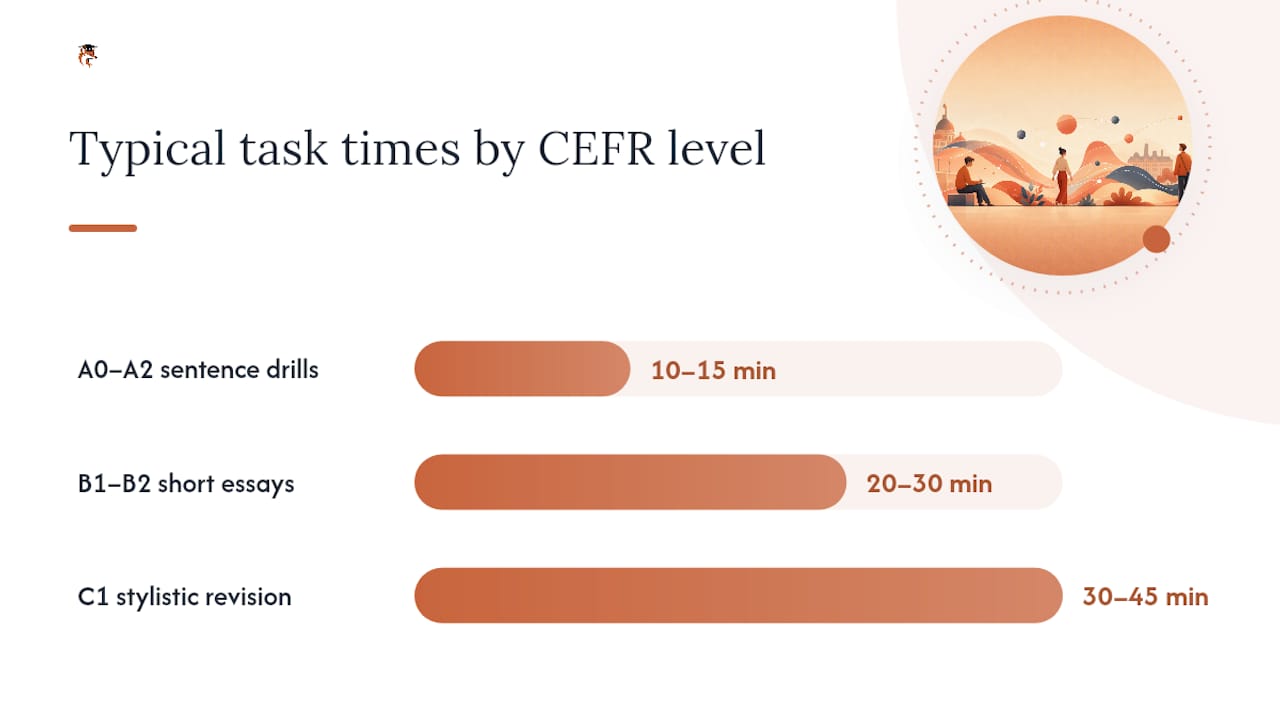
Matching exercises to your actual CEFR level prevents two common traps: frustration from tasks too advanced, and stagnation from tasks too easy. Structured modules that list estimated completion times per unit make it easier to plan a session around exactly the gap you have, whether that’s fifteen minutes on verb agreement or forty on paragraph cohesion.
- A0 to A2: word and sentence-level drills, guided dictation, simple present-tense narration. Estimated time: 10 to 15 minutes per task.
- B1 to B2: short essays (150 to 250 words), pastiche exercises, connective-focused paragraphs. Estimated time: 20 to 30 minutes per task.
- C1: stylistic revision of existing drafts, sustained argumentative essays, register-shifting exercises. Estimated time: 30 to 45 minutes per task.
Sample tasks by level: an A2 learner might rewrite a five-sentence paragraph swapping present tense for passé composé. A B1 learner might write a short opinion paragraph on a familiar topic using three connectives. A C1 learner might take a published editorial and rewrite one paragraph in a more formal or more colloquial register.
| CEFR level | Core focus | Typical task time |
|---|---|---|
| A0 to A2 | Sentence drills, guided dictation | 10 to 15 min |
| B1 to B2 | Short essays, connectives, pastiche | 20 to 30 min |
| C1 | Stylistic revision, sustained argument | 30 to 45 min |
Interactive CEFR-graded practice works best when it’s paired with feedback. A module tells you your paragraph has an agreement error; a tutor or a checker explains why, which is what actually prevents the same error next week.
A prompt bank you can start using today
Ten prompts, ranked roughly by difficulty, give you enough variety to fill several weeks without repeating a task type.
- Describe your morning routine in the present tense (10 minutes, narrative, A2 to B1).
- Write a short formal email requesting an appointment (10 minutes, formal register, B1).
- Summarize a news article in three sentences (15 minutes, summary, B1 to B2).
- Argue for or against a four-day work week (20 minutes, opinion, B2).
- Describe a childhood memory using at least four connectives (15 minutes, narrative, B1 to B2).
- Write a complaint letter about a faulty product (15 minutes, formal register, B2).
- Compare two cities you know well (20 minutes, descriptive/comparative, B2).
- Rewrite a casual text message as a formal note (10 minutes, register shift, B2 to C1).
- Argue a position using exactly five different connectives, no repeats (20 minutes, structured argument, C1).
- Take one paragraph you wrote weeks ago and revise it for style alone, changing no facts (15 minutes, revision, C1).
For error-spotting practice, take any of your own drafts, hide the corrected version, and try to find three planted errors before checking. Slot these prompts into your weekly plan by replacing Thursday’s timed writing slot, and adjust difficulty by loosening a lexical constraint (any vocabulary allowed) or tightening it (must use five specific idioms).
How tutoring accelerates progress beyond self-study
Self-study covers most of the groundwork, but a tutor closes gaps that solo practice tends to miss, especially the errors you don’t notice because they feel natural to you. Réussite A+ has built its approach around this exact problem over more than 25 years, selecting tutors at the university level and pairing each student with a plan built around their specific error patterns rather than a generic curriculum.
A typical tutoring session follows a structure that dovetails directly with the self-study plan above:
- Diagnostic: the tutor reviews a recent piece of writing to identify the two or three most costly recurring errors.
- Focused drill: targeted practice on exactly that pattern, not a generic worksheet.
- Corrective feedback: immediate, explained correction, the same explanatory approach that makes tools like Antidote useful, but with a human able to answer follow-up questions.
- Homework: a short, specific task tied directly to the session’s focus.
A student stuck on agreement errors for months can often resolve the pattern within a few focused sessions once a tutor isolates exactly which rule is being misapplied, rather than treating it as generalized “grammar trouble.”
For a learner following the weekly plan solo, a tutor session every week or two acts as a checkpoint that catches drift before it becomes a habit.
Pro Tip: Bring your tutor your “Three Errors” notebook page. It turns a general session into a laser-focused one from minute one.
Small, focused changes compound faster than you expect
The biggest misconception I see among learners is that writing improvement requires broad, general practice: write more, read more, hope it clicks. It rarely does. What actually moves a learner from B1 to B2 writing is absurdly narrow: pick one error, drill it for two weeks, move on. Teachers who ask students to fix everything at once usually watch nothing improve, because attention split five ways fixes nothing well.
One exercise worth trying with a study partner: swap drafts, and each of you must find exactly three errors, no more, no less. It forces precision instead of a vague “this sounds off” reaction.
Expect visible gains within two to three weeks of targeted practice. Full consolidation, where a corrected pattern stops requiring conscious thought, usually takes a couple of months, sometimes longer depending on your starting level. That timeline is normal. Persistence, not talent, is what separates learners who plateau from those who don’t.
Getting personalised support when you’re ready for it
Self-study drills and a solid weekly plan take most learners a long way, but some errors are stubborn precisely because they’re invisible to the person making them. That’s the gap tutoring closes. Réussite A+ pairs each student with a university-level tutor and builds a plan around their specific writing patterns rather than a one-size-fits-all worksheet.

Three ways tutoring complements everything covered here: a proper diagnostic identifies your real recurring errors instead of guessing, drills get tailored to those exact patterns instead of generic grammar sheets, and progress gets tracked session over session so you can see whether a targeted drill is actually working. Getting started is straightforward: an initial assessment maps your current level and error patterns, then you’re matched with a tutor and begin regular sessions on a schedule that fits your week, all delivered online with flexible scheduling and rates that keep consistent, personalised support accessible.
If you’d rather see the full case for tutor-led support first, this breakdown of the 7 advantages of online tutoring covers what a structured program adds beyond self-study. Either way, the next step is the same: book an initial assessment and find out exactly which two or three errors are holding your writing back.
Where to find exercises, dictations, and CEFR-graded practice
A handful of resources cover most of what a self-directed learner needs. Kwiziq offers CEFR-graded writing exercises with instant feedback, useful for structured, level-appropriate practice sessions. BonPatron catches spelling and grammar errors quickly and for free, ideal as a first pass before a final submission. Antidote goes further with explained corrections, style suggestions, and built-in reference tools, worth the cost if you write regularly. For grammar and conjugation questions, Bescherelle remains a reliable reference guide, especially for verb tables and orthography rules.
- University-built modules with time estimates per unit help you plan sessions around specific weaknesses.
- Curated exercise collections like 100 progressive exercises build revision habits and stylistic control over time.
- For guided, personalised progress, Réussite A+’s online tutoring and homework support pairs self-study with tutor feedback.
Sources
Feedback only improves your writing if you turn corrections into targeted drills instead of one-off fixes. Different feedback sources catch different things, and knowing which one to reach for saves you time.
Automated checkers like BonPatron catch surface-level spelling and basic grammar errors fast and for free, which makes them ideal for a quick pass before you submit anything. Antidote, Druide’s premium correction suite available in Canada, goes deeper: it flags style issues, offers a built-in dictionary and conjugation guide, and explains why a correction is needed rather than just applying it. That explanatory layer is what turns a tool into a teaching moment instead of a crutch.
Teacher or tutor feedback catches what software structurally can’t: whether your argument holds together, whether your register fits the task, and whether your sentence, though grammatically fine, sounds unnatural to a native ear. Language exchanges and peer workshops sit in between: less rigorous than a tutor, but useful for catching awkward phrasing before a formal submission.
A workflow that gets real mileage: run a draft through an automated checker first, take the flagged pattern (say, agreement errors) to a tutor for a five-minute explanation, then rewrite three sentences using that exact rule before moving on.
CEFR-graded exercise portals, including university-built modules that list estimated completion times per unit, let you customize study paths around exactly the skill you’re weakest in, whether that’s lexical orthography or sentence-level grammar.
Pro Tip: Don’t just accept a tool’s correction. Ask yourself why it’s wrong. If you can’t explain the rule, that’s your next drill.
- J’améliore ma maîtrise du français — portail
- Améliorer les compétences en français oral et écrit : un enjeu crucial de la réussite (CSLF)
- Guide de rédaction en français — UNE-SEN
- 100 exercices pour améliorer son écriture — Baptiste Noury
FAQ
How to practise French writing effectively?
Combine purposeful reading at your CEFR level, regular dictation, timed drafting, and staged review, focusing on one recurring error at a time rather than trying to fix everything at once.
What is the 80/20 rule in French?
There’s no single canonical “80/20 rule” specific to French writing; the principle borrowed from general learning is that roughly 20% of vocabulary and grammar patterns cover most everyday writing needs, so prioritizing high-frequency connectives and structures pays off faster than obscure rules.
What are the 5 W’s in French?
The English “5 W’s” (who, what, when, where, why) translate to “qui, quoi, quand, où, pourquoi” and are commonly used as a planning checklist before drafting a summary or news-style paragraph in French.
Can I get to B2 French in one year?
Reaching B2 in one year is achievable for some learners with consistent daily practice, but it depends heavily on starting level, exposure time, and whether you get regular feedback; structured tutoring, like the programs at Réussite A+, can meaningfully speed up that timeline by catching errors early.
How often should I do dictation exercises?
Two to three short dictations per week, each 60 to 90 seconds of audio, is enough to build noticeable improvement in accents, homophones, and sentence rhythm without causing fatigue.