




The single most effective thing you can do this week is shift from supervising your teen to supporting their autonomy. Research from the Fonds de recherche du Québec shows that autonomy-supportive parenting produces larger positive effects on motivation than controlling approaches, especially in math and science. When that isn’t enough, personalised online tutoring with Réussite A+ gives your teen the structured, confidence-building support that Self-Determination Theory (SDT) says works: satisfying the needs for autonomy, competence, and relatedness.
Your one-week action plan:
- Have one calm, curiosity-led conversation about what your teen finds hard or boring at school (no fixing, just listening).
- Agree on one small, specific study goal together for the week — not “study more,” but “finish the three practice problems on page 47.”
- Set up a consistent 30-minute study window at the same time each day, chosen with your teen’s input.
- After each session, name one thing they did well — effort or strategy, not just the grade.
- If you see no shift after two weeks, consider booking a diagnostic session with Réussite A+.
Early signs to watch for:
- Your teen sits down to study without a battle
- They ask a question about the material (curiosity returning)
- They mention something they learned without being prompted
Pro Tip: The goal this week isn’t perfect study habits. It’s one small win your teen can feel proud of — that feeling is what rebuilds motivation.
Table of Contents
- Why do teenagers lose motivation to study?
- Practical strategies parents can use at home
- How to set goals and build study routines that stick
- What to say to your teen (and what to avoid)
- How does personalised online tutoring help teens in Quebec?
- How to choose and work with a tutor in Quebec
- When low motivation may signal something deeper
- Key takeaways
- Our perspective on motivating teens to study
- Réussite A+ supports Quebec families with personalised online tutoring
- Useful sources for parents
- FAQ
Why do teenagers lose motivation to study?
Demotivation in teens is rarely about laziness. Research synthesises that it accumulates when school tasks feel meaningless, too easy, or opaque — a mismatch between the teen and their learning environment, not a character flaw.
Self-Determination Theory gives parents a compact framework: teens stay motivated when three psychological needs are met. Autonomy means feeling like the author of their own choices. Competence means believing they can succeed. Relatedness means feeling connected to a teacher, parent, or tutor who genuinely cares. When any one of these is missing, engagement drops.
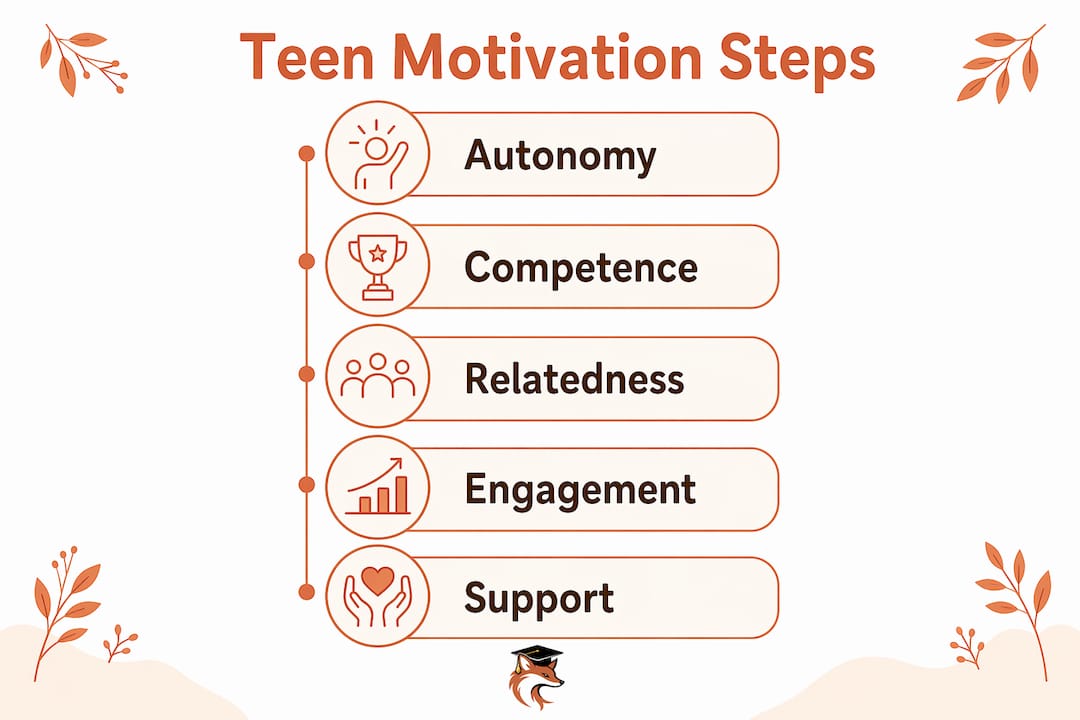
A UQAM longitudinal study of Quebec secondary students found that high and more stable motivation profiles are associated with parental warmth, autonomy support, and adequate structure, while low-quality motivation profiles also persist without intervention. That stability cuts both ways: a teen who builds good habits early keeps them, but one who slides into disengagement needs active support to reverse the pattern.
| Motivation driver | What undermines it | What supports it |
|---|---|---|
| Autonomy | Constant supervision, no choices | Offering options, involving teen in planning |
| Competence | Tasks too hard or too easy, harsh feedback | Micro-goals, effort-focused praise |
| Relatedness | Cold or critical interactions | Warmth, availability, trusted tutor |
“Parental warmth combined with autonomy support and adequate structure is associated with higher and more stable motivation profiles in secondary students.”
UQAM (LEP-IS)
The Conseil supérieur de l’éducation reinforces this: student engagement rises in inclusive learning climates that respect individual paces and build meaningful relationships. That principle applies at home too.
Pro Tip: How your teen perceives your involvement matters more than what you actually do. A DOI study on parental supervision found that teens’ perception of parental control predicts academic engagement more strongly than parents’ own reports of their behaviour. Small wording changes can shift that perception entirely.

Practical strategies parents can use at home
The single most effective routine to try first: a fixed, short daily study window your teen helped choose. Consistency lowers friction; co-creation builds buy-in.
- Set up the environment. A clutter-free, phone-free space signals “study time” to the brain. It doesn’t need to be a desk — a cleared kitchen table works.
- Break work into micro-tasks. Instead of “study for the math test,” try “do questions 1–5, then take a five-minute break.” Visible progress triggers a reward response that sustains effort.
- Use timeboxing. The Pomodoro method (25 minutes on, 5 minutes off) works well for secondary students. Two cycles is a solid session.
- Recognise effort, not just results. After a session, say: “I noticed you stuck with that problem even when it got hard.” That kind of feedback supports competence without creating dependency on grades.
- Introduce rewards carefully. For tasks your teen already finds interesting, a promised reward can actually reduce intrinsic motivation. Save tangible incentives for genuinely tedious tasks, and keep them modest.
Pro Tip: For math and science specifically, autonomy-supportive practices produce the largest gains. Ask your teen which part of the problem they want to tackle first, rather than walking them through it step by step.
Feedback phrases that build competence:
- “You figured out the hard part on your own.”
- “That approach was smart — what made you try it that way?”
- “You got further than last time.”
How to set goals and build study routines that stick
The single best rule for goal-setting with teens: make the goal small enough to achieve this week and visible enough to feel real.
Micro-task template (10–30 minute chunks):
- Monday: Re-read notes from today’s class and highlight three key ideas (15 min)
- Tuesday: Complete the assigned practice problems (25 min)
- Wednesday: Review errors from Tuesday and redo two problems (20 min)
- Thursday: Summarise the week’s material in five bullet points (15 min)
- Friday: Light review only — no new material (10 min)
Simple weekly planning template:
| Day | Subject | Task | Time |
|---|---|---|---|
| Monday | French | Vocabulary review | 20 min |
| Tuesday | Math | Practice problems p. 47 | 25 min |
| Wednesday | French | Grammar exercise | 20 min |
| Thursday | Math | Error correction | 15 min |
| Friday | Both | Quick review | 10 min |
Pro Tip: Pin a simple progress tracker — even a paper checklist on the fridge — where your teen can tick off completed tasks. Visible progress reliably increases perseverance. The act of ticking a box is a small but genuine motivator.
Building study autonomy takes time, but a predictable routine removes the daily negotiation that drains both you and your teen.
Routine anchors that reduce friction:
- Same start time every weekday
- A short transition ritual (snack, five-minute walk) before sitting down
- A clear end signal so your teen knows when they’re done
What to say to your teen (and what to avoid)
The best opener is a genuine question that hands control to your teen: “What would make studying feel less awful this week?”
Sample conversations:
- Starting the plan: “I’m not here to tell you what to do. I’d like to figure out together what’s making school feel hard right now. What’s one thing that’s been frustrating you?”
- Negotiating a goal: “What do you think is a realistic amount to get done tonight? I’ll trust your call.”
- Responding to resistance: “I hear you — you’re tired. Can we agree on just 20 minutes, and then you’re done for the night?”
Do:
- Ask open questions
- Let your teen name the problem before you offer solutions
- Acknowledge effort out loud, even for small things
Don’t:
- Compare to siblings or classmates
- Lead with grades (“Your mark in math is dropping”)
- Hover during study time
“A teen’s perception of parental control predicts academic engagement more than parents’ own supervision behaviours.”
DOI study on parental supervision
Pro Tip: If a conversation turns into an argument, pause it. Say: “Let’s come back to this in an hour.” Returning calmly models exactly the self-regulation you want your teen to build.
How does personalised online tutoring help teens in Quebec?
A good tutor does two things a parent often can’t: they close specific knowledge gaps without judgment, and they make the subject feel manageable. That combination directly feeds the competence and relatedness needs at the heart of SDT.
The typical timeline looks like this: a diagnostic session identifies where the gaps are, then 6–12 weeks of targeted weekly sessions produce measurable gains in confidence and performance. Parents usually notice the first signs of progress within three to four weeks — a teen who asks fewer “I don’t get it” questions and starts attempting problems independently.
“Inclusive environments and pedagogical options significantly support sustained engagement.”
Conseil supérieur de l’éducation
| Tutoring stage | What happens | What parents notice |
|---|---|---|
| Diagnostic (week 1) | Tutor maps skill gaps and learning style | Teen arrives at session with specific questions |
| Targeted work (weeks 2–6) | Structured micro-objectives, effort feedback | Fewer meltdowns before homework |
| Consolidation (weeks 7–12) | Practice under exam conditions, autonomy built | Teen attempts problems before asking for help |
Réussite A+ has helped more than 3,500 Quebec students over 25+ years, with a 99% client satisfaction rate. Every tutor is selected at the university level for subject knowledge and teaching ability. For families preparing for secondary school entrance exams, that combination of subject depth and pedagogical fit is what moves the needle.
Pro Tip: The online tutoring format removes commute time and puts the teen in a familiar, low-anxiety environment — a practical advantage for students who shut down in new settings.
How to choose and work with a tutor in Quebec
One hiring rule: prioritise subject knowledge plus pedagogical fit over price or convenience alone.
Decision checklist:
- Does the tutor have a strong background in the specific subject (not just general tutoring)?
- Is there a trial or diagnostic session before committing?
- Does the tutor provide progress reports you can share with the school?
- Does your teen feel comfortable — not intimidated — after the first session?
Step-by-step process:
- List the subjects and specific gaps (e.g., “fractions and word problems in Secondary 1 math”).
- Book a diagnostic session and attend the debrief.
- Align tutor sessions with school assignment deadlines so practice is immediately applicable.
- Check in with your teen after the third session — not about grades, but about how they feel during the session.
- Review progress with the tutor at the six-week mark.
Red flags to watch for:
- Tutor does the work for the teen rather than guiding them
- No clear plan or objectives after the first session
- Your teen dreads sessions rather than feeling neutral or positive about them
Pro Tip: Coordinate with your teen’s school teacher. Share the tutor’s focus areas so classroom instruction and tutoring reinforce each other rather than pulling in different directions.
When low motivation may signal something deeper
Three red flags that go beyond a normal motivation dip and need attention:
- Sustained decline — grades and effort drop consistently over six or more weeks, not just around exams.
- Large gap between ability and performance — your teen clearly understands material in conversation but fails tests or refuses to submit work.
- Mood changes and withdrawal — increased irritability, social withdrawal, or loss of interest in activities they previously enjoyed.
Next steps, in order of urgency:
- Have a calm, private conversation with your teen — not about school, but about how they’re feeling generally.
- Contact the school counsellor to flag the pattern and ask for an observation period.
- Request a psychoeducational assessment if the gap between ability and performance is significant.
- Consult a psychologist or mental health professional if mood changes persist beyond two to three weeks.
In Quebec, school counsellors (conseillers en orientation) are the first point of contact. For learning disorders, a neuropsychologist can conduct a formal assessment. For anxiety or depression, your family doctor can provide a referral.
Pro Tip: If you suspect a learning difficulty rather than a motivation issue, ask the school for a referral before booking additional tutoring — tutoring works best once the underlying barrier is identified.
Key takeaways
Autonomy-supportive parenting, visible micro-goals, and a trusted tutor are the three levers most likely to rebuild a Quebec teen’s study motivation within six to twelve weeks.
| Point | Details |
|---|---|
| Start with autonomy | Let your teen co-create goals and study schedules; perceived control predicts engagement more strongly than parents’ actual supervision. |
| Use micro-goals and visible progress | Break work into 10–30 minute tasks and track completion; visible wins sustain effort. |
| Feedback beats rewards | Praise effort and strategy rather than grades; promised rewards can reduce intrinsic motivation for tasks teens already find interesting. |
| Watch for deeper signals | Sustained decline over six or more weeks, mood changes, or a large ability-performance gap warrants a school counsellor or psychologist referral. |
| Réussite A+ as next step | When home strategies plateau, a diagnostic session with Réussite A+ maps gaps and launches a 6–12 week targeted plan. |
Our perspective on motivating teens to study
The conversation around teen motivation tends to focus on tactics — apps, reward charts, study schedules. Those tools have their place, but they miss the deeper issue: most teens who resist studying aren’t lazy. They’ve lost the sense that effort leads anywhere worth going.
What the Quebec research consistently shows is that the relationship comes first. A teen who feels heard by a parent, respected by a tutor, and capable of at least one small success per session will engage. Not immediately, and not without friction — but reliably, over weeks. The tactics only work once that relational foundation is in place.
The implication for parents is uncomfortable but important: the most powerful thing you can do isn’t to find the right app or the right schedule. It’s to change how you talk about school. Less “you need to study more,” more “what’s getting in the way?” That shift, backed by the parental role research from Quebec, is where lasting change begins.
Réussite A+ supports Quebec families with personalised online tutoring
When home strategies have been tried and your teen still needs a push, a structured, personalised tutoring programme is the efficient next step — not because it replaces your involvement, but because it adds a trusted, subject-expert relationship your teen can’t get from a parent.

Réussite A+ offers online personalised tutoring in French and mathematics for elementary and secondary students across Quebec, including targeted exam preparation for secondary school entrance exams. Every programme starts with a diagnostic session, then builds a custom plan around your teen’s specific gaps and learning pace. With 25+ years of experience, 3,500+ students helped, and a 99% client satisfaction rate, Réussite A+ is a proven choice for Quebec families who want results without guesswork.
Ready to see whether tutoring is the right fit? Book a session and get a clear picture of where your teen stands and what it will take to move forward.
Useful sources for parents
- Fonds de recherche du Québec — parental role in math and science motivation. Supports the autonomy-supportive parenting recommendations throughout this article. FRQ report
- UQAM (LEP-IS) — parental practices and secondary student motivation. Source for the motivation profile findings and the warmth-structure-autonomy combination. UQAM study
- Conseil supérieur de l’éducation — supporting student engagement at the secondary level. Basis for the inclusive environment and pace-sensitive instruction recommendations. CSE guidance
- DOI study on parental supervision perceptions. Supports the conversation scripts section and the finding that teen perception of control matters more than actual supervision. Perception study
- Psychology Today Canada — motivating teens to do school work. Practical classroom and home evidence for visible progress and micro-goals. Psychology Today
“For families ready to take the next step, Réussite A+ offers a low-commitment diagnostic session to map your teen’s gaps and build a personalised plan. Start here.”
FAQ
What is the fastest way to encourage a teenager to study?
The fastest shift comes from giving your teen a genuine choice — let them pick the study time, the subject order, or the goal for the session. Autonomy reduces resistance immediately, even before any other strategy is in place.
How long does it take to see results from tutoring?
Most families notice early signs of improved confidence within three to four weeks. Measurable gains in performance typically appear after 6–12 weeks of consistent, targeted sessions.
How do I motivate a child to study when they refuse completely?
Start by separating the conversation from the homework itself. Ask what feels hard or pointless about school, listen without fixing, and agree on one tiny task — not a full study session. A small, achievable win rebuilds the belief that effort is worth it.
When should I consider professional help instead of tutoring?
If your teen shows sustained grade decline over six or more weeks alongside mood changes or social withdrawal, contact the school counsellor first. A psychoeducational assessment may be needed before tutoring can be effective.
Does Réussite A+ offer tutoring for Quebec secondary school entrance exams?
Yes. Réussite A+ specialises in exam preparation for Quebec secondary school entrance exams, with a proven track record across more than 3,500 students and a 99% client satisfaction rate.