




The single most effective step your child can take today is to read a matched-level French text for 15 minutes, actively stopping to summarise each paragraph in their own words. Three actions to start right now:
- Pick a text at the right level. A book where your child understands roughly most of the words without too much difficulty is the sweet spot. Too hard, and they decode without comprehending; too easy, and they stop growing.
- Build a daily 15–20 minute reading habit. Consistency matters more than session length. Even weekends count.
- Use one active strategy per session. Ask one question before reading (“What do I think this is about?”), one during (“Does this make sense?”), and one after (“What was the main idea?”).
Quebec researchers confirm that explicit strategy instruction and regular modelling by adults are among the most reliable ways to build lasting reading competence.
Table of Contents
- What strategies actually improve French reading comprehension?
- A simple weekly practice plan your child can follow
- When does tutoring help, and what should you expect?
- Québec and Canadian resources worth using right now
- How to track progress and set measurable goals
- Common mistakes that slow progress (and how to fix them)
- Key takeaways
- Our perspective on what actually works
- Réussite A+ can help your child move forward
- Useful sources
- FAQ
What strategies actually improve French reading comprehension?
The three strategies with the strongest evidence behind them are active questioning, summarising, and inference-making. Teach these first, and everything else builds on top.
Active questioning means your child asks themselves a question before each section, then reads to answer it. Alloprof recommends prompts like “What do I think will happen?” before reading and “Can I retell this in my own words?” after. That simple loop shifts reading from passive decoding to genuine comprehension.

Summarising is harder than it sounds. Ask your child to retell a paragraph in one or two sentences without looking back. If they can’t, that’s the signal to reread, not to move on.
Inference-making is where many students struggle most. Authors don’t spell everything out. Practise by asking “What does the author mean but not say?” after a tricky passage. For secondary students especially, this skill transfers directly to exam performance.
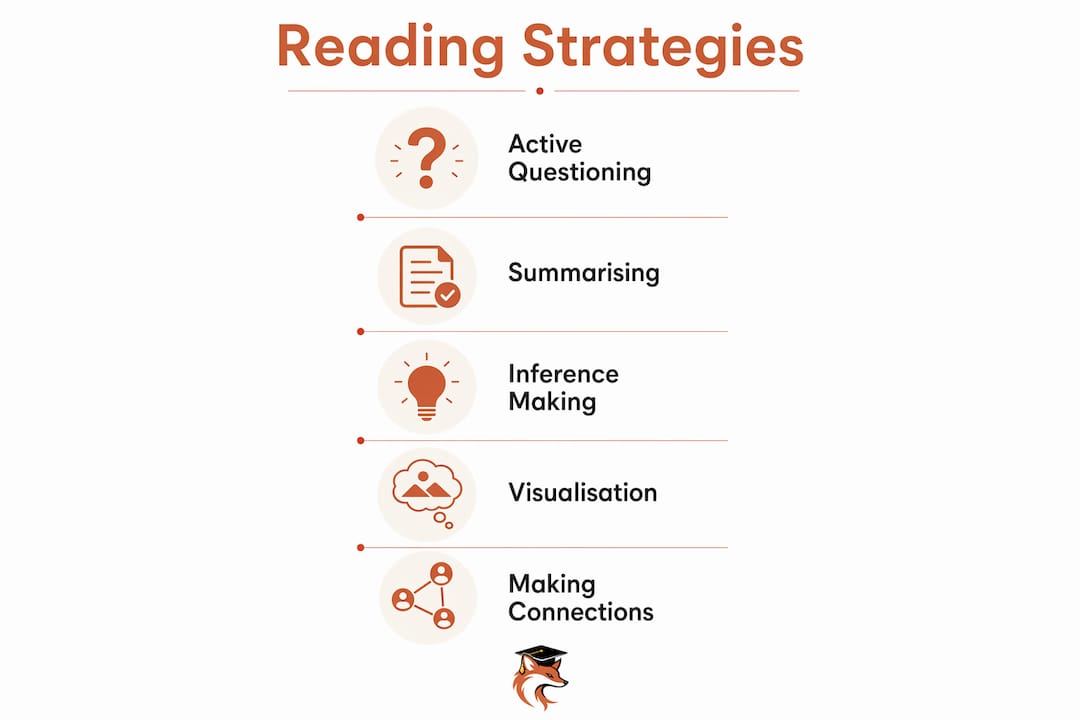
For elementary students, prioritise visualisation and making connections to personal experience. For secondary students, shift toward macro-strategies: identifying the main thread of a text, recognising text structure, and self-monitoring for comprehension breakdowns. Quebec’s FRQ research confirms that macro-strategy use and self-efficacy both increase when teachers and tutors apply explicit modelling consistently.
Bridging pleasure reading and academic reading is also worth addressing directly. Quebec educational researchers note that treating these as entirely separate activities misses an opportunity. A student who reads graphic novels for fun can be guided to apply the same inference skills to a “texte courant” in class. The CTREQ inventory recommends offering choice, linking reading to personal interests, and using social reading activities to keep motivation alive.
Pro Tip: Model metacognition out loud for five minutes before your child reads independently. Say things like “I’m confused here, so I’m going to reread that sentence” or “I think the main idea is X because the author keeps coming back to it.” Short, repeated think-alouds are more effective than long explanations.
A simple weekly practice plan your child can follow
Follow this four-week structure and you will see measurable gains in strategy use and reading confidence within a month.
| Day | Activity | Duration | Goal |
|---|---|---|---|
| Monday | Pleasure reading (chosen book) | 15 min | Build habit and enjoyment |
| Tuesday | Academic text + active questioning | 20 min | Practise pre/during/after questions |
| Wednesday | Vocabulary in context (highlight 3 new words, guess meaning from text) | 15 min | Build vocabulary without a dictionary |
| Thursday | Oral summary with a parent or tutor | 10 min | Strengthen summarising and recall |
| Friday | Pleasure reading or audio + text pairing | 15 min | Reinforce fluency and stamina |
| Saturday | Short comprehension check (3 questions on Thursday’s text) | 10 min | Measure retention |
| Sunday | Rest or free choice reading | Optional | Sustain motivation |
Timeline milestones to expect:
- Weeks 1–2: Your child begins using at least one strategy consistently and can retell the main idea of a short text.
- Week 4: Fewer re-reads needed; your child catches their own comprehension breakdowns more often.
- Weeks 8–12: Faster extraction of key ideas from academic texts; noticeably more confidence during class reading tasks.
Research is clear that sustained, regular practice is necessary for real competence gains. Strategy use improves before measured comprehension scores do, so don’t be discouraged if test results lag a few weeks behind the visible behavioural changes.
When does tutoring help, and what should you expect?
The clearest signs that tutoring will help are a plateau despite consistent practice, falling grades in French, or a child who avoids reading because it feels pointless or frustrating. A motivation gap is just as valid a reason to seek support as a comprehension gap.
Quick checklist for parents:
- Your child re-reads passages repeatedly without improvement
- They cannot retell the main idea of a text they just finished
- Comprehension errors are consistent across different text types
- Confidence around reading has dropped noticeably
- Grades in French have declined over two or more reporting periods
If two or more of these apply, booking a diagnostic session is worth doing now rather than waiting.
What a quality tutor should deliver:
- A brief diagnostic assessment covering oral summary, vocabulary-in-context questions, inference tasks, and a strategy inventory
- A personalised plan tied to your child’s specific gaps and the Quebec curriculum
- Explicit modelling of strategies during sessions, not just comprehension questions after reading
- Measurable goals with regular progress reports so you can see what’s improving
Criteria to evaluate any tutoring offer:
- Tutors hold university-level qualifications in education or a related field
- The programme includes curriculum alignment to Quebec’s Ministry of Education expectations
- Progress is tracked session by session with written reports or summaries
- Sessions are flexible enough to fit your family’s schedule
You can also check for signs your child needs academic support before booking.
Québec and Canadian resources worth using right now
Start with Alloprof, BAnQ, Scholastic Canada, and La courte échelle. These four resources cover everything from graded exercises to curriculum-aligned fiction, and most are free or low-cost.
Alloprof is the go-to for Quebec students. Its parent-facing articles walk through each reading strategy step by step, with examples tied directly to the provincial curriculum. The exercises are free and available online any time.
Bibliothèque et Archives nationales du Québec (BAnQ) offers library cards that unlock thousands of French titles in digital and audio formats. Audio-plus-text pairings are especially useful for students who struggle with decoding: they hear fluent French while following along, which builds both comprehension and vocabulary. The Quebec government recommends school libraries and BAnQ as central resources for developing lasting reading habits.
Scholastic Canada publishes French titles across a wide reading-level range, making it straightforward to find matched-level books for both elementary and secondary students. Their levelled readers are particularly useful for building fluency before tackling longer texts.
La courte échelle is a Quebec children’s and young adult publisher with a strong catalogue of fiction rooted in Quebec culture and experience. For secondary students who resist reading, a novel that reflects their own world often breaks the resistance faster than any strategy lesson.
For levelled book recommendations to match your child’s current level, Réussite A+ has curated a starting list. The general rule: begin with texts where your child reads comfortably, then increase complexity every three to four weeks as confidence grows. Mix fiction for pleasure with “textes courants” (informational texts) for academic practice, since Quebec’s curriculum draws heavily on both.
How to track progress and set measurable goals
Track three things: strategy use, comprehension accuracy, and reading stamina. These give you a complete picture without requiring formal tests.
- One-minute oral summary. After each session, ask your child to summarise what they read in 60 seconds. Note whether they can identify the main idea, at least one supporting detail, and the overall structure.
- Three-question comprehension check. Write three questions about the text: one literal (what happened?), one inferential (why did the character do that?), one evaluative (what do you think about the ending?). Track accuracy week over week.
- Vocabulary-in-context check. Choose three words from the week’s reading. Ask your child to explain what each means based on the surrounding sentences, without a dictionary.
Sample measurable goals:
- Within two weeks: “Summarise the main idea of a one-page text in one sentence.”
- Within four weeks: “Answer two out of three comprehension questions correctly without re-reading.”
- Within eight weeks: “Identify the main thread of a two-page ‘texte courant’ independently.”
Log results in a simple notebook or shared document. Online tutoring makes this tracking easier because session notes are recorded automatically and shared with parents after each lesson.
Common mistakes that slow progress (and how to fix them)
The most damaging mistake is treating reading as passive decoding rather than active comprehension. A child who reads every word correctly but cannot explain what they just read has a comprehension problem, not a fluency problem.
Six pitfalls to avoid:
- Over-reliance on the dictionary. Looking up every unknown word breaks reading flow and trains dependence. Teach inferencing instead: use context clues, word roots, and surrounding sentences to guess meaning first.
- Ignoring metacognition. Students who don’t notice when they’ve lost the thread keep reading without understanding. Model the recovery moves explicitly: stop, identify where understanding broke down, reread that section, adjust pace.
- Treating all texts the same. A narrative novel and a science “texte courant” require different strategies. Textes courants represent a large portion of what students encounter academically and demand inference, navigation of graphics, and specialised vocabulary skills.
- One-off vocabulary lists. Memorising words in isolation rarely sticks. Vocabulary learned in context, through reading, transfers far better.
- Prioritising speed over understanding. Reading faster is not the goal at this stage. Reading with comprehension is. Speed follows naturally once strategies are automatic.
- Skipping pleasure reading. Academic practice alone drains motivation quickly. The CTREQ inventory is clear that choice, interest, and social reading activities are what keep adolescents engaged over time.
Sustainable practice means short, consistent sessions with one strategy focus, not intensive weekend cramming sessions that exhaust a child’s willingness to read.
Key takeaways
Consistently applying explicit reading strategies, matched-level texts, and regular progress tracking is the most reliable path to stronger French reading comprehension for Quebec elementary and secondary students.
| Point | Details |
|---|---|
| Start with matched-level texts | Choose books where your child understands most of the words to build fluency without frustration. |
| Practise one strategy daily | Active questioning, summarising, and inference-making are the highest-impact strategies to rotate through. |
| Follow the four-week plan | Use the weekly schedule above; expect visible strategy gains within two weeks and confidence gains by week four. |
| Track three simple metrics | Monitor oral summary quality, comprehension quiz accuracy, and vocabulary-in-context guessing each week. |
| Réussite A+ for personalised support | When progress plateaus or motivation drops, Réussite A+’s university-level tutors and personalised plans provide structured, curriculum-aligned support. |
Our perspective on what actually works
The conventional wisdom says “just read more.” That advice is not wrong, but it is incomplete in a way that leaves a lot of students stuck. Reading more of the wrong texts, at the wrong level, without any strategy guidance, can actually reinforce passive habits rather than break them.
What Quebec research consistently shows is that the how of reading instruction matters as much as the how much. Students who are explicitly taught to monitor their own comprehension, recover from confusion, and extract the main thread of a text make faster, more durable gains than students who simply accumulate reading hours. That’s not a small distinction. It’s the difference between a child who reads and a child who reads with understanding.
There’s also a motivation dimension that parents often underestimate. Adolescents who feel no sense of choice or personal relevance in what they read disengage, and no amount of strategy instruction fixes that. The answer isn’t to abandon academic texts; it’s to build enough pleasure reading into the routine that the academic work feels like a smaller part of a larger reading life.
Réussite A+’s approach is built on exactly this combination: explicit strategy instruction, curriculum alignment, and a personalised plan that accounts for what actually motivates each student. With more than 25 years of experience and a track record of over 3,500 students supported, the methodology is grounded in what Quebec’s own research says works.
Réussite A+ can help your child move forward
Réussite A+ offers personalised French reading tutoring built around a diagnostic-first approach: every student starts with a brief assessment that identifies their specific comprehension gaps, strategy use, and confidence level. From there, a university-level tutor builds a custom plan aligned to the Quebec curriculum, with flexible online scheduling that fits your family’s week.

Parents receive regular progress updates so you always know what’s improving and what to work on next. Whether your child is in elementary school building foundational habits or in secondary school preparing for entrance exams, the support is calibrated to where they are right now.
Ready to see the difference a structured, personalised plan makes? Book a tutoring session or explore the advantages of online tutoring to find the right fit for your child.
Useful sources
These are the most authoritative sources for evidence-based French reading instruction in Quebec. Tutors and parents will find reproducible strategies and curriculum-aligned guidance in each one.
- FRQ — Explicit reading strategy instruction and motivation at the secondary level: The foundational Quebec research on explicit instruction, macro-strategies, and self-efficacy. Essential reading for any tutor working with secondary students.
- Gouvernement du Québec — Developing children’s reading habits: Official guidance on family and school practices, including library use and adult role modelling.
- CTREQ — Motivating 10–20 year-olds to read for pleasure: Practical inventory of motivational strategies, including reading clubs, mentorship, and interest-based projects.
- ADEL/UQAM — Pedagogical guide: 8 strategies for understanding “textes courants”: Detailed classroom strategies for the informational texts that make up the bulk of Quebec’s academic reading demands.
- Alloprof — Helping your child develop reading strategies: Parent-friendly explanations of each core reading strategy, with examples and warning signs to watch for.
FAQ
How long does it take to improve French reading skills?
With consistent daily practice of short sessions and explicit strategy instruction, most students notice improved strategy use within a few weeks and measurable comprehension gains after sustained practice.
What are the best books for French learners in Quebec?
Scholastic Canada offers levelled French readers across elementary and secondary grades, while La courte échelle publishes Quebec-rooted fiction that resonates with local students. BAnQ provides free digital and audio access to both.
How does Réussite A+ support French reading improvement?
Réussite A+ begins with a diagnostic assessment, then assigns a university-level tutor who builds a personalised plan targeting each student’s specific comprehension gaps, with ongoing progress monitoring and curriculum alignment to Quebec’s programme.
What is the difference between pleasure reading and academic reading in French?
Pleasure reading builds motivation, vocabulary, and fluency through student-chosen texts; academic reading develops the inference and text-structure skills needed for school. Quebec researchers recommend combining both in a weekly routine for the best results.
How can parents help without being French experts themselves?
Ask your child to summarise what they read in one or two sentences after each session. That simple habit reinforces the summarising strategy and gives you a clear signal of whether comprehension is happening, no French expertise required.