



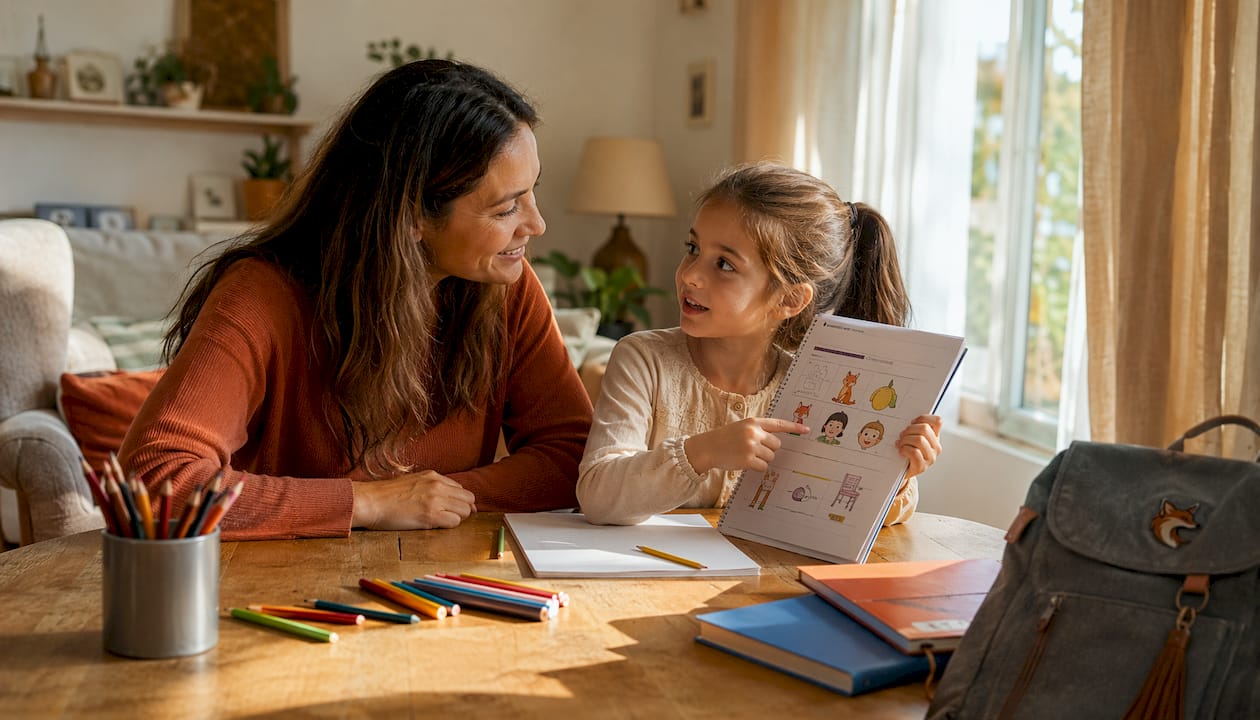
You can strongly support your child’s French learning even if you don’t speak a word of it yourself. Your attitude, your consistency, and the environment you create at home matter far more than your fluency. Start tonight with these three steps:
- Set a consistent homework spot and time — same place, same time every day, even if sessions are short.
- Add a few minutes of French exposure daily — a French show, an audiobook, or a read-aloud before bed.
- Ask one guiding question — “What did you learn in French today?” is enough to get the conversation going.
If your child is showing signs of persistent struggle — falling grades, avoidance, or low confidence — that’s the signal to consider a tutor sooner rather than later.
Table of Contents
- Do you need to speak French to help your child succeed?
- How can you help with French homework when you don’t speak it?
- Simple daily habits that build French at home
- What are the best free and paid French resources for kids in Canada?
- When does tutoring help, and how do you choose a tutor in Canada?
- Quick French phrases and phonics moves you can learn in minutes
- What does progress look like, and when should you escalate?
- How French learning connects to Canadian school curriculum expectations
- Key takeaways
- What actually makes the difference for non-French parents
- Réussite A+ supports your child’s French learning
- Useful Canadian sources and further reading
- FAQ
Do you need to speak French to help your child succeed?
The short answer is no, and Canadian research backs that up clearly. Canadian Parents for French links a positive parental attitude directly to higher achievement in French-as-a-second-language programmes. What predicts success isn’t whether you can conjugate a verb — it’s whether your child senses that you value the language.
This plays out across the country. In British Columbia, many students in francophone schools have at least one non-Francophone parent, which means non-French-speaking households are the norm in many programmes, not the exception. Families navigate it successfully every year.
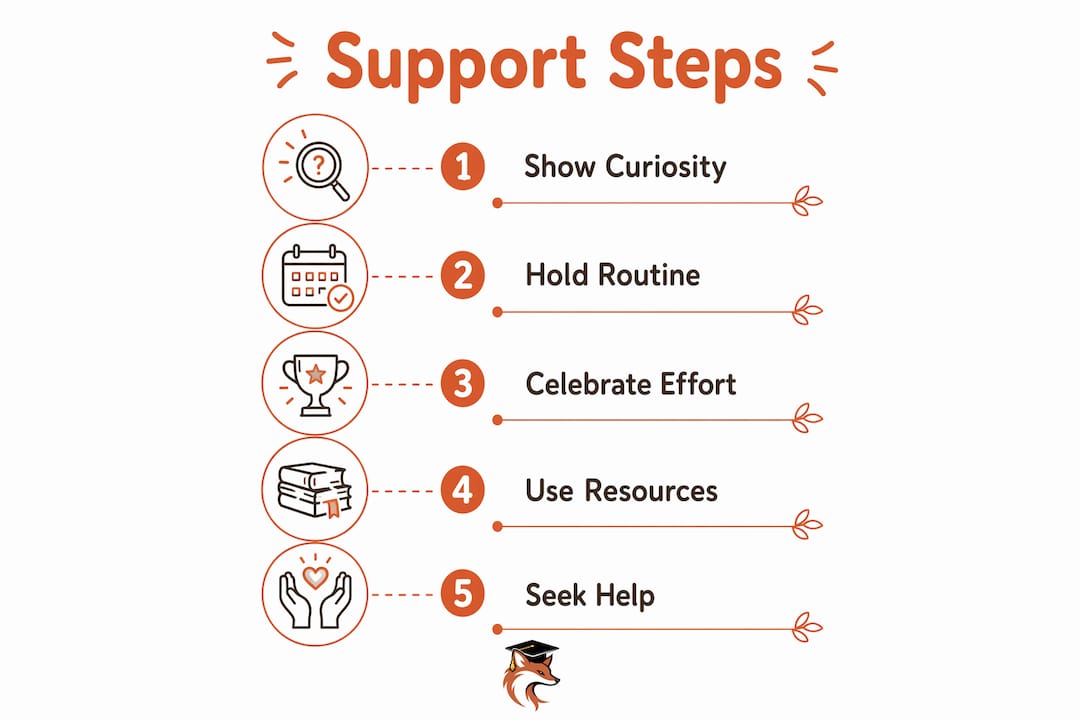
Your job is not to be a French teacher. It’s to show curiosity, hold the routine, and celebrate effort. That combination is genuinely powerful.
How can you help with French homework when you don’t speak it?
Homework support doesn’t require translation. It requires structure, good questions, and a few practical tools. Here are five approaches that work:
Create a consistent routine and workspace. A predictable time and a clutter-free spot reduce resistance before the first pencil touches paper. A 15-minute homework organisation system can make the whole evening calmer.
Use guiding questions instead of giving answers. Ask: “Which words in the instructions do you recognise?” or “Does any word look like an English word you know?” These prompts build metacognitive skills and help your child work through instructions independently, even when the text is in French.
Work beside your child. You don’t need to understand the assignment to be present. Sit nearby, do your own reading or tasks, and check in every few minutes. Your presence signals that the work matters.
Photograph the instructions. Take a photo of the assignment sheet and ask your child to highlight or translate the key words. This creates a shared reference point and encourages independence rather than dependence on you.
Use colour-coding for word families. For struggling readers, colour-coding parts of speech or word families helps with pattern recognition even when you can’t translate the full text. Translation apps are a last resort — use them to verify, not to replace your child’s thinking.
Pro Tip: Ask your child to explain the assignment to you in English before they start. If they can’t explain it, they likely haven’t understood it yet — and that’s the moment to contact the teacher, not to guess.

Simple daily habits that build French at home
Short, consistent exposure beats occasional long sessions every time. District guides recommend as little as 5–10 minutes of French daily to support immersion learning, and that’s a target most families can actually hit.
The most accessible starting point is your home language. Reading frequently in the language you speak at home raises metalinguistic awareness — the ability to think about how language works — and those skills transfer directly to French reading and comprehension. So reading an English novel together isn’t wasted time; it’s building the same cognitive muscles your child uses in French class.
A few activity templates that work well:
- Picture walks: Before reading a French book, flip through the pages and ask your child to predict what the story is about from the illustrations alone.
- Prediction prompts: “What do you think happens next?” works in any language and sharpens comprehension.
- Bilingual read-alouds: Read the English version of a book your child is reading in French. Discuss the story together. Comprehension deepens when the same narrative lives in both languages.
For media, encourage French shows with subtitles — TFO, Zone des petits, and Ici Radio-Canada’s Zone jeunesse are all age-appropriate and free. Rotating between the French and English versions of a favourite film is another low-effort way to increase exposure without it feeling like homework.
Pro Tip: Let your child teach you a French word or phrase each evening. Teaching strengthens the learner’s fluency and confidence — and your child will love correcting your pronunciation.

What are the best free and paid French resources for kids in Canada?
Canada has a genuinely strong ecosystem of French resources, and many of the best ones cost nothing.
Free resources:
- Storybooks Canada — Stories read aloud in French with highlighted text so children can follow along word by word. Excellent for early readers.
- TFO and Mini TFO — Ontario’s French-language educational broadcaster offers free streaming for children of all ages.
- Ici Radio-Canada (Zone des petits / Zone jeunesse) — Free, age-sorted French content from Canada’s national public broadcaster.
- Public library — Most Canadian public libraries carry French books, audiobooks, and films. A library card also unlocks digital collections.
- Sora — Students can borrow French e-books and audiobooks through their school or public library account. Ask your child’s teacher for the login details.
- L’École ouverte — Learning resources from the Quebec Ministry of Education, available at ecoleouverte.ca.
Paid options (and when they’re worth it):
| Resource type | Best for | Cost range |
|---|---|---|
| Structured online tutoring | Skill gaps, exam prep, confidence | Varies by provider |
| Guided reading subscriptions | Building a home French library | Low monthly fee |
| French summer programmes | Immersive exposure during school breaks | Varies by programme |
For choosing apps and channels, match the tool to your child’s reading level, not their age. A Grade 4 student who started French immersion in Kindergarten reads at a very different level than one who started in Grade 4. Ask the classroom teacher for a reading level benchmark before downloading anything.
When does tutoring help, and how do you choose a tutor in Canada?
Not every child needs a tutor, but some signs make the decision straightforward. Watch for: persistent gaps that don’t close after a few weeks of extra practice, a drop in confidence or a sudden reluctance to go to school, avoidance of French homework specifically, or assessment results that show the same skill missing repeatedly.
Tutoring works best as a complement to classroom instruction, not a replacement. A good tutor consolidates skills the teacher has introduced, teaches strategies for tackling unfamiliar text or grammar, and prepares students for specific assessments like Quebec secondary school entrance exams.
When evaluating a tutoring service, ask these questions:
- What diagnostic assessment do you use before the first session?
- How is the learning plan customised to my child’s specific gaps?
- What does a progress report look like, and how often will I receive one?
- Is a trial lesson available before committing to a full programme?
- What qualifications do your tutors hold?
Réussite A+ offers personalised online tutoring for elementary and secondary students across Quebec, specialising in French and Mathematics. Every student receives a customised learning plan built around their individual strengths and gaps. Tutors are selected at the university level for academic excellence and teaching ability. With more than 3,500 students helped and a 99% client satisfaction rate, the results are consistent and measurable.
Quick French phrases and phonics moves you can learn in minutes
You don’t need to become bilingual to be useful. A handful of phrases and a few phonics pointers go a long way.
Everyday phrases with pronunciation hints:
- Bravo! (bra-VO) — Well done!
- C’est bien! (say byAN) — That’s good!
- Essaie encore. (es-SAY on-KOR) — Try again.
- Tu peux le faire. (too puh luh FAIR) — You can do it.
- C’est l’heure des devoirs. (say lur day duh-VWAR) — It’s homework time.
Three phonics rules worth knowing:
- H is always silent — heure sounds like “ur,” not “hur.”
- S at the end of a plural is silent — les livres sounds like “lay LEE-vruh,” not “lee-vruh-S.”
- Ou sounds like “oo” — vous sounds like “voo,” tout like “too.”
Cognates are your shortcut. Words like possible, capable, important, and animal mean exactly what they look like. Point these out to your child and make a game of spotting them in reading.
For pronunciation practice, Simon Fraser University’s Beginner’s French phonics resources are a short, free option parents can work through in under five minutes. Letting your child correct your pronunciation is the whole point — it builds their confidence and makes the learning feel like play.
What does progress look like, and when should you escalate?
Progress in French immersion is rarely linear, and the first few months often feel slower than parents expect. A realistic timeline for elementary grades looks roughly like this:
- After 3 months: Your child recognises common classroom vocabulary and can follow simple routines in French. Reading may still feel laboured.
- After 6 months: Comprehension improves noticeably. Your child starts using French words spontaneously at home.
- After 1 year: Reading fluency builds, writing shows basic sentence structure, and oral confidence grows in familiar contexts.
These are general patterns, not guarantees. Children who started immersion later, or who have a learning difference, may follow a different curve.
Clear escalation signs include: falling grades in both French and English (which suggests a broader learning need, not just a language gap), repeated inability to follow classroom instructions after several months, or visible anxiety around anything French-related. When you see these, document specific observations — dates, examples of work, what your child said — and bring that record to a teacher meeting. Concrete notes make the conversation far more productive than general concerns.
How French learning connects to Canadian school curriculum expectations
Every province structures French education differently, and knowing your local framework helps you support your child more precisely.
In Quebec, French is the language of instruction across all subjects in the public system, so gaps in French affect every course. The Quebec Ministry of Education’s curriculum sets clear competency expectations at each grade level, and secondary school entrance exams test those competencies directly. Staying aligned with the school’s programme means knowing which skills are assessed and when.
In Ontario, the French Immersion curriculum is governed by the Ontario Ministry of Education and balances oral communication, reading, and writing across all grades. The curriculum explicitly prioritises oral skills as the foundation for literacy, which means talking about stories and ideas at home — in any language — directly supports what teachers are building in class.
In British Columbia, the BC Ministry of Education oversees French immersion programmes with specific learning standards for each grade band. The province also supports francophone schools through the Conseil scolaire francophone, which serves families across the province regardless of their home language.
Across all provinces, the practical implication is the same: check the grade-level expectations on your provincial Ministry of Education website, ask your child’s teacher which competencies are being assessed this term, and align your home support to those specific targets. A tutor who understands provincial curriculum standards can close gaps far more efficiently than general practice alone.
Key takeaways
Parents who don’t speak French can meaningfully support their child’s learning through consistent routines, guiding questions, daily exposure, and well-chosen Canadian resources — with tutoring as a targeted escalation when gaps persist.
| Point | Details |
|---|---|
| Attitude over fluency | Canadian research links positive parental attitude to higher French achievement — your mindset matters more than your vocabulary. |
| Daily 5–10 minutes | Short, consistent daily exposure builds habit and reduces resistance more effectively than occasional long sessions. |
| Home language literacy | Reading in your home language strengthens skills that transfer directly to French reading and comprehension. |
| Escalation signs | Falling grades in both languages, avoidance, or persistent anxiety are clear signals to involve a teacher or tutor. |
| Réussite A+ | Offers personalised online French tutoring for Quebec students, with customised plans, university-level tutors, and a 99% satisfaction rate. |
What actually makes the difference for non-French parents
The parents who feel most confident supporting their child’s French aren’t the ones who secretly took evening classes. They’re the ones who stopped apologising for not speaking French and started showing up consistently in the ways they could.
There’s a tendency to think that not speaking the language means you have nothing to offer. That belief is the real obstacle, not the language gap. A parent who asks “What did you learn today?” every single evening, who sits beside their child during homework, who celebrates a new French word the way they’d celebrate a goal — that parent is doing more than most. The research on parental attitude and student outcomes isn’t subtle on this point.
The one concrete behaviour worth adopting immediately: make French feel normal in your home, not special or stressful. Put on a French show during dinner. Let your child teach you a word. Laugh when you mispronounce it. Children absorb the emotional register of the adults around them. When French feels like a natural part of daily life rather than a subject to dread, the whole trajectory shifts.
Réussite A+ supports your child’s French learning
Knowing what to do at home is one thing. Having a qualified tutor who can diagnose exactly where your child is struggling and build a plan around it is another. Réussite A+ offers personalised online tutoring and homework help for elementary and secondary students across Quebec, with a focus on French and Mathematics.
Every student starts with a diagnostic assessment. From there, a customised learning plan targets the specific gaps holding your child back — whether that’s reading comprehension, grammar, oral expression, or exam preparation for secondary school entrance. Sessions are flexible, online, and led by university-level tutors selected for both academic excellence and their ability to connect with students.
Three outcomes parents consistently report:
- Renewed confidence — children who dreaded French begin to engage with it willingly.
- Measurable skill gains — progress is tracked and reported so you always know where your child stands.
- Exam readiness — for students preparing for Quebec secondary school entrance exams, the preparation is structured and proven.
With more than 25 years of experience and over 3,500 students helped, Réussite A+ has the track record to back it up. To get started, register for a tutoring session and have your child’s most recent report card or assessment ready for the first conversation.
Useful Canadian sources and further reading
| Source | What it offers | How to use it |
|---|---|---|
| Canadian Parents for French (CPF) | Research on parent attitude and student outcomes in FSL programmes | Share with teachers; use to understand what predicts success |
| Fédération des parents francophones de C.-B. (FPFCB) | Practical guides for non-French-speaking parents in francophone schools | Download the parent resources section for homework tips |
| Storybooks Canada | Free French read-alouds with highlighted text | Use for nightly 5–10 minute read-aloud sessions |
| Sora (soraapp.com) | French e-books and audiobooks via school or library account | Ask your child’s teacher for the district login |
| SD62 French Immersion Parent Guide | Comprehensive parent guide including phonics tips and resource lists | Print the phonics section and keep it near the homework spot |
| WRDSB French Immersion Parent Guide | Ontario-focused guide on oral language, literacy, and curriculum expectations | Use the “Talk, talk, talk” section to build oral skills at home |
FAQ
What is the best way for kids to learn French at home?
Short, consistent daily exposure works better than occasional long sessions. Combining read-alouds, French media with subtitles, and guiding questions in the home language builds both vocabulary and comprehension over time.
Do I need to speak French to help my child with their French homework?
No. Canadian Parents for French research shows that a positive parental attitude predicts higher achievement more reliably than parental fluency. Guiding questions, consistent routines, and encouragement are the tools that matter most.
What is a good app or tool for children learning French in Canada?
Storybooks Canada offers free French read-alouds with highlighted text for early readers, while Sora gives students access to French e-books and audiobooks through their school or public library account. TFO and Zone des petits are strong free video options for younger children.
What is the best age to start French immersion in Canada?
Early French immersion typically begins in Kindergarten or Grade 1, and research consistently shows that earlier exposure supports stronger long-term fluency. That said, children who start in middle immersion (Grade 4–5) or late immersion (Grade 6–7) can still reach strong proficiency with consistent support.
When should I consider a French tutor for my child?
Consider tutoring when gaps persist after several weeks of home support, when grades drop in both French and English, or when your child shows avoidance or anxiety around French. Réussite A+ offers a diagnostic-first approach with customised plans designed to close specific skill gaps efficiently.