




The single most effective approach to high school entrance exam preparation combines a diagnostic assessment, a focused weekly study plan, regular mock exams, and targeted tutoring wherever gaps appear. Start here, in the next 48 hours:
- Book a diagnostic assessment with a qualified tutor or programme like Réussite A+ to pinpoint exactly where your child stands.
- Gather the last two years’ report cards — most independent schools, including those listed through Independent Schools Quebec, request them as part of the application.
- Confirm your target school’s test date and format (many Quebec schools use a common admissions calendar).
- Schedule a daily 20-minute practice slot this week, even before formal prep begins.
- Check Alloprof’s parent guidance for a clear overview of what the exam covers and how to approach review.
Table of Contents
- What does a high school entrance exam actually test?
- How do prep programmes work, and when should you start?
- A week-by-week study plan and test-taking strategies
- How to use mock exams to close gaps fast
- How do you choose the right prep programme?
- What results does personalised tutoring actually produce?
- How parents can support their child’s preparation
- Key takeaways
- What we have seen over 25 years of exam prep
- Réussite A+ exam prep: personalised support across Quebec
- Useful sources
- FAQ
What does a high school entrance exam actually test?
Entrance exams typically assess Grade 5-level skills across four core areas: French or English language, mathematics, general knowledge, and critical thinking. That means your child does not need to master secondary-level content — the goal is demonstrating solid mastery of elementary fundamentals.
| Subject area | Typical question types |
|---|---|
| French / English language | Spelling, vocabulary, grammar, reading comprehension |
| Mathematics | Fractions, operations, number sense, word problems |
| General knowledge | Science, social studies, current events |
| Critical thinking | Verbal reasoning, non-verbal patterns, visual logic |
Before test day, confirm these logistics with each school:
- Total exam duration (typically around three hours; breaks are usually not permitted)
- Whether the exam is in person or online supervised
- For online exams: a personal computer with webcam, microphone, and a compatible browser (Chrome, Edge, Safari, or Firefox) is usually required — tablets and phones are often incompatible
- Calculators or other approved materials
- Special accommodations and how to request them
- Application fees (some schools charge a non-refundable fee; Académie Ste-Cécile, for example, lists a $300 CAD application fee) and document requirements
The admissions process at Quebec independent schools can include a school visit, open house, entrance exam, application review, and interview. Scores matter, but so does overall fit — so prep should address the whole picture, not just raw marks.
How do prep programmes work, and when should you start?
Most structured prep packages follow the same basic shape: an initial diagnostic, weekly lessons targeting identified gaps, assigned practice between sessions, scheduled mock exams, and a written progress report. What varies is the intensity and duration.
| Prep type | Duration | Weekly hours | Mock exams | Best for |
|---|---|---|---|---|
| Light review | 4 weeks | 2–3 hrs | 1 | Strong students, minor gaps |
| Standard prep | 8–12 weeks | 3–4 hrs | 2–3 | Most students |
| Intensive boot camp | 2 weeks | 6–8 hrs | 2 | Late starters |
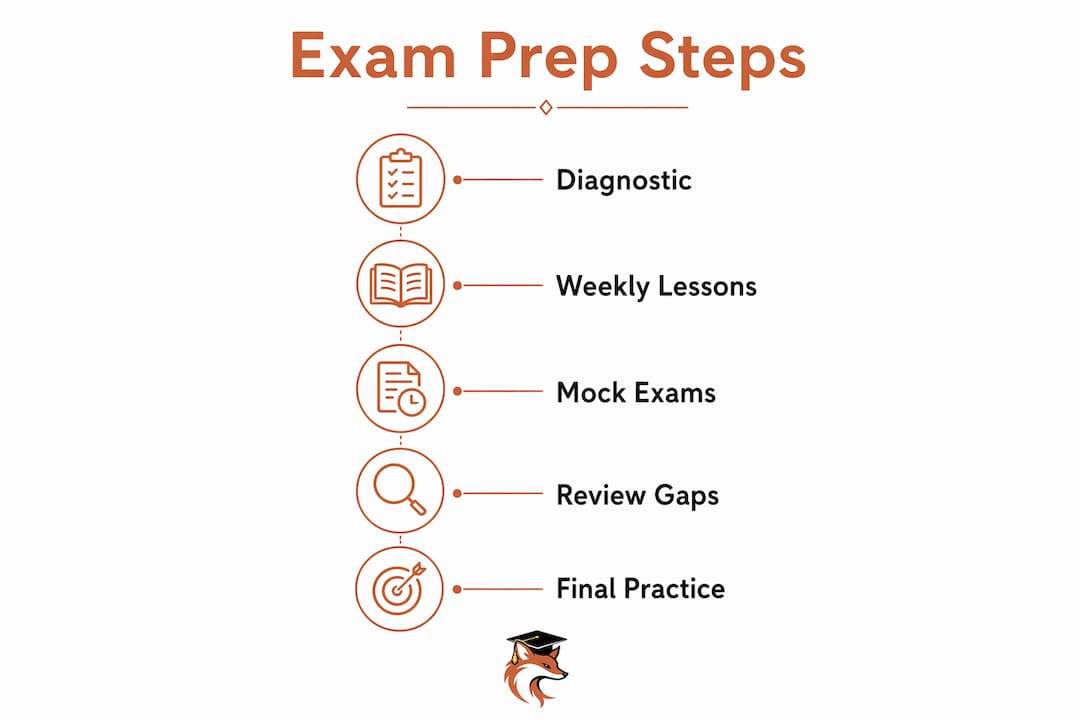
Alloprof recommends roughly 10–15 hours of study spread over several weeks for a thorough review. That maps neatly onto a standard 8-week plan at 2–3 hours per week, with mock exams layered in at weeks 4 and 8.
Registration and deadline reminders:
- Most Quebec independent schools open applications in the fall for the following September entry.
- Common admissions test dates (used by schools such as LCC, The Study, and St. George’s through the Quebec Association of Independent Schools) are typically announced in late summer — check the QAIS calendar early.
- Application fees are usually non-refundable, so confirm the school is a genuine fit before paying.
- Gather required documents early: last two years’ report cards, birth certificate, and a passport-size photo are commonly requested.
A week-by-week study plan and test-taking strategies
A practical plan for a Grade 5 or 6 student looks like this:
- Week 1–2 (Diagnostic and foundations): Complete a diagnostic assessment. Use results to build a subject priority list. Begin with the weakest area — usually mathematics or reading comprehension — for 20–25 minutes per day.
- Week 3–5 (Focused review): Rotate through all four subject areas across the week. Dedicate two sessions to math (fractions, operations, word problems), two to language (spelling, grammar, comprehension passages), and one to reasoning patterns.
- Week 6–7 (Mock exam and gap-closing): Run a full timed mock. Score it, identify the top three error patterns, and spend the following week drilling those specific skills.
- Week 8 (Light review and confidence): Reduce intensity. One short review session per day, one final timed practice section, and focus on sleep and routine.
Subject-specific tactics worth knowing:
- Math: Practise word problems out loud — verbalising the steps catches errors that silent reading misses. Review fractions, equivalent fractions, and multi-step operations weekly.
- Language: Build a personal list of spelling “trap words” your child consistently misses. Read one short passage daily and summarise it in two sentences.
- Reasoning: Pattern tests improve with repetition. Use timed sets of 10 questions rather than open-ended practice — the clock is part of the skill.
Test-taking strategies on exam day:
- Triage questions on first pass: answer what you know, mark uncertain ones, skip and return.
- Allocate time by section before starting — if the exam is three hours with four sections, that is roughly 40–45 minutes per section.
- For multiple choice, eliminate two wrong answers first; then choose between the remaining options.
- Use time management techniques practised during mock exams, not invented on the spot.
Pro Tip: Simulate the full exam timing at least once before attempting any complex reading tasks under pressure. Children who have sat through a three-hour timed session once perform noticeably more calmly the second time.
Short, regular sessions work better than long marathons for this age group. Fifteen to thirty minutes of focused practice maintains concentration far better than a two-hour block — save longer sessions for the final two weeks when stamina needs building.

How to use mock exams to close gaps fast
A mock exam is only as useful as what you do with the results. Setting it up properly matters just as much as scoring it.
Setting up a realistic mock:
- Use a timer and enforce the full exam duration without interruption.
- For online-style exams, use a single screen and have an adult act as invigilator.
- Replicate allowed materials exactly (pencil, eraser, no calculator unless permitted).
- Confirm the technical setup in advance: personal computer, compatible browser, working webcam and microphone.
| After the mock | What to do |
|---|---|
| Score each section separately | Identify which subject areas lost the most marks |
| Review every wrong answer | Determine whether the error was a knowledge gap or a time/careless mistake |
| Rank the top 3 skill gaps | Focus the next two study sessions entirely on those areas |
| Note time spent per section | Adjust pacing strategy for the real exam |
A well-structured diagnostic report should include a score by topic, an item-level breakdown, and a ranked list of recommended lesson focuses. If a provider cannot show you a sample report before you sign up, that is a red flag.
Pro Tip: Practise pencil-and-paper answering even if the real exam is online. The physical act of writing slows down impulsive answer selection and reduces careless errors — a habit worth building early.
Timed mock exam practice is most valuable when paired with a clear, item-level diagnostic that converts errors into a ranked lesson plan. Without that second step, a mock is just a score.
How do you choose the right prep programme?
Not all prep courses are equal. Here is what to look for — and what to avoid.
Core selection criteria:
- A structured diagnostic at the start, not a generic placement quiz
- Tutors selected at the university level for subject knowledge and teaching ability
- Documented success rates or client satisfaction data
- Regular progress reports with item-level detail
- Flexible scheduling that fits your family’s calendar
Questions to ask any provider:
- Can I see a sample diagnostic report?
- How are your tutors screened and trained?
- How many mock exams are included, and are they timed under real conditions?
- What is your cancellation or refund policy if we need to pause?
- How do you communicate progress to parents between sessions?
Red flags to watch for:
- No diagnostic before lessons begin
- Vague claims like “high success rate” with no supporting data
- Pressure to commit to a long package before seeing any results
- No sample report available on request
- Tutors whose qualifications are not disclosed
Pro Tip: Ask for a trial session before committing. A provider confident in their methodology will offer one. If they resist, keep looking.
Comparing value means looking at hours of instruction, number of mock exams, and reporting quality together — not advertised price alone. A cheaper package with no diagnostic or reporting often costs more in the end, in both time and results.
What results does personalised tutoring actually produce?
Réussite A+ has 25+ years of educational experience, has helped more than 3,500 students, and maintains a 99% client satisfaction rate — figures that reflect a methodology built around measurable progress, not generic instruction.
The methodology works in four steps:
- Diagnostic assessment: Every student begins with a personalised assessment that maps strengths, gaps, and learning pace — not a one-size-fits-all placement test.
- Personalised lesson plan: Lessons are built around the diagnostic results, targeting the specific skills the exam will test.
- University-level tutors: Every tutor is selected for academic excellence and teaching ability, not just subject knowledge.
- Progress tracking and mock exams: Regular checkpoints and scheduled mock exams with written reports let families see exactly where improvement is happening — and where to focus next.
Families typically see measurable gains in diagnostic scores between the first and second mock exam, alongside a noticeable improvement in their child’s confidence going into test day.
How parents can support their child’s preparation
Your role during prep is more important than you might think — and it does not require you to reteach Grade 5 mathematics.
The most effective thing a parent can do is create a calm, consistent study environment. That means a set time each day, a quiet space, and a predictable routine. Children who know exactly when study happens spend less mental energy resisting it.

Talking openly about the exam format, duration, and rules also reduces anxiety. When children know what to expect — a test lasting about three hours with no breaks, and a webcam if online — the unknown stops feeling threatening. Specific, honest preparation beats vague reassurance every time.
Celebrate effort, not just scores. After a mock exam, ask “What did you figure out today?” before asking “How did you do?” That small shift keeps motivation steady through a multi-week prep period. For practical pre-exam routines around sleep and nutrition, Réussite A+’s parent-facing stress tips are worth bookmarking.
Finally, stay in contact with your child’s tutor. Progress reports are most useful when parents read them, ask questions, and adjust the home practice schedule accordingly. You are the bridge between the tutoring session and the daily habit.
Key takeaways
Effective high school entrance exam preparation requires a diagnostic assessment, a structured weekly plan, regular timed mock exams, and targeted tutoring to close specific skill gaps before test day.
| Point | Details |
|---|---|
| Start with a diagnostic | Identify your child’s exact gaps before choosing study topics or a prep package. |
| Plan for 10–15 study hours | Spread review across several weeks; short daily sessions outperform long weekend blocks. |
| Run at least two timed mocks | Score each section separately and use item-level results to direct the next week’s focus. |
| Confirm school logistics early | Check test format, tech requirements, fees, and document deadlines well before the application window closes. |
| Réussite A+ for targeted prep | Réussite A+ offers diagnostic assessment, personalised lesson plans, university-level tutors, and mock exams with written progress reports across Quebec. |
What we have seen over 25 years of exam prep
Parents often ask whether a few weeks of prep can really make a meaningful difference. The honest answer is: it depends entirely on how that prep is structured. Generic review workbooks and last-minute cramming rarely move the needle. What does work is starting with an honest picture of where a child actually stands, then building a plan around that picture — not around a generic curriculum.
Families sometimes underestimate how much the exam format itself affects performance. A child who has never sat through an approximately three-hour timed session will spend the first hour of the real exam adjusting to the experience rather than demonstrating what they know. That is not a knowledge problem; it is a preparation problem, and it is entirely solvable with the right practice conditions.
After 25 years and more than 3,500 students, the pattern is consistent: children who arrive at the exam having completed at least two realistic mock exams, with a tutor who knows their specific gaps, perform with noticeably more confidence and accuracy. The goal is never to make the exam feel easy. It is to make it feel familiar.
Réussite A+ exam prep: personalised support across Quebec
Réussite A+ offers something most generic prep courses do not: a preparation programme built around your child specifically, not around an average student. Every family begins with a personalised diagnostic assessment that maps exactly where their child stands across French, mathematics, and reasoning skills.
From there, a university-level tutor builds a lesson plan targeting the gaps the diagnostic reveals, schedules timed mock exams at the right intervals, and delivers written progress reports after each one. Sessions are conducted online, with flexible scheduling that fits around school and family life throughout Quebec.
The exam preparation programme at Réussite A+ is designed for students in Grade 5 and 6 preparing for secondary school admissions. With a 99% client satisfaction rate and 25+ years of experience, the results are consistent and measurable. Ready to see where your child stands? Register for a diagnostic session and get a personalised plan within the week.
Useful sources
Official school and admissions resources:
- Independent Schools Quebec — Admissions overview: General admissions process for Quebec private schools, including application steps and what to expect.
- Quebec Association of Independent Schools — Admission process and exam calendar: Common admissions test dates and the confidential school report form used by participating schools.
- Sacred Heart School of Montreal — How to apply (Grades 7–11): Document checklist and entrance test requirements for older grades.
- Académie Ste-Cécile — Admissions: Staged application process and fee information.
- St. George’s — Online exam technical guide (PDF): Technical requirements for online supervised admissions exams.
Study resources:
- Alloprof — How to prepare for the high school entrance exam: Subject breakdown, study hour guidance, and parent-friendly preparation tips.
Réussite A+ resources:
- Exam preparation sessions: Primary landing page for Réussite A+ exam prep packages.
- Mock exam role in preparation: How diagnostic mock exams work and what a progress report includes.
- Exam stress management strategies: Practical techniques for students and parents to manage test anxiety.
- Subject-specific techniques in French and mathematics: Exercises and methods for the two core tested subjects.
FAQ
What is the best way to study for a high school entrance exam?
Start with a diagnostic assessment to identify specific gaps, then follow a structured weekly plan that rotates through all tested subjects. Pair that with at least two timed mock exams and item-level review of errors — that combination consistently produces the strongest results.
How early should a student start preparing for the entrance exam?
An 8–12 week standard prep plan works well for most students, with 10–15 hours of study spread across that period. Students starting with fewer than four weeks should move to an intensive format with daily sessions and at least two mock exams.
What subjects are covered on Quebec high school entrance exams?
Most Quebec independent school entrance exams test French or English language skills (spelling, grammar, reading comprehension), mathematics (fractions, operations, word problems), general knowledge, and critical thinking or reasoning skills — all at approximately a Grade 5 level.
How do you manage exam anxiety before the test?
Open, specific conversations about the exam format, duration, and rules reduce anxiety more reliably than general reassurance. Completing at least one full timed mock exam under realistic conditions also helps considerably — familiarity with the experience lowers stress on the real day. Réussite A+’s stress management strategies offer practical techniques for both students and parents.
Is Grade 11 the hardest year of high school?
Difficulty varies by student and programme, but Grade 11 is widely considered demanding in Quebec because it introduces advanced secondary content across multiple subjects simultaneously. Strong foundational skills built during entrance exam preparation in Grade 6 give students a measurable advantage when they reach those upper years.