




French spelling is rule-governed, not random: most errors come from a small set of predictable patterns, not thousands of unrelated exceptions. Learn the accent rules and the handful of common sound-to-spelling correspondences, such as the common o / au / eau spellings for the /o/ sound or an / en / on spellings for nasal vowels, and you can spell many words more reliably. The fastest path forward is phonics-based practice inside real sentences, not memorizing isolated word lists.
TL;DR:
- Most French spelling errors stem from a small set of predictable sound-to-letter patterns, making phonics-based practice highly effective.
- Accent marks serve specific functions: é indicates a closed “ay” sound, while è distinguishes words and reflects historical letter changes.
- Recognizing common graphemic patterns, such as o/au/eau or nasal vowels before b/p, reduces guesswork and improves spelling consistency.
- Final silent consonants usually follow patterns where “s,” “t,” or “d” are silent, while their presence often signals gender or grammatical modifications.
- Learning regular plural and hyphenation rules, along with distinctions in homophone spelling, helps prevent frequent misunderstandings and mistakes.
Table of Contents
- How French orthography works: the logic behind letters, sounds and history
- French accent marks: what each mark does and practical cues for using them
- Common sound-to-spelling correspondences and frequent grapheme sets
- Silent letters and final consonants: patterns that predict pronunciation
- Plural and compound-word rules: hyphens, borrowed words, and placement
- Tricky verb and orthographic traps learners often miss
- Evidence-based learning strategies and quick practice routines for spelling improvement
- The 1990 orthographic rectifications: what changed and what learners need to know
- Quick-reference cheatsheet: the rules to keep at hand
- Rules for liaison and elision in spelling
- Use and rules of capitalization in French writing
- Hyphenation rules beyond compounds, including numerals and prefixes
- Differences between homophones and how spelling distinguishes them
- Guidelines for gender agreement affecting spelling
- Typographical conventions related to punctuation spacing and quotation marks in French
- Réussite A+ perspective: why a personalised, pattern-based approach works
- How Réussite A+ can help you master these spelling patterns
- Sources
- FAQ
How French orthography works: the logic behind letters, sounds and history
French spelling follows two overlapping systems: a phonemic principle (spelling reflects sound) and a historical principle (spelling preserves origin, grammar, or Latin roots). Neither system runs the show alone, which is exactly why one sound in French can have several accepted spellings.
A grapheme is a written unit that represents a sound: a single letter like “o,” a digraph like “ch” (two letters, one sound), or a trigraph like “eau” (three letters, one sound). French relies heavily on digraphs and trigraphs because its alphabet has only 26 letters to represent roughly three dozen distinct sounds. That mismatch is the root cause of most “silent letter” confusion learners run into.
Morphology and etymology explain the rest. A word’s spelling often preserves a grammatical family member or a Latin ancestor rather than its current pronunciation:
- Petit keeps its final “t” because the feminine form, petite, pronounces it. The silent letter is a clue to a hidden relative.
- Temps carries a silent “p” and “s” inherited from the Latin tempos, not from anything you hear when you say the word.
- Enfant and enfance share a root, so recognizing the family helps you spell both correctly, even though the sounds shift slightly.
This is why French spelling rewards pattern recognition over rote copying. Once a learner sees that chat, chien, and chapeau all share the “ch” digraph, or that grand becomes grande because gender agreement adds a silent letter that surfaces in speech, the system stops looking arbitrary. The rules exist; they’re just distributed across sound, shape, and history rather than sitting in one tidy column. The French orthography system, in fact, developed over centuries as scribes balanced phonetic spelling against preserving a word’s Latin lineage, which is why modern French still carries so many “extra” letters that once had a job to do.
French accent marks: what each mark does and practical cues for using them
Five accent marks appear in written French, and each one does a specific job rather than functioning as decoration. Get comfortable with what each mark signals, and a huge share of spelling errors disappear on their own.
Accent aigu (é)
The acute accent appears only on the letter “e” and produces a closed sound, similar to the “ay” in “say.” You’ll find it constantly at the end of past participles (pale, fini) and in common nouns like café and été. If you hear a crisp “ay” sound on an “e,” reach for the é first; it’s the most frequent accented letter in the language.
Accent grave (è, à, ù)
The grave accent shows up on “e,” “a,” and “u,” though its job changes depending on the letter. On “e,” it opens the sound, so mère and père sound noticeably different from mes or le. On “a” and “u,” it has nothing to do with pronunciation at all; it exists purely to distinguish homophones. Compare a (the verb “has”) with à (the preposition “to/at”), or ou (“or”) with où (“where”). If two words sound identical but mean different things, check whether a grave accent is doing the distinguishing work.
Accent circonflexe (â, ê, î, ô, û)
The circumflex is the accent with the most history behind it. It frequently marks a letter, often an “s,” that disappeared from spelling centuries ago: hospital descends from hospital, fête from fest, île from isle. On “a,” “ê,” and “o,” it still affects pronunciation, giving vowels a slightly longer or more open sound. On “i” and “u,” it usually doesn’t change pronunciation at all, which is exactly why the 1990 rectifications made the circumflex optional on those two letters in most words, except where it distinguishes grammar, such as dû (past participle) versus du (the article).
Tréma (ë, ï, ü)
The diaeresis tells you that two adjacent vowels, which would normally blend into a single sound, need to be pronounced separately. Naïve is pronounced na.ive, not “nave.” Noël keeps its “o” and “e” distinct rather than collapsing into the “oeu” sound you’d expect. When you see two vowels sitting side by side and one carries a tréma, that’s your cue to say both sounds out loud.
Cédille (ç)
The cedilla only ever attaches to “c,” and it has one job: forcing a soft “s” sound before “a,” “o,” or “u,” where a plain “c” would normally sound like “k.” Français, garçon, and façade all need the cedilla because without it, they’d be mispronounced as “frank,” “garçon,” and “faked.” Before “e” and “i,” “c” is already soft on its own, so the cedilla never appears there.
A few practical habits make accents far less painful in daily writing:
- Type accented letters using your device’s built-in French keyboard layout or long-press shortcuts; guessing at accents from memory is where most errors creep in.
- Read your sentence aloud before finalizing it. Open and closed “e” sounds are usually audible if you slow down.
- When two words sound the same, assume a grave or circumflex accent might be the only thing separating them, and check a dictionary.
- Keep a running list of your own recurring accent mistakes rather than trying to memorize every rule at once. Tutors consistently see faster gains when students track their personal error patterns instead of studying accents in the abstract. Our guide on French accent marks breaks down typing shortcuts if that’s where you’re getting stuck.
Pro Tip: Say the word slowly, syllable by syllable, before you write it. Most accent errors happen when learners write from memory rather than from sound; slowing down forces your ear to catch what your hand wants to skip.
Common sound-to-spelling correspondences and frequent grapheme sets
A small set of grapheme patterns accounts for a large share of French spelling. Learn these systematically, and unfamiliar words become far less intimidating because you’re recognizing patterns instead of guessing.
- The /o/ sound: o, au, eau. All three spellings can produce the same closed “o” sound, and there’s no perfect rule for choosing between them, but frequency helps: “eau” appears almost exclusively at the end of words (chapeau, bateau, Nadeau), “au” appears mid-word or before a consonant (Chad, autre), and plain “o” is the default elsewhere (pot, radio). Teaching the pattern’s distribution, rather than memorizing each word individually, is the more efficient strategy for most learners.
- Nasal vowels and the m-before-b/p rule. French nasal sounds, written as an, en, in, and un, normally use “n.” But directly before “b” or “p,” the spelling switches to “m”: chamber, exporter, impossible, sombre. This is one of the most reliable rules in the language; if a nasal vowel is followed by “b” or “p,” the “n” almost always becomes “m,” with rare exceptions like bonbon.
- Digraphs and trigraphs to recognize on sight. “Ch” produces the “sh” sound (chat, checker). “Gn” produces a soft “ny” sound (montage, Agnes). “Ill” often signals a “y” sound (famille, file), though ville and mille are notable exceptions where “ill” stays hard. “Oi” makes a single “wa” sound (moi, voiture), and “ui” makes a quick “wee” sound (hit, cuisine). Spotting these clusters on sight, rather than sounding out each letter individually, is what separates fluent readers from those still decoding word by word.
- Minimal pairs worth drilling. Practising near-identical words sharpens pattern recognition faster than studying rules in isolation: dessin (drawing) versus Hussein (intention), or pain (bread) versus pin (pine tree). These pairs force you to notice that spelling, not sound alone, carries meaning in French.
Silent letters and final consonants: patterns that predict pronunciation
Most French words that end in a consonant don’t pronounce it, and that silence is rarely random. Final “s,” “t,” “d,” “p,” and “x” are silent in the vast majority of common words: les, petit, grand, trop, deux. The exceptions cluster around specific consonants: final “c,” “f,” “l,” and “r” are usually pronounced (sac, chef, mal, finer), which is memorable through the classic teaching acronym CaReFuL, spelling out the consonants that tend to stay audible at the end of a word.
Silent letters aren’t decorative; they carry grammatical information. A word ending in a silent consonant will often make that consonant audible the moment you add a feminine “-e”: petit becomes petite, grand becomes grande, content becomes content. That shift is your built-in proofreading tool. If you’re unsure whether a word needs a final consonant, try making it feminine (even if the sentence doesn’t call for it) and listen for whether the sound reappears.
- Silent final “e” rarely affects pronunciation on its own, but it frequently signals gender or triggers agreement elsewhere in the sentence.
- When in doubt about a silent letter, check the word’s feminine form or a related family member; the sound almost always resurfaces there.
- Rely on morphology (word family, grammatical role) over pronunciation whenever the spoken form gives you no clue at all, since French hides more grammar in silent letters than any other Romance language.
Plural and compound-word rules: hyphens, borrowed words, and placement
Regular French nouns add “s” to form the plural (chat → chats), but several categories break that pattern in predictable ways. Nouns ending in “-eau” take “x” instead of “s” (chapeau → chapeaux, bateau → bateaux). Nouns ending in “-al” typically shift to “-aux” (coeval → cheap, animal → animal), though a handful of exceptions like carnaval → carnivals resist the pattern. Nouns already ending in “s,” “x,” or “z” don’t change at all in the plural (une souris → des souris).
Compound nouns follow their own logic, and this is where a lot of otherwise strong spellers stumble. In a hyphenated compound, only the elements that can logically be plural take the plural marker:
- Un grand-père becomes des grands-pères because both “grand” and “père” can be plural.
- Un timbre-poste becomes des timbres-poste, because “poste” describes the function, not the object, so it stays singular.
- Un porte-monnaie stays invariable, because “porte” is a verb form (from porter, to carry) that never takes a plural.
The 1990 rectifications simplified a chunk of this confusion by recommending “soudure,” welding many hyphenated compounds into single words: portemonnaie and weekend are now accepted alongside the older hyphenated forms. Borrowed words follow a similar francisation trend; week-end and leader have largely been absorbed into standard spelling without their original foreign markings, though usage still varies by publication and region.
Tricky verb and orthographic traps learners often miss
Certain patterns cause disproportionate trouble on tests, and most of them come down to a handful of concrete checks.
- The -eler / -eter rule. Most verbs ending in “-eler” or “-eter” double the consonant in front of a silent “e”: appealer → j’appeal, Peter → je Bette. But a smaller group changes the “e” to “è” instead: Chester → j’machete, Peter → je Pele. There’s no shortcut except memorizing which group a verb belongs to, so keep a running list of the ones you personally mix up.
- Circonflexe as a grammar marker. Even where the 1990 rectifications made the circumflex optional on “i” and “u,” it still matters when it distinguishes forms: dû (past participle of devoir) needs its accent to separate it from du (the article). Teachers should present both accepted spellings but flag which one an exam expects.
- Participle agreement. With avoir, the past participle agrees with a preceding direct object: “Les pommel que j’ai mangoes.” With être, it agrees with the subject: “Elle est parties.” Check by asking what the object or subject actually is before adding the agreement letter.
- The m-before-b/p rule and consonant doubling. As covered earlier, nasal vowels switch “n” to “m” before “b” or “p.” Consonant doubling in derived words (professionnel, traditionnellement) tends to follow the base word’s own doubling, so check the root first.
Evidence-based learning strategies and quick practice routines for spelling improvement
Explicit, sequenced instruction beats memorizing scattered word lists. Programs that teach letter-sound correspondences inside real reading and writing tasks consistently outperform isolated drilling, because students see the pattern doing actual work in a sentence rather than sitting in a vacuum.
- Sequence sounds before spelling rules. Start with vowels, move to the most reliable consonants, then introduce digraphs and trigraphs once the basics are automatic. Piling every exception onto a beginner at once is what makes French spelling feel chaotic when it isn’t.
- Practise at the sentence level, not the word level. A short dictée, where a student writes a sentence read aloud by a tutor or parent, forces the brain to apply rules in context instead of recalling a memorized list. Our step-by-step dictée method breaks this into three manageable stages for elementary students.
- Use sound walls and sorting activities. Grouping words by their shared grapheme (all the “eau” words together, all the “gn” words together) trains pattern recognition faster than flashcards, and classroom phonics-based teaching strategies back this approach consistently.
- Track errors, don’t just correct them. Keep a running log of a student’s recurring mistakes. If “eu” versus “œu” keeps tripping someone up, that becomes the next week’s five-minute warm-up, not a one-time correction.
Pro Tip: Turn every writing mistake into a two-minute mini-lesson on the spot. When your child misspells a word, don’t just supply the correct version; ask them which rule applies, then have them write two more words that follow the same pattern. That’s how a single error becomes three points of mastery instead of one quick fix.
The 1990 orthographic rectifications: what changed and what learners need to know
The 1990 rectifications were designed to smooth out inconsistencies without overhauling the language. They didn’t replace the old spellings; they added accepted alternatives alongside them. The three changes learners run into most often:
- Soudure (welding): Many hyphenated compounds became single words, so weekend and portemonnaie sit alongside their older hyphenated forms as fully accepted spellings.
- Hyphenation in numbers: Compound numbers now take hyphens throughout, so vingt-et-un and descents follow a consistent pattern rather than the older mix of hyphens and spaces.
- Optional circumflex on i and u: The accent can be dropped in most words (parasite instead of paraître) unless it marks a necessary grammatical distinction, like dû.
The Office Quebecois de la langue française and CCDMD recognize these rectifications in Quebec education, and most francophone teaching bodies treat both the old and new spellings as correct. For assignments and exams, the safest approach is asking the teacher which form they expect, since older textbooks and some standardized tests still default to pre-1990 spellings, while newer classroom materials increasingly favour the rectified versions.
Quick-reference cheatsheet: the rules to keep at hand
Keep this list near your desk during homework or exam prep:
- Accents: é closes the sound, è opens it or distinguishes words, â/ê/î/ô/û often mark a lost letter, ë/ï separate vowel sounds, ç softens “c.”
- Top graphemes: o/au/eau for the /o/ sound, an/en/in/un for nasal vowels (switching to am/em/im/um before b or p), ch/gn/ill/oi/ui as fixed sound units.
- Silent letters: final s, t, d, p, x are usually silent; c, r, f, l (“CaReFuL”) are usually pronounced.
- Plurals: add “s” by default, “x” after “-eau,” switch “-al” to “-aux,” and check which part of a hyphenated compound can logically be plural.
- Three checks before submitting any writing: read the sentence aloud for accent sounds, make nouns feminine to test for silent consonants, and confirm participle agreement matches the subject or object.
Five mnemonics worth memorizing: “CaReFuL” for pronounced final consonants; “m before b or p” for nasal vowels; “eau usually ends words, au mostly sits mid-word” for the /o/ sound; “make it feminine to hear the silent letter”; and “check the object for avoir, check the subject for être.”
For daily practice, spend five to ten minutes on one pattern: five minimum-pair words, one short dictée sentence, or a quick sort of ten words by their shared grapheme.
Rules for liaison and elision in spelling
Liaison and elision affect pronunciation directly, but they leave clear fingerprints in spelling that learners need to recognize. Elision drops a vowel and replaces it with an apostrophe when a word ending in a vowel meets another word starting with a vowel: le + enfant becomes l’enfant, je + ai becomes j’ai. This applies to a fixed set of short words, including le, la, je, ne, de, que, and si (only before “il” or “ils”).
Liaison, by contrast, doesn’t usually change spelling; it changes how a normally silent final consonant gets pronounced when the next word starts with a vowel. Les amis pronounces the “s” in “les” because “amis” starts with a vowel, even though that same “s” stays silent in les chats. Liaison never adds an apostrophe or alters the written word itself, so the spelling rule here is really about recognizing when a silent letter becomes temporarily audible in speech, not about writing anything differently.
The practical distinction for spelling purposes: elision changes what you write (a vowel disappears, an apostrophe appears), while liaison changes only what you say. Mixing the two up is common among learners transcribing spoken French, since both phenomena “smooth over” a vowel-to-vowel or consonant-to-vowel collision, but only one of them shows up on the page.
Use and rules of capitalization in French writing
French capitalizes far fewer words than English does, and that gap trips up a lot of learners moving between the two languages. Days of the week, months, and languages stay lowercase in French: lundi, janvier, and le français never take a capital letter unless they open a sentence. Nationalities follow a split rule that surprises most beginners: the noun referring to a person is capitalized (un Canadien, une Française), but the adjective and the language are not (un citizen canadien, elle pale français).
Titles and honorifics are capitalized only when used as a direct form of address or as part of a proper title: Monsieur Tremblay takes a capital, but “il a rencontré le monsieur” (referring generically to “the man”) does not. Geographic and institutional names follow patterns close to English: le Canada, la ville de Québec, l’Université de Montréal all capitalize the proper noun itself. Titles of books, films, and other works generally capitalize only the first word and any proper nouns within the title, unlike English’s tendency to capitalize every major word.
Hyphenation rules beyond compounds, including numerals and prefixes
Hyphens in French do specific grammatical jobs beyond joining compound nouns. Numbers follow a rule most learners find genuinely helpful once they learn it: since the 1990 rectifications, every element of a compound number takes a hyphen, so vingt-et-un (21) and quatre-cent-clinquant-trois (453) hyphenate consistently throughout, rather than mixing hyphens and spaces the way older texts did.
Inverted verb-pronoun constructions require a hyphen: as-tu, dit-elle, allons-y. This shows up constantly in questions and in narrative dialogue tags, and it’s one of the most common places learners forget the hyphen entirely. Certain prefixes trigger a mandatory hyphen, particularly ex- (ex-marine), non- in specific fixed expressions (non-famous), and demi- (demi-heure), while other prefixes like re- or pré- usually attach without a hyphen (refire, préchauffer) unless the base word starts with a vowel that would create an awkward double letter.
The imperative combined with an object pronoun also takes a hyphen: donne-moi, regarde-le. As with the circumflex, some hyphenation choices vary between older and rectified spelling conventions, so when a specific assignment or exam matters, checking which convention the instructor expects saves unnecessary point deductions over a stylistic choice rather than an actual error.
Differences between homophones and how spelling distinguishes them
French has an unusually high number of homophones, words that sound identical but carry different meanings and spellings, and this is where accent marks, silent letters, and grammar all converge to do their real work. Consider ou (or) versus où (where): identical sound, different meaning, distinguished entirely by a grave accent that carries zero pronunciation change.
Grammatical homophones cause the most exam errors because they require understanding sentence structure, not just vocabulary. Ce (this, a demonstrative) versus se (a reflexive pronoun) sound the same but serve completely different grammatical roles: “Ce livre est intéressant” versus “Il se lave.” Son (his/her, possessive) versus sont (they are, from être) trip up even strong writers under time pressure, since only the sentence’s grammar reveals which one belongs.
The most efficient way to master homophones isn’t memorizing definitions in isolation; it’s practising minimal pairs inside full sentences until the grammatical role becomes automatic. Ask what function the word is performing (Is it replacing a noun? Is it a verb form? Is it linking two ideas?) rather than relying on sound alone, since sound gives you nothing to work with when two words are truly identical.
Guidelines for gender agreement affecting spelling
Every French noun carries a grammatical gender, and that gender ripples outward into the spelling of adjectives, articles, and past participles attached to it. The default pattern adds a silent “e” to form the feminine (petit → petite, grand → grande), which, as covered earlier, often makes a previously silent consonant audible.
Several adjective families follow their own feminine-formation patterns rather than the simple “add e” default:
- Adjectives ending in “-eux” switch to “-euse” (heureux → heureuse).
- Adjectives ending in “-if” switch to “-ive” (actif → active).
- Adjectives ending in “-eur” often switch to “-euse” or “-rice” depending on the word (travailleur → travailleuse, auteur → actrice).
- Adjectives ending in a doubled consonant plus “e” show the doubling only in the feminine form (bon → bonne, gros → grosse).
Agreement doesn’t stop at the noun and adjective; it extends to past participles under specific conditions, covered earlier in the verb traps section, and to plural forms, where an adjective describing a mixed-gender group defaults to the masculine plural regardless of how many feminine nouns are in that group. Getting gender agreement right consistently comes down to knowing a noun’s gender cold, since almost every other agreement rule downstream depends on that one piece of information.
Typographical conventions related to punctuation spacing and quotation marks in French
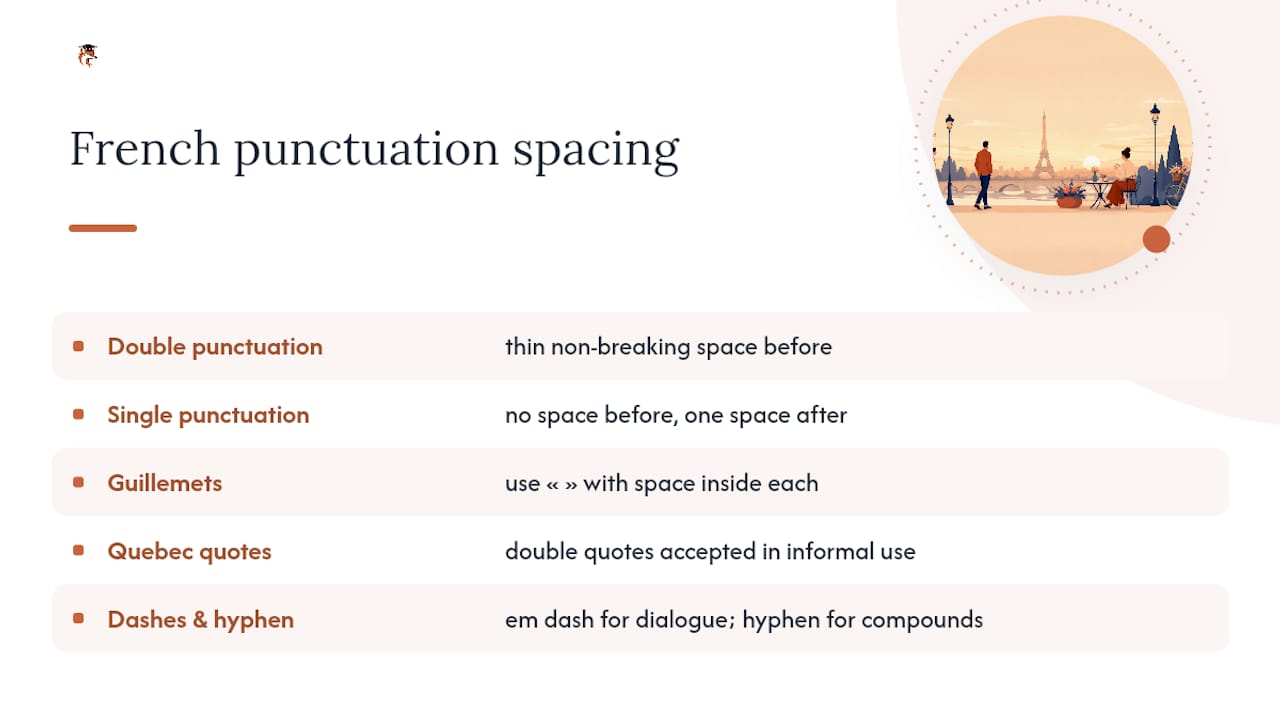
French typography follows different spacing rules than English, and ignoring them is one of the fastest ways to make formal writing look off, even when every word is spelled correctly. Double punctuation marks, specifically the colon, semicolon, exclamation point, and question mark, take a thin, non-breaking space before them in formal French typography: “Il a demand : « Où vast ? »” Single punctuation marks like the period and comma follow the same spacing convention as English, with no space before and one space after.
Quotation marks use guillemets («») rather than the English-style double quotation marks, and each guillemet gets its own space: a space after the opening «and a space before the closing ». Inside a quotation, if a speaker’s own dialogue tag interrupts the quote, French typically uses an em dash rather than nesting additional quotation marks. Quebec French writing, especially in less formal contexts and most digital communication, increasingly accepts standard double quotation marks in place of guillemets, so the strict rule matters most in formal, published, or academic writing rather than everyday texting.
The em dash and en dash also carry distinct roles: an em dash commonly introduces a change of speaker in dialogue, while a hyphen (never an en dash) handles compound words and grammatical constructions like inverted questions. Getting these typographic details right won’t affect your grade on a spelling test, but it matters for anyone preparing formal essays, cover letters, or academic work where presentation is part of the evaluation.
Réussite A+ perspective: why a personalised, pattern-based approach works
Spelling instruction fails most often when it treats every student’s error pattern as identical. Over more than 25 years working with students across Quebec, we’ve watched two learners misspell the same word for completely different reasons: one hasn’t internalized the nasal-vowel rule, the other simply hasn’t seen the word enough times in context. A generic worksheet fixes neither problem efficiently.
That’s why Every plan is built around the individual student’s actual error patterns rather than a fixed curriculum pace. A tutor who spends the first session mapping exactly which grapheme patterns and accent rules trip up your child can build a practice plan around those specific gaps instead of re-teaching what’s already solid.
If your child’s spelling errors feel scattered and hard to pin down, a short diagnostic conversation with a tutor is usually the fastest way to find the actual pattern underneath them.
— Réussite A+
How Réussite A+ can help you master these spelling patterns
Spelling gains stick when someone identifies your specific error pattern and drills it deliberately, not when you reread the same rulebook a third time. This service is an alternative to generic workbooks and one-size-fits-all worksheets, with university-level tutors building a plan around the student’s actual mistakes, not a fixed lesson sequence everyone follows regardless of where they’re stuck.
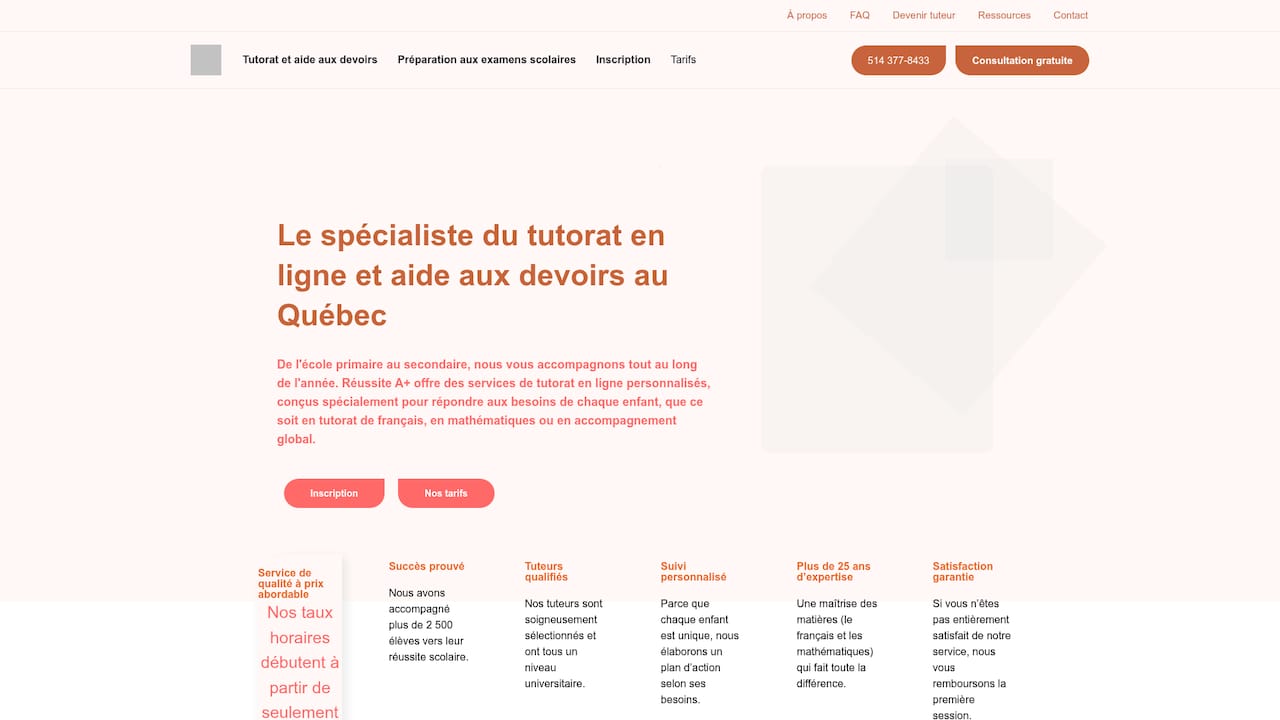
For a student working through accents, silent letters, and homophone traps, Session régulière tutoring at 30 to 35 dollars per hour gives consistent, weekly correction that compounds over a school term. Students heading into a secondary school entrance exam get more targeted support through exam preparation sessions, also priced at 30 to 35 dollars per hour, which focus specifically on the spelling traps that show up most often on timed assessments. Families looking for full French-language support beyond spelling alone can explore our French tutoring programs.
A first session typically starts with a short diagnostic, mapping which grapheme and accent patterns need the most work, followed by a tailored plan built around those specific gaps. There’s a one-time $65 registration fee to get started, and if your child isn’t satisfied after the first session, we refund it. Book a session and let a tutor pinpoint exactly what’s holding your child’s spelling back.
Sources
- Les rectifications de l’orthographe (Ministère de la Culture, France)
- RO – Rectifications orthographiques (CCDMD)
- Developing spelling skills in the French immersion classroom (Newfoundland and Labrador education, 2010)
- 7 simple strategies for teaching phonics that will help you teach spelling – La Classe de Mme Caroline
- French orthography — Wikipedia
FAQ
What are the 7 rules of spelling?
French spelling doesn’t have one fixed list of key rules, but the highest-yield patterns include accent placement, the m-before-b/p nasal rule, silent final consonants, plural formation, gender agreement, homophone distinctions, and hyphenation in compounds and numbers. Mastering these areas covers the majority of common errors learners make.
What is the 80/20 rule in French?
Applied to spelling, it means roughly 20% of French’s sound-to-spelling patterns, like the o/au/eau family, nasal vowels, and the most frequent digraphs (ch, gn, ill, oi), account for the large majority of words a learner will encounter. Focusing study time on those high-frequency patterns first produces faster gains than trying to memorize every exception at once.
Is it “pour vous” or “pour toi”?
Both are correct; the choice depends entirely on your relationship with the person you’re addressing, not on spelling rules. Pour vous is used with someone you address formally or in the plural, while pour toi is used with someone you address informally, typically a peer, close friend, or family member.
Can you give me 20 basic French words?
Common starting vocabulary includes: bonjour (hello), merci (thank you), oui (yes), non (no), s’il vous plait (please), au Renoir (goodbye), chat (cat), chien (dog), maison (house), école (school), livre (book), eau (water), pain (bread), temps (time/weather), grand (big), petit (small), enfant (child), famille (family), jour (day), and année (year). Practising these in full sentences, rather than as an isolated list, builds spelling accuracy faster; our dictée method shows how to structure that kind of practice at home.