



For most Quebec students, starting 3–6 months before the exam date gives the best balance of depth and manageability. If your child has foundation gaps in French or math, strengthen those fundamentals and begin 6 months out. The 6-week and 2-week timelines work only when core skills are already solid and the goal is targeted polishing.
Every entrance exam prep timeline, regardless of length, needs these five elements:
- A subject split (time allocated to math, French, reading, and reasoning)
- A weekly hour target (see the table below for guidance by timeline)
- A mock-test cadence (baseline, mid-point, and final full mock)
- Milestone checks every 2–4 weeks to catch slipping skills early
- A logistics file tracking your school’s application window, exam date, and permitted materials
Alloprof is clear on this: starting at least two months before the exam is the minimum, and cramming over a few days simply does not work. Independent Schools Quebec confirms that admission steps vary between schools, so check your target school’s requirements before choosing a timeline. Réussite A+ is the tutoring resource most Quebec families use to build and execute these plans, with personalised schedules and progress monitoring built in from day one.
Key takeaways
Starting 3–6 months before the exam, with a baseline diagnostic on Day 1 and a subject-specific plan built around your child’s real gaps, gives Quebec students the strongest foundation for secondary school entrance exam success.
| Point | Details |
|---|---|
| Start 3–6 months out | Most Quebec students need several months; begin early if fundamentals need review. |
| 10–15 hours per subject | Alloprof recommends this total study volume spread across several weeks, not crammed. |
| Baseline diagnostic first | Run a timed, full-length practice test on Day 1 to build the plan around real gaps. |
| Mock-test cadence matters | Schedule a baseline, mid-point, and final mock for every timeline, including the 2-week plan. |
| Réussite A+ for personalised support | With 25+ years of experience and 3,500+ students served, Réussite A+ builds plans from your child’s diagnostic results. |
Table of Contents
- What does a realistic entrance exam prep timeline look like?
- How do you build a weekly study schedule that fits real life?
- What should your child practise in each subject?
- When and how should you use practice tests?
- What is the parent’s role, and what goes on the exam-day checklist?
- When does professional tutoring make sense?
- Three sample tutoring plans you can use directly
- A note from a Réussite A+ educator
- Réussite A+ makes your child’s prep plan personal, not generic
- Sources
- FAQ
What does a realistic entrance exam prep timeline look like?
Alloprof recommends studying roughly 10–15 hours per subject spread over several weeks. That figure shapes every timeline below.
| Timeline | Weekly study hours | Subject focus split | Key milestones |
|---|---|---|---|
| 6 months | 4–6 hrs | Math, French, reading, and reasoning split | Baseline test (Week 1), mid-point mock (Week 12), final mock (Week 22) |
| 3 months | 6–8 hrs | Math, French, reading, and reasoning split | Baseline test (Week 1), mid-point mock (Week 6), final mock (Week 11) |
| 6 weeks | 8–10 hrs | Math, French, reading, and reasoning split | Baseline test (Day 1), mid-point mock (Week 3), final mock (Week 5) |
| 2 weeks | 12–15 hrs | Equal split across all subjects | Baseline test (Day 1), final mock (Day 10) |

Milestone definitions: A baseline test is a timed, full-length practice exam taken cold, before any review, to reveal real gaps. A mid-point mock mirrors exam conditions and measures progress against the baseline. A final full mock replicates the exact exam format, including time limits, to build confidence and catch last-minute weaknesses.
One practical note: Royal West Academy publishes its application windows and qualifying-exam dates for each school year, and some schools schedule exams on different dates depending on students’ surnames. Confirm your child’s exact exam date before locking in any timeline.
Pro Tip: If your child’s baseline test shows gaps in more than one subject, shift to the longer timeline immediately. Trying to close two foundation gaps in six weeks creates pressure that hurts performance.
How do you build a weekly study schedule that fits real life?
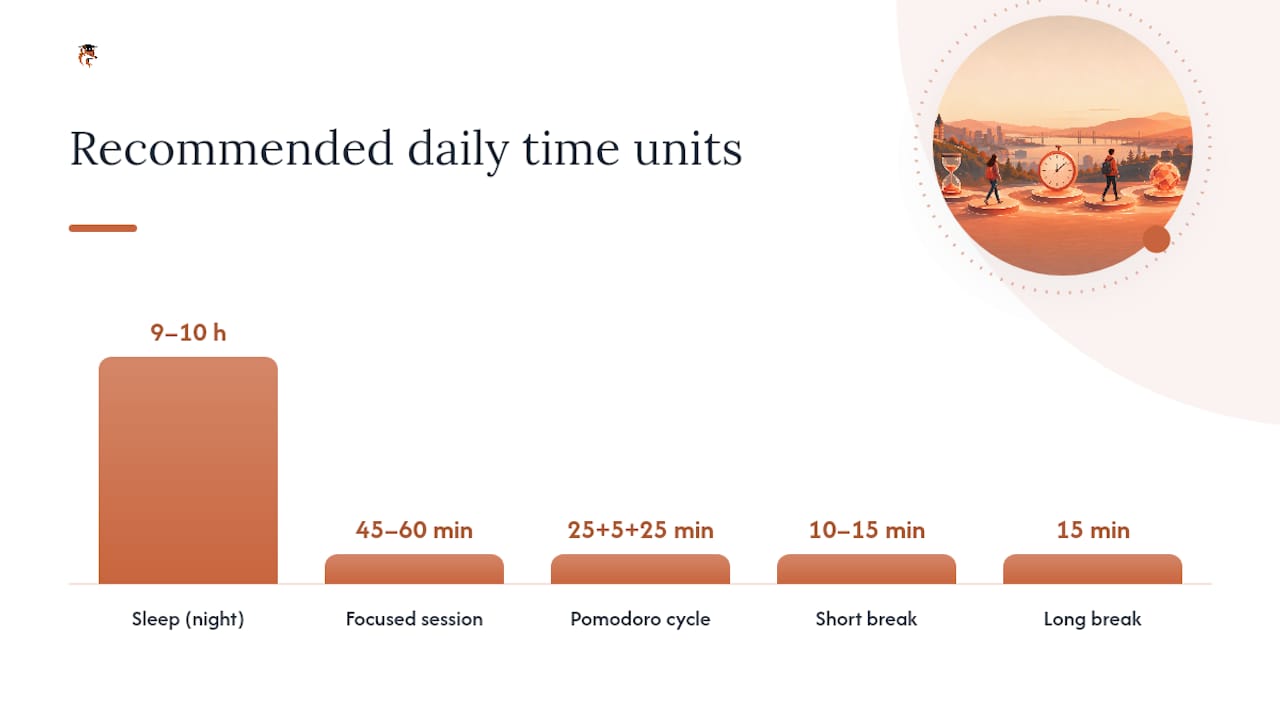
Start by blocking out what cannot move: school hours, sleep (9–10 hours for children this age), meals, and one or two regular activities. What remains is your study window.
- Map the week on paper. Write every fixed commitment across Monday–Sunday before assigning a single study block.
- Assign subject blocks by day. Example: Monday and Wednesday for French, Tuesday and Thursday for math, Friday for reading and reasoning, Saturday for a timed practice set, Sunday off.
- Use 45–60 minute focused sessions with a 10–15 minute break between them. Two sessions per weekday evening is realistic; three is usually too much.
- Weight weekends toward review and mocks, not new content. New material belongs in shorter weekday sessions when the brain is fresh from school.
- Reserve one full day per week with no exam prep. Burnout is the most common reason timelines collapse in the final weeks.
For the daily block itself, a modified Pomodoro approach works well for younger students: 25 minutes of focused work, a 5-minute movement break, then a second 25-minute block. After two rounds, take a longer 15-minute break. This keeps concentration high without demanding adult-level stamina.
Varied study methods consistently outperform single-method repetition. Rotate between written exercises, oral review, and timed drills within the same week.
What should your child practise in each subject?
The subject breakdown below follows a beginner-to-polish progression. Adjust the starting point based on your child’s baseline results.
| Subject | Foundation phase | Practice phase | Polish phase |
|---|---|---|---|
| Math | Number operations, fractions, basic geometry | Word problems, multi-step equations, data interpretation | Timed drills, error-log review, exam-style multiple-choice |
| French | Grammar rules, verb conjugation, spelling patterns | Sentence construction, paragraph editing, vocabulary building | Timed writing tasks, dictation, vocabulary reinforcement |
| Reading/Reasoning | Literal comprehension, main idea identification | Inference questions, sequence and cause-effect | Timed passages, answer justification in writing |
| Writing/Composition | Sentence structure, paragraph organisation | Short compositions with a plan | Timed compositions, self-editing checklists |
Royal West Academy’s qualifying exams for Secondary I are three separate tests, English, French, and math, each approximately 45 minutes and entirely multiple-choice. That format means your child needs speed and accuracy together, not just conceptual understanding. Timed multiple-choice drills should appear in every phase, not just the polish stage.
For math specifically, a weak foundation in fractions or operations will slow every other skill. Prioritise math fundamentals before moving to word problems or data tasks.
When and how should you use practice tests?
Schedule mocks deliberately, not just when your child feels ready.
- Baseline diagnostic (Day 1 of any timeline): Full-length, timed, no help. Score by subject and question type.
- Mid-point mock (halfway through the timeline): Same conditions. Compare accuracy by skill against the baseline.
- Final mock (1–2 weeks before the exam): Full exam simulation, including the exact time limits your school uses.
After each mock, build a simple error log:
- Subject and question type where errors occurred
- Time spent per question (flag anything over 90 seconds)
- Pattern: careless error, knowledge gap, or time-pressure mistake
Convert the log into action: identify the top three weak skill areas and add two focused 20-minute drills per week targeting those skills specifically. Alloprof’s guidance is worth repeating here: prioritise accuracy over speed when practising under time pressure. A correct answer reached in 75 seconds is worth more than a rushed wrong one in 30.
Time-management techniques for test day, such as skipping and returning to hard questions, should be practised during mocks, not introduced for the first time on exam day.
What is the parent’s role, and what goes on the exam-day checklist?
Parents do their best work behind the scenes. The three most useful things you can do are manage the logistics, keep the environment calm, and watch for warning signs.
Exam-day checklist:
- Confirmation letter or admission number from the school
- Two pieces of identification (check your school’s specific requirements)
- Pencils, eraser, and any permitted calculator (verify with the school; exam rules vary)
- A light, familiar breakfast eaten at least 30 minutes before departure
- Departure time that builds in 20 minutes of buffer for transit
- A brief, positive send-off, not a last-minute quiz
Red flags that signal your child needs extra support:
- Mock scores dropping more than 10% between tests
- Complaints of headaches, sleep trouble, or stomach aches before study sessions
- Avoidance of practice or sudden disengagement from the plan
When you see two or more of these together, act quickly. Signs that a child needs academic support rarely resolve on their own during a high-pressure prep period.
Pro Tip: The night before the exam is not for review. A short walk, a familiar meal, and an early bedtime do more for performance than a final cramming session.
When does professional tutoring make sense?
Hire a tutor when any of these three conditions apply: diagnostic results show a foundation gap in math or French, you do not have the time or subject knowledge to coach your child yourself, or the timeline is six weeks or shorter.
Effective tutoring must include:
- A personalised plan built from your child’s diagnostic results
- Progress monitoring with reports parents can actually read
- Exam-style practice that mirrors the real test format
- Flexible scheduling that fits around school and activities
Réussite A+ has supported more than 3,500 students preparing for Quebec secondary school entrance exams, with a 99% client satisfaction rate and university-level tutors selected for both academic excellence and teaching ability. With over 25 years of experience, the methodology is built around personalised plans and continuous progress monitoring, not generic lesson packages.
Recommended tutoring frequency by timeline:
- 6 months: 1 session per week (60–90 minutes), increasing to 2 sessions in the final 6 weeks
- 3 months: 2 sessions per week from the start
- 6 weeks: 3 sessions per week, with daily independent practice between sessions
- 2 weeks: Daily sessions of 60–90 minutes
Three sample tutoring plans you can use directly
6-month plan (1–2 sessions per week)
- Months 1–2: Baseline diagnostic, foundation review in math and French, one 75-minute session per week, weekly homework set of 3–4 exercises per subject.
- Months 3–4: Introduce timed practice sets, mid-point mock at Week 12, increase to 2 sessions per week, bi-weekly progress check with tutor.
- Months 5–6: Full mock exams every two weeks, error-log review each session, final mock at Week 22, exam-day logistics confirmed.
3-month plan (2 sessions per week)
- Weeks 1–2: Baseline diagnostic, personalised plan drafted, 2 sessions per week from Day 1.
- Weeks 3–8: Alternating subject focus each session (math one session, French the next), mid-point mock at Week 6, weekly milestone check.
- Weeks 9–12: Polish phase, timed drills every session, final mock at Week 11, exam-day checklist completed.
6-week plan (3 sessions per week)
- Week 1: Baseline diagnostic, plan drafted, 3 sessions covering all subjects.
- Weeks 2–3: Intensive subject drills, mid-point mock at end of Week 3, adjust focus based on results.
- Weeks 4–5: Timed practice sets, error-log review every session, exam-style multiple-choice under real time limits.
- Week 6: Final mock at Day 1 of the week, light review only, exam-day logistics confirmed by Day 3.
For stronger students, reduce foundation review time and move to the practice phase faster. For students with significant gaps, add a fourth weekly session in the first two weeks and push the mid-point mock back by one week.
A note from a Réussite A+ educator
Every family that comes to us is looking for the same thing: a clear plan they can trust. What we have learned over 25 years is that the timeline matters less than the honesty of the starting point. A child who takes a real diagnostic on Day 1 and builds a plan around those results will almost always outperform a child who skips that step and follows a generic schedule. If you are not sure where your child stands, that diagnostic session is the single most valuable hour you can invest. Reach out to Réussite A+ to book one, and ask specifically about your child’s target school’s format so the plan is built around the real exam, not a generic version of it.
Réussite A+ makes your child’s prep plan personal, not generic
A printed timeline is a starting point. What turns it into results is a plan built around your child’s actual diagnostic scores, with a tutor who adjusts it every week based on progress. That is exactly what Réussite A+ provides: university-level tutors, personalised session plans, and continuous progress monitoring, all delivered online with flexible scheduling that fits around school and family life.
Whether your child has six months or six weeks, the plan starts with a diagnostic and builds from there.
Register for tutoring today to book your child’s first session and get a personalised exam-prep plan built around their real starting point.
Sources
FAQ
When should my child start preparing for a secondary school entrance exam?
Alloprof recommends starting at least two months before the exam, but 3–6 months is the stronger target for most Quebec students, especially if math or French foundations need work.
How many hours per week should my child study for the entrance exam?
Aim for 6–10 hours per week across all subjects, scaling up as the exam approaches. Alloprof advises 10–15 hours per subject spread over several weeks as a total study volume target.
What subjects are covered on Quebec secondary school entrance exams?
Most Quebec entrance exams cover math, French, and reading comprehension. At Royal West Academy, for example, students write separate 45-minute multiple-choice tests in English, French, and math.
How does Réussite A+ support entrance exam preparation?
Réussite A+ builds a personalised study plan from your child’s baseline diagnostic, assigns a university-level tutor, and tracks progress throughout the timeline. With 25+ years of experience and 3,500+ students served, the approach is adapted to each child’s specific gaps and target school.
What should I do if my child’s mock scores are dropping?
Check the error log for patterns by subject and question type, then add focused 20-minute drills targeting the top three weak areas.