


French uses five accent marks: é, à/è/ù, â/ê/î/ô/û, ë/ï/ü, and ç. Skip one and you can change a word’s meaning entirely, so they matter in every piece of formal French writing, from a school essay to a job application. The good news? Typing them takes seconds once you know the trick for your device.
- Windows: switch to the US International keyboard (dead keys) for instant accents
- macOS: hold down a letter for a pop-up menu, or use Option combos like Option+e then e for é
- Mobile: long-press any vowel to reveal the accented versions
- No time to change settings? TypeIt lets you click, copy, and paste any French accent in your browser
Key Takeaways
Correctly typing and using French accent marks depends on matching the right platform shortcut to the accent, and understanding that each mark can change a word’s meaning.
| Point | Details |
|---|---|
| Five accents total | Accent aigu, accent grave, accent circonflexe, tréma, and cédille each serve a distinct purpose in French spelling. |
| Meaning changes with accents | Word pairs like à/a and où/ou show how one accent can shift grammar or meaning entirely. |
| Fastest typing methods vary by device | Windows dead keys, macOS Option combos, and mobile long-press each offer quick, built-in solutions. |
| Capitals need accents too | The OQLF confirms capital letters keep their accents except in acronyms and initialisms. |
| Réussite A+ builds accent habits into tutoring | Short weekly drills combining typing practice and dictation help students retain correct spelling. |
Table of Contents
- What are the five French accents and what do they do?
- Why does one missing accent change a whole sentence?
- How do you type French accents on Windows, macOS, and mobile?
- Do capital letters need accents too?
- What accent mistakes do beginners make most often?
- How can you build lasting accent habits?
- What our tutors actually see in sessions
- Get personalized help mastering French spelling and accents
- Sources
- FAQ
What are the five French accents and what do they do?
Each of the five French diacritical marks does a specific job. Some change how a word sounds. Others change what it means without touching the pronunciation at all. Here’s the full set, explained the way we walk students through it in tutoring sessions.
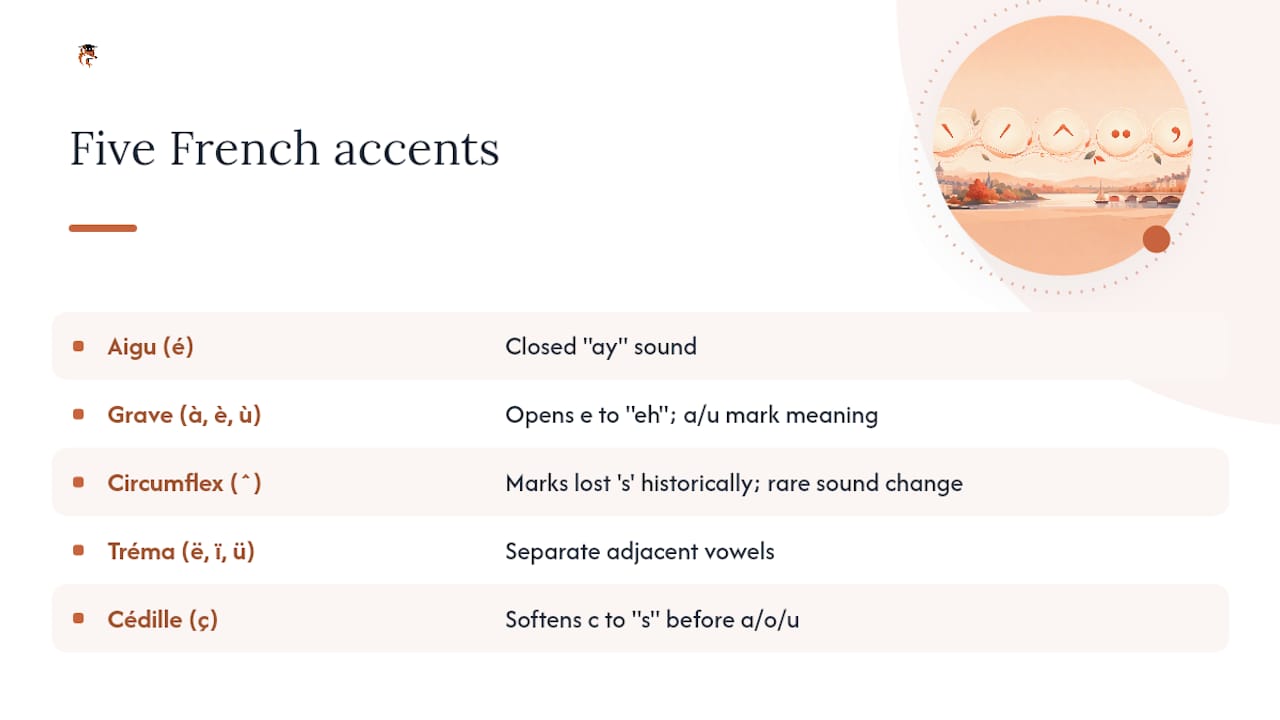
Accent aigu (é) appears only on the letter e, and it always produces a closed “ay” sound, as in café or été. It’s the most common accent in French, and it’s the one beginners reach for automatically, sometimes in places where it doesn’t belong.
Accent grave (à, è, ù) shows up on three vowels but does different work on each. On e, it opens the sound to an “eh,” as in père or mère. On a and u, it doesn’t change pronunciation at all, it just tells your eyes the word is a different one: à (to/at) instead of a (has), or où (where) instead of ou (or).
Accent circonflexe (â, ê, î, ô, û) is the most historical of the five. According to French orthography reference on Wikipedia, the circumflex frequently marks a letter, usually an s, that disappeared from the spelling centuries ago. That’s why hôtel traces back to hostel, and forêt to forest. It occasionally shifts pronunciation, but for most learners it’s simply a spelling to memorize.
Tréma (ë, ï, ü) signals that two vowels sitting side by side should be pronounced separately rather than blended. Noël is pronounced “no.el,” not “nwel,” because of that tréma over the e.
Cédille (ç) turns a hard “k” sound into a soft “s” sound before a, o, or u. Without it, garçon would be pronounced with a hard c. With it, the word reads correctly as “gar.son.”

Pro Tip: Group the accents by function, not by letter, when you’re memorizing them. Two of the five (tréma and cédille) change sound. Two others (grave on a/u, and often circumflex) change meaning or spelling without changing sound at all. That mental split makes the whole system click faster.
Why does one missing accent change a whole sentence?
French is full of minimal pairs, words that are spelled almost identically but mean completely different things depending on their accent. Miss one, and your sentence can say something you never intended.
- A / à. Il a un chien means “he has a dog.” Il va à Paris means “he’s going to Paris.” Same three letters minus the accent, completely different grammar.
- Ou / où. Tu veux du thé ou du café? asks “or.” Où vas-tu? asks “where.” Drop the accent grave and a question about location becomes nonsense.
- La / là. La maison is “the house.” Elle est là means “she is there.” One is an article, the other is an adverb of place.
- Du / dû. Du pain is “some bread.” J’ai dû partir means “I had to leave,” the past participle of devoir. The circumflex here is the entire difference between a partitive article and a verb form.
Pronunciation matters too: é and è are not interchangeable, even though they look similar on the page. É is closed and tight, è is more open, closer to the “e” in the English word “bed.” Getting this right in formal writing, essays, exam answers, cover letters, isn’t optional, and practising the distinction early tends to build spelling habits that stick.
How do you type French accents on Windows, macOS, and mobile?
Every major platform has a fast built-in method, so you rarely need special software. Here’s what actually works on each one.
On Windows, the quickest fix is switching your keyboard to US International, which uses dead keys. Press the apostrophe key, then a vowel, and you get an accent aigu automatically, apostrophe plus e produces é. The backtick key does the same for accent grave, and the caret (shift + 6) produces circumflex. For quick one-off use without changing settings, Alt codes still work: holding Alt and typing 0233 on the numeric keypad produces é.
On macOS, press and hold a letter key and a small pop-up menu appears with every accented variant, tap the one you need. For faster, repeatable typing, Option-key sequences are more reliable, especially useful if you’re teaching a student the same keystrokes every session:
- Option+e, then e → é
- Option+`, then e → è
- Option+i, then i → î
- Option+u, then u → ü
- Option+c → ç
According to Busuu’s guide to French accent marks, the hold-key pop-up is faster for occasional typing, while the Option sequences pay off once you’re typing accents daily.
On iOS and Android, long-press any vowel and a row of accented options pops up above the keyboard. If you’re writing in French often, add a French keyboard layout in your device settings so the long-press options match what you actually need.
When you can’t change system settings (a shared computer, a locked-down school laptop), TypeIt’s online French keyboard lets you click each accented letter and copy the result straight into your document. It’s a solid short-term fix, but learning your own system’s method pays off faster once you’re typing French regularly across multiple apps.
Pro Tip: On Windows International layouts, typing an apostrophe followed by a vowel creates an accent by default, so a word like “l’école” can turn into an unwanted accented letter. Press apostrophe, then the space bar, to get a plain apostrophe instead.
Do capital letters need accents too?
Yes. The Office québécois de la langue française recommends keeping accents, trémas, and cédilles on capital letters whenever the lowercase word has them. École stays ÉCOLE in all caps, not ECOLE.
- The exception: acronyms and initialisms drop the accent, so it’s still ONU, not ÓNU.
- This matters most in headings, titles, and formal documents, exactly where accents get skipped most often.
- If you’re preparing exam answers or a school assignment, treat capital letters the same way you treat lowercase ones.
What accent mistakes do beginners make most often?
Most accent errors fall into the same three patterns, and all three are fixable with a five-minute habit change.
- Skipping accents when rushing a final draft. Do one proofreading pass focused only on accents before you submit anything formal.
- Confusing similar-looking accents. When in doubt, check the word in context rather than guessing, à and â look close but behave completely differently.
- Fighting your keyboard layout. If you type in French even a few times a week, set your daily keyboard to an international layout rather than relying on Alt codes or copy-paste every time.
Pro Tip: Keep a running list of the words that trip you up personally, not a generic list. Everyone’s blind spots are different, and your own list will teach you faster than any general chart.
How can you build lasting accent habits?
A simple two-step drill works well: five minutes of typing practice using your platform’s accent shortcuts, followed by a short dictation where you write down five sentences a parent or tutor reads aloud. Pair that with oral French practice so you hear the difference between é and è, and handwriting practice so the accents show up correctly on paper too.
What our tutors actually see in sessions
Tutors build short accent drills into almost every French session, not as a separate lesson but as a few minutes woven into regular reading and writing work. Students who repeat this weekly stop second-guessing themselves within a few sessions.
Get personalized help mastering French spelling and accents
Typing the right accent is one thing. Using it correctly in a sentence, every time, under exam pressure, is another skill entirely, and it’s exactly the kind of gap a generic app or worksheet can’t close. Réussite A+ pairs each student with a university-level tutor who builds a learning plan around their specific spelling weaknesses, whether that’s accent confusion, verb conjugation, or general written French.
Sessions run online across Quebec with flexible scheduling, so practice fits around homework and exam prep rather than competing with it. If accents and spelling keep costing your child marks on written work, an online tutoring assessment is the fastest way to find out exactly where the gaps are. You can also go straight to enrolment to book a session and start correcting these habits this week.
Sources
- Majuscules : accents, trémas et cédilles | BDL (OQLF)
- Type French accents – online French keyboard
- Accent Marks in French (and How to Type Them) – Busuu
- French orthography – Wikipedia
FAQ
What’s the difference between è and é?
É (accent aigu) produces a closed “ay” sound, while è (accent grave) produces a more open sound similar to the “e” in “bed.” They’re never interchangeable in correct spelling.
What’s the difference between e, è, é, ê, ë, and other e variants?
Plain e can be silent or lightly pronounced depending on the word, é is closed, è and ê are open, and ë (tréma) signals that the e should be pronounced separately from a neighbouring vowel rather than blended into it.
How do you type an accent aigu (é)?
On Windows with US International enabled, press apostrophe then e. On macOS, press Option+e then e, or hold the e key for the pop-up menu.
How do I type a French accent if my keyboard doesn’t support it?
Use TypeIt’s online French keyboard to click and copy any accented letter, though switching your system keyboard is faster for regular use.
Do accents change the meaning of a word or just the pronunciation?
Both happen depending on the accent. Accent aigu and accent grave on e change pronunciation, while accent grave on a or u changes meaning only, as in à versus a.