


Prioritize a clear essay structure and short, timed practice with focused feedback. That single combination, taught with a scaffold like PEEL and reinforced weekly, closes more gaps than any vocabulary list or grammar drill on its own. Many tutors have coached Quebec families through this exact process for secondary school entrance exams, and the pattern holds no matter the child’s starting point.
TL;DR:
- Focusing on a three-minute outline and PEEL paragraph structure improves organization and clarity, which are critical for scoring well.
- Practice timed essays at least twice weekly, with dedicated review of the Explain step and targeted feedback to strengthen weak points.
- Recognizing the essay prompt type early—persuasive or narrative—guides the opening approach and overall focus.
- A six-week routine combining outlining, timed writing, and targeted revision can lead to measurable essay score improvements.
- Professional coaching helps identify specific habit gaps and ensures consistent progress beyond self-guided practice.
Table of Contents
- Top 8 entrance exam essay tips parents can teach today
- How to structure an entrance exam essay: PEEL and grade targets
- Timed exam strategy: exact minute plan and micro‑habits
- Persuasive vs narrative: what to teach for each genre
- A practical 6‑week practice plan parents and tutors can run
- Common mistakes and quick corrections parents can coach in 10 minutes
- How parents and tutors should support practice and how Réussite A+ helps
- A parent’s perspective: what changed with one small habit
- Get structured, personalized exam prep support
- Sources
- FAQ
Top 8 entrance exam essay tips parents can teach today
You don’t need a curriculum to start helping tonight. Pick two or three of these and practise them over the kitchen table this week.
- Plan first, always. A 2 to 5 minute outline with a thesis in the first two sentences prevents the meandering essays that lose marks before they even reach the conclusion.
- PEEL every paragraph, and push the hardest on the “Explain” step, since that’s where most children stop short and simply move to the next point.
- Start narratives inside the action. Skip the “It was a sunny Saturday morning” setup and drop the reader straight into the complication.
- Set time checkpoints and end every practice essay with a two or three minute proofreading pass, no exceptions.
- Use precise, everyday-academic vocabulary (words like “reluctant” or “persuade” rather than “sad” or “convince”) and vary sentence length for rhythm.
- Match the practice medium to the exam. If the test is typed, practise typing; if it’s handwritten, practise legibility under time pressure.
- Two strong ideas beat five thin ones. Depth reads as maturity to an examiner; breadth without development reads as rushed.
- Do one final read for mechanics, hunting specifically for homophones, comma splices, and missing paragraph breaks.
Pro Tip: Give your child a highlighter during the final read and have them mark only the “Explain” sentence in each paragraph. If a paragraph has no highlighted sentence, that’s the fix for tomorrow’s practice, not today’s whole essay.
How to structure an entrance exam essay: PEEL and grade targets
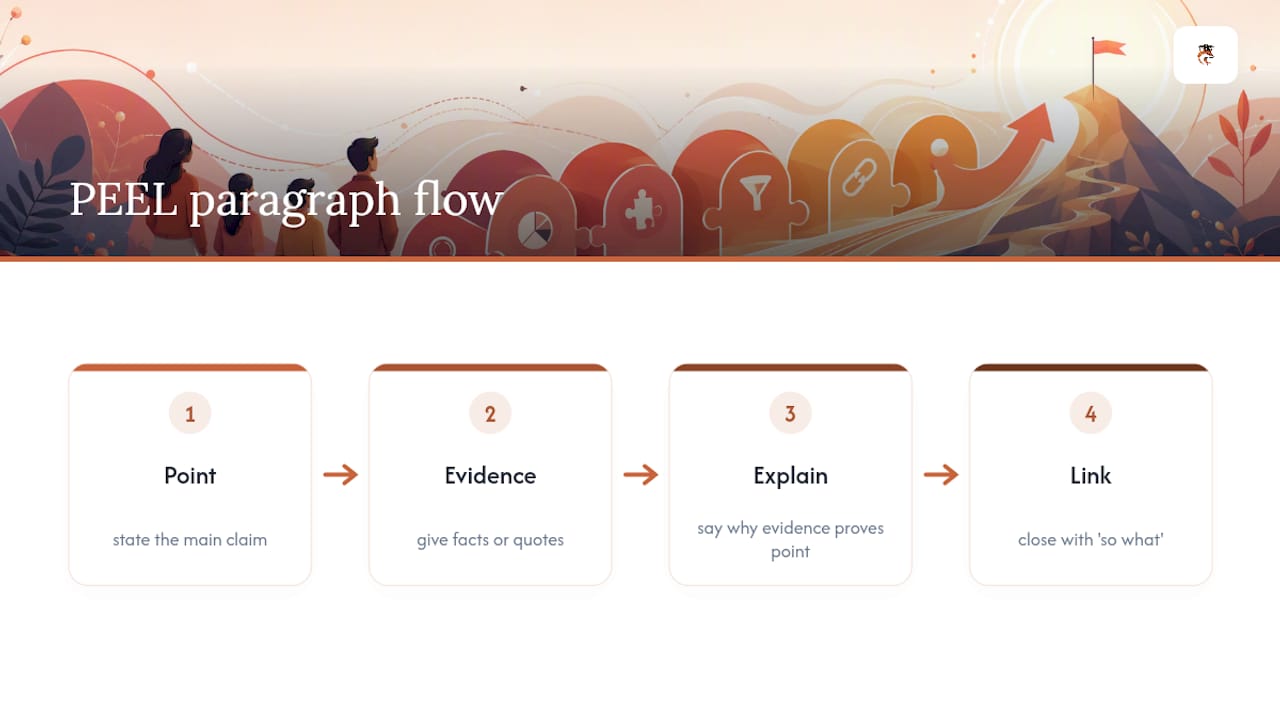
PEEL stands for Point, Evidence, Explain, Link, and it’s the scaffold behind most basic essay format guidance taught at the post-secondary level, adapted down for younger writers. The University of Calgary’s own analysis of scored essays found that weak paragraphing and a missing explanation are the top reasons marks disappear. The “Explain” step is the one students skip most, because stating evidence feels like enough. It isn’t. A paragraph needs a sentence that says why the evidence proves the point.
Length and paragraph count should scale with grade level, increasing progressively to allow more developed arguments and refinement as students advance.
A workable thesis template: “While [opposing idea], [your position] because [reason one] and [reason two].” A topic sentence template: “One reason [claim] is [point], as shown by [evidence].” The University of Toronto’s writing advice stresses a strong opening within the first two sentences, not a slow windup. Close with a “so what” line that tells the reader why the point mattered.
Timed exam strategy: exact minute plan and micro‑habits
Most entrance exam essay failures aren’t about ideas. They’re about running out of time before the ideas get organized on the page. A short outlining habit, even just three to four minutes, is what separates organized writers from those who stall out when the clock is running.
Here’s a split that works for most timed formats:
- 30-minute task: 5 minutes to plan, 22 minutes to write, 3 minutes to proofread.
- 20-minute task: 3 minutes to plan, 15 minutes to write, 2 minutes to proofread.
- Visible checkpoints: glance at the clock every 8 to 10 minutes and ask, “Am I on pace to finish the conclusion?”
- Proofreading checklist: homophones (their/there, its/it’s), comma splices, paragraph breaks, and one or two weak word swaps.
- If the exam is typed, build typing speed in advance; a child who hunts for keys loses writing time no outline can recover.
Réussite A+ tutors often start a coaching session by timing a cold outline. It shows a family, in three minutes, exactly where the habit needs work. You can also explore practical time management techniques for exam day for more on building this into a routine.
Persuasive vs narrative: what to teach for each genre
Entrance exams typically ask for one of two essay types, and each rewards a different set of instincts. Teaching a child to recognize the prompt type in the first ten seconds saves the whole essay.
- Persuasive essays want the claim stated immediately, followed by two or three well-developed reasons in PEEL paragraphs. A one-sentence acknowledgment of the opposing view can add sophistication, but it’s optional. The closing line should push toward action or a firm restatement, not a vague summary.
- Narrative essays reward starting inside the complication rather than easing in with backstory. Keep the scope to a single scene; a story that tries to cover a whole weekend usually loses focus. Sensory detail should show emotion rather than naming it outright (“her hands shook” instead of “she was nervous”), and shorter sentences during tense moments create pacing.
A persuasive opener might read: “Schools should allow more outdoor learning because it improves focus and health.” A narrative opener might read: “The gym door slammed shut behind me before I could turn around.” Practise one genre per session rather than mixing both. Réussite A+’s French tutoring programs build this genre recognition directly into weekly writing drills.
A practical 6‑week practice plan parents and tutors can run
Structure and timing improve fastest with a plan, not scattered practice sessions. Research on selective exam writing prep shows that a consistent multi‑week routine with timed writes and targeted revision produces measurable gains, and two timed essays per week is a commonly recommended pace.
- Weeks 1 and 2: Focus entirely on outline drills and thesis formation. No full essays yet, just three-minute outlines and one-sentence thesis statements, five to ten repetitions per week.
- Weeks 3 and 4: Introduce timed essays, one to two per week, followed by a review session where you circle the PEEL steps present and missing.
- Weeks 5 and 6: Shift to targeted revision on the child’s specific weak spot, then run one full mock test under real exam conditions in week six.
A reasonable weekly load: two timed writes, one revision session, and one short reading or vocabulary session. When you give feedback, pick one target skill per week, whether that’s vocabulary, paragraph linking, or sentence variety, since narrowing feedback to a single focus speeds progress more than a long list of corrections. Ease off the intensity in the final few days before the test; a tired writer makes more mechanical errors than a rested one. Réussite A+’s exam preparation guide offers a broader timeline if you’re coordinating essay practice alongside math or reading review.
Common mistakes and quick corrections parents can coach in 10 minutes
Most low scores trace back to a short list of repeat offenders. You can catch and correct several of these in a single ten-minute session.
- No plan before writing: fix with “outline three bullets in three minutes” before every practice essay, no exceptions.
- Irrelevant backstory in narratives: fix by asking, “Does this sentence happen in the last five minutes of the story?” Cut what doesn’t.
- Weak Explain step: fix by requiring one sentence per paragraph that starts with “This shows…” or “This matters because…”
- Run-ons and comma splices: fix by reading the essay aloud; where the child naturally pauses for breath, a period likely belongs.
- No paragraph breaks: fix by colour-coding each PEEL element so gaps in structure become visible at a glance.
- Weak openings or conclusions: fix by drafting three different opening sentences and picking the strongest, rather than settling for the first attempt.
A simple mini-rubric works well for marking practice essays at home: does it have a thesis, does every paragraph explain its evidence, and does the conclusion answer “so what?” Three yes answers is a strong essay regardless of polish.
How parents and tutors should support practice and how Réussite A+ helps
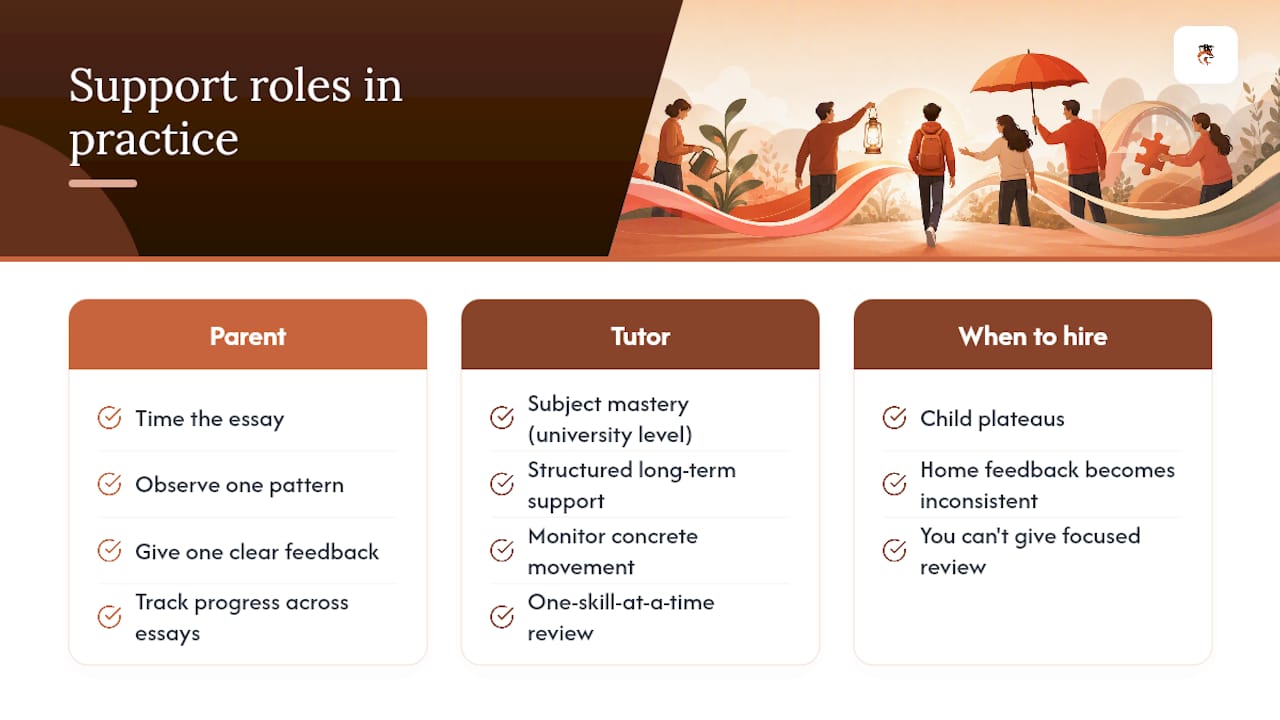
Your job during practice isn’t to write the essay. It’s to time it, watch for one pattern, and give one clear piece of feedback afterward. Track progress across essays rather than judging each one in isolation. Improvement in this skill is rarely linear.
Structured academic support is often refined over many years, with tutors selected for subject mastery and teaching ability at the university level. Progress monitoring means a family sees concrete movement across sessions, not just a final grade.
Consider bringing in professional support when a child plateaus, when feedback at home has become inconsistent, or when you simply can’t offer the focused, one-skill-at-a-time review that speeds real progress.
A parent’s perspective: what changed with one small habit
A parent we worked with described a child who wrote fluidly but scored poorly, essays with no clear point. Adding a three-minute outline before writing, paired with a PEEL checklist during revision, sharpened the coherence within two weeks. Try the outline habit tonight, before anything else.
— Réussite A+
Get structured, personalized exam prep support
Reading about PEEL paragraphs and timed splits is one thing. Watching your own child apply them under real time pressure, with someone correcting the habit in the moment, is another. Personalized learning plans can address specific gaps such as the Explain step, pacing, or vocabulary precision, paired with tutors who track progress session over session.
The exam preparation sessions are built specifically around secondary school entrance requirements, priced at $30 to $35 per hour, with a $65 one-time registration fee. If your child’s practice essays keep hitting the same wall, book a session and let a tutor identify the fix in the first meeting rather than the fifth.
Sources
- Basic essay format (Canada College learning centre)
- Planning: intros and conclusions (University of Toronto)
- Essay structure and writing strategies (University of Calgary)
- BASIS Independent Fremont essay tips (STEM Critical Thinking)
- Selective writing prep and 12‑week plan (EurekaWrite)
FAQ
What is the single best entrance exam essay tip?
Teach a clear structure, PEEL for body paragraphs and a thesis in the first two sentences, then practise it under timed conditions every week. Structure consistently accounts for where marks are won or lost, according to University of Calgary’s analysis of scored scripts.
How long should an entrance exam essay be?
It depends on grade level: roughly 150 to 200 words for grade 5, 200 to 280 words for grades 6 to 7, and 280 to 450 words for grades 8 to 9. Paragraph count should scale the same way, from three paragraphs up to four or five.
How much should my child practise before the exam?
A six-week routine with one to two timed essays per week, plus a revision session, tends to produce measurable improvement, based on selective exam prep research. Ease the intensity in the final few days before test day.
What’s the biggest difference between persuasive and narrative essays?
Persuasive essays lead with the claim and build two or three developed reasons; narrative essays plunge straight into a single scene without backstory. Each genre rewards a different opening instinct, so recognizing the prompt type quickly matters.
Does Réussite A+ offer entrance exam essay coaching?
Yes. Réussite A+’s exam preparation sessions are delivered by university-level tutors at $30 to $35 per hour, with a $65 registration fee, and include ongoing progress monitoring across practice essays.