



Start with the free programs: LEARN Tutoring and Alloprof cover most everyday homework and skill gaps for eligible Quebec students at no cost. Check LEARN’s eligibility page or open Alloprof’s chat tonight. When your child needs a sustained, tailored plan (persistent gaps, exam prep, or accelerated learning), a paid option like Réussite A+ delivers the structure free services can’t.
TL;DR:
- Free programs like LEARN Tutoring and Alloprof address most homework and skill gaps for eligible Quebec students, with LEARN limited to English school board students.
- Paid tutoring makes sense when a student needs a personalized plan to address recurring skill gaps, exam preparation, or acceleration beyond classroom pace.
- Choosing a tutor involves verifying credentials, understanding session structure, reviewing progress reporting methods, and clarifying cancellation and refund policies.
- Typical paid tutoring costs around $30 to $35 per hour, with some offering satisfaction guarantees or trial options before committing financially.
- For immediate help, start with free options tonight, and gather recent report cards and specific goals before considering paid programs for sustained support.
Table of Contents
- Free provincial and community tutoring options for Quebec families
- When does paid online tutoring make sense?
- How to choose an online tutor or program
- What happens during an online tutoring session
- What online tutoring costs in Quebec, and where to find free help first
- Get started this week: a short checklist
- Why tailored tutoring matters more than people think
- Réussite A+: personalised support when free options aren’t enough
- Sources
- FAQ
Free provincial and community tutoring options for Quebec families
Before paying for anything, check what your school board or the province already offers. Two programs cover most needs.
LEARN Tutoring provides live, one-on-one online appointments with Quebec-certified teachers for students in grades 2 through 11, but only if they’re enrolled in an English school board or CSS du Littoral. Sessions run Monday through Thursday evenings during the Fall, Winter, and Spring terms, and each appointment uses a shared whiteboard with multi-way audio, plus weekly feedback sent back to families and schools.

Alloprof works differently. Instead of booking ahead, your child texts, chats, or calls in during scheduled hours, Monday to Thursday evenings and Sunday afternoons, and gets connected with one of nearly 200 teachers on staff.
Alloprof’s reach is massive. Alloprof serves a very large number of students, and its resource library is accessed many times annually, a scale few paid platforms in Quebec can match.
Beyond these two, check your local school board and community organizations. Programs like volunteer homework clubs and targeted literacy services fill gaps the provincial options don’t cover, especially for younger kids or families needing in-person support alongside the online help.
- LEARN Tutoring: grades 2 to 11, English school boards and CSS du Littoral only, Monday to Thursday evenings
- Alloprof: no eligibility restriction by school board, chat/text/phone Monday to Thursday evenings plus Sunday afternoons
- Community programs: check your school board’s resource page for local homework clubs and literacy supports
When does paid online tutoring make sense?
Free services solve most day-to-day homework questions. They’re not built for a student who needs the same concept revisited three different ways over six weeks, or one preparing for a specific entrance exam with a fixed date on the calendar. That’s the gap paid, personalised tutoring fills.
A tailored program builds a plan around one student rather than whoever happens to answer the chat that evening. That distinction shows up in three situations parents describe most often:
- A skill gap that keeps resurfacing despite help at school (fractions, verb conjugation, reading comprehension)
- Preparation for a secondary school entrance exam with a firm timeline
- A student who’s doing fine but wants to move faster than the classroom pace allows
This tutoring service builds its programs around individualised plans in French and math rather than a fixed curriculum every student follows the same way. Tutors are university-level, selected for academic strength and teaching ability, and progress is tracked continuously rather than assessed once at the end of a term.
Pro Tip: Before switching to paid tutoring, ask your child to name the exact topic that trips them up. “I’m bad at math” tells a tutor nothing. “I mix up when to carry a number in long division” tells them exactly where to start.
The trade-off is straightforward: free tutoring is reactive, answering whatever question comes up that night. Paid tutoring is proactive, working toward a goal you set together.
How to choose an online tutor or program
Not every paid tutoring service delivers what it promises. Use this before signing up with anyone.
- Check tutor credentials. Ask specifically what subject background and teaching experience the assigned tutor has, not just the company’s general marketing claims.
- Ask how the first session is structured. A real program starts with an assessment, not straight into homework help.
- Confirm how progress gets reported. You should get updates you can actually read, not vague check-in calls.
- Compare pricing against session length and format. A lower hourly rate for a 30-minute group session isn’t automatically cheaper than a 60-minute one-on-one.
- Ask about the refund or satisfaction policy before paying for a package.
Questions worth asking on a first call:
- “What happens if my child and the tutor aren’t a good fit?”
- “How often will I get a progress update, and in what format?”
- “Can you show me a sample lesson plan for this subject and grade?”
Red flags: no clear cancellation policy, vague answers about tutor qualifications, or pressure to commit to a long package before a single session.
What happens during an online tutoring session
Most sessions follow a predictable rhythm: a quick review of what’s been covered, focused practice on the trouble spot, some interactive whiteboard work, then a short homework assignment to reinforce the lesson.
On the tech side, your child needs a computer or tablet, reliable internet, headphones, and a quiet spot away from siblings or the TV. Most platforms run on Zoom, so testing the app and camera the day before avoids a scramble at the start of the first session.
- Device charged and internet tested beforehand
- Headphones on hand to cut distractions
- A notebook nearby for the tutor’s homework notes
Pro Tip: Sit in on the first five minutes of a new tutor’s first session. You’ll immediately see whether they ask good diagnostic questions or just dive into a generic worksheet.
What online tutoring costs in Quebec, and where to find free help first
Paid one-on-one or small-group online tutoring in Quebec typically runs in the $30 to $35 per hour range, with many programs charging a modest one-time registration fee on top. Réussite A+, for example, lists its regular sessions at $30 to $35 per hour with a $65 one-time registration fee.
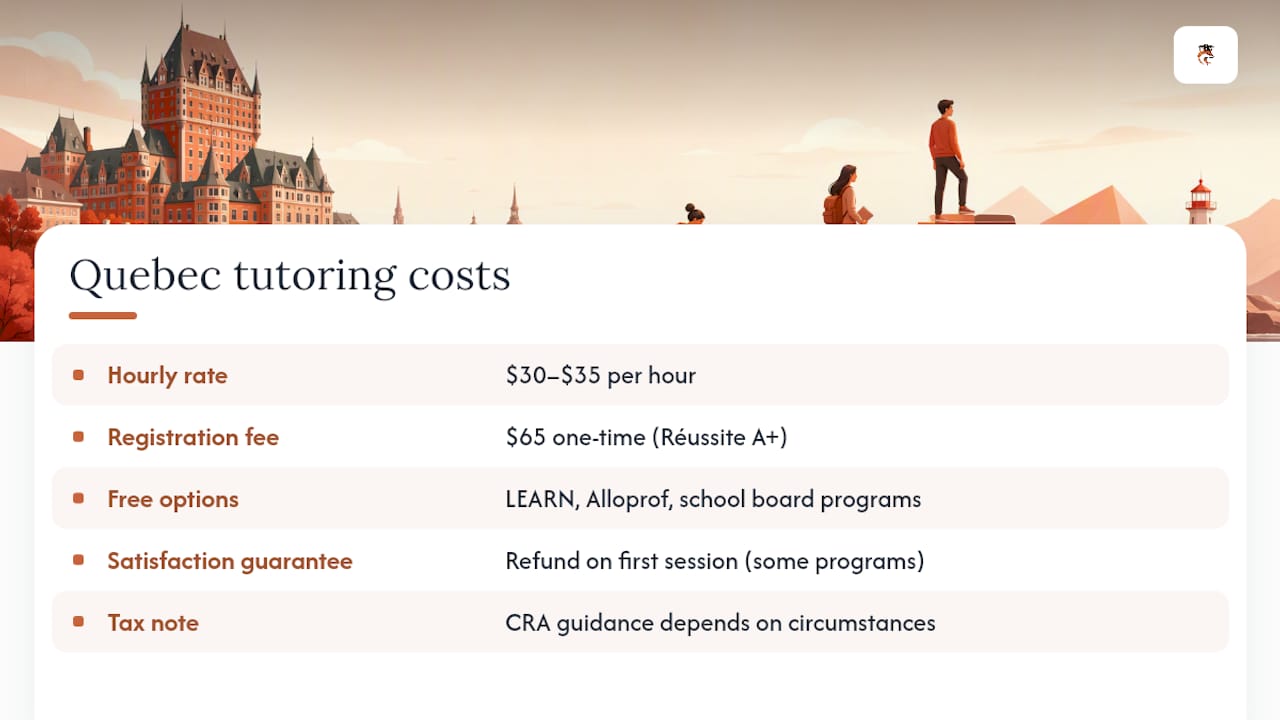
Look for a satisfaction guarantee before committing to a package. Some programs offer a refund on the first session if the fit isn’t right, which lowers the risk of trying a new tutor.
Before paying anything, exhaust the free options. LEARN Tutoring and Alloprof cost families nothing, and community programs run through your school board often fill gaps for younger students. For tax questions about tutoring expenses, Canada Revenue Agency guidance depends on individual circumstances, so don’t assume it’s automatically deductible.
Get started this week: a short checklist
You don’t need to overhaul anything tonight. Just take the next right step.
- Open Alloprof’s chat this evening if your child has a homework question right now.
- Check LEARN’s eligibility and upcoming session hours if your child qualifies by grade and school board.
- If you’re considering paid support, gather a recent report card, a couple of graded assignments, and one or two specific learning goals before a first consultation.
- Review what’s typically required for online tutoring so the first session isn’t lost to tech troubleshooting.
Why tailored tutoring matters more than people think
Twenty-five years of watching students struggle and improve has taught us one thing: generic help plateaus fast. A worksheet pulled from a general bank might fix today’s homework, but it rarely fixes the pattern behind it. The students who’ve gone through Réussite A+’s programs, more than 3,500 of them, made progress because someone tracked what actually changed session over session, not just whether homework got done.
— Réussite A+
Réussite A+: personalised support when free options aren’t enough
Once you’ve tried LEARN and Alloprof and know your child needs something more sustained, Réussite A+ offers exactly that: a plan built around your child’s pace, not a generic curriculum. Sessions run $30 to $35 per hour across regular tutoring, French programs, and math support, with a $65 one-time registration fee.

Families preparing for a secondary school entrance exam can book exam preparation sessions built specifically around that timeline, while kids who fell behind during the school year often start with a summer session to rebuild fundamentals before September. Every tutor comes from the university level, and the programs include a satisfaction guarantee covering the first session. If your child needs steady, one-on-one homework support rather than exam-specific prep, the homework help program covers that too. Book a consultation and bring a recent report card and one or two specific goals. That’s enough for a tutor to build a plan around your child from the first session.
Sources
- LEARN Tutoring – Students
- How to find free tutoring for your child | Alloprof
- Academic Support Resources — EMSB prevention & promotion
- Canada Revenue Agency — individuals
FAQ
What is the best online tutoring platform for Quebec students?
For free help, LEARN Tutoring and Alloprof are the strongest starting points since both use Quebec-certified teachers and cost nothing. For ongoing, personalised support in French or math, Réussite A+ offers tailored plans built around individual students rather than a fixed curriculum.
Which online tutoring site is considered the best overall?
It depends on the need: Alloprof wins for immediate, on-demand homework questions, LEARN wins for structured appointment-based help within eligible school boards, and a paid program like Réussite A+ wins when a student needs a sustained plan with progress tracking.
How much should an online tutor cost?
One-on-one online tutoring in Quebec typically runs $30 to $35 per hour, sometimes with a modest one-time registration fee. Réussite A+ lists its regular sessions at $30 to $35 per hour plus a $65 registration fee.
Is tutoring a tax write-off in Canada?
Tax treatment of tutoring expenses depends on individual circumstances and isn’t automatically deductible. Check current Canada Revenue Agency guidance before assuming any expense qualifies.