


Online tutoring is a live, one-on-one (or small-group) lesson between your child and a tutor, held over video and a shared digital workspace instead of at your kitchen table or a tutoring centre. You book a time, your child logs in with a computer and an internet connection, and the tutor works through homework, gaps or exam material in real time. The rest of this guide shows you what happens before, during and after a session, so you can decide with confidence whether it suits your family.
TL;DR
- An online session is a live lesson on a computer, with a tutor who explains, checks understanding and adjusts as your child answers.
- You need a computer, a headset or speakers, and a stable internet connection. A webcam helps, and your child can send homework before the session.
- Research shows online tutoring can improve learning, especially when it is live, two-way and well structured. Results depend on the model.
- Online tutoring removes travel and fits more easily around school, activities and family routines.
- With Réussite A+, sessions cost $30–$35 per hour, plus a one-time $65 registration fee, and the first session is covered by our satisfaction guarantee.
Table of Contents
- How online tutoring works, step by step
- What you need at home
- What happens during a session
- Does online tutoring work?
- Online or in-person: how they compare
- How often should your child have a session?
- How to follow your child’s progress
- What online tutoring costs with Réussite A+
- Which subjects and programs fit your child
- Our perspective
- Ready to start?
- FAQ
- Sources
How online tutoring works, step by step
The process is simpler than most parents expect. Here is the usual path, and how we run it at Réussite A+.
- You describe your child’s needs. Grade level, subject (French, mathematics or both), recent report card results, and your goal: catch up, keep pace, prepare for an exam or go further.
- A learning plan is built. At Réussite A+, every student receives a personalized plan based on strengths, challenges, learning pace and goals. A child who rushes through problems and a child who freezes at word problems do not need the same plan.
- You are matched with a tutor. Our tutors are selected from university-level students and graduates for academic excellence, teaching ability and commitment.
- You choose a schedule. Sessions can be weekly or more intensive, for example before an exam or during the summer.
- Your child logs in and learns live. The tutor teaches, asks questions, corrects and explains again in a different way when needed.
- Progress is monitored. The tutor tracks what has been mastered and what comes next, and the plan evolves with your child.
If you want a second walkthrough, we also describe how an online tutoring session unfolds from start to finish.
What you need at home
The equipment list is short:
- a computer or laptop (a tablet can work for some families, but a keyboard and larger screen make maths work easier)
- headphones or speakers, and a microphone
- a reliable internet connection
- a quiet corner, paper and a pencil
A Quebec online tutoring program describes a similar setup in its survey of families, and the same study notes that younger children sometimes need more help with technology. For a Grade 1 to 3 student, plan to sit nearby for the first session or two, open the link together and then step back.
A five-minute pre-session checklist
- Charge the laptop and test the sound.
- Close other tabs and silence phone notifications.
- Put the homework, the notebook and a pencil within reach.
- Write down one or two questions your child wants answered.
- Send the tutor any worksheet or exam copy in advance, if that is possible.
This small routine makes the first minutes productive and removes the stress of “is it working?”
What happens during a session
A good session has a rhythm. Here is what it typically looks like.
The first minutes: check-in. The tutor asks how school went, what is due and what felt hard. This is also when your child can say “I didn’t understand fractions on Tuesday.”
The middle: guided practice. The tutor explains a concept, then has your child try an example while talking through the steps. In French, this might mean spotting the verb, finding the subject and applying the agreement. In maths, it might mean reading a word problem, underlining the question and choosing the operation. A shared digital whiteboard lets both of them write, draw and correct on the same screen, which is why online tutoring is a good fit for step-by-step subjects.
The end: recap and next step. The tutor summarizes what was learned, gives a short task for the week and notes what to work on next time.

The research on how this model is built backs up the approach. A Canadian review of tutoring evidence found that live, two-way, one-to-one online tutoring is logistically simpler to organize than in-person tutoring. The same review warns that “digital tutoring” covers very different models, from software-led programs to live interaction. What we describe here is the live, human kind.
Session length
The length that suits your child depends on age and focus. A Quebec case study of an online tutoring program reports that it used 30-minute sessions for most of its tutorials, and that students can stay with the same tutor over the school year to build trust. Research reviews more broadly find that tutoring sessions usually run 30 to 60 minutes. Younger children usually do best with shorter sessions, and older students with longer ones.
Does online tutoring work?
Yes, online tutoring can improve learning. The honest picture is that how it is designed matters as much as the fact that it is online.
Here is what the evidence says:
- Broader tutoring research reports a pooled effect of 0.288 standard deviations on learning, according to the Canadian evidence review. That is a meaningful gain in education research terms.
- A 2025 randomized trial of virtual tutoring for kindergarten to Grade 2 found positive early-literacy effects, as summarized in the same review.
- In a Quebec survey, more than 95% of respondents said tutoring helped their child understand class material better. That is parent-reported experience, not a controlled experiment, but it reflects what families see at home.
- A Canadian qualitative study of high-school students and parents using online maths tutoring reported individualized attention, enough time to ask questions, more confidence and better school maths results.
What do the best programs have in common? A design guide on high-impact tutoring points to small groups of no more than three students, lessons aligned with the school curriculum, quality materials, trained tutors and regular progress monitoring. Those are the same principles behind our approach: a personalized plan, custom educational material, tutors selected for teaching ability, and continuous progress tracking.
For a deeper look, read what personalized tutoring delivers according to the evidence or the seven benefits of online tutoring.
Online or in-person: how they compare
Both formats put a knowledgeable person beside your child. The difference is mostly in logistics and comfort.
| Criterion | Online tutoring | In-person tutoring |
|---|---|---|
| Travel | None | Driving or a tutor visiting your home |
| Scheduling | Easier to fit around activities and work | Tied to travel time and location |
| Tools | Digital whiteboard, screen sharing, files sent in advance | Paper and pencil, in the room |
| Setting | Child’s own space, often calmer | New space or shared home space |
| Tutor choice | Anyone in Quebec, whatever your postal code | Limited to your area |
| Younger children | A parent helps with setup at first | A parent helps with setup less |
The Quebec survey found just under 74% of respondents saw online tutoring as equally effective to face-to-face tutoring. Families named reduced driving time, easier scheduling, fewer distractions for some children, less anxiety at home and a child’s comfort with technology as advantages.
This matters most if you live in Montreal, Laval, Longueuil, Brossard or Gatineau, where traffic and activity schedules can make a weekly trip a real effort. For a longer comparison, see online versus in-person tutoring or home tutoring versus online tutoring.
How often should your child have a session?
The right rhythm depends on the goal, the age and the subject. Here is a practical way to think about it.
- Homework help or clarifying one topic: a weekly session can be enough to keep a child on track.
- Catching up in French or maths: more frequent sessions help. The research on tutoring dosage finds that longer and more frequent programs generally produce larger effects, and the high-impact design guide recommends at least three sessions a week over ten weeks or more for the strongest results.
- Exam preparation: an intensive schedule over several weeks before the exam works well. Our high school entrance exam preparation plan shows how to structure it.
- Summer: a concentrated block helps your child return in September with strong foundations.
You do not need to commit to the maximum. Start with the rhythm that fits your family, then adjust as you see progress. That flexibility is one of the benefits of online scheduling.
How to follow your child’s progress
As a parent, you want to know it is working. Good online tutoring gives you visible signals:
- the tutor’s notes on what was covered and what is next
- homework and quiz results that move in the right direction
- your child asking questions more freely, and saying “I get it” more often
- improvement in report card marks over a term
In the Canadian qualitative study, families also noted the confidence boost and a sense of competence that came with tailored support. Our article on how online tutoring helps parents monitor academic progress goes into more detail.
What online tutoring costs with Réussite A+
Our rates are published and simple:
- Regular session, summer session, homework help, French programs, and exam preparation: $30–$35 per hour
- Registration fee: $65, one time
Our satisfaction guarantee means that if you are not satisfied after the first session, we refund it. Rates for regular and exam preparation sessions are listed on our pricing page.
Private tutoring is an investment, and the Canadian study mentioned above notes that access to it can be shaped by family income. That is one reason we keep our hourly rates affordable and clear: quality support should be within reach of more Quebec families.
Which subjects and programs fit your child
- French: reading, grammar, verb agreement, writing and comprehension. See our French tutoring programs.
- Mathematics: number sense, fractions, problem solving and secondary-level algebra, with a focus on the démarche, the reasoning steps that earn marks.
- Homework help: a tutor alongside your child for daily assignments. See online tutoring and homework help.
- Entrance exam preparation: targeted practice for secondary school entrance exams, including the mots-pièges (trap words) that trip students up.
- Summer session: intensive online courses to catch up or get ahead.
Our perspective
We have tutored online for more than 25 years of educational experience, and we have helped more than 3,500 students. What we have learned is simple: the screen is not what makes a session work. The person and the plan do.
A child learns when someone notices exactly where the confusion starts, explains it in a way that fits, and then checks that it stuck. That is why we build a personalized plan for every student around strengths, challenges, pace and goals, and why we select our tutors from the university level for academic excellence and teaching ability.
Online delivery adds something real for families: no travel, flexible scheduling, and a child learning in a space where they feel at ease. Parents tell us this is what lets them keep a steady routine through the school year.
Our approach is designed to build foundations, confidence and lasting success, whether your child needs to catch up, prepare for an exam or go beyond grade-level expectations.
Réussite A+
Ready to start?
If you would like your child to try a live, personalized session, we make the first step easy. Tell us the grade, the subject and the goal, and we will build a plan around your child. Sessions with university-level tutors run at $30–$35 per hour, with a $65 one-time registration fee. You can register for tutoring and academic support or start with a regular session.
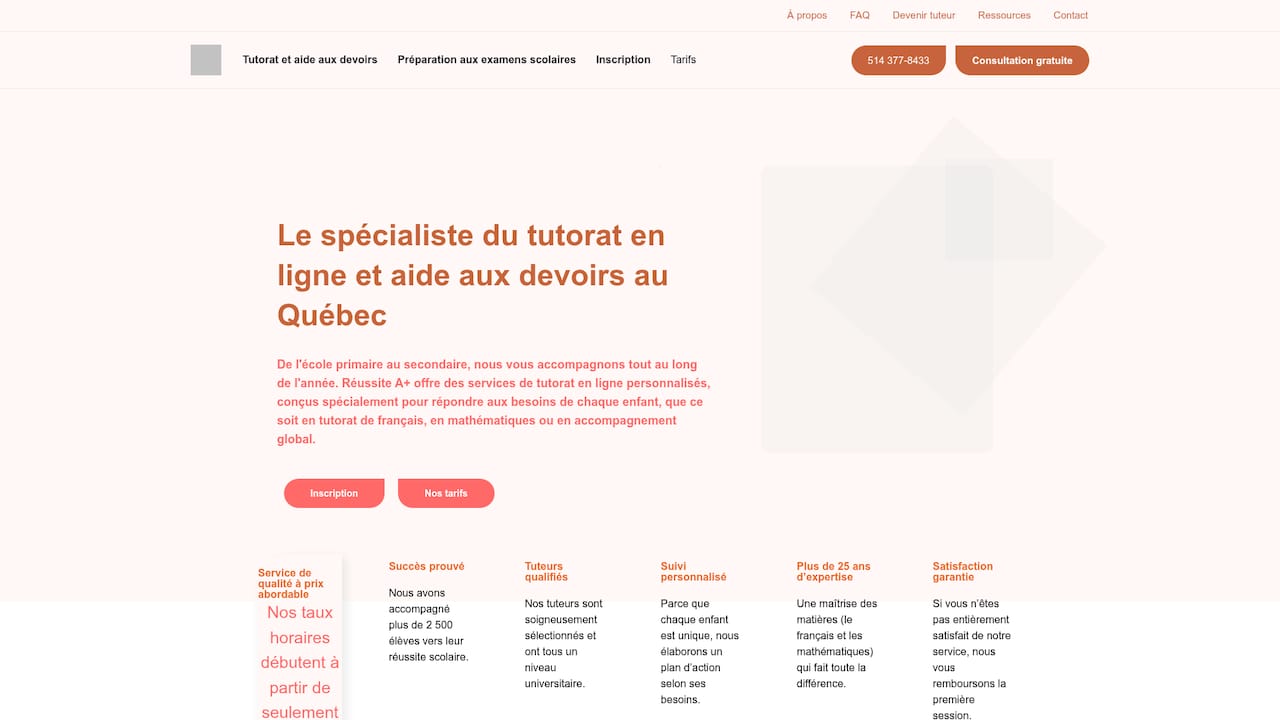
If an exam is coming, our exam preparation sessions are built for that purpose. If you are planning ahead, look at our summer session.
FAQ
Is online tutoring effective for elementary students?
It can be, particularly when sessions are live, interactive and short enough for a child’s attention. A 2025 randomized trial found positive early-literacy effects for virtual tutoring in kindergarten to Grade 2, as reported in the Canadian evidence review. Younger children do best when a parent helps with the first login and the session is kept focused.
Does my child need a webcam?
Not necessarily. The essentials are a computer, sound and an internet connection. A webcam lets the tutor read your child’s expressions, which helps, but the shared whiteboard and voice do most of the teaching work. Ask us about your setup and we will help you get ready.
How is a session different from homework help at school?
A tutor gives your child full attention for the whole session, so there is time to ask every question and to practise until the idea clicks. The Canadian qualitative study highlighted individualized attention and enough time to ask questions as key benefits. Our tutoring and homework help also follows a plan that targets the gaps your child has, not only tonight’s worksheet.
How quickly will I see results?
Most families notice more confidence and smoother homework first, then better marks over a term. The pace depends on your child’s starting point, how often they have sessions, and regular practice between sessions. Progress monitoring lets you see the steps along the way.
What if my child does not click with the tutor?
We stand behind our service with a satisfaction guarantee: if you are not satisfied after the first session, we refund it. Tell us what you noticed, and we will use it to improve the match and the plan.
Sources
- The Evidence for Tutoring to Accelerate Learning (Toronto Metropolitan University)
- LEARN Online Tutoring Program Study (January 2023)
- Online Tutorials and Responding to the Special Needs of Students (Quebec case study)
- From the Peripheral to the Transboundary: Documenting the Online Tutoring Experience (2024)
- The Impressive Effects of Tutoring on PreK-12 Learning (NBER, 2020)
- Design Principles for Accelerating Student Learning with High-Impact Tutoring (Stanford, 2024)