



You can help your child with French even if you barely speak it yourself. What matters most is not your accent or your grammar. It is the habits you build around French: a little exposure every day, calm questions about homework, books your child chooses, and praise for every effort. This guide gives you simple, structured ways to do that, step by step, and tells you when it makes sense to bring in a tutor.
TL;DR
- Short, regular, playful contact with French beats long, stressful study sessions.
- You do not need to speak French to help: guiding questions about homework and good work habits go a long way.
- Let your child choose books, games and songs, and avoid correcting every mistake.
- If a child refuses to speak French, keep French present in the background and reward any attempt, however small.
- If gaps keep growing or homework turns into conflict, a personalised plan with a tutor can restore confidence.
Table of Contents
- Start with habits, not grammar
- Bring French into everyday life
- If your child refuses to speak French
- Make reading and writing enjoyable
- Supporting a child in a French immersion or French-language school
- Early learners: ideas for younger children
- A simple weekly plan
- Our perspective: confidence comes before correctness
- When a tutor can help
- FAQ
- Sources
Start with habits, not grammar
Many parents feel stuck because they think helping means explaining the passé composé or checking every accent. It does not. Scholastic’s guide for French immersion families suggests that parents can support students by developing habits such as organization and critical thinking, rather than feeling obliged to help with the French content of each assignment.
In practice, this means you become the project manager of the homework, not the teacher. Here is a simple routine:
- Pick a fixed time and place. Fifteen to twenty minutes at the same table, with the tablet away, is better than an hour of struggle on Sunday night.
- Let your child explain the task. Ask them to tell you, in their own words, what the teacher is asking for.
- Look for the action verb. Is the instruction asking them to souligner, relever, justifier, compléter? Many mistakes come from misreading the instruction, not from not knowing French.
- Watch for trap words. Words like sauf, au moins or plusieurs change the answer. Have your child circle them. Turning this into a small game of “find the trap word” lowers the stress.
- Check the work with a short checklist. Capital letter, end punctuation, agreements, verb ending, and a quick reread aloud.
The same Scholastic guide notes that parents can ask guiding questions about homework assignments, even without speaking French, to help children recall and understand the instructions. Useful questions include:
- “What is the first thing you have to do?”
- “Which word tells you what kind of answer the teacher wants?”
- “Where in the text could you find that?”
- “Can you show me an example from your notebook?”
If you want a deeper walk-through for parents who do not speak the language, we have written a separate guide for non-French-speaking parents.
Bring French into everyday life
Children learn a language best when it is attached to things they care about and do daily. The BBC’s learning site quotes language specialist Tamsin Anderson recommending fun, humour and short bursts of immersion, such as conversation at dinner, on a family walk or during a car journey. Ten relaxed minutes is enough.
Turn chores into vocabulary
Laundry, groceries and cooking are full of language. A resource on everyday interactions explains that these routines can build language through talk about textures, colours, numbers, adjectives and recipe steps. In French, that might look like this:
- At the grocery store: “Trouve-moi trois pommes rouges.”
- While cooking: “D’abord, on casse les œufs. Ensuite, on mélange.”
- Sorting laundry: “Les chaussettes bleues, les chaussettes blanches.”
You can use a translation app for the words you do not know. Learning alongside your child is a good model: it shows that mistakes are normal.
Play games in French
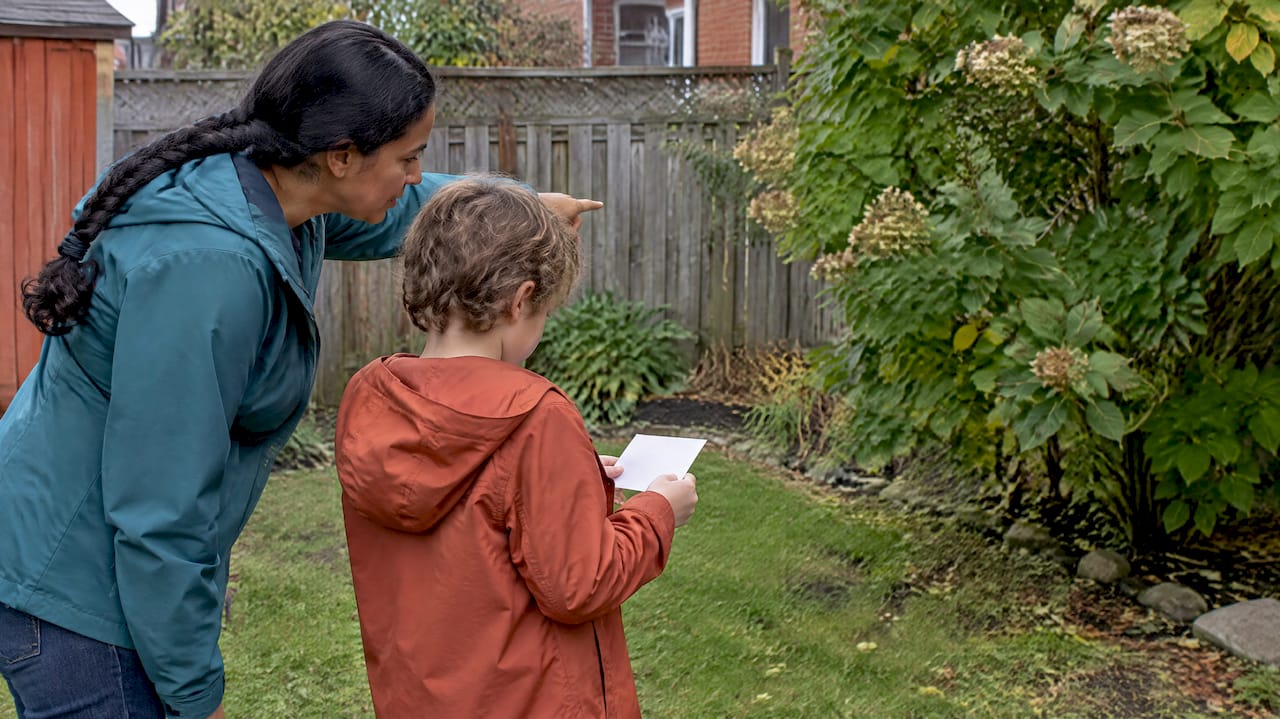
Board games are an easy way to get everyone talking. Active For Life suggests language-focused games such as the French edition of Bananagrams or Dixit to encourage conversation and vocabulary building in the family. The same article proposes outdoor scavenger hunts with clues and instructions in French, which train children to listen, understand and follow directions. A hunt around the backyard or park, with five written clues, takes ten minutes to prepare.
Use music, shows and screens wisely
Play French songs in the car, put on a French cartoon your child already knows in English, and keep subtitles on if needed. The goal is not a lesson. It is making French a normal sound in your home.
For more speaking ideas you can start today, see our list of seven ways to practise speaking French.
If your child refuses to speak French
This is very common, especially with children who are comfortable in English at home. Pressure usually makes it worse. Canadian Parents for French advises in its parent FAQ to keep French present through background music, books or shows without expecting an immediate reply. It also recommends avoiding negative correction, using positive reinforcement when a child uses a French word, and offering choices in how they practise.
Here is how that looks day to day:
- Speak, but do not demand. Ask a question in French and accept an answer in English. Your child is still listening and processing.
- Celebrate every French word. “Tu as dit merci en français, bravo!” is enough.
- Repeat, do not correct. If your child says “Je suis allé à la école”, you reply naturally: “Ah, tu es allé à l’école! C’était comment?”
- Offer two choices. “Do you want to read a comic or play a card game in French?” Choice gives back a feeling of control.
- Start early and keep it playful. The same organization notes that introducing French through music, books and playful interactions from an early age helps French become part of daily routines and makes refusal less likely.
If your child is older and the refusal comes from embarrassment about mistakes, a one-on-one setting with a patient tutor can be easier than speaking in front of classmates or family.
Make reading and writing enjoyable
Reading is the single most useful habit for improving vocabulary, spelling and sentence structure. The challenge is making it feel like a pleasure, not a school task.
Build a small French library
Scholastic’s guide recommends that parents build a French library at home, let children choose among books, and encourage them to reread a favourite English book in French. Rereading a story your child already knows is a clever trick: the plot is familiar, so the brain can focus on the French words. Public library cards are free in most Quebec municipalities, so a small shelf can cost nothing.

The guide also cites the 2024 Kids & Family Reading Report (Canadian Edition), which found that children are more engaged with reading when they have more books at home and choose their own material. Since that finding comes through a publisher’s guide, treat it as encouragement rather than a rule: the practical lesson is simply to let your child pick.
Read together, then switch roles
Try a 10-minute routine:
- Day 1: you read a page aloud, your child follows with a finger.
- Day 2: your child reads the same page to you.
- Day 3: your child tells you the story in their own words, in any language.
For children who struggle with decoding, read the text slowly, and focus on sounds before meaning. Our guide on how to improve French reading skills goes through this in more detail for Quebec students. If reading remains unusually hard despite effort, particularly in the early grades, read our page on dyslexia and learning French and speak to your school’s resource teacher or a qualified professional about an assessment.
Write for a real reason
Writing improves when it has an audience. Have your child:
- write the grocery list in French
- send a short message to a grandparent
- keep a three-line daily journal (“Aujourd’hui, j’ai… Mon moment préféré, c’était…”)
- create a short skit and act it out, an idea that Active For Life also suggests
At this stage, correct only one thing at a time, for example the agreement of adjectives or the -é ending of past participles. Too many red marks discourage young writers.
Supporting a child in a French immersion or French-language school
If your child attends a French school or an immersion program and you speak little French, you are not alone. School boards and parent organizations have produced guides for exactly this situation. One Ontario family guide to French immersion mentions that Canadian Parents for French Ontario has tip sheets for parents of children in French Immersion, Extended or Core French programs, and lists the French as a Second Language Homework Toolbox, with videos, audio files and printable tip sheets. The guide dates from 2014, so check that the current resources are still online, but the principle is the same today: practical help exists and is free.
Some ways to support your child:
- Show interest in school. Ask what the best part of the French day was.
- Talk to the teacher early. Ask what to focus on at home and whether any specific skills (reading fluency, verb conjugation, dictation) need attention.
- Keep both languages strong. Reading and talking in English about ideas helps your child understand concepts they will express in French.
- Stay calm about homework. Your reassurance matters more than your French.
We also have a page about French immersion homework if a diagnostic session would help you understand where your child is struggling.
Early learners: ideas for younger children
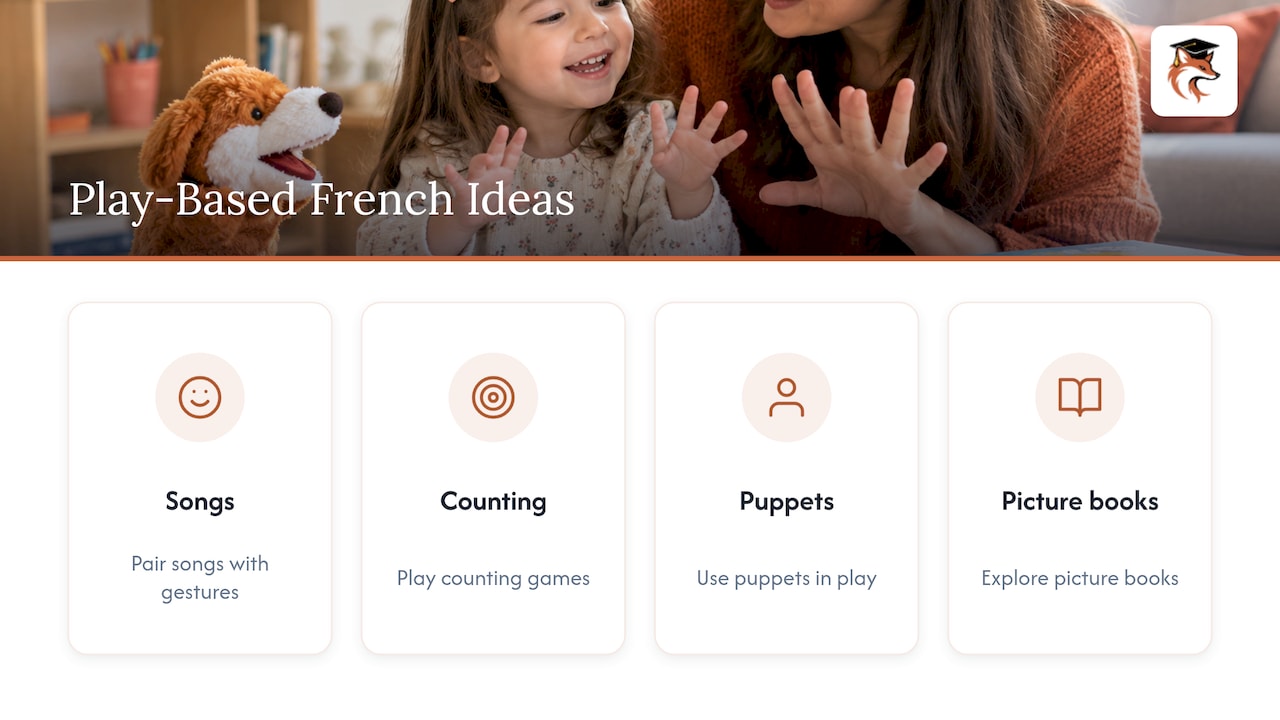
For preschool and early elementary children, play comes first. BC French Education states that early exposure to play-based language learning leads to greater social, emotional and academic success. Songs with gestures, counting games, puppets and picture books are all enough.
If you would like a ready-made starting point, Canadian Parents for French sells a French Footprints Parent Kit for $25. It includes a French book, a musical shaker, a play scarf, a finger puppet, vocabulary flashcards, a counting mat, a popping toy and a 12-page resource guide, with free shipping anywhere in Canada. Prices can change, so check the page before ordering.
A simple weekly plan
Consistency matters more than intensity. Here is a realistic plan for a busy family:
| Day | Activity | Time |
|---|---|---|
| Monday | Homework routine and checklist | 15–20 min |
| Tuesday | French song or cartoon in the car or at breakfast | 10 min |
| Wednesday | Read a chosen book together, then swap | 10–15 min |
| Thursday | Homework routine, one targeted skill (e.g. verb endings) | 15–20 min |
| Friday | Family game in French | 15–20 min |
| Saturday | Cooking or scavenger hunt with French instructions | 20 min |
| Sunday | Rest, or a three-line journal | 5 min |
Adjust it to your child’s age. A six-year-old needs more play, a twelve-year-old more writing and independence.
Our perspective: confidence comes before correctness
After more than 25 years in education and having helped more than 3,500 students, we see the same pattern in Quebec families. Children rarely struggle with French because they are “not good at languages”. They struggle because gaps piled up quietly, instructions were misread, or they lost confidence after too many corrections.
That is why every student we work with receives a learning plan built around their strengths, challenges, pace and goals. We start by finding which foundations are shaky, then rebuild them in small steps, tracking progress as we go. We also keep sessions positive: a child who feels capable takes more risks in French, and risks are how languages are learned.
Our advice to parents is simple: protect the relationship first. Homework that ends in tears teaches a child that French is a source of conflict. A short, calm session that ends with a success teaches the opposite.
— Réussite A+
When a tutor can help
Home habits solve many problems, but not all. Consider extra support if:
- homework regularly ends in arguments or tears
- your child’s marks in French keep dropping despite effort
- your child has gaps from earlier years and cannot follow current lessons
- an important exam, such as a secondary school entrance exam, is approaching
- you cannot help with the content and the school cannot offer enough support
At Réussite A+, our university-level tutors work online with elementary and secondary students across Quebec, including Montreal, Laval, Longueuil and Brossard. Our French tutoring programs start from your child’s actual level, with custom material and continuous progress monitoring. Sessions are $30–$35 per hour, and there is a one-time registration fee of $65, detailed on our pricing page. If you are not satisfied after the first session, we refund it.
If you are ready, you can register for tutoring and academic support or learn how our regular session works across the school year. For the holidays, our summer activities for French and math can help your child keep what they learned.
FAQ
What is the best way for a child to learn French?
Regular, short and enjoyable contact works best: songs, stories, games and conversation, combined with good school instruction. Early play-based exposure is linked to better social, emotional and academic outcomes, according to BC French Education. Choose activities your child likes so that practice does not feel like a chore.
Can I help my child with French if I do not speak it?
Yes. Ask guiding questions about the homework instructions, set up a routine and show interest in what your child learns. Scholastic’s guide says that building habits such as organization and critical thinking is more useful than trying to teach the content yourself. A tutor can cover the language itself.
My child answers in English when I speak French. What should I do?
Keep speaking French without demanding a reply, and praise any French word your child uses. Canadian Parents for French recommends background French, positive reinforcement and choices rather than correction. Give it time: understanding comes before speaking.
How much French practice does my child need each day?
Ten to twenty minutes of focused, relaxed practice is a good target for most elementary students, plus whatever French happens naturally at school. Short bursts of immersion, such as dinner conversation or a car ride, are recommended by language specialist Tamsin Anderson. If your child is preparing for an exam, a tutor can plan the extra hours with you.
When should I consider a French tutor?
Consider one when gaps are growing, homework causes constant stress, or an exam is coming. A tutor can pinpoint what is missing and rebuild it step by step, so your child regains confidence. You can start with our French tutoring programs.
Sources
- French Footprints: Parent Resource Hub, Canadian Parents for French
- French Literacy Resources for Families, BC French Education
- How to teach your child languages at home, BBC Bitesize
- Building Language Through Everyday Interactions
- 20 ways French immersion parents can help embrace a love of French, Active For Life
- BC French Immersion Guide 2024, Scholastic
- Supporting Your Child’s Success in French Immersion, Family Guide
- Parent FAQ, Canadian Parents for French (2025)