




A tutor meeting should leave you with a shared baseline, one short-term goal and a clear follow-up plan. Expect the parent, the tutor and sometimes the child in the room for a typical session lasting from a short to a moderate length. Before you leave or log off, confirm how and when you will hear from the tutor next.
TL;DR:
- Gathering recent report cards, test papers, and home routine notes helps parents provide accurate baseline information for tutoring plans.
- Asking how the tutor measures progress in four to six weeks ensures the effectiveness of the sessions is clearly tracked over time.
- Setting short-term, measurable goals tied to specific skills or curriculum targets prevents conversations from drifting without clear outcomes.
- Establishing a consistent follow-up method, such as weekly updates and written summaries, reduces misunderstandings and keeps communication clear.
- For children with special needs, pairing specific IEP goals with trial plans and involving school supports can address ongoing concerns effectively.
Table of Contents
- What to expect during the first parent-tutor meeting
- How parents should prepare: a practical checklist to bring
- Questions parents should ask the tutor
- Agreeing goals and reviewing progress
- Agreeing communication and follow-up
- Handling concerns and supporting students with special needs
- How Réussite A+ supports parents during the first tutoring meeting
- A parent-centred perspective: keeping meetings collaborative
- If you want organised, measurable tutoring support
- FAQ
- Sources
What to expect during the first parent-tutor meeting
Most first meetings follow a similar shape. The tutor introduces themselves, asks about your child’s learning profile, looks at sample work or recent tests, reviews any teacher or IEP notes you bring, and proposes one or two goals before setting next steps.
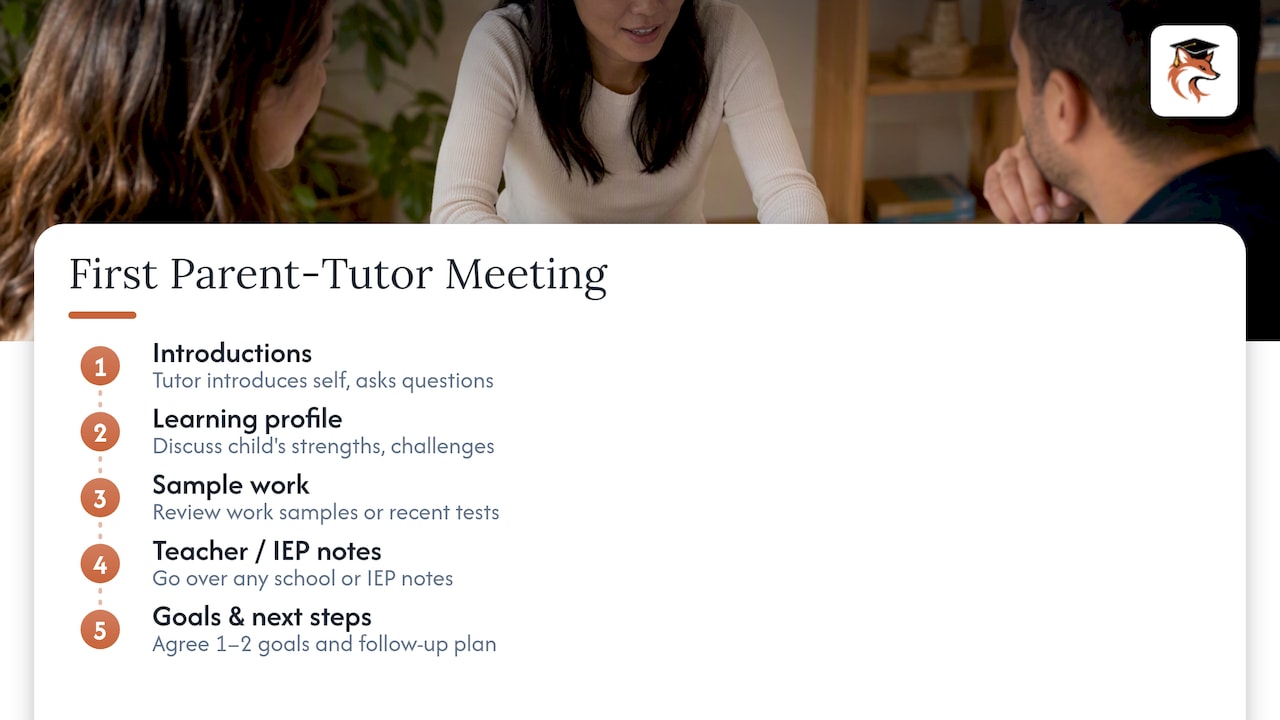
Live formats work best for this first exchange. Research on parent engagement consistently rates face-to-face or synchronous video meetings as more effective for building trust than email alone, since tone and follow-up questions travel better in real time. A phone call is fine in a pinch, but a video call lets the tutor show you sample exercises on screen.
Expect questions that go beyond grades: how your child does homework alone, whether they ask for help or avoid it, and what feedback the school has given recently. These questions are not small talk. They tell the tutor how independent your child already is, which shapes the whole plan.
How parents should prepare: a practical checklist to bring
A little preparation turns a vague chat into a working session. Gather what you can before the meeting, even if it is incomplete.
- Recent report cards and any recent test papers or homework samples that show current performance.
- IEP or accommodation documents, if your child has one, plus any recent teacher emails worth mentioning.
- Notes on home routines: when and how your child studies, what languages are spoken at home, and anything affecting sleep, health or focus.
- A short note on what motivates your child, since tutors use this to frame goals in language the student will actually respond to.
- Confirmation of logistics: who is attending, whether your child will join for all or part of the meeting, and your preferred way to hear updates afterward.
Sharing home-context details matters more than parents often expect. Tutors rely on parents’ everyday knowledge of their child to build an accurate baseline, since that information rarely appears in school records. You can read more about sharing routines and needs with an online tutor if you want a fuller picture of what to pass along.
Questions parents should ask the tutor
A short list of pointed questions gets you further than a general conversation.
- “Can you walk me through how a typical session is structured, and why you teach this way?”
- “What would you use as a starting point to measure where my child is right now?”
- “How will we know in four to six weeks whether this is working?”
- “What should homework support from me look like, and where should I step back?”
- “How often will I get an update, and who is my point of contact if something comes up between sessions?”
These cover fit, measurement, daily support and logistics in one pass. If you want a ready-made version to print, the tutoring consultation questions checklist covers the same ground with space to jot answers.
Agreeing goals and reviewing progress
A meeting without a measurable goal tends to drift. Aim for one or two short-term goals, written in plain terms tied to something concrete: a curriculum expectation, an IEP target or a specific skill gap.
- A workable template: “By [date], [child] will [specific skill], measured by [sample test, quiz or assignment].”
- Baseline evidence worth collecting now: a recent quiz, a writing sample, or a teacher’s comment on a report card, since you will compare future work against this starting point.
- Ontario’s own guidance on assessing student learning recommends tracking baseline achievement and regular progress toward goals rather than relying on grades alone, and the same logic applies outside a formal IEP.
- A simple review rhythm works well: a short weekly note on what was covered, and a monthly summary comparing current work to the baseline.
A template for turning this conversation into a written plan is available in this personalized learning plan guide, useful whether or not your child has a formal IEP.
Agreeing communication and follow-up
Decide how you will stay in touch before small issues become big ones.
- A brief video check-in works well for anything nuanced, like a change in motivation or a new school concern.
- A weekly email suits short, factual updates: what was covered, what is next.
- A shared communication notebook or document suits families who want a running record both sides can check anytime.
Set a few ground rules at the first meeting: a realistic response time, who to contact if something feels urgent, and how resources get shared. Ask the tutor to send a short written note after each meeting listing what was agreed and by when. A reliable rhythm like this reduces the number of surprises that turn into bigger conflicts later.
Handling concerns and supporting students with special needs
Concerns come up. The way you raise them matters as much as the concern itself. Instead of “this isn’t working,” try “I’m noticing X at home, can we adjust Y?” This keeps the conversation focused on a fix rather than fault.
If your child has an IEP or formal accommodations, bring the document and ask the tutor directly how specific session activities connect to specific IEP goals. Vague alignment is not enough.

If something still isn’t working after a few sessions, ask for a short trial plan instead of an open-ended change: four sessions with a clear success measure and a set review date. If concerns persist beyond that, loop in school-based supports or a mediator where appropriate.
Pro Tip: Put your concern and your proposed fix in the same sentence. It reads as collaborative, not combative.
How Réussite A+ supports parents during the first tutoring meeting
A highly personalised assessment of the student’s strengths, pace and goals, delivered by experienced tutors and backed by ongoing progress monitoring, forms the basis of effective tutoring plans. That structure mirrors what this guide recommends: a real baseline, a written goal, and a way to track movement over time.
A shared baseline, a measurable goal and a documented follow-up plan protect both the family and the tutor from drifting conversations.
Parents can adapt our own printable consultation questions checklist for any tutor meeting, not only ours, and use it to keep every future check-in anchored to the same goals.
A parent-centred perspective: keeping meetings collaborative
Walking into a tutor meeting with a stack of report cards and a knot in your stomach is normal. Treat it as a team huddle, not an evaluation. A warm greeting and plain language go a long way on both sides.
If you expect a hard conversation, bring a support person. And always ask for a short written summary afterward: it protects the relationship as much as it protects the plan.
— Réussite A+
If you want organised, measurable tutoring support
If the idea of turning a single meeting into a lasting plan feels like the hard part, that is exactly where Réussite A+ starts. Every student gets a personalised plan built from the same baseline-and-goal approach covered above, whether the need is a regular tutoring session, focused homework help, or secondary school entrance exam preparation.

Experienced tutors deliver the sessions, with progress tracked regularly rather than left to a single annual report card. Families can also use our printable consultation checklist before booking, so the first meeting starts with real information rather than guesswork about what to ask.
Ready to see what a structured first session looks like for your child? Book a regular tutoring session and bring your filled-out checklist to the first call.
FAQ
What are some good ideas for a parent-teacher meeting?
Bring recent work samples, a short note on home routines, and one or two specific questions about progress. Ending with a written summary of agreed next steps keeps the meeting useful rather than just friendly.
What are some good topics for parent meetings?
The most useful topics are baseline performance, a measurable short-term goal, homework expectations, and how often you will hear updates. Covering these four areas usually prevents most follow-up confusion.
What do you call a parent-teacher meeting?
It is commonly called a parent-teacher conference or parent-teacher interview, and the same format applies to a tutor meeting, sometimes called a consultation or progress review. The purpose stays the same across names: align on where the student stands and what comes next.
How can a tutor handle a difficult or emotional parent meeting?
Practitioner guidance suggests asking the parent directly what would help, rather than defending the current plan first. Offering a short trial plan with a clear review date, followed by a prompt written summary, tends to lower tension and rebuild trust.
How often should parents expect updates after the first meeting?
A short weekly note plus a more detailed monthly summary is a common and workable rhythm. Provincial reporting practices already lean on a mix of written and informal updates throughout the year, and tutoring check-ins can follow the same pattern.
Sources
- Assessing student learning | Special education in Ontario Kindergarten to Grade 12 – Policy and resource guide
- EdCan Network (parent engagement resources)