


A personalized learning plan is a student-centred roadmap that sets one to three SMART goals and the concrete steps to reach them. You start today, not next month, by drafting a single SMART goal and booking your first check-in date.
Réussite A+ has built and adjusted these plans with more than 3,500 students across Quebec, so we know where most families get stuck: too many goals, no baseline data, no clear check-in schedule.
Here’s what to do right now:
- Pick one subject or skill where progress matters most this term.
- Write it as a SMART goal (specific, measurable, achievable, relevant, time-bound).
- Set a check-in date two to four weeks out.
- Name who is responsible for tracking it.
Key Takeaways
A personalized learning plan succeeds when it limits itself to one or two SMART goals, tracks them on a fixed schedule, and involves the student directly in setting them.
| Point | Details |
|---|---|
| Start with one goal | A single measurable SMART goal beats a long list every time; add more once it’s on track. |
| Collect baseline data first | Pull recent grades or a quick assessment before writing any goal, so progress is measurable. |
| Set a real review cadence | Weekly micro-checks, monthly progress notes, and a full review at term’s end keep plans active. |
| Expect gains over time, not overnight | RAND’s multi-year study found stronger math gains typically appearing in year two of use. |
| Get professional support when needed | Réussite A+ builds and monitors individualized learning plans with university-level tutors across Quebec. |
Table of Contents
- What is a personalized learning plan, and how is it different from an IEP?
- Core components every plan needs
- How to create a learning plan step by step
- A one-page template and two SMART goal examples
- How to monitor, review, and adjust the plan
- Who does what: roles for students, parents, and tutors
- What the research says about results and timelines
- Our take: why most plans fail before they start
- Get a plan built for your child, not a template off the shelf
- Where to go for more detail
- Sources
- FAQ
What is a personalized learning plan, and how is it different from an IEP?
A personalized learning plan (PLP) is a flexible, student-centred document built around a learner’s goals, strengths, and pace. It typically follows a SMART goals framework and gets revised throughout the year rather than locked in place. Explainers aimed at families describe personalized learning as tailoring what, when, and how a student learns while still keeping their work aligned with grade-level standards and graduation requirements.
A PLP is not the same thing as an Individualized Education Program (IEP). An IEP is a legal document tied to a diagnosed disability, with formal entitlements and compliance requirements set by school boards. A PLP carries no legal weight. It is an operational tool that any student, struggling or advanced, can use.
- PLP: voluntary, flexible, owned by the student and family, revised anytime.
- IEP: legally mandated, formal, tied to a diagnosis, reviewed on a fixed schedule.
The plan works best when the student helps write it, alongside a parent, tutor, or teacher acting as a collaborator rather than the sole author.
Core components every plan needs
A plan missing any of these pieces tends to stall within a month. Model templates used by school districts converge on the same five building blocks, and Connecticut’s own model PLP document is a useful reference for the exact fields to include.
- Learner profile — strengths, interests, and how the student prefers to learn (visual, hands-on, verbal).
- Baseline data — recent grades, test scores, or a quick diagnostic assessment.
- SMART goals — one to three, mixing a short-term win with a longer-term target.
- Strategies and supports — the specific methods, accommodations, or tools that will get the student there.
- Progress-monitoring plan — who checks what, and how often.
Pro Tip: Skip the temptation to write five or six goals at once. A plan with one sharp goal gets finished; a plan with six vague ones gets abandoned by week three.
How to create a learning plan step by step
Building a personalized education plan doesn’t require a formal meeting room or a school-issued form. It requires about 45 minutes and the five steps below, in order.
- Gather evidence and build the learner profile. Pull the last two report cards, a recent test, or a teacher comment, and jot down what the student says they find hard and what they enjoy.
- Agree on one to three priority SMART goals. Fewer goals executed well beat a long wish list. Practitioner guides on building an individualized learning plan consistently recommend narrowing to what actually moves the needle this term, a method Collective Learning outlines in its own stepwise process.
- Select strategies, supports, and who owns each one. Decide if the strategy is extra practice, a tutor session, a graphic organizer, or extended time, and name the adult responsible for each.
- Set short review cycles. Weekly for the habit, monthly for the trend, and a fuller review at the term’s end.
- Document it, share it, and hold the first check-in within two weeks. A plan sitting in a drawer helps nobody; a plan reviewed on schedule keeps momentum.
A few things that trip families up at this stage:
- Setting goals around what the student “should” want instead of what actually motivates them.
- Skipping the baseline data and guessing at where the student currently stands.
- Forgetting to write down who’s responsible for tracking progress.
A one-page template and two SMART goal examples
You don’t need special software to draft a personalized education plan. A single page with six fields does the job, and it mirrors the structure recommended in most model templates, including the Nebraska Department of Education’s PLP booklet.
- Student profile: name, grade, interests, learning preference
- Baseline data: current grade or score, date collected
- Goals: one to three SMART goals, short and long term
- Strategies and supports: methods, tools, accommodations
- Monitoring plan: who checks in, how often, what tool
- Signatures: student, parent, tutor or teacher, with the date
A worked academic example: “By November 15, [student] will improve their reading comprehension score from 68% to 80% on the monthly benchmark quiz, tracked through weekly guided reading sessions and a running log of quiz results.”
A worked SEL/organization example: “By the end of the month, [student] will complete and submit homework on time four out of five school days, tracked with a daily checklist signed by a parent.”
Both goals share the same shape: a measurable number, a deadline, and a tracking method built right into the sentence.
How to monitor, review, and adjust the plan
A plan is only as good as the check-ins behind it. The cadence doesn’t need to be complicated:
- Weekly: a two-minute micro-check on whether the student did the agreed task.
- Monthly: a short written progress note comparing current data to baseline.
- Annually (or termly): a full review, resetting goals and updating the learner profile.
Simple tools work fine here: a one-page rubric, a shared Google Sheet, or even a handwritten log taped inside a binder. What matters is that someone actually looks at it on schedule.
Pro Tip: If a goal is met two check-ins in a row with no effort, raise the bar. If it’s missed three times running, the goal or the strategy needs to change, not just the student’s effort level.

Write down every adjustment with a date and a one-line reason. That history becomes useful evidence when a teacher or tutor asks what’s already been tried.
Who does what: roles for students, parents, and tutors
A personalized learning plan only works when responsibilities are specific and short enough to actually remember.
- Student: complete the daily task, and answer one self-reflection prompt each week (what worked, what didn’t).
- Parent: protect the study time on the calendar, encourage without nagging, and set up a workspace with fewer distractions.
- Tutor or teacher: deliver targeted instruction, collect the progress data, and suggest adjustments when the data calls for it.
- Everyone: show up to a short 15-minute check-in covering three questions: What’s working? What’s stuck? What changes next?
Cross-stakeholder involvement, especially consistent parent engagement, is repeatedly identified as the single biggest driver of whether a plan actually gets followed through. A tutoring relationship built around this kind of shared visibility, where parents can track progress alongside the tutor, tends to hold up better over a full school year than a plan one adult manages alone.
What the research says about results and timelines
A large multi-year RAND study tracking roughly 10,600 students across 40 schools found statistically significant math gains for schools running personalized-learning models, with the strongest gains typically showing up in year two, not year one. That’s the honest timeline: real improvement takes sustained use, not a single term.
The biggest barrier isn’t the plan itself, it’s follow-through. Watch for softer signals too: does the student sound more confident describing their own goals? Are they finishing homework more consistently? Those signs often show up before test scores do.
Our take: why most plans fail before they start
Most personalized learning plans collapse for a boring reason: they try to fix everything at once. A family drafts a plan with five goals covering math, reading, organization, confidence, and screen time, and by week two nobody remembers which one they were supposed to be tracking.
The customized education strategies that actually stick are almost embarrassingly narrow. One goal. One tracker. One person accountable for checking it. Réussite A+ builds every student plan this way, starting with a short diagnostic assessment, not a guess, and layering in a second goal only once the first one is running on its own momentum. That’s not caution for its own sake; it’s what extensive tutoring experience across Quebec families has shown works. Start small. Check often. Adjust without guilt when the data says to.
Get a plan built for your child, not a template off the shelf
Reading a template is one thing; having a tutor sit down with your child, run a real diagnostic, and build the plan around what they actually need is another. That’s the gap Réussite A+ closes for families across Quebec who want expert hands on the plan without spending their evenings decoding report cards alone.
The process is straightforward: an initial assessment identifies baseline strengths and gaps, a university-level tutor co-creates the plan with your child’s actual SMART goals, then weekly sessions build toward them with a monthly review to adjust course. It’s the same structure covered in this guide, run by someone trained to catch what a first-time plan-writer might miss. If your child struggles in French or math specifically, the tutoring and homework help program is built to plug directly into a personalized learning plan from the very first session. Book an initial assessment and have a working plan in place within your first two sessions.
Where to go for more detail
- RAND’s research brief on personalized-learning outcomes.
- The PSLP implementation guide for school-level policy adoption.
- Collective Learning’s guide for home and tutoring-focused plans.
Sources
- Insights on personalized learning implementation and effects — RAND Corporation
- Personal learning plan — Connecticut State Department of Education (model PLP PDF)
- How to create personalized learning plans — Collective Learning
- Personalized learning: What you need to know — Understood
FAQ
What are examples of personalized learning?
Examples include a reading comprehension goal tracked weekly, a math fluency target tied to a monthly quiz, or a homework-completion goal tracked with a daily checklist, each built around the student’s own baseline and pace.
How do I create a personal learning plan?
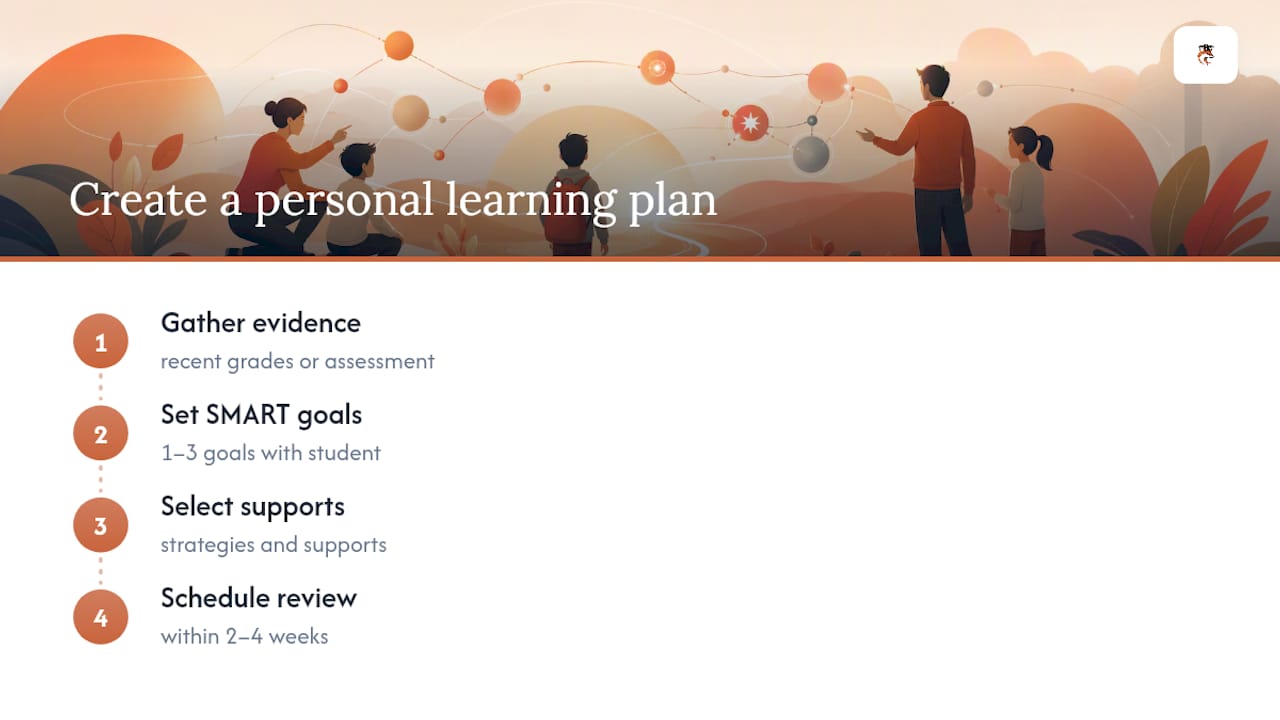
Gather recent grades or a quick assessment, agree on one to three SMART goals with the student, choose specific strategies and supports, and set a review date within two to four weeks.
Can you give an example of a full learning plan?
A full plan includes a student profile, baseline data, one or two SMART goals, chosen strategies, a monitoring schedule, and signatures from the student and the adults involved, all fitting comfortably on one page.
What does personalized learning actually mean?
It means tailoring what, when, and how a student learns to fit their pace and strengths, while their work still stays aligned with grade-level expectations.
How is a PLP different from an IEP?
A PLP is a flexible, non-legal planning tool anyone can use, while an IEP is a legally mandated document tied to a diagnosed disability with formal school board obligations.
Can a tutor help build and run a personalized learning plan?
Yes. Réussite A+ tutors run a diagnostic assessment, co-create SMART goals with the student, and track progress weekly, which covers the entire process described in this guide from start to finish.