




The best way to prepare for a Quebec high school interview is simple: pick three to five real stories your child already has, confirm the interview logistics with the school, and run two or three unpredictable mock interviews at home. Skip the memorized speeches. Admissions committees can spot a scripted answer within seconds, and it rarely leaves a good impression.
TL;DR:
- Most Quebec high school interviews last between 20 and 45 minutes and may include virtual, in-person, or combined formats, often with different interviewers.
- Families should focus on storytelling rather than scripted answers, using real experiences that highlight curiosity, resilience, and personal growth, adaptable to multiple questions.
- Preparations must include confirming logistics like timing, platform, and interview format, along with running two to three mock sessions with unpredictable follow-up questions.
- In virtual settings, testing technology, setting an eye-level camera, and tidy backgrounds are essential, while in-person visits benefit from early arrival, neat attire, and confident greetings.
- Effective answers reveal honesty, adaptability, and specific school knowledge, with parents stepping back after helping identify stories and practicing, avoiding over-coaching or last-minute cramming.
Table of Contents
- What to expect in a Quebec high school admission interview
- Practical pre-interview checklist (logistics parents and students must confirm)
- How to practise answers: the story method and realistic mock interviews
- Sample interview questions by category with answer prompts
- What parents should do (and avoid) while preparing and during the interview
- Day-of interview: in-person and virtual best practices
- Common mistakes and how to avoid them
- How Réussite A+ prepares Quebec students for interviews and entrance exams
- Tips for managing interview anxiety and building confidence
- Examples of culturally or regionally relevant questions specific to Quebec schools
- How to research the school’s values and programs to tailor answers effectively
- Why the conventional advice on school interviews gets it backwards
- How Réussite A+ can help with your child’s next steps
- Sources
- FAQ
What to expect in a Quebec high school admission interview
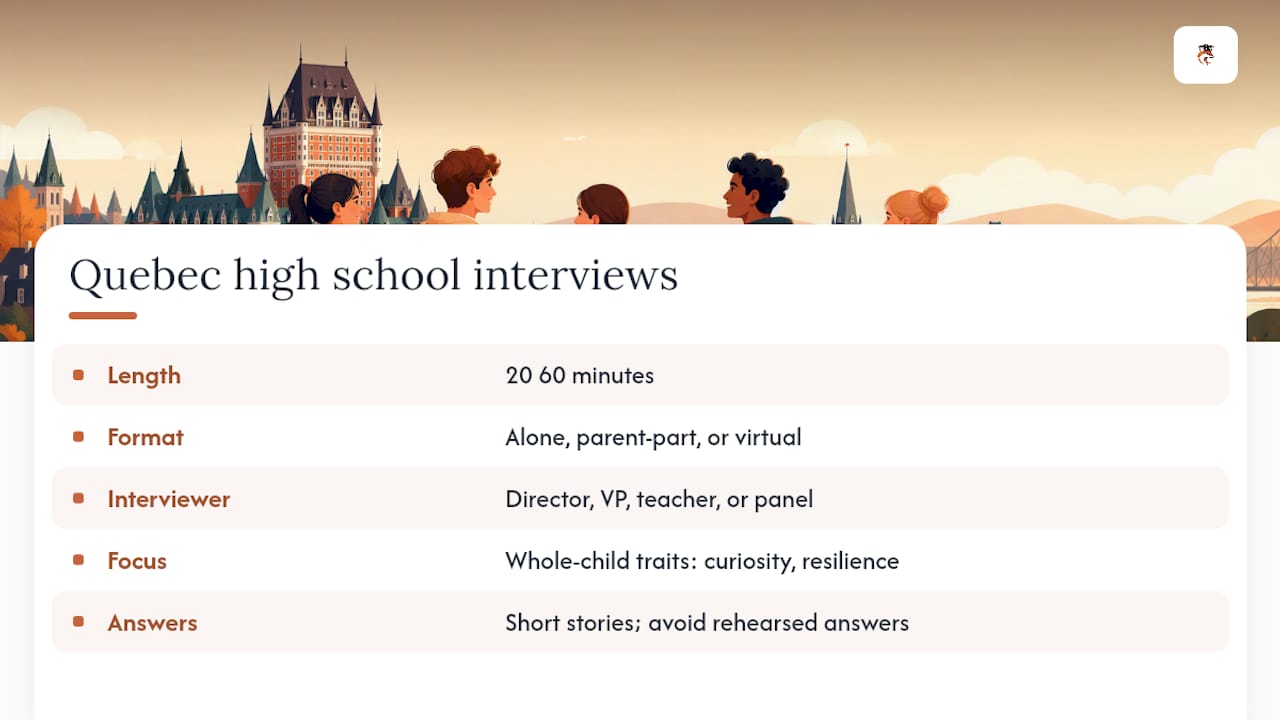
Most Quebec private and specialized secondary schools run interviews somewhere between 20 and 45 minutes, and the format varies more than families expect. Some schools interview the student alone in a quiet office. Others bring the parent in for part of the conversation, then ask them to step out so the child can speak freely. Since 2020, plenty of schools have kept a virtual option in place, especially for families outside the immediate region, so your child might be sitting at the kitchen table facing a laptop instead of a desk across from an adult.
Who actually runs the interview depends on the school. It could be an admissions director, a vice principal, a teacher from the program your child is applying to, or a small panel of two people. Whoever it is, they aren’t grading your child on a single “correct” answer. They’re doing what admissions offices call a whole child assessment: looking past the report card to gauge curiosity, resilience, how the student handles being challenged, and whether they’d actually thrive in that school’s specific environment.
This is where a lot of families get the emphasis backwards. Academic performance already showed up in the application file. The interview exists to find out who the child is when nobody’s grading a worksheet. Admissions officers interviewed by Maclean’s say they want to meet the real learner, not a rehearsed version of one, and that over-coached answers are easy to spot and tend to work against the student. A kid who says “I’m not sure, let me think about that” and then gives an honest, slightly imperfect answer usually comes across better than one who recites a paragraph that sounds like it was written by an adult.
Many schools also expect students to answer in short stories rather than one word, according to admissions guidance from Oriel Admissions, which is exactly why the practice method later in this guide focuses on stories instead of scripts.
Practical pre-interview checklist (logistics parents and students must confirm)
Before your child rehearses a single answer, lock down the practical details. An otherwise well-prepared student who shows up at the wrong time, or logs into the wrong video link, starts the whole process on the back foot for reasons that have nothing to do with how well they’d have answered the questions.
- Confirm the exact date, time, and format: in person, or a video call, and if virtual, which platform the school uses.
- Ask who will be present. Some schools want the parent in the room for introductions; others prefer the student alone for the whole conversation.
- Find out whether the visit includes anything beyond the interview: a written placement test, a group activity, or a timed exercise.
- Read the school’s own website and program pages closely. Note any specific programs, sports teams, arts streams, or traditions your child can reference naturally.
- Book two or three mock interview sessions in the two weeks before the real one, spaced a few days apart.
- For virtual interviews, do a full technical rehearsal at least once: camera, microphone, internet connection, and lighting, on the actual device your child will use.
The Gouvernement du Québec’s interview preparation guidance recommends exactly this two-part approach for any interview: verify the logistics first, then run a simulation. It’s written for job seekers, but the advice transfers directly to a 13-year-old walking into a school admissions office.
If your child is also sitting a written entrance exam around the same date, it helps to map both preparations on one calendar rather than treating them as separate projects. An entrance exam prep timeline built for Quebec families can keep the interview and the test from colliding in the same stressful week.
How to practise answers: the story method and realistic mock interviews
Scripting answers word for word is the single most common mistake families make, and it’s almost always well intentioned. Parents want their child to sound confident, so they write out a paragraph and have the child memorize it. The problem is that memorized language doesn’t survive an unexpected follow up question, and admissions staff know exactly what a recited answer sounds like.
The fix is a story method, adapted from the STAR approach used in professional interview coaching: situation, action, result or learning. Instead of memorizing what to say, your child memorizes what happened, then explains it in their own words every time. The wording changes slightly each rehearsal. That’s the point. It proves the story is real.
Build the story bank in three steps:
- Sit down with your child and list three to five real experiences: one success, one challenge or failure, and one genuine interest or hobby. These don’t need to be dramatic. A robotics club setback, a tough soccer season, or a summer spent teaching a younger sibling to read all work fine.
- For each story, write down (informally, not as a script) what happened, what your child actually did, and what changed or what they learned. This is the situation, action, result skeleton.
- Practise telling each story out loud, twice, with slightly different wording each time. If your child can retell the same story naturally without notes, it’s ready to reuse across several different questions.
The same five stories can usually answer eight or nine different interview questions, because most questions are really just asking “tell me about a time when.” That’s what makes this method efficient instead of exhausting.
Pro Tip: Run mock interviews in short, timed rounds of ten to twelve minutes, not one long session. After each round, give exactly one piece of feedback, have your child try the same question again, and stop. Piling on five corrections at once overwhelms a nervous kid and teaches them to freeze instead of adapt.
Vary who asks the questions across sessions. A parent, an older sibling, a family friend, or a tutor will each ask follow ups differently, and that unpredictability is what actually builds adaptability. Spacing mock interviews out over two or three weeks, with different questioners each time, tends to produce faster improvement than cramming them all into one weekend, according to Oriel Admissions.
If the real interview is virtual, rehearse virtually too. Set the camera at eye level rather than looking up from a low laptop screen. Check that the room behind your child is tidy and well lit from the front, not backlit by a window. Remove any notes or index cards from view. A student glancing down every twenty seconds is one of the fastest ways to signal a memorized answer rather than a genuine one.
Sample interview questions by category with answer prompts
Quebec secondary schools draw from a fairly predictable set of question categories, according to a breakdown of common private school interview questions from Maclean’s. Knowing the categories matters more than memorizing exact wording, because the same story can answer several phrasings of the same underlying question.
About you
“Tell me about yourself” opens almost every interview, and it trips up more students than any other question simply because it’s so open ended. The best structure connects two or three threads: an academic interest, an activity, and a personal quality, kept to roughly 60 to 90 seconds according to interview coaching from Oriel Admissions.
- “Tell me a bit about yourself.”
- “What would your friends say makes you a good friend?”
- “What’s something people are usually surprised to learn about you?”
A strong 90 second answer might sound like: “I love science, especially anything hands on. I’ve been in my school’s robotics club for two years, and last year I ended up leading the wiring team for our competition robot. Outside of school I play goalie for my local soccer team, which has taught me to stay calm under pressure, which actually helps a lot when a robot wire comes loose five minutes before a match.”
Academics
- “What’s your favourite subject, and why?”
- “Tell me about a subject or topic you found difficult recently. How did you handle it?”
- “Is there a subject you struggle with? What have you tried to improve at it?”
These questions aren’t looking for a perfect academic record. They’re looking for whether your child can talk honestly about a struggle. A student who says “math has been tough this year, especially algebra, so I started asking my teacher for extra practice problems and it’s slowly clicking” sounds far more credible than one who claims to have no weaknesses at all.
Activities and involvement
- “What activities or clubs are you involved in outside of school?”
- “Tell me about a time you worked as part of a team.”
- “Have you ever taken on a leadership role? What happened?”
Interviewers use these to see what a student contributes to a group, not just what they belong to. A specific detail (the exact role, the specific problem the team solved) always beats a general list of clubs.
Fit: why this school
- “Why are you interested in our school?”
- “Is there a program, teacher, or tradition here that stands out to you?”
- “What do you think you could bring to our school community?”
Vague flattery (“it seems like a really great school”) falls flat every time. Naming a specific program, a course sequence, or a school tradition and connecting it to a real interest your child has shows they’ve actually done the homework, which the next section covers in detail.
Character and challenges
- “Tell me about a time you failed at something. What did you learn?”
- “Describe a challenge you faced and how you dealt with it.”
- “How would you handle it if you disagreed with a teacher or a friend?”
These are the questions where authenticity matters most, and where scripted answers fall apart fastest. Admissions officers in Montreal and Quebec have described wanting to meet the real learner behind the application, according to the Montreal Gazette, and a slightly messy, honest failure story does that far better than a polished one that sounds rehearsed.
Questions the student should ask
Every interview ends with some version of “do you have any questions for us?” A blank stare here is a missed opportunity. Prepare six to eight genuine questions in advance, and pick two or three depending on how the conversation went.
- “What do students in the [specific program] enjoy most about it?”
- “How does the school support students who want extra help in a subject they find hard?”
- “What’s a tradition at this school that current students look forward to every year?”
- “How much choice do students have in electives once they reach grade nine or ten?”
- “What’s something you wish more applicants asked you?”
- “How do teachers here typically support students who are new to the school?”
What parents should do (and avoid) while preparing and during the interview
Your role is closer to a coach who sets up the practice field than a scriptwriter who hands over the lines. Parents who help identify strong stories and run structured practice sessions give their child a real advantage. Parents who feed exact wording, or worse, answer questions for their child during the actual interview, tend to do the opposite.
- Help your child choose the three to five stories worth practising, but let them decide the wording every single time.
- Give one piece of feedback per practice round, then have your child try again immediately rather than stacking multiple corrections.
- If the school splits the interview into a joint segment and a student-only segment, use the joint portion to introduce your family briefly and then let your child carry the conversation.
- Resist the urge to jump in during a pause. A few seconds of silence while a child thinks is normal and expected, not a crisis.
- After the interview, ask open questions like “what part felt easiest?” instead of grading the performance question by question.
This lines up with advice from Maclean’s: identify the stories together, then step back and let the student use their own words, including when a follow up question catches them off guard. Limiting formal rehearsal to around three realistic mock interviews, with feedback focused on content and clarity rather than exact phrasing, tends to work better than endless repetition.
Day-of interview: in-person and virtual best practices
Preparation matters far less if the first three minutes go sideways. A calm arrival and a confident greeting set the tone for everything that follows.
In person:
- Arrive 10 to 15 minutes early. Rushing in flustered undoes weeks of practice in the first handshake.
- Greet the interviewer with a smile, a clear “hello, nice to meet you,” and eye contact, then sit with an open, relaxed posture.
- Dress neatly and comfortably. Smart casual works for almost every Quebec secondary school; a suit isn’t necessary, but wrinkled gym clothes send the wrong signal.
Virtual:
- Test the camera, microphone, and internet connection at least once the day before, on the exact device that will be used.
- Position the camera at eye level with a plain, tidy background and front facing light rather than a bright window behind the screen.
- Have a backup plan ready in case of a dropped connection: a phone number for the school, or a way to quickly restart the call.
Interviewers do notice presentation. Admissions staff quoted by Maclean’s point to a neat appearance, steady eye contact, and attentive posture as visible signals of how seriously a student is taking the process, alongside the substance of the answers themselves.
When a question catches your child off guard, a short recovery line works better than an awkward silence: “That’s a great question, let me think for a second,” followed by a brief, structured answer. That pause alone often calms the nerves enough to produce a clearer response.
Pro Tip: Practise this exact recovery phrase during mock interviews so it becomes automatic. A rehearsed pause is far less risky than a rehearsed answer.
Close the interview by asking two or three of the prepared questions from the earlier list, thank the interviewer by name if possible, and follow up within a day or two with a short thank you email, three or four sentences is plenty, mentioning one specific thing discussed during the conversation.
Common mistakes and how to avoid them
Most interview stumbles trace back to one of four fixable habits.
- Over-rehearsal. Memorized paragraphs crack under an unexpected follow up. Fix it by practising the underlying story, not the wording, so your child can retell it a different way each time.
- Parents answering for the child. It happens almost reflexively when a parent sees their child hesitate. Fix it by agreeing beforehand on a quiet signal, and by practising sitting through five full seconds of silence during mock rounds.
- One word answers. “Good,” “fine,” and “I don’t know” close a conversation instead of opening one. Fix it by prepping one or two short concrete examples for each likely question category, so there’s always a real detail to reach for.
- Tech and timing failures. A late arrival or a frozen video call happens more often than families expect. Fix it with a full dry run: drive the actual route once, or test the actual video platform once, before the real day.
Pro Tip: Time the drive to an in-person interview during the same time of day and, if possible, the same day of the week as the real appointment. Traffic patterns around Montreal, Laval, and Longueuil shift enough between a Tuesday morning and a Friday afternoon to matter.
How Réussite A+ prepares Quebec students for interviews and entrance exams
Interview prep rarely happens in isolation from the rest of the admissions process. Most students walking into a secondary school interview are also studying for an entrance exam in math or French around the same time, and An experienced tutoring service has spent many years helping Quebec families manage exactly that overlap.
The approach starts with a tailored learning plan built around each student’s actual strengths and gaps rather than a generic template. For interview and entrance exam preparation specifically, that means a tutor who understands both the academic content being tested and the kind of conversational confidence an admissions interview demands. Sessions can include realistic mock interview practice with unpredictable follow up questions, alongside targeted academic review, so families aren’t juggling two separate preparation tracks with two different providers.
Tutors are trained to give feedback the way this guide recommends: one clear point at a time, focused on content and clarity, never on scripting exact words for a child to repeat.
A typical prep session for a family targeting entrance exams and interviews together starts with a short conversation about the target school’s specific program and admission requirements, moves into a mock interview round with real follow up questions, and wraps with a few minutes of direct feedback the student can apply immediately. Families who want a full runway from application to interview day often start with the entrance exam preparation session a few months out, then layer in mock interview practice as the interview date approaches.
Tips for managing interview anxiety and building confidence
Nervousness before a school interview is normal, and trying to eliminate it completely usually backfires. A little adrenaline sharpens focus. The goal is keeping it from tipping into a freeze.
Physical prep helps more than most families expect. A short walk or a few minutes of stretching an hour before the interview burns off nervous energy that would otherwise show up as fidgeting or a shaky voice. Slow breathing, four seconds in, four seconds out, repeated five or six times right before walking in or logging on, calms a racing heart rate quickly.

Confidence tends to come from repetition, not pep talks. A student who has run three mock interviews with three different questioners walks in knowing they’ve already handled unexpected questions before, which matters more than any last minute reassurance from a parent in the car. Reframing the interview also helps: it’s a conversation where the school wants to like the student, not a test with a single correct answer.
On the day itself, avoid cramming new material or last minute quizzing in the waiting room. That tends to spike anxiety rather than settle it. A quiet few minutes reviewing nothing, just breathing and reminding the student of one story they’re proud of, works better than a final drill.
Examples of culturally or regionally relevant questions specific to Quebec schools
Quebec’s education landscape has its own texture, and some schools weave that directly into their interview questions. Bilingual and French-immersion programs are common enough that a student applying to a French-language or bilingual secondary school might hear: “How comfortable are you switching between English and French in a school setting?” or “Tell me about a time you had to communicate in a language that wasn’t your strongest.”
Schools with a specific pedagogical identity, whether that’s an International Baccalaureate stream, a sports-academic program, or a strong arts focus, often ask questions tied directly to that identity: “What does ‘community’ mean to you in a school like ours?” or “Our school places a lot of weight on [specific value, like bilingualism or community service]. Can you tell me about a time you lived that out?”
Students moving from the public system into a private secondary school sometimes get a version of: “What are you looking forward to about a smaller or different learning environment?” And for schools tied to a religious or cultural tradition, a gentle “What do you know about our school’s history or community?” is common enough to be worth a quick look at the school’s own site beforehand.
None of these need a polished, formal answer. A specific, honest response tied to a real experience always outperforms a generic one aimed at sounding impressive.
How to research the school’s values and programs to tailor answers effectively
Twenty minutes on a school’s own website before the interview changes the quality of a student’s answers more than almost anything else on this list. Start with the school’s mission or values page, most Quebec secondary schools publish one, and pull out two or three specific words or phrases they emphasize: community, bilingualism, leadership, creativity, whatever it is.
Next, look at the specific program your child is applying to: the course sequence, any special streams like sports-études or an arts concentration, and any traditions or annual events mentioned on the site. A single detail (an annual science fair, a specific exchange program, a named club) gives your child something concrete to reference instead of a vague “I really like the vibe of this school.”
Fit matters more than prestige here. Admissions officers themselves frame the whole process around match rather than ranking, since the right school depends on language of instruction, program, pedagogy, and daily logistics like transport, not a single “best” list, a point echoed in Réussite A+’s own ranking of the best schools in Quebec. A student who can explain specifically why a program fits their interests, using the school’s own language, sounds far more prepared than one reciting general praise.
Why the conventional advice on school interviews gets it backwards
Most interview prep advice still treats the process like a job interview: polish every answer, eliminate every pause, present a flawless version of the child. That’s the wrong model for a 13 or 14 year old, and the research bears this out. Admissions officers consistently say they can spot over-coaching, and that it works against the student rather than for them.
What actually predicts a strong interview isn’t polish. It’s whether the child can talk honestly about something real, adapt when a follow up question veers off script, and sound like themselves under mild pressure. That’s a completely different skill than memorization, and it’s built through repetition with variation, not repetition of the exact same lines.
The parent’s job is narrower than most families assume: pick good stories together, run a few realistic practice rounds, confirm the logistics, then step back. Prioritize that over another draft of the “perfect” answer to “tell me about yourself.” The kids who walk in relaxed and honest tend to leave a stronger impression than the ones who walk in rehearsed.
— Réussite A+
How Réussite A+ can help with your child’s next steps
Beyond the interview itself, most Quebec families preparing for secondary school admissions are also managing an entrance exam in math or French, and trying to do both well without burning out a 12 or 13 year old in the process. Réussite A+ exists for exactly that overlap: one tutor, one plan, covering both the academic content being tested and the conversational confidence an interview demands, instead of families cobbling together separate resources for each.
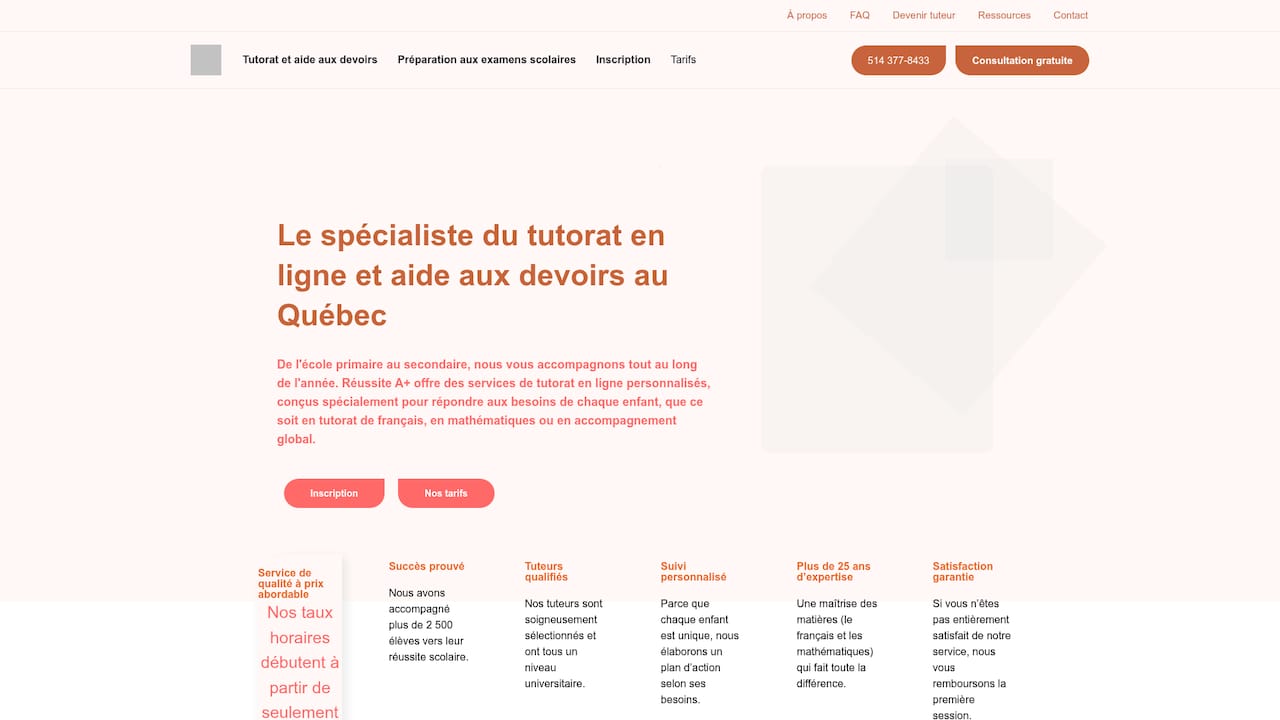
The entrance exam preparation session, priced between $30 and $35 per hour, pairs targeted math and French review with structured mock-interview practice, so your child isn’t relearning long division one week and rehearsing interview answers the next with two unrelated tutors. Families who want ongoing academic support through the whole application season, not just a short exam sprint, can also look at a regular tutoring session at the same hourly rate. A one-time registration fee of $65 applies when starting a program.
If your child’s interview is still months away, book a consult now while there’s room to run two or three properly spaced mock sessions rather than cramming them into the final week.
Sources
- How to navigate private school admissions interviews — Maclean’s
- Preparing for an interview — Gouvernement du Québec
- How to ace your high-school admittance interview — Montreal Gazette
FAQ
How do I prepare for a high school interview as a student?
Pick three to five real stories about a success, a challenge, and a genuine interest, then practise telling them out loud in your own words rather than memorizing exact sentences. Confirm the interview logistics ahead of time and run two or three mock interviews with different family members asking unpredictable follow up questions, as recommended by Quebec government interview guidance.
What questions are asked in a high school interview?
Expect questions in five broad categories: about yourself, academics, activities, why this school, and how you’ve handled a challenge, based on common patterns identified by Maclean’s. Most schools also expect you to have two or three thoughtful questions ready to ask the interviewer at the end.
Which high school in Quebec is considered the best?
There isn’t one universal “best” school. Admissions officers frame the choice around fit: language of instruction, program, pedagogy, transport, and admission requirements all vary by family, a point Réussite A+ covers in its ranking of the best schools in Quebec. A school that’s an excellent fit for one student can be a poor fit for another with different needs or interests.
How long does a Quebec high school admission interview usually last?
Most run between 20 and 45 minutes, sometimes split between a joint segment with a parent present and a student-only portion, according to interview format research from Oriel Admissions. The exact structure varies by school, so it’s worth confirming ahead of time.
Can Réussite A+ help my child practise for an interview?
Yes. Réussite A+’s entrance exam preparation session combines mock interview practice with academic review in math and French, priced at $30 to $35 per hour, so families can prepare for both the interview and any related entrance exam with the same tutor.