


Yes. Children and adults with dyslexia can learn French successfully when they receive structured literacy instruction, timely screening, classroom accommodations, and targeted practice. Dyslexia doesn’t rule out French, French Immersion, or bilingualism. The first moves that matter: ask your school for reading screening now, request structured literacy teaching rather than exposure-only immersion, build a daily listening and audiobook habit at home, and consider tutoring that starts with an assessment before it starts teaching.
TL;DR:
- Early screening in kindergarten or grade 2 is crucial for identifying dyslexia risk, with French-specific tools like ÉCLAIR providing accurate phonological assessments.
- Structured literacy approaches, including decodable texts and multisensory techniques like Oral Spelling, are essential for supporting French learning in dyslexic students.
- Classroom accommodations such as text-to-speech, extended test time, and alternative assessment formats significantly improve reading and writing outcomes in French.
- Home support through daily listening, cognate recognition, and assistive tools enhances vocabulary and decoding skills without demanding extensive reading at first.
- A tutoring program must start with assessment and include explicit, French-adapted decoding instruction, avoiding programs focused solely on exposure or general conversation practice.
Table of Contents
- How does dyslexia affect learning French specifically?
- When should my child be screened for dyslexia in French?
- What French instruction actually works for dyslexic learners?
- What accommodations should I ask the school for?
- What can I do at home to support French learning?
- How do I choose the right French tutoring or support program?
- How Réussite A+ applies this in real tutoring
- Getting started with Réussite A+
- Where to find more support
- Sources
- FAQ
How does dyslexia affect learning French specifically?
Dyslexia is a neurodevelopmental difference rooted in phonological processing. It makes it harder to connect sounds to symbols and to decode words automatically, and that difficulty shows up in any language a child is learning, not just English. So a child who struggles to sound out “ship” in English will likely struggle to sound out “chien” in French, for the same underlying reason.
French brings its own wrinkles. Its vowel system is more complex than English’s, with nasal vowels and multiple written forms for a single sound. Silent letters pile up at the ends of words. But French spelling is also more consistent in places than English spelling. Once a child learns a pattern, it tends to hold. And cognates, words that look and sound similar across French and English, give bilingual learners a real vocabulary shortcut.
Here’s the reassurance many parents need most:
- Dyslexia is present across languages; French Immersion does not cause it.
- Bilingualism itself is not a risk factor and often supports cognitive flexibility.
- Early identification inside a French Immersion program can lead to earlier support and better outcomes than waiting.
When should my child be screened for dyslexia in French?
Screening ideally starts in kindergarten to grade 2, with progress monitoring roughly three times a year through those early grades. That cadence catches reading risk early, while gaps are still small and easier to close.
Screening and diagnosis aren’t the same thing. A screen is quick and tells you whether a child is at risk. A full diagnostic assessment, usually done by a psychologist or specialized team, confirms dyslexia and details exactly which skills need support. Some Quebec and Ontario schools use French-specific tools like ÉCLAIR to check phonological awareness and phonics directly in French, rather than assuming English results transfer.
- Ask your child’s teacher or resource team whether French reading screening happens, and how often.
- Request the most recent screening or assessment results in writing.
- If results show risk, ask what intervention starts immediately, and get a review date on the calendar.
- Keep a simple folder: report cards, screening scores, teacher notes, and work samples. It becomes essential if you ever request a formal assessment or an individualized plan.
What French instruction actually works for dyslexic learners?
Structured literacy, often called the science of reading, is the instructional approach with the strongest track record for dyslexic learners in any language, and it applies directly to French classrooms. It teaches phonology, phonics, morphology, and syntax explicitly and in sequence rather than expecting children to absorb patterns through exposure alone.
That matters more for French Immersion than most parents realize: structured literacy principles have to be adapted to French’s own sound-symbol patterns. A tutor or teacher following an English scope and sequence, and simply translating it, misses the French-specific letter combinations that trip dyslexic readers up.
Concrete techniques worth asking about:
- Decodable French texts that match exactly what’s been taught in phonics lessons, not books pitched at general reading level.
- Simultaneous Oral Spelling, where a child says a word, names each letter aloud while writing it, then reads the word back. It’s a genuinely multisensory technique adapted from English methods like Orton-Gillingham, and it works in French.
- An explicit, planned sequence for French letter-sound correspondences, taught in a deliberate order rather than as they happen to appear in a story.
Pro Tip: Ask any teacher or tutor directly: “What is your scope and sequence for French phonics?” A confident, specific answer is a strong sign they understand structured literacy. A vague answer about “practice and exposure” is a red flag.
What accommodations should I ask the school for?
A handful of accommodations consistently make a real difference for dyslexic learners in French classrooms, according to LD@School’s guidance on supporting students with learning disabilities in French programs.
- Text-to-speech and speech-to-text tools for reading and writing tasks.
- Extended time on tests and assignments.
- Decodable texts that match the phonics already taught, instead of grade-level books.
- Graphic organizers for writing structure.
- Alternate assessment formats, like oral responses instead of written ones, where appropriate.
Walk into any school meeting with your screening notes and assessment results in hand. Ask for a trial period on specific accommodations, with a set date to review whether they’re working, rather than accepting an open-ended “we’ll see how it goes.” If your child moves between a French program and English-language support services, ask explicitly how the two teams share notes. That coordination often falls through the cracks unless a parent asks for it directly.
What can I do at home to support French learning?
Home practice doesn’t need to be elaborate. It needs to be consistent, and it works best when it leans on listening and speaking before it leans on reading and writing.
- Build a daily listening habit: French audiobooks in the car, French audio with French subtitles on a family movie night, or a French music playlist during homework time.
- Run a weekly “learning partner” routine: pick one new word, then practise its pronunciation, its meaning, and its spelling across a few short sessions, rather than a single long one.
- Lean on cognates deliberately. Point out that “important” is “important,” that “nation” is “nation.” Every recognized cognate is vocabulary your child doesn’t have to learn from scratch.
- Try assistive tools: text-to-speech for reading assignments, speech-to-text for writing tasks, and decodable French readers matched to what’s being taught at school.
Research on inclusive language teaching backs this up directly: multisensory and technology-supported approaches tend to increase motivation and support vocabulary gains specifically in learners with dyslexia, more than passive exposure does.
Rich oral language at home, in whichever language your family speaks most comfortably, also builds the background knowledge and vocabulary that support comprehension once your child is decoding French text. You don’t need to speak French yourself for this to work; reading aloud and talking things through in your home language still pays off.

How do I choose the right French tutoring or support program?
A tutoring program worth paying for starts with assessment, not a lesson plan. If a tutor can’t tell you how they’ll measure your child’s starting point in French decoding, spelling, and comprehension, they can’t show you progress later either.
Look for these features before signing up:
- Explicit structured literacy instruction adapted specifically for French, not English methods loosely translated.
- A documented plan built from an actual assessment of your child’s skills.
- Regular, measurable progress tracking, not just a general sense that “things are going well.”
- Tutors with real training in reading difficulties, not simply French fluency.
Ask directly, at the first conversation: What does a typical first month look like? How is progress reported, and how often? What materials will my child actually use?
Pro Tip: Treat “exposure-only” as a warning sign. If a program’s whole pitch is “more French time,” with no mention of decoding strategy or assessment, it’s not built for a dyslexic learner. Watch for vague promises with no French-specific decoding strategy behind them. Programs like structured tutoring plans built around measurable goals tend to hold up better over a full school year than generic conversation practice.
How Réussite A+ applies this in real tutoring
Our approach at Réussite A+ starts where this article starts: assessment before instruction. Every student’s plan is built from where they actually are in French decoding, not a generic grade-level curriculum, and adjusted as progress monitoring shows what’s working.
One student we’ve supported struggled to decode simple French words in grade 3, guessing from pictures instead of sounding out letters. After a structured, phonics-first plan with weekly tracking, decoding accuracy and reading confidence both improved within a single term. Parents stay involved throughout, seeing what’s practised and why.
— Réussite A+
Getting started with Réussite A+
If you’ve read this far, you already know the fix for a dyslexic learner struggling in French isn’t more exposure. It’s the right structure, applied consistently, by someone qualified to adapt it. That’s the gap Réussite A+ is built to close: personalized plans built from an actual assessment of your child’s French decoding and spelling, delivered by university-level tutors, with progress tracked and shared with you on a regular schedule, not left to guesswork at report card time.
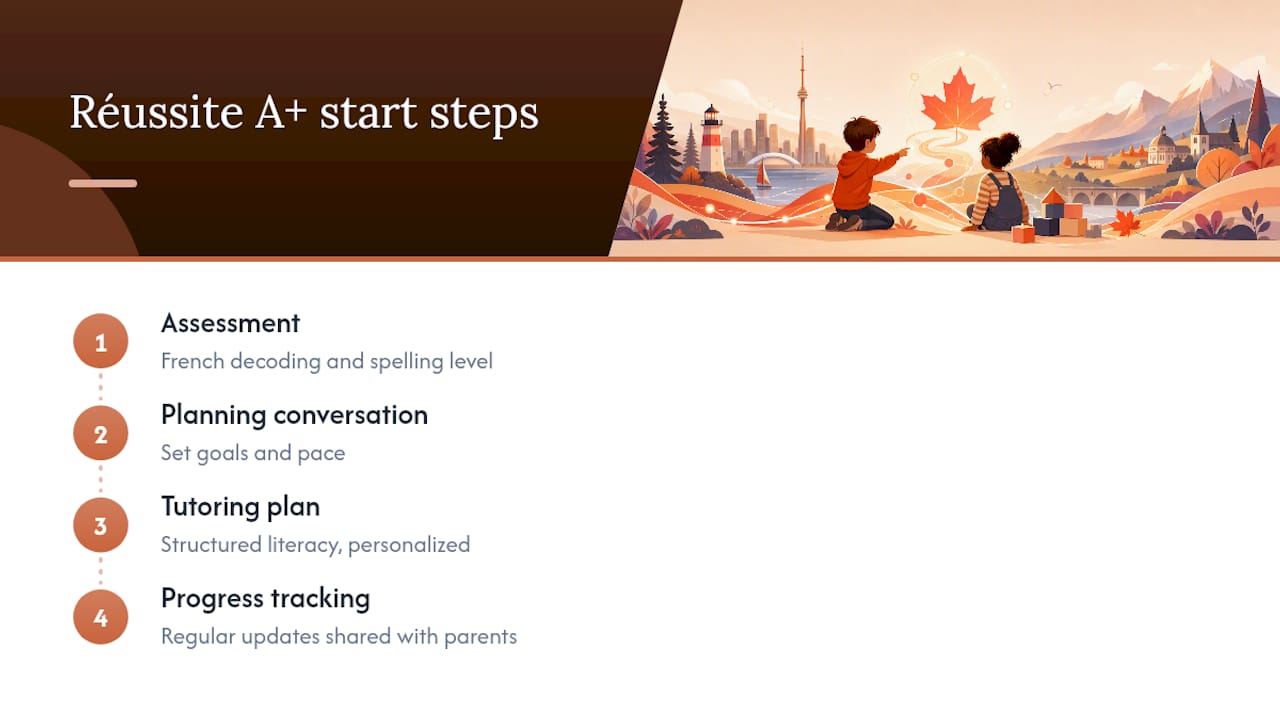
Getting started is simple. Réussite A+ begins with an assessment of where your child stands in French, followed by a planning conversation with you about goals and pace, then a tutoring plan built around structured literacy techniques suited to your child’s needs. If your child is struggling with French reading, spelling, or confidence, book a consultation for online tutoring and homework support and get a plan built around an actual assessment, not a guess.
Where to find more support
A few organizations are worth bookmarking alongside this guide. Dyslexia Canada offers French Immersion-specific guidance and screening information for families. LD@School publishes classroom-level strategies for teachers, useful to share directly with your child’s school. IDA Ontario covers practical home strategies and French Immersion supports. Canadian Parents for French offers advocacy resources and guidance for parents of children with special needs navigating French programs.
Sources
- Supporting Students with Learning Disabilities in French as a Second Language Programs – LD@School
- Dyslexia and French Immersion: What Families Need to Know – Dyslexia Canada
- French immersion in schools – IDA Ontario
- Breaking down barriers for parents with special needs children – Canadian Parents for French (CPF)
- Inclusive practices for dyslexic language learners (scholarly article)
FAQ
How can people with dyslexia learn French?
People with dyslexia learn French most successfully through structured literacy instruction: explicit phonics, decodable texts matched to what’s been taught, multisensory techniques like Simultaneous Oral Spelling, and consistent progress monitoring rather than exposure alone.
What language is easiest for dyslexics to learn?
Languages with highly consistent spelling-to-sound rules, like Spanish or Italian, are often easier for dyslexic learners than languages with many irregular patterns. French sits in between: it has real irregularities, but also predictable rules that become easier once explicitly taught.
Is it harder for dyslexic people to learn languages?
Dyslexia makes decoding and phonological processing harder in any language, including a first language, so a second language isn’t inherently a bigger obstacle on its own. With structured, evidence-based instruction, dyslexic learners can succeed in bilingual programs at rates comparable to their peers.
What is the hardest language to learn if you are dyslexic?
Languages with deep spelling irregularities and complex orthography, such as English, tend to be harder for dyslexic learners than languages with more consistent letter-sound patterns. French’s mix of nasal vowels, silent letters, and irregular spellings puts it on the more challenging end, though far less so than English.
Does French Immersion make dyslexia worse?
No. Dyslexia is present across all languages, and French Immersion does not cause or worsen it. Early identification within an immersion setting can actually lead to earlier support and better outcomes than waiting to see if difficulties resolve on their own.