



Twenty minutes of focused math practice, three to four days a week, prevents the summer slide and produces measurable gains, but only when it targets one or two priority skills instead of a random mix of worksheets. Start with a quick 10-question diagnostic, pick the gaps that matter most, and build the routine around those. A meta-analysis of 37 studies found summer math programs deliver an average gain of +0.10 standard deviations on achievement, and many educators have experience turning research into plans real families can follow.
TL;DR:
- Short, consistent daily practice of 20 minutes, three to four times a week, effectively prevents summer learning loss when focused on specific skills.
- Diagnostic tests should identify skill, setup, or accuracy gaps to determine targeted review priorities, especially for students heading into advanced grades.
- Resources should offer quick feedback and mix skills within each session, avoiding long, monotonous exercises or heavily gamified apps that may induce anxiety or disinterest.
- Families should avoid doing nothing or overloading with lengthy workbooks; structured, goal-oriented plans with regular progress checks are more effective.
- For persistent gaps or exam prep, engaging a tutor for personalized, skill-focused support accelerates progress beyond generic practice.
Table of Contents
- Summer math review plans by grade band
- How to diagnose gaps and pick the right priorities
- Building a routine that survives a real summer
- Choosing resources that fit a 20-minute routine
- What families get wrong about summer math review
- Get personalised summer math support from Réussite A+
- Research behind this summer math review guide
- Sources
- FAQ
Summer math review plans by grade band
A summer math review plan only works if it matches where your child actually is, not where the report card says they should be. Below are four-week templates organized by grade band, each built around one weekly diagnostic check and a short daily habit.
1. Kindergarten to Grade 2: Number sense and facts
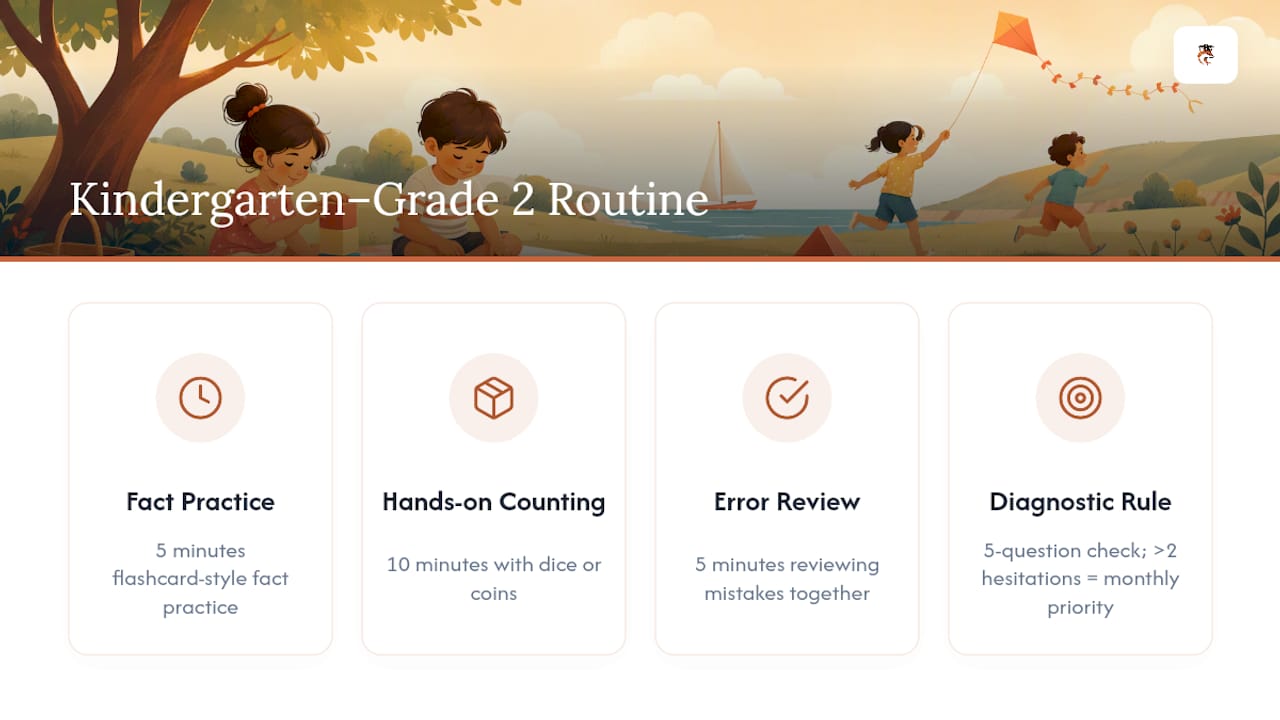
Priorities: counting strategies, addition and subtraction facts to 20, and basic shape and pattern recognition. Start with a five-question diagnostic (count by 2s to 20, add two single-digit numbers, identify a shape from a description). If a child hesitates on more than two questions, that is your priority skill for the month. Daily session: 5 minutes of flashcard-style fact practice, 10 minutes of hands-on counting with dice or coins, 5 minutes reviewing mistakes together. Weekly engagement activity: a grocery store “add it up” game where the child estimates and checks a small cart total.
2. Grades 3 to 5: Fractions and multi-digit operations
Priorities: multiplication and division fluency, fraction equivalence, and multi-digit subtraction with regrouping. A strong mini diagnostic includes one long division problem, one fraction comparison, and one multi-step word problem. Daily session: warm up with a timed fact drill, spend 10 minutes on the priority skill, finish by having the child explain one problem out loud. Weekly activity: a baking or building project that forces fraction conversions in a real context.
3. Grades 6 to 8: Ratios, integers, and equations
Priorities: solving one-step and two-step equations, working with negative numbers, and applying ratios and percentages. The diagnostic should include a percentage-of-a-number problem, an integer operation, and a simple linear equation. Daily session: 5 minutes reviewing vocabulary (variable, coefficient, ratio), 10 minutes of guided practice, 5 minutes of self-correction using an answer key. Weekly activity: budgeting a mock allowance or planning a trip with distance-rate-time calculations.
4. Grades 9 to 12: Algebra readiness and functions
Priorities: graphing linear functions, factoring, and interpreting function notation. A diagnostic here should include graphing a line from an equation, factoring a simple quadratic, and evaluating a function at a given value. Daily session: 5 minutes of mental math warm-up, 10 minutes on the target skill, 5 minutes connecting it to next year’s course (previewing what’s coming builds confidence rather than dread). Weekly activity: analyzing a real data set (sports stats, weather trends) and modelling it with a simple equation.
How to diagnose gaps and pick the right priorities
A 10-question diagnostic works best when it mixes grade-level review with one or two questions from the grade the student is entering. Give it without notice, without help, and without a time limit for the first pass. What you’re really scoring is the type of mistake, not just the wrong answer.
Errors tend to fall into three buckets:
- Skill gap: the student doesn’t know the procedure at all (they never learned long division, for example).
- Setup gap: they understand the concept but misread or mis-structure the problem (wrong operation chosen from a word problem).
- Accuracy gap: they know the method but make careless arithmetic slips under no time pressure.
Each bucket needs a different fix. Skill gaps need direct re-teaching. Setup gaps need more word-problem practice with a “what is this question actually asking” step. Accuracy gaps often improve just from slowing down and self-checking.
Once you’ve sorted the errors, prioritize based on frequency and how much next year’s curriculum depends on it. A fraction weakness that shows up three times and underpins next year’s algebra beats a one-off geometry slip.
Pro Tip: Keep a simple error log on a sheet of paper: date, question, mistake type. After two weeks, patterns jump out that a single test never reveals.
Building a routine that survives a real summer
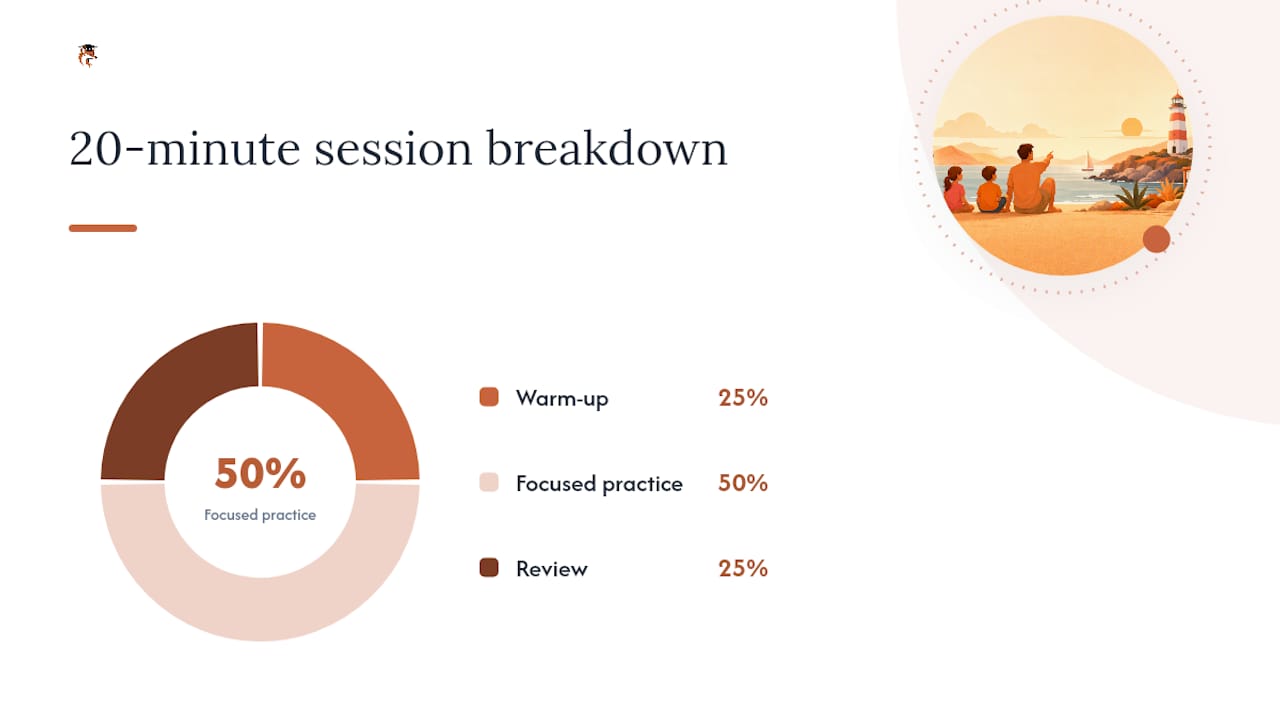
The session structure that holds up best across a full summer is short and predictable: 5 minutes of warm-up (mental math or fact review), 10 minutes of focused practice on the priority skill, and 5 minutes reviewing what went wrong and why. That 20-minute shape matters more than the specific worksheet.
- Daily plan: 20 minutes, 3 to 4 days a week, same time of day if possible (right after breakfast works well for most families).
- Weekly alternative: if daily sessions aren’t realistic around camp or travel, batch it into one 60 to 90 minute weekend session instead, split into three shorter blocks.
- Vacation weeks: don’t aim for zero. A single 10 minute mental math conversation in the car counts and keeps the habit alive.
Regular, distributed practice in that 15 to 20 minute daily range prevents the summer slide more reliably than one long weekly cram session, and the same EdWorkingPaper meta-analysis found stronger gains tied specifically to more daily math time paired with structured instruction, not just more total hours.
For engagement, mix skill types within a session rather than drilling one operation for 20 straight minutes, and use “teach-back” (have the child explain a problem to a sibling or stuffed animal) as a low-pressure way to check understanding without adding test anxiety.
Choosing resources that fit a 20-minute routine
Not every math resource is built for short sessions, and the wrong format can quietly sabotage a good routine. The best options share two features: they give quick feedback, and they mix skill types instead of drilling one thing for pages at a time.
- Printable packets: good for quick daily use if they include an answer key and a mixed-skill layout rather than one operation repeated forty times.
- Short grade-level workbooks: useful for structure across four weeks, but skip anything advertised as a full-summer “mega workbook” — those tend to sit unused after week two.
- Teacher-created packets: often the best-targeted option since they reflect exactly what a specific student struggled with that year; ask your child’s teacher before the last day of school.
- Brief apps with feedback: apps that combine automated scoring with a way to revise wrong answers reduce summer learning loss better than static worksheet apps, according to research on online summer review interventions.
A few red flags to watch for: long marathon booklets designed to be finished in one sitting (they encourage rushing, not learning), and heavily gamified apps with penalty-based scoring, which can spike anxiety for neurodiverse learners rather than motivate them. When hunting for free packets, prioritize ones with visible answer keys and a genuine mix of skills per page rather than single-skill repetition. Réussite A+’s summer activity ideas for French and math are built with that mixed-skill principle in mind.
What families get wrong about summer math review
Most families overcorrect in one of two directions: either they do nothing all summer and hope September sorts itself out, or they buy a 200-page workbook and expect a reluctant nine-year-old to finish it out of sheer willpower. Neither works, and the research backs that up. A 2024 scoping review found strong, consistent evidence of summertime numeracy decline, often steeper than the literacy decline that gets more attention. Doing nothing has a real cost.
But volume isn’t the answer either. Some online programs show almost no benefit unless they include clear objectives, structured feedback, and a manageable scope, and that’s the piece most store-bought packets skip entirely.
Some tutoring approaches use two templates that consistently work with families: a mini diagnostic to find the one or two skills worth targeting, followed by a four-week plan built on those priorities, with a short progress check at the two-week mark to confirm the plan is still aimed at the right target. If a gap persists past a few weeks of consistent home practice, or if a student is heading into a secondary school entrance exam, that’s usually the signal to bring in professional support.
— Réussite A+
Get personalised summer math support from Réussite A+
If your child’s diagnostic reveals a gap that home practice isn’t closing, or if you’re prepping for a secondary school entrance exam this fall, a structured plan from an experienced tutor closes that distance faster than another workbook ever will. Such tutoring services are designed for students with persistent skill gaps, families seeking thorough exam preparation, and Francophone households wanting support in the language their child learns best in.

Getting started doesn’t require a long commitment. A session usually opens with a short diagnostic conversation, much like the 10-question check described above, so your tutor can build a summer plan around the one or two skills that matter most for your child, not a generic curriculum. From there, sessions run on a flexible online schedule that fits around camp, vacations, and the rest of a normal summer. If you’re ready to see what a customised plan looks like for your child, you can book a tutoring session or register for a summer program directly through Réussite A+.
Research behind this summer math review guide
The routines above draw on the AERA meta-analysis of summer math programs, the related EdWorkingPaper analysis, and a scoping review of summer academic decline. For a broader prevention strategy beyond math alone, see our parent’s guide to summer learning loss.
Sources
- The Impact of Summer Programs on Student Mathematics Achievement: A Meta-Analysis
- The impact of summer programs on student mathematics achievement: a meta-analysis (EdWorkingPaper No. 21-379)
- Children’s health, wellbeing and academic outcomes over the summer holidays: a scoping review
FAQ
What math level should a 7-year-old be at?
Most seven-year-olds (roughly Grade 1 to 2) should be comfortable with counting strategies, adding and subtracting within 20, and recognizing basic shapes and patterns; if a child struggles with more than two of these, that’s a priority for summer review.
Is math hard for kids with ADHD?
Math can be harder for children with ADHD mainly because multi-step problems demand sustained working memory, not because the concepts themselves are more difficult; short, structured sessions with immediate feedback tend to work better than long, unstructured practice blocks.
What is the best way to review math over summer?
The best approach combines a short diagnostic to identify one or two priority skills with brief, consistent daily practice, roughly 20 minutes, three to four days a week, rather than long infrequent sessions; a meta-analysis of 37 studies found this kind of targeted, regular practice produces measurable achievement gains.
How do I know if my child needs a tutor instead of home practice?
If a diagnosed gap doesn’t improve after two to three weeks of consistent home sessions, or your child is preparing for a secondary school entrance exam, that’s usually the point where personalised tutoring, like the customised plans Réussite A+ builds around individual diagnostics, becomes worth considering.