



Focus first on articles, nouns and number, common verbs, adjective agreement, pronouns, negation, and basic prepositions, always in that rough order of payoff. Start with short formats: five to ten minutes of discovery using pictures or a short video, followed by ten to twenty minutes of guided practice with a worksheet, word mat, or sentence builder. For printables and grade-aligned activities, teacher resource hubs are your fastest route to something usable tonight.
TL;DR:
- Most children benefit from focused, short discovery sessions of five to ten minutes, followed by ten to twenty minutes of guided practice to reinforce grammar rules.
- Visual aids, matching games, and sentence builders are effective tools for internalizing patterns like articles, adjectives, and negation, especially when tailored to the child’s grade level.
- Repetition with varied formats, such as stories, songs, and interactive matching games, helps embed grammar concepts without making lessons feel like drills.
- Tracking progress through quick recognition checks and observation of common mistake patterns guides targeted practice and reduces the need for formal testing.
- Persistent errors after consistent quality practice may indicate a need for targeted tutoring to identify and address specific learning gaps more efficiently.
Table of Contents
- French grammar basics for kids: the core topics to teach first
- Which resource format fits which grammar goal?
- How do you structure a short grammar practice cycle?
- Three ready-to-run mini lessons for grammar practice
- Where to find reliable French grammar printables
- What makes an explanation age-appropriate for young learners?
- How can you make grammar lessons feel less like a lesson?
- What grammar mistakes do kids make most often, and why?
- How do you track a child’s progress in French grammar?
- How do you keep grammar practice consistent at home?
- Réussite A+ perspective: how targeted tutoring supports grammar cycles
- How Réussite A+ supports French grammar at home
- Sources
- FAQ
French grammar basics for kids: the core topics to teach first
French grammar for kids works best when you resist the urge to cover everything at once. Children build reliable habits faster when they see the same pattern repeated in common, predictable examples before they meet the exceptions. That is the logic behind Eduscol’s guidance for French schools, which recommends anchoring early grammar instruction in prototypical cases rather than the full complexity of the language.
Here is what that looks like broken into the areas that matter most for a young learner:
- Articles and determiners. Teach le, la, les, un, une, des through matching games before touching contractions like au or du. Goal: your child sorts nouns by gender using the article as the clue.
- Nouns and number. Focus on adding s for plural and recognizing common irregular plurals only after the regular pattern feels automatic.
- High-frequency verbs. Start with être, avoir, aller, and one or two er verbs in the present tense. Goal: correct subject-verb pairing in short spoken sentences.
- Adjectives and agreement. Use colours and size words first, since their feminine and plural forms are visually obvious (petit becomes petite, grand becomes grands).
- Pronouns. Introduce il, elle, ils, elles attached to familiar nouns before tackling object pronouns like le, la, lui.
- Negation. Model ne…pas around actions the child already knows how to state positively.
- Prepositions and simple sentence structure. Cover dans, sur, sous, avec through picture prompts, keeping sentences to subject plus verb plus one detail.
Save irregular verb conjugations, complex agreement rules (like adjectives that don’t change form), and compound tenses for later grades. A child who has fully internalized the regular pattern learns the exception far faster than one who meets both at once.
Which resource format fits which grammar goal?
Not every grammar point needs the same tool. Matching format to purpose saves you from forty-five minutes of frustration when five would have worked.
Short video clips do one job exceptionally well: they let a child notice a pattern in context and hear it pronounced correctly, which matters for liaison and gender cues that are easy to miss on paper. Printable worksheets are the workhorse for focused training. They give you something concrete to correct and keep for later comparison. Games and matching activities, including the interactive exercises on Ortholud, build the kind of quick retrieval that turns a rule into a habit rather than a memorized fact. Word mats and sentence builders solve a specific problem: they lower the mental load during agreement practice, since a child juggling gender, number, and word order at once tends to make more errors than one working from a visual bank of ready-made pieces.
A few practical adjustments make any material work harder for you:
- Simplify sentences before adding a new rule. Two changes at once is one too many for most primary learners.
- Add pictures next to unfamiliar vocabulary rather than translating every word.
- Pre-teach two or three key words before starting an exercise so the grammar point stays the focus, not the vocabulary.
Pro Tip: Keep a “starter sentence” on hand for every exercise. When a child freezes, having one example to copy and adapt gets them moving again without you re-explaining the whole rule.
How do you structure a short grammar practice cycle?
The most reliable structure for teaching French grammar for kids is the same one Eduscol recommends for classroom sequencing: discovery first, training second. It works just as well at a kitchen table as it does in a classroom.
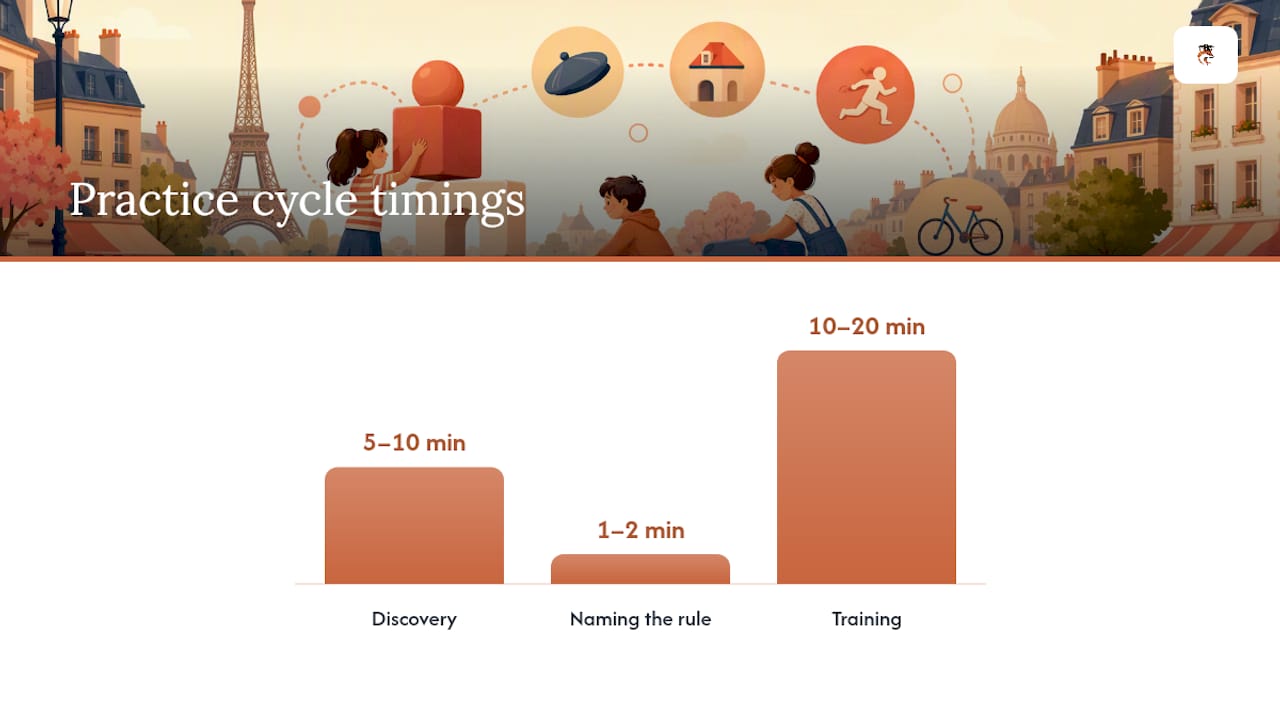
- Discovery (five to ten minutes). Show a handful of examples using picture cards, short video clips, or objects around the house, and ask your child to sort or notice a pattern themselves. Do not explain the rule yet.
- Naming the rule (one to two minutes). Once the child spots the pattern, put it into a simple sentence together. This step should feel like confirming something they already noticed.
- Training (ten to twenty minutes). Move into guided exercises: fill-in-the-blank sentences, matching cards, or a short worksheet. Correct errors immediately and model the fix out loud rather than just marking it wrong.
- Light production, later. Only after two or three training sessions should a child try producing full sentences independently. Jumping to free writing too early just gives them more chances to practise the wrong form.
Repeat the same grammar point across two or three short sessions rather than one long one. A child who needs more repetition benefits from smaller chunks, like sorting five examples instead of ten, not from a longer single sitting.
Pro Tip: If your child keeps making the same mistake in the training phase, go back to discovery with new examples rather than repeating the same worksheet. A fresh set of examples often reveals what they misunderstood the first time.
Three ready-to-run mini lessons for grammar practice
Each of these takes under twenty minutes and needs only paper, scissors, and maybe a few printed picture cards.
- Articles: definite versus indefinite. Discovery: hand your child ten picture cards and two boxes labelled le/la and un/une. Have them sort by ear, saying each noun aloud with its article. Training: move to a worksheet with fill-in-the-gap sentences (“___ chat dort”). For a child who needs more scaffolding, cut the set to six cards and add colour coding by gender.
- Adjective agreement. Discovery: match colour cards to objects and notice how rouge stays the same while petit becomes petite. Training: use sentence builder strips where the child slides in an ending (e, s, es) to match the noun. Quick check: read three sentences aloud and ask which one sounds wrong.
- Negation. Discovery: read true or false statements (“Le chien vole.”) and have your child respond with oui or non, il ne vole pas. Training: build short dialogues using ne…pas around familiar routines like bedtime or breakfast. Extension: for a stronger learner, introduce ne…jamais or ne…plus once ne…pas feels automatic.
All three lessons follow the same skeleton: notice, name, practise, check. Once your child gets used to that rhythm, you can rebuild it around almost any grammar point in minutes.
Where to find reliable French grammar printables
You do not need to build materials from scratch, and honestly, most parents shouldn’t try. A handful of hubs already do the grade-alignment work for you.
Twinkl offers worksheets, word mats, and games organized by Canadian grade level, which saves you the guesswork of whether a resource matches what your child is actually learning in class. Pass-Education provides downloadable lesson packs covering verbs, nouns, articles, and adjectives, often built around the same discovery-then-practice logic recommended for classroom grammar teaching. Ortholud rounds things out with interactive games best used as short reinforcement after a worksheet, not as the first introduction to a new rule. For the underlying scope, Eduscol’s guidance remains the clearest public reference on which grammar cases French schools treat as foundational versus advanced.
Before you print or buy anything, run a quick check:
- Does it state a clear learning goal, not just a topic label?
- Is there an answer key?
- Are there visual supports for a child who is not yet a strong reader?
- Does a sample page match your child’s actual grade, not just their age?
Some France-based resources use slightly different spelling conventions or curriculum labels than what’s used locally. That is rarely a problem for core grammar rules, but check number formatting and any references to grade names before assuming a perfect match.
What makes an explanation age-appropriate for young learners?
An explanation lands when it uses words and comparisons a child already owns, not when it’s technically accurate. Telling a seven-year-old that “adjectives agree in gender and number with the noun they modify” describes the rule correctly and teaches almost nothing. Telling them “colour words wear a matching outfit, so if the cat is a girl, petit puts on an e and becomes petite” gives them something to hold onto.
The comprehension gap between a six-year-old and a ten-year-old is real, and it shows up most in how much abstraction a child can handle at once. Younger children do better with a single visual anchor per rule: one picture, one gesture, one silly comparison. Older primary students can handle a short verbal rule alongside an example, as long as the example comes first.
A useful test: if you can’t explain the rule in one sentence a child could repeat back in their own words, the explanation is still too abstract. Adjust by shrinking the example set, not by adding more words to the rule.
Age-appropriate does not mean less rigorous. It means sequencing the same content differently. A ten-year-old and a six-year-old can both learn that le pairs with masculine nouns. The ten-year-old might get there through a short written rule plus practice; the six-year-old gets there through sorting games and repetition, arriving at the same accurate understanding through a different path.
How can you make grammar lessons feel less like a lesson?
Stories, songs, and short interactive activities work because they hide repetition inside something a child wants to repeat anyway. A song with a repeated ne…pas line gets more accurate practice reps in three minutes than most worksheets manage in fifteen, simply because kids will ask to hear it again.
Short stories work particularly well for pronoun and verb practice. Pick a five or six sentence story with a clear character, then ask your child to retell it using il or elle instead of the character’s name. This turns pronoun substitution, normally a dry drill, into a small performance.
Interactive games serve a narrower but valuable purpose: quick, low-stakes retrieval. A matching game that pairs adjectives with their feminine forms gives immediate feedback without the emotional weight of a graded worksheet. That matters more than it sounds. Children who feel judged on every attempt tend to guess less and freeze more, which slows down exactly the kind of trial-and-error that builds fluency.
The common thread across stories, songs, and games is that the grammar point stays embedded in something meaningful rather than presented as an isolated rule. A child sorting picture cards into “one” and “many” piles is practising plural nouns without ever hearing the word “plural.” That’s often the fastest way in.
What grammar mistakes do kids make most often, and why?
Most recurring errors trace back to overgeneralization: a child learns a rule that works most of the time, then applies it everywhere. Regular plural formation with s is a good example. Once that pattern feels solid, children often extend it to irregular nouns that don’t follow it, which is actually a sign the regular rule has been learned well, not a failure.
Agreement errors cluster around working memory limits rather than misunderstanding. A child juggling gender, number, and correct word order in a single sentence often gets one element right and drops another, not because they don’t know the rule but because they’re tracking too many things at once. This is exactly why sentence builders and word mats help: they remove one or two of those tracking demands so the child can focus on the specific feature you’re teaching.
Negation trips up English-speaking children in particular, since French wraps the verb in two parts (ne…pas) rather than adding a single word. The fix is repetition in short, predictable frames rather than abstract explanation. Hearing and producing “il ne mange pas” ten times in different contexts does more than being told the rule once.
Pronunciation-driven spelling confusion is common too. Silent letters and liaison mean a child can say a sentence correctly but spell it based on what they hear, missing an s or e that changes agreement on paper. Video clips and read-aloud practice help close that gap by pairing sound with the written form directly.
How do you track a child’s progress in French grammar?
You don’t need formal testing to know whether a grammar point has landed. A short, low-pressure check after each training cycle tells you almost everything.
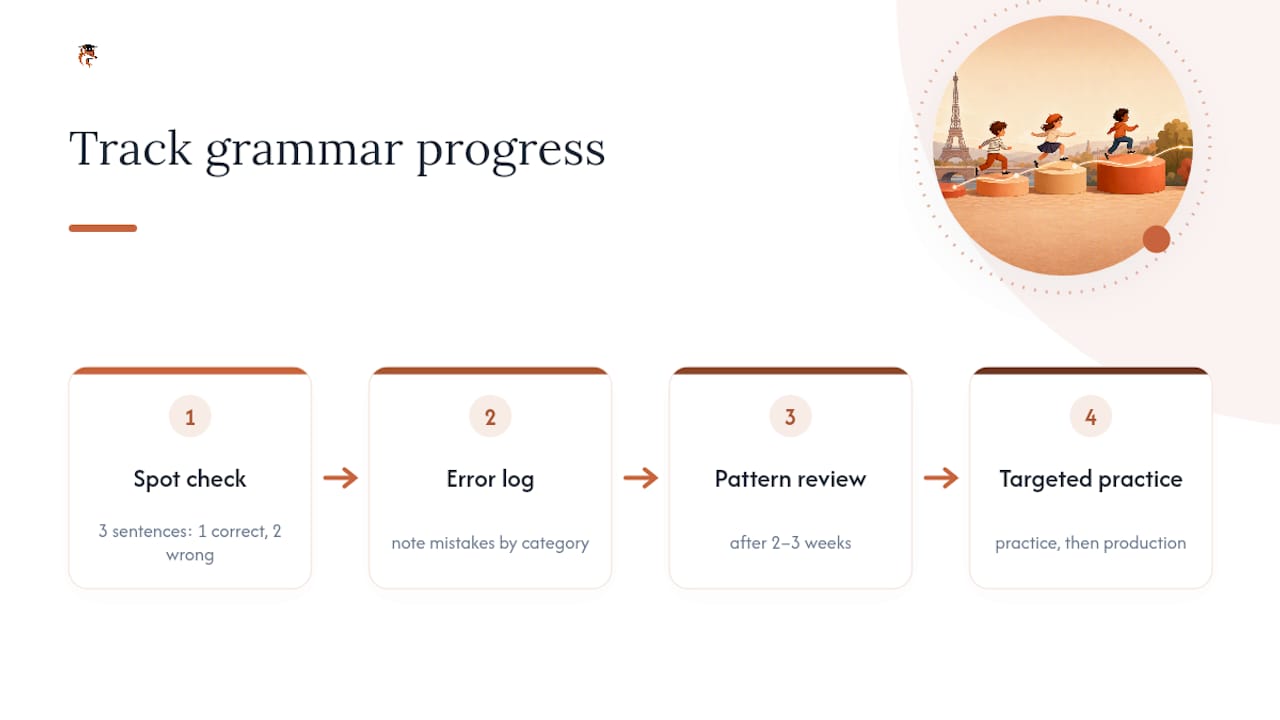
Try a three-sentence spot check: read three sentences aloud, one correct and two with a targeted error, and ask your child which one sounds right and why. This tests recognition, which usually develops before correct production. If they can consistently spot the error, they’re ready to move toward producing the form themselves.
A simple error log works well over longer stretches. Jot down the specific mistakes you notice during homework or conversation, sorted loosely by category (agreement, verb form, article choice). After two or three weeks, patterns emerge that tell you exactly where to send the next round of practice, rather than guessing.
For a more structured check, most printable packs from hubs like Pass-Education include short assessment sheets at the end of a lesson set, useful for confirming a skill before moving on. Treat a wrong answer there as information about what to revisit, not as a grade. The goal at this stage is catching gaps early, not ranking performance.
How do you keep grammar practice consistent at home?
Consistency beats intensity almost every time with young learners. Ten focused minutes four times a week outperforms one exhausting hour on a Sunday, mostly because grammar rules need spaced repetition to move from short-term memory into habit.
Anchor practice to an existing routine rather than trying to carve out new time. Right after breakfast, in the car on the way to an activity, or during a snack all work better than “sometime this evening,” which tends to slide. Keep sessions short enough that your child never dreads seeing the materials come out.
Celebrate specific wins, not general effort. “You caught that petite needed an e because chat is feminine there… wait, chatte” is more useful than “good job,” because it tells the child exactly what they did right and reinforces the rule itself. For common mistakes primary students make in French, a little targeted praise around the specific pattern goes further than general encouragement.
Mix formats across the week so nothing gets stale: a video on Monday, a printable worksheet on Wednesday, an interactive game on Friday. And resist correcting every single error in casual conversation. Pick one target pattern per week and let the rest go, or grammar practice starts to feel like constant correction rather than progress.
Réussite A+ perspective: how targeted tutoring supports grammar cycles
Discovery and training cycles work well for most grammar points, but some children hit the same wall session after session no matter how the material is presented. That’s usually a sign the gap needs a second set of eyes, not more worksheets. Short, focused tutoring sessions map naturally onto the same micro-cycle structure, just with someone catching the specific error pattern faster than a parent working solo might. Students with persistent mistakes, or those who need to move faster than self-directed practice allows, tend to benefit most. If you’re unsure whether that describes your child, a diagnostic session is a low-commitment way to find out before booking a full program.
— Réussite A+
How Réussite A+ supports French grammar at home
Réussite A+ is the option for families who’ve tried the worksheet-and-video route and still hit the same wall. Instead of guessing which grammar gap is holding your child back, a Réussite A+ tutor identifies it directly and builds a session plan around it, one that follows the same discovery-then-practice rhythm this article recommends, but with immediate correction built in.
Sessions run online, one-on-one or in small groups, with tutors who specialize in French and math for elementary and secondary students. A typical starting point is a short diagnostic session where the tutor pinpoints exactly which grammar areas need attention, whether that’s agreement, verb conjugation, or something further along like French verb conjugation for older students.
What that looks like in practice:
- A plan built around specific grammar gaps.
- Scheduling that aims to fit around school and other commitments.
- Progress tracked session to session to monitor improvement.
To get started, book a session through online tutoring and homework help, or go straight to registration for tutoring programs if you already know what your child needs.
Sources
- La grammaire du français du CP à la 6e (Eduscol)
- Twinkl
- Verbe, nom, article, adjectif : Primaire 2 (Pass-Education)
- Ortholud — jeux et exercices en ligne
FAQ
What age should a child start learning French grammar?
Most children can begin simple grammar concepts, like matching articles to nouns, around age five or six, once they’re comfortable with basic vocabulary and short sentences.
How long should a grammar practice session be for a young child?
Aim for five to ten minutes of discovery followed by ten to twenty minutes of guided practice, based on the discovery-then-training sequence Eduscol recommends for school grammar teaching.
What is the easiest French grammar topic to teach first?
Articles and determiners (le, la, un, une) tend to work well as a starting point because they’re highly visual and easy to pair with picture sorting games.
Are free online games enough to teach French grammar?
Games like those on Ortholud work best as short reinforcement after guided practice, not as a child’s first introduction to a new grammar rule.
How do I know if my child needs a tutor instead of at-home practice?
If the same grammar mistakes keep showing up after several weeks of consistent home practice, a diagnostic session with a tutor can identify the specific gap faster than continued self-study.