




The most effective homework routine kids can stick with follows a short, predictable sequence: same place, a quick landing ritual after school, then a work window capped at roughly 10 minutes per grade level. Add a 20- to 30-minute decompression break before that window starts, and most of the nightly friction disappears within two weeks. This simple structure tends to outperform elaborate reward charts and rigid clock schedules for one reason: kids need rhythm more than rules.
TL;DR:
- Using a fixed homework routine with a consistent space and land ritual reduces conflicts and improves focus within two weeks.
- Educational research supports limiting homework time to about 10 minutes per grade level to prevent burnout and frustration.
- Tracking total time, conflicts, and task completion helps identify when the routine needs adjustment or if skill gaps are causing delays.
- Parental support should focus on guiding reasoning rather than solving, especially by asking questions instead of providing answers.
- Ensuring children have enough sleep and proper nutrition is critical, as fatigue and hunger directly impair concentration and task completion.
Table of Contents
- Key elements of an effective homework routine kids can rely on
- Two practical routine templates you can start tonight
- How to build a homework schedule for children that actually sticks
- Perspective: when routines and personalised tutoring reinforce each other
- Parent role: support vs solving
- Why consistent sleep and nutrition make or break the routine
- Adapting the routine by age and learning style
- Monitoring progress and knowing when to adjust
- A realistic take on homework routines
- Sources
- FAQ
Key elements of an effective homework routine kids can rely on
A homework routine kids will actually follow needs four pieces in place before the backpack even hits the floor: a fixed spot, a landing ritual, a time limit, and a plan for breaking tasks down. Skip any one of these and you’re back to nightly negotiating.
The space matters more than the decor. It doesn’t need a dedicated desk in a quiet office. It needs consistency: same table, same chair, same supplies within arm’s reach every single day. Nemours/KidsHealth points to a homework-friendly area as one of the core habits that separates smooth evenings from chaotic ones, and the reason is practical, not aesthetic. A child who has to hunt for a pencil sharpener loses focus before the first math problem is even read.
The landing ritual buys you calm before you buy you compliance. Kids walk out of school running on empty, socially and mentally. A snack, five minutes of talking about the day, or even just changing out of school clothes signals a shift. Outschool’s after-school checklist recommends a 20 to 30 minute decompression window, followed by a firm five-minute transition, screens off, workspace ready, before homework starts. Longer breaks tend to backfire: momentum drains and getting a child back to the table becomes its own battle.
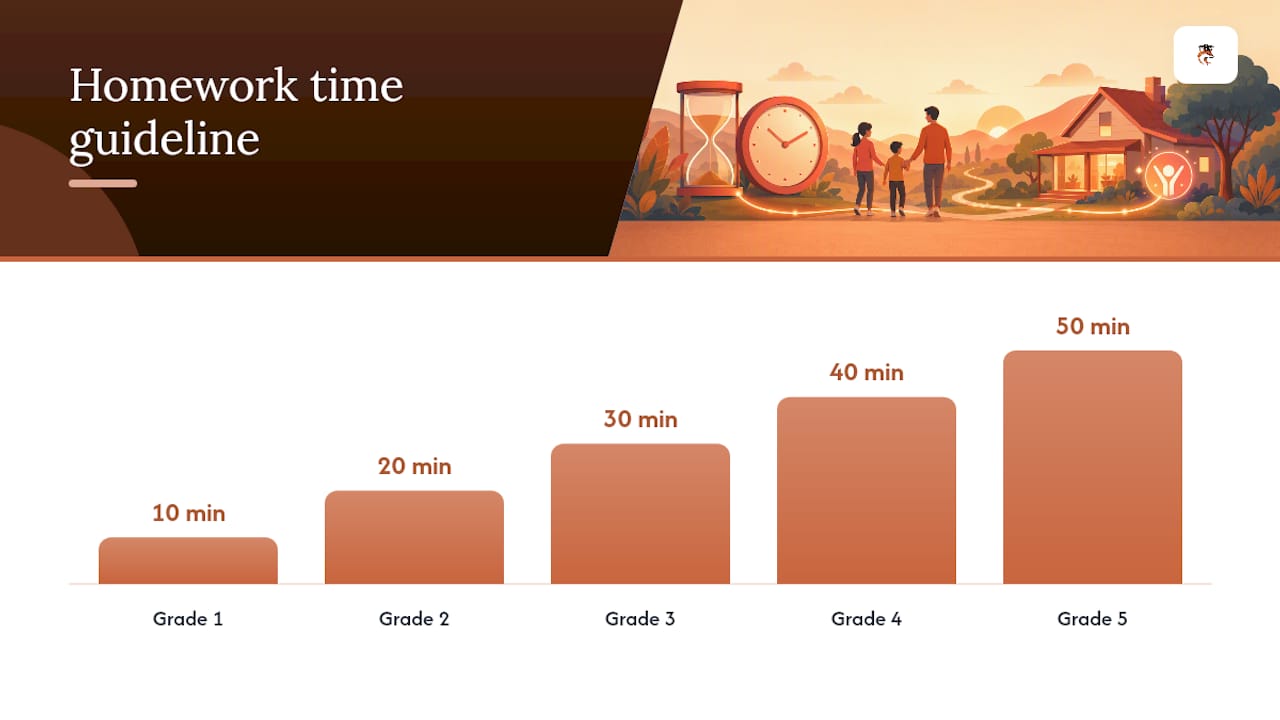
Quick Stat: The Duke University summary on homework research backs the “10 minutes per grade” guideline: a Grade 1 student tops out around 10 minutes, a Grade 5 student around 50 minutes. Treat it as a ceiling to aim under, not a target to hit every night.
Once the timer starts, help your child sort tasks before diving in. A two-minute planning pass prevents the common trap of burning 20 minutes on the easiest worksheet and running out of steam for the assignment that actually needs attention.
Use this checklist before the first pencil touches paper:
- Confirm the space is stocked (pencils, paper, calculator, headphones if needed)
- Complete the landing ritual and set a five-minute countdown to “homework starts now”
- List every task and estimate minutes for each, using the grade-level guideline as your outer limit
- Order tasks by energy required, not just due date
- Set a visible timer for the full work window
Two practical routine templates you can start tonight
Some kids thrive on a fixed clock. Others need flexibility with clear checkpoints. Try one of these for two weeks before deciding which fits.
- Fixed schedule template: 3:30 to 3:50 p.m., snack and decompression. 3:50 to 3:55 p.m., transition (screens off, materials out). 3:55 to 4:35 p.m., work session (adjust the end time to the grade-level guideline). 4:35 to 4:40 p.m., check-in with a parent. 4:40 p.m. onward, free time.
- Flexible block template: a 90-minute window (say, 4:00 to 5:30 p.m.) with three sub-blocks inside it. Sub-block one covers the hardest subject first. A five-minute checkpoint follows each sub-block, where the child reports what’s done and what’s left. The child chooses the order of remaining subjects within the window.
Scholastic’s teacher-backed tips lean toward tackling the hardest subject first while a child’s focus is freshest, right after decompression. Save the easy win, often reading or a review worksheet, for the end, so the routine closes on something the child can finish without a struggle.
Timers do a lot of the heavy lifting here. A visible countdown (a kitchen timer, a phone app, or a simple sand timer for younger kids) turns “how much longer” into a question the child can answer themselves.
Pro Tip: Let your child pick the timer. A neon 15-minute sand timer feels like a game to a seven-year-old; a phone countdown feels more grown-up to a 12-year-old. The buy-in matters more than the tool.
How to build a homework schedule for children that actually sticks
Don’t guess which template works. Test it. Run either version for two full weeks and track three numbers each night: total minutes spent, number of conflicts or meltdowns, and whether tasks got fully completed.
- Total time: Compare it against the grade-level guideline. Consistently running 20+ minutes over signals either a skill gap or a routine that’s too loose.
- Conflict count: Even one argument-free week is a signal worth keeping. Two rough weeks in a row means the template, not the child, needs adjusting.
- Completion rate: Partial completion night after night points to task load or focus issues that time limits alone won’t fix.
If the numbers stay rough past two weeks, loop in the teacher before assuming the routine is broken. A child who consistently blows past the 10-minutes-per-grade estimate, or explodes emotionally over homework on a regular basis, may be signalling a skill gap rather than a scheduling problem, a pattern worth flagging early rather than pushing through with more repetition.
Built-in choice keeps kids invested in a routine they didn’t design. Letting a child pick the order of subjects, the reward after finishing, or the timer style gives them ownership without changing the structure. For children with ADHD or a heavier-than-usual assignment load, break work windows into shorter sub-blocks with movement breaks between them rather than stretching one long sitting.
Pro Tip: Keep a small notebook by the homework table for two weeks and jot one line a night: minutes, mood, done or not done. Patterns show up fast once they’re written down instead of remembered.
- Track for two weeks before changing anything
- Loop in the teacher if time or conflict numbers don’t improve
- Offer choice within the structure, not instead of it
Perspective: when routines and personalised tutoring reinforce each other
A solid homework routine and quality tutoring aren’t competing solutions. They’re built for different problems. A routine fixes when and how homework happens. Tutoring fixes what happens when the material itself is the obstacle, not the schedule.
Experienced educators have observed families running both at once. When a two-week routine trial keeps showing the same pattern, minutes running well past the grade-level guideline, tears over the same subject, a tutor’s job becomes clear: close the specific skill gap so the routine has a fair chance to work.
Our tutors build sessions around a student’s personalised learning plan, which means practice at home lines up with what’s actually being taught, not generic worksheets. Families typically see two changes once that alignment happens:
- Nightly homework time shortens because the child isn’t relearning a concept from scratch each night
- Evening anxiety drops because the child walks into homework already understanding the material, rather than guessing at it
A routine gives structure. Targeted instruction gives the child the tools to use it.
Parent role: support vs solving
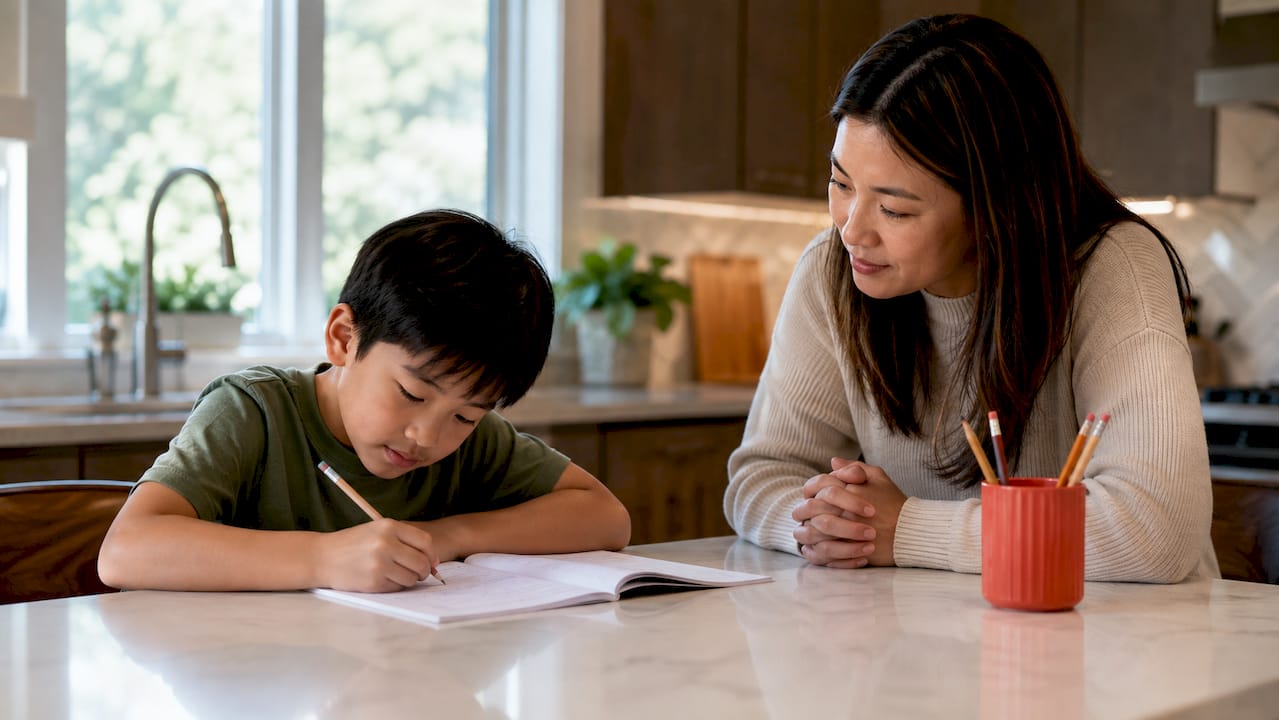
The single hardest habit for a caring parent to break is answering the question before the child has struggled with it. It feels helpful in the moment. Over weeks, it teaches a child to wait for you instead of trying first.
Child Mind Institute’s guidance frames the parent role as a guide, not a solver: ask questions that point toward the answer rather than supplying it. “What does the instruction actually ask you to do?” gets a child further than “here, let me show you.” This mirrors classroom questioning strategies teachers use to keep students actively reasoning instead of passively receiving answers.
Set a rule for yourself: sit nearby, check in at the halfway point, and step in only if your child has tried and genuinely gotten stuck. If you find yourself dictating answers most nights, that’s usually a sign the material is above grade level for your child right now, not a sign your child needs less independence. That distinction changes what you do next, whether it’s a conversation with the teacher or a session with a tutor, not more hovering at homework time.
Some kids resist independence at first because solving-for-them has become the pattern. Expect a few rocky nights when you pull back. Consistency in your response matters more than getting the balance perfect on night one.
Why consistent sleep and nutrition make or break the routine
No homework routine survives a tired, hungry kid. This is the piece families overlook most often because it happens before the homework routine even starts.
A child running on six hours of sleep or an empty stomach doesn’t have the working memory to focus on a math problem, regardless of how well the workspace is set up or how short the timer runs. The landing ritual snack isn’t a nicety. It’s often the difference between a child who can sit through a 30-minute work session and one who melts down at minute ten.
Sleep timing matters just as much as homework timing. A consistent bedtime, even 20 minutes earlier on school nights, tends to do more for next-day focus than any amount of homework strategy. If your evenings are running late because homework keeps sliding past the target window, the fix usually isn’t a longer work session. It’s an earlier start, tighter decompression, or a shorter task list negotiated with the teacher.
Keep the connection simple: protect sleep and food first, then layer the homework routine on top. Trying to fix focus problems with a stricter schedule while sleep and meals stay inconsistent is building on a shaky foundation, and it rarely holds for more than a few nights.
Adapting the routine by age and learning style
A homework routine kids in Grade 1 can follow looks nothing like one built for a Grade 8 student, and that gap is often where routines quietly fail. What worked last year may need adjusting simply because your child got older.
Younger children (Kindergarten to Grade 3) need shorter work windows, more hands-on tasks, and a parent physically nearby, not necessarily helping, but present. The 10-minutes-per-grade guideline keeps sessions realistically short here. Visual timers work better than digital countdowns at this age because the shrinking colour or sand is easier to grasp than a number.
Middle elementary (Grade 4 to Grade 6) can typically handle longer independent stretches with periodic check-ins rather than constant supervision. This is a good age to introduce the flexible block template, letting the child choose subject order within a set window.
Middle and high schoolers often juggle multiple subjects and longer assignments, which makes the checkpoint structure from the flexible template more useful than a single fixed block. Teenagers also respond better to routines they helped design, so involve them in setting the schedule rather than handing one down.
Learning style matters too, though less than most parents assume. A child who reads instructions poorly but listens well might benefit from reading assignments aloud during the landing ritual. One who fidgets constantly may need movement built into checkpoints rather than a straight 45-minute sit. Our guide to study habits for elementary students breaks these adjustments down further by grade band.
Monitoring progress and knowing when to adjust
The two-week trial isn’t a one-time exercise. Revisit those same three numbers, total time, conflict count, completion rate, every few weeks, especially after a report card, a schedule change, or a jump in assignment difficulty.
A routine that worked flawlessly in September can start cracking by November once assignments get longer and extracurricular schedules shift. That’s not a sign the routine failed. It’s a sign it needs a small correction, not a rebuild. Maybe the work window needs 10 extra minutes. Maybe the decompression break needs to move earlier because after-school activities pushed dinner later.
Watch for these adjustment signals specifically:
- Homework time creeping consistently above the grade-level guideline for more than a week
- The same subject triggering frustration night after night, which often points to a specific skill gap rather than general resistance
- A previously cooperative child suddenly resisting the same routine that worked fine a month earlier
Small, frequent tweaks beat waiting until the whole system collapses and starting from scratch. If conflict keeps climbing despite adjustments, our action plan for stopping homework battles walks through troubleshooting steps for high-conflict nights specifically.
Keep one thing steady while everything else adjusts: the sequence itself. Consistency in the order of steps matters more than hitting an exact clock time every single night. A landing ritual, decompression, transition, and work session that always happen in that order gives a child predictability even when the actual start time shifts by 20 minutes because of a late bus or a dentist appointment.
A realistic take on homework routines
No family runs this perfectly every night, and expecting otherwise sets you up to feel like you’re failing at something that was never meant to be flawless. A rough Tuesday doesn’t erase a solid Monday and Wednesday.
If you try one thing tonight, make it the five-minute transition: screens off, materials out, timer set. It’s small enough to actually happen on a busy evening. Track it for two weeks, adjust what doesn’t work, and let the wins be modest ones. Consistency over months beats intensity over one perfect week.
— Réussite A+
Sources
For further reading on building and refining a homework routine, these sources cover the research and practical tips referenced throughout: the Child Mind Institute’s homework strategies, Duke University’s homework time research, Scholastic’s homework habit tips, Nemours/KidsHealth’s top 10 homework tips, and Outschool’s 10-step homework checklist.
Families looking for support beyond routine building can explore Réussite A+’s online homework help and tutoring services, designed to pair structured practice with a personalised learning plan when a skill gap, not just a schedule, is standing in the way.
- Study summary on homework time guidelines (Duke University)
- Strategies to make homework go more smoothly — Child Mind Institute
- After-school homework routine: a 10-step checklist — Outschool
- Top 10 homework tips — Nemours/KidsHealth
- Successful homework habits — Scholastic
FAQ
What is a good homework routine?
A good homework routine follows a consistent sequence: a landing ritual after school, a 20 to 30 minute decompression window, a five-minute transition, then a work session capped near 10 minutes per grade level. Consistency in the order of steps matters more than hitting an exact start time every night.
What is the 3-3-3 rule for children?
The 3-3-3 rule isn’t a standard homework guideline, and definitions vary depending on the source. For homework specifically, the more established and research-backed reference point is the 10-minutes-per-grade guideline from Duke University’s research summary.
What is the 7-7-7 rule for parenting?
There’s no consistent, widely recognized definition of a “7-7-7 rule” tied to homework or parenting routines. If you’ve seen it referenced elsewhere, treat it cautiously since it isn’t grounded in the established research behind homework time guidelines.
What is the 10-10-10 rule for kids?
The 10+10+10 rule divides 30 minutes into three 10-minute blocks, talking, playing, and learning together, to maintain daily parent-child connection. It supports homework routines indirectly by keeping the relationship steady, which makes cooperation easier at homework time.
How long should homework take each night?
Homework should take roughly 10 minutes per grade level, so a Grade 3 student averages about 30 minutes and a Grade 6 student about 60 minutes. Regularly running well past that guideline is worth flagging with the teacher rather than pushing through with a longer nightly session.