



You can stop most homework battles tonight by changing one thing first: stop policing and start coaching. The fight usually isn’t about the worksheet. It’s about a child who feels cornered and a parent who feels responsible for the outcome, and that combination escalates fast. Shifting into a coach role, paired with a predictable routine, lowers the emotional temperature enough for actual work to happen. This works because it takes you out of the enforcer seat, which is what triggers the power struggle, and it gives your child’s brain the external structure it’s still building on its own.
Here’s what to try tonight:
- Build in a buffer of at least an hour after school before any homework starts, so your child isn’t running on empty willpower.
- Set a visible timer for a short sprint (15 minutes for younger kids, 20 to 25 for older ones).
- Sit nearby doing your own quiet task instead of hovering or quizzing.
- Make a two-column Done/To-Do list together before starting, so the workload looks finite.
- Stop at the agreed end time, even if work remains, and send the teacher a short, factual note instead of forcing another hour.
Pro Tip: Try “body doubling” before anything else: just sit near your child doing your own quiet work, with minimal talking or correcting. For a lot of kids, the hardest part of homework is starting it alone, not doing it.
Key Takeaways
Homework battles usually ease once parents swap enforcement for short, curiosity-led coaching layered on a predictable, timed routine.
| Point | Details |
|---|---|
| Shift roles first | Move from “homework police” to coach; guide the process instead of grading the outcome. |
| Use short talks, not lectures | Limit conversations to one or two brief, curious exchanges a day instead of one long argument. |
| Build a repeatable workflow | Buffer after school, unpack together, sprint with a visible timer, then stop at the agreed time. |
| Target one behaviour at a time | Pick a single measurable goal and pair it with a small, immediate, privilege-based reward. |
| Watch for ADHD signals | Homework taking about twice or more the expected time warrants a calm, specific note to the teacher. |
| Get targeted help if it’s chronic | Réussite A+ offers a diagnostic session and tailored plan when the same subject keeps causing nightly conflict. |
Table of Contents
- What causes homework battles by child temperament?
- Why short, curious talks beat one big lecture
- What routine actually reduces homework fights?
- How do you pick which homework habit to fix first?
- Why does ADHD make homework harder, and what helps?
- When does tutoring stop the homework fight for good?
- A parent’s note on what actually changed our evenings
- Considering extra help if the conflict keeps coming back
- Sources
- FAQ
What causes homework battles by child temperament?
Not every child stalls out for the same reason, and using one script on every kid is why so many strategies fail after a week. Match the tactic to the pattern you’re actually seeing.
The procrastinator. Sign: they wander off for snacks, bathroom trips, and “just one more thing” before starting. Break the assignment into two visible chunks, set a 10 minute timer for just opening the first chunk, sit nearby while they start, and praise the start rather than the finish. Script: “Let’s just open the math book for ten minutes. We’ll check in when the timer goes.”
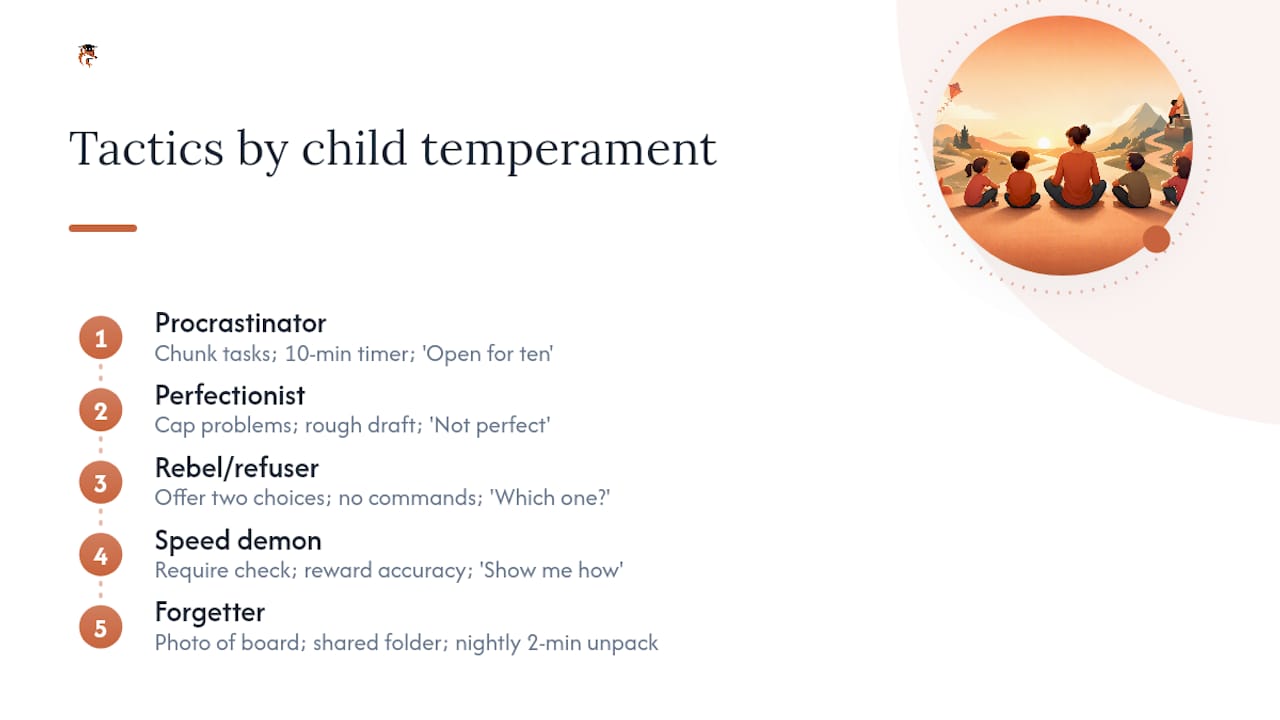
The perfectionist. Sign: erasing the same line five times, refusing to hand in “messy” work. Set a word or problem cap instead of a quality bar, normalize a rough draft, and remove your own comments on neatness. Script: “This is the practice copy. It doesn’t need to be perfect. What’s one sentence you can get down right now?”

The rebel or refuser. Sign: flat “no” or arguing about the point of the assignment. Avoid direct commands, offer two real choices (“math or French first?”), and drop the lecture about consequences. Script: “You don’t have to like it. Which one do you want to knock out first?”
The speed demon. Sign: finishes in six minutes with sloppy, wrong answers. Ask for a specific check step, not more time, and reward accuracy over speed. Script: “Show me how you got answer three before we move to number four.”
The forgetter. Sign: no clue what’s due, no agenda written down. Externalize everything: a photo of the classroom board, a shared homework folder, a nightly two-minute bag unpack. This is often less about attention and more about organisation systems that haven’t been built yet.
Elementary kids generally need more physical presence, while middle schoolers do better with check-ins at the start and end of a session rather than constant supervision. Scale back your involvement gradually as each behaviour stabilizes, and resist the urge to correct or finish the work yourself. If a pattern persists for weeks despite matched tactics, that’s a signal to loop in the teacher rather than escalate at home.
Pro Tip: Whatever the temperament, praise the process (“you started right on time”) instead of the product (“great grade”). Process praise survives a bad night; grade praise doesn’t.
Why short, curious talks beat one big lecture
A single long lecture about responsibility rarely changes behaviour, but many brief, curious conversations often do. The 25 One-Minute Conversation approach works because it replaces confrontation with information gathering, and kids stop bracing for a fight the moment they sense you’re actually listening.
- Start with genuine curiosity, not a fix: “What’s making this one tricky?”
- Validate before problem-solving: “That does sound annoying.”
- Ask one small, specific question, then stop talking.
- Limit yourself to one or two of these brief exchanges per day, not a running commentary through the whole session.
- Follow up the next day on whatever tiny experiment you agreed to try.
A short exchange might sound like this:
- Parent: “You’ve been staring at that page a while. What’s going on?”
- Child: “I don’t get how to start it.”
- Parent: “That’s frustrating. Want to try just reading the first question out loud?”
- Child: “…fine.”
- Parent: “Okay, let’s see how that goes.”
No lecture, no consequence talk, no fixing the whole assignment in one go. This approach is especially useful when resistance is rooted in shame, perfectionism, or a kind of quiet shutdown where a child goes still rather than loud. Pushing harder on a shut-down kid usually backfires; curiosity gives them a way back in without losing face.
What routine actually reduces homework fights?
Most nightly conflict isn’t really about the material. It’s about ambiguity: when to start, how long it’ll take, and whether it will ever end. A repeatable workflow removes most of that friction before it starts.
- Buffer. Give at least an hour after school for a snack and movement before opening a single book. Kids run out of self-control by dismissal, a pattern sometimes called after-school restraint collapse, and skipping this step is the single most common reason homework starts badly.
- Unpack and checklist. Empty the backpack together and build a short Done/To-Do list so the workload has a visible edge.
- Sprint with a visible timer. One or two short bursts, 15 minutes for elementary kids, up to 25 for older students, using an analogue clock or countdown timer your child can actually see.
- Finish and praise the start, not just the result.
- Stop at the agreed time. If work remains, stop anyway and send the teacher a short note the next morning.
A communal table tends to outperform an isolated bedroom desk for most kids under twelve, since body doubling and low-level supervision are built into the setup. Keep the workspace low-sensory: minimal background noise, a stocked supply bin nearby so nobody has to hunt for a glue stick mid-sprint.
- Supplies to keep in one bin: pencils, eraser, ruler, calculator, sticky notes, a whiteboard for scratch work.
- Workspace check: enough light, a chair that fits, no phone or tablet within reach unless it’s the timer.
Pro Tip: The 60 to 90 minute after-school buffer is the fix parents skip most often, because it feels like wasted time. It isn’t. A regulated kid who starts at 5:00 finishes faster than a depleted one forced to start at 3:30.
How do you pick which homework habit to fix first?
Trying to fix everything at once is why most home interventions collapse inside two weeks. Pick one or two behaviours, define them in plain, observable terms, and leave the rest alone for now.
Good targets look like: “records every assignment in the planner,” “starts within five minutes of sitting down,” or “completes at least three math problems before a break.” Vague goals like “try harder” or “be more responsible” can’t be tracked, so nobody knows if it’s working.
- Choose one or two specific behaviours based on what’s actually breaking down most nights.
- Write the success criteria in a sentence your child could repeat back to you.
- Track it daily on a simple chart, even just tally marks on a sticky note.
- Attach a small, immediate, privilege-based reward, not a material one.
- Review after five school days and adjust before adding a third target.
Reward ideas that tend to work better than toys or money:
- An extra 15 minutes of screen time that evening.
- Picking dessert or the family movie.
- Staying up 20 minutes later once, on a Friday.
Daily tracking matters more than the size of the reward. A same-day tally and a quick “you hit it” comment builds momentum faster than a big prize promised for Friday. Once a behaviour holds steady for a week or two, retire that reward and pick the next target.
Why does ADHD make homework harder, and what helps?
Homework is one of the most common sources of school conflict for kids with ADHD, and it’s rarely about effort. Executive-function challenges around task initiation, time perception, and working memory make starting and tracking work genuinely harder, even for a bright, motivated kid. A student can ace the unit test and still fail the assignment simply because it never got written down or handed in.
Tactics that tend to help:
- Visible timers and analogue clocks, since time often feels abstract without a concrete visual.
- Body doubling: an adult or sibling working quietly nearby, often enough to solve the “can’t get started” problem without any direct coaching.
- Breaking assignments into micro-steps smaller than feels necessary.
- Externalizing organization completely: a photo of the classroom whiteboard, one dedicated homework folder, nothing relying on memory alone.
Watch for these signals that it’s time for outside support: homework consistently taking one and a half to two times longer than the teacher’s stated estimate, frequent meltdowns tied specifically to schoolwork, or assignments that are done but never submitted. If any of that sounds familiar, a calm, specific email to the teacher documenting actual time-on-task is often the single most effective first move, and it can open the door to classroom accommodations like an IEP or 504 plan. Our ADHD-specific strategies page goes deeper on session structure for these kids.
When does tutoring stop the homework fight for good?
Routine changes fix a lot of nightly conflict, but not all of it. When the real problem is a skill gap, no amount of timers or curiosity-led talks will close it, because your child is stuck, not resistant.
Targeted academic support tends to help when:
- A specific subject (often math or a step in French grammar) is the recurring flashpoint, night after night.
- Homework time keeps stretching well past what the teacher expects, despite a solid routine at home.
- Your child avoids starting because they’ve quietly decided they “can’t do this,” not because they’re being defiant.
- You need objective progress data to bring to the teacher instead of a vague sense that things are hard.
A diagnostic session identifies exactly which foundational skills are missing, not just which grade the report card shows. From there, a tailored plan targets those specific gaps, with progress tracked session over session so both parents and teachers can see real movement instead of guessing.
A family working through chronic nightly math battles found that once the actual skill gap (not the assignment itself) was identified and targeted directly, homework time shortened and submission rates improved within a few weeks, because the child was finally practising at the right level instead of guessing at material two steps ahead of what they’d mastered.
Try routine and behaviour changes first if the conflict is new or tied to one rough week. Consider targeted tutoring support when the same subject has been a nightly fight for a month or more despite a consistent workflow at home.
A parent’s note on what actually changed our evenings
The turning point in our house wasn’t a big system. It was noticing that my son would fight the entire assignment but rarely fought just the first two problems. So we stopped talking about “homework” as one block and started talking about “the first two.” Once he was two problems in, momentum usually carried him the rest of the way, and the nightly standoff at the kitchen table mostly disappeared.
Pro Tip: If your child balks at “doing homework,” ask for “just the first two problems” instead. The whole assignment feels like a mountain; two problems feels like nothing, and starting is almost always the hardest part.
Nothing here worked on the first try. What changed things was staying with small experiments long enough to see which ones actually stuck, rather than judging a new routine after one bad Tuesday. Consistency beats any single perfect fix.
Considering extra help if the conflict keeps coming back
Some families try every tactic in this article and the same subject keeps causing the same fight, week after week. That usually means the issue is a skill gap, not a discipline problem, and it’s worth outside help if you’re seeing persistent gaps in math or French, homework that consistently takes far longer than it should, or a child gearing up for an entrance exam who needs focused preparation rather than general review.

Réussite A+ starts with a diagnostic session to pinpoint exactly where the gap sits, then builds a tailored learning plan around it, with regular progress monitoring so you can see real change instead of guessing from grades alone. Sessions run online with university-level tutors, and parents get concrete homework-coaching tips alongside the academic work itself, so the nightly routine at home improves too. If the same subject has been a fight for weeks despite trying the strategies above, book an online tutoring session and get a clear plan for the weeks ahead instead of another night of guessing.
Sources
- Stop Homework Battles: The 25 One-Minute Conversation Rule
- How parents can help children who struggle with homework
- Homework problems in ADHD (CHADD)
- Homework battles: a calmer system that actually works
When a tactic doesn’t work, prefer a call to the teacher over a punishment at home; teachers can often adjust expectations once they see objective data on time spent.
FAQ
Do kids with ADHD struggle with homework more than other kids?
Yes. Executive-function challenges around task initiation, time perception, and working memory make homework a common flashpoint for kids with ADHD, even when they understand the material well.
What are some disadvantages of homework?
Common downsides include nightly family conflict, lost time for sleep and free play, reinforced frustration when a skill gap hasn’t been addressed, and diminishing returns once a session drags on well past a reasonable length for the child’s age.
How can my child finish homework faster?
Use short, timed sprints (15 minutes for younger kids, up to 25 for older students) with a visible timer, a clear Done/To-Do list, and a parent nearby doing quiet work rather than hovering or correcting.
Do most kids dislike homework?
Homework resistance is common enough that entire parenting frameworks exist around it, though the resistance usually points to a specific cause, like a skill gap, fatigue, or shame, rather than dislike of learning itself.
When should we consider tutoring instead of just fixing our routine?
Try routine changes first for a new or short-lived conflict. Consider tutoring when the same subject has caused nightly battles for a month or more despite a consistent workflow at home.