



For most Canadian families, the SSAT is the right choice. It is the default admissions test across the Canadian independent school circuit, particularly in the Greater Toronto Area and at boarding schools, while the ISEE appears mainly when a student is also applying to specific U.S. private schools that require it.
TL;DR:
- The SSAT is the de facto standard for Canadian independent school admissions, especially in Ontario and BC.
- The ISEE is more common in the United States; Canadian families encounter it mainly for cross-border applications.
- The SSAT rewards strong vocabulary recall; the ISEE leans more on reasoning from context.
- The SSAT includes a wrong-answer penalty; the ISEE does not, which changes guessing strategy entirely.
- Both tests deliver score reports in roughly two weeks.
Pro Tip: If your child is applying to schools in Canada and one or two U.S. schools, check each school’s admissions page before registering for either test. Some Canadian schools accept both; a handful accept only one. Confirming this early saves you from preparing for a test you do not need.
Table of Contents
- How do the SSAT and ISEE compare at a glance?
- What is the SSAT and who takes it in Canada?
- What is the ISEE and when does it matter for Canadian applicants?
- How do the formats and question styles actually differ?
- How are SSAT and ISEE scores reported?
- Which schools accept or prefer each test in Canada?
- How do you choose between the SSAT and the ISEE?
- When should your child test, and how do retakes work?
- What does effective prep actually look like?
- How Réussite A+ prepares students for the SSAT and ISEE
- Key takeaways
- What tutors see that the guides often miss
- Réussite A+ can help your child prepare with confidence
- Useful sources for parents who want to dig deeper
- FAQ
How do the SSAT and ISEE compare at a glance?
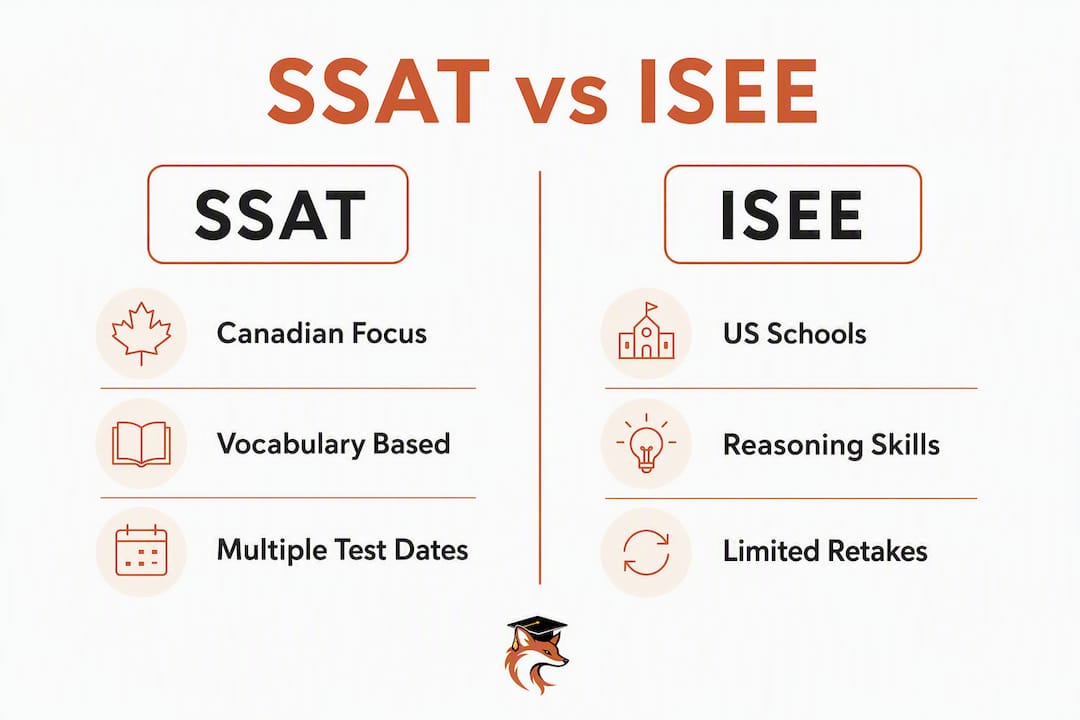
The table below maps the main decision dimensions side by side. Read it alongside the short rationale beneath it to identify which test fits your child’s situation.

| Dimension | SSAT | ISEE |
|---|---|---|
| Who uses it | Most Canadian independent schools; GTA and boarding schools | Primarily U.S. private schools; some international recruiters |
| Levels | Elementary (Gr. 3–4), Middle (Gr. 5–7), Upper (Gr. 8–11) | Primary (Gr. 2–4), Lower (Gr. 5–6), Middle (Gr. 7–8), Upper (Gr. 9–12) |
| Verbal question types | Synonyms + analogies | Synonyms + sentence completion |
| Quantitative sections | One quantitative section | Quantitative reasoning + mathematics achievement (two sections) |
| Guessing penalty | Yes: −¼ point per wrong answer | No penalty for wrong answers |
| Score reporting | Scaled score + percentile | Scaled score + stanine + percentile |
| Retake flexibility | More flexible (multiple attempts per year) | More restricted (once per season) |
| Delivery modes | Paper, Prometric, SSAT at Home | Paper and select test centres |

Choose the SSAT if: your child is applying primarily to Canadian schools, prefers vocabulary-based verbal questions, and benefits from more retake opportunities.
Choose the ISEE if: your child is applying to U.S. schools that specifically require it, reasons well from sentence context, and is comfortable with a faster-paced two-section math format.
What is the SSAT and who takes it in Canada?
The SSAT (Secondary School Admission Test) has been the standard private school entrance exam since 1957. It assesses verbal, quantitative, and reading skills, plus a non-scored writing sample, and is used by students in Grades 3 through 11.
Three levels cover the full range of applicants:
- Upper Level: — Grades 8–11 (applying to Grade 9 through 12)
In Canada, the SSAT is the dominant test for independent school admissions, particularly across the Greater Toronto Area and at boarding schools. Most families in Ontario and BC will encounter the SSAT as the expected or preferred test, not the ISEE.
The SSAT is available in three delivery formats: paper-based at official test centres, computer-based at Prometric locations, and SSAT at Home for students who prefer to test in a familiar environment. The number of times a student may sit the test per testing year is limited and varies by format, so checking the current rules on SSAT.org before booking is worth doing. Retake policies are more flexible than the ISEE, which matters when a student wants to improve a score before an application deadline.
What is the ISEE and when does it matter for Canadian applicants?
The ISEE (Independent School Entrance Exam) is administered by the Educational Records Bureau (ERB) and is widely used by U.S. private schools. It covers four levels rather than three, with slightly different grade boundaries than the SSAT.
ISEE levels and grade coverage:
- Upper Level: — Grades 9–12 (applying to Grades 10–12)
For Canadian families, the ISEE is rarely the first test to consider. Most local guides and prep services advise focusing on the SSAT unless the student is specifically applying to U.S. schools that require it. The ISEE does appear in applications to some internationally recruiting schools, but this is the exception rather than the rule in Canada.
The ISEE limits retakes to once per testing season (fall, winter, spring, summer), which means a student who sits the test in October cannot retest until the winter window. Score reports go to families and up to five schools, with additional reports available for a fee. For registration and current test dates, the ERB’s official site at erblearn.org is the authoritative source.
How do the formats and question styles actually differ?
This is where the SSAT vs ISEE decision gets practical. The two tests look similar on paper but feel quite different in the room, and those differences directly shape how your child should prepare.
Verbal sections
The SSAT verbal section uses synonyms and analogies. Synonyms test pure vocabulary recall; analogies ask students to identify the relationship between a pair of words and find a matching pair. Both question types reward a wide, precise vocabulary built over years of reading.
The ISEE verbal section uses synonyms and sentence completion. Sentence completion gives students a sentence with a blank and asks them to choose the word that fits best. This format tends to favour students who reason well from context rather than those who rely on memorised definitions alone.
A quick illustration of the difference:
- SSAT analogy style: “Physician : Hospital :: Teacher : ___” (Answer: School)
- ISEE sentence completion style: “The scientist’s findings were so ___ that even her colleagues struggled to follow her reasoning.” (Answer: abstruse)
Quantitative and math sections
The SSAT has one quantitative section covering arithmetic, algebra, and geometry. The ISEE splits this into two: a quantitative reasoning section (problem-solving and data interpretation) and a mathematics achievement section (curriculum-based content). Students who are strong in applied reasoning may find the ISEE’s two-section structure plays to their strengths; students who prefer a single focused math block often find the SSAT more manageable.
Writing sample
Both tests include a non-scored writing sample. Neither result affects the scaled score, but schools receive the writing sample alongside the score report and may use it to assess writing ability and maturity.
Scoring mechanics and guessing strategy
The SSAT applies a wrong-answer penalty of −¼ point per incorrect response; the ISEE does not penalise wrong answers. This single difference changes test strategy significantly. On the SSAT, skipping a question you cannot narrow down is often the better move. On the ISEE, answering every question is always correct strategy because a blank and a wrong answer both score zero, but a correct guess scores a full point.
Effective SSAT prep includes explicit practice in elimination strategies: teaching students to identify when they can eliminate two or three options (making a guess worthwhile) versus when they are truly guessing blind (making a skip the safer choice). ISEE prep should prioritise speed and context-based reasoning, since the pace is brisk and every question deserves an answer.
Pro Tip: Run a timed practice section of each test before committing to one. Students often discover a clear preference after just 20–30 minutes with real questions, and that preference is a reliable signal about which format will produce the stronger score.
How are SSAT and ISEE scores reported?
Understanding the score report is half the battle when setting realistic targets.
SSAT scoring
The SSAT reports a scaled score for each section (verbal, quantitative, reading) and an overall scaled score. Alongside the scaled score, students receive a percentile rank comparing their performance to other students of the same grade who have taken the test in the past three years. A student scoring at the 75th percentile performed better than 75% of that comparison group.
ISEE scoring
The ISEE reports a scaled score, a percentile rank, and a stanine (a 1–9 scale). Stanines group percentile ranges into nine bands: stanine 1–3 is below average, 4–6 is average, and 7–9 is above average. Many schools use stanines as a quick filter because they are easy to interpret across different grade levels.
| Score metric | SSAT | ISEE |
|---|---|---|
| Scaled score | Yes (section and total) | Yes (section and total) |
| Percentile rank | Yes | Yes |
| Stanine | No | Yes (1–9 scale) |
| Writing sample score | Not scored | Not scored |
What counts as a competitive score?
Competitive applicants to selective schools often sit above the 75th percentile on the SSAT or in stanine 7–9 on the ISEE. These benchmarks are not universal, and the bar shifts depending on the school and the applicant pool in a given year.
Standardised test scores are one part of a holistic application. Teacher references, interviews, and transcripts often carry as much weight as a strong score, and a small difference in percentile rarely determines an outcome on its own.
Many Canadian independent schools use scores as one of several inputs, alongside school-specific assessments, interviews, and transcript reviews. Ask each school’s admissions office what role the test score plays in their process before fixating on a target number.
Which schools accept or prefer each test in Canada?
The short answer: most Canadian independent schools accept the SSAT, and many do not require the ISEE at all. The longer answer requires you to check each school individually, because admission policies change year to year and a school that accepted both tests last year may have updated its policy.
Checklist for confirming each target school’s policy:
- Visit the school’s admissions page and look for a section on entrance testing or assessment requirements.
- Note whether the school lists SSAT, ISEE, or a school-specific assessment as required, preferred, or accepted.
- If the page is unclear or has not been updated recently, email or call the admissions office directly.
- Ask specifically: “Do you accept both the SSAT and the ISEE, or do you have a preference? Do you report a minimum score or percentile?”
- Document the response with the date and the name of the person you spoke with.
Some schools, particularly in Ontario, use their own entrance assessments entirely and do not require either national test. Others accept SSAT or ISEE interchangeably. A small number of schools that recruit internationally may list the ISEE as an option alongside the SSAT.
Pro Tip: Contact admissions offices in September or October, well before application deadlines. Staff are more available to answer detailed questions early in the cycle, and you will have time to act on their guidance before registration windows close.
How do you choose between the SSAT and the ISEE?
Work through this checklist with your child before registering for either test.
- List every target school and its test policy — Use the checklist above. If all schools accept only the SSAT, the decision is made.
Questions to ask each school’s admissions office:
Sample email to an admissions office:
Pro Tip: If your child’s practice scores differ significantly between the two formats, consider taking the test where they score higher, provided the target schools accept it. A 15–20 percentile difference in practice is a meaningful signal worth acting on.
When should your child test, and how do retakes work?
Timing the test correctly is as important as choosing the right one. Most Canadian independent school applications open in the fall and close between November and January, which means test scores need to be in hand well before those deadlines.
Practical timeline for Canadian families:
- May–June: Research target schools and confirm test requirements. Begin light diagnostic work.
- July–August: Start structured prep (12 weeks before the intended test date is a solid target).
- September–October: Sit the first test. This leaves time for a retake if needed before most application deadlines.
- November: Retake if the first score was below target and the school’s deadline allows.
- December–January: Most application deadlines fall here; scores should already be submitted.
The SSAT offers multiple test dates throughout the year across its three delivery formats, giving families more scheduling flexibility. The ISEE limits students to one sitting per testing season (fall, winter, spring, summer), so a poor October sitting cannot be corrected until the winter window, which may be too late for some deadlines.
Score reports for both tests arrive in roughly two weeks. Build that turnaround into your timeline so you are not waiting on scores while an application deadline approaches.
What does effective prep actually look like?
A 12-week study plan gives most students enough time to cover the material, build stamina, and run full-length practice tests before the real thing.
12-week sample study plan:
- Weeks 3–6 (Targeted skill work): — Focus on the weakest areas. For SSAT: vocabulary building (aim for 10–15 new words per day using flashcard systems), analogy pattern recognition, and quantitative fundamentals. For ISEE: sentence-completion practice, quantitative reasoning strategies, and mathematics achievement review.
Recommended resource types:
- Vocabulary builders: For the SSAT, building vocabulary before the admission exam is one of the highest-return activities a student can do in the months before the test.
- Mathematics review: Both tests cover arithmetic, algebra, and geometry. A structured mathematics review for secondary admissions helps students consolidate gaps before timed practice begins.
Pro Tip: Simulate the actual test environment at home at least twice before the real sitting. Use the same start time, the same desk, and no phone. Students who have already sat through a full timed test in a quiet room arrive at the real test with far less anxiety.
How Réussite A+ prepares students for the SSAT and ISEE
Réussite A+ works with students across Quebec who are preparing for private school entrance exams, including the SSAT and ISEE. The approach starts with a diagnostic session to identify exactly where a student’s skills sit relative to the test level they will face, rather than applying a generic curriculum.
Students who arrive with strong French and mathematics foundations from their regular schooling often need less time on content review and more time on test-specific strategy: pacing, elimination, and question-type recognition. Targeted prep in those areas tends to produce the most meaningful score gains in the shortest time.
A typical prep programme at Réussite A+ includes:
- An initial diagnostic to map strengths and gaps across verbal, quantitative, and reading sections
- Personalised session plans that address the specific question types your child finds most challenging
- Timed practice integrated from the early weeks, not just at the end of the programme
- Vocabulary modules for SSAT-focused students, with structured daily review built into the plan
- Progress tracking after every session so parents can see exactly where improvement is happening
With more than 25 years of educational experience and a 99% client satisfaction rate, Réussite A+ brings the same student-centred methodology to entrance exam prep that it applies to its core French and mathematics tutoring. Every tutor is selected from the university level for both academic excellence and teaching ability.
For families preparing for high school entrance exams, a structured and personalised approach makes a measurable difference, particularly when the test date is 10–12 weeks away and there is no time to waste on material the student already knows.
Key takeaways
For most Canadian families, the SSAT is the right starting point because it is the default test at Canadian independent schools, while the ISEE becomes relevant only when applying to specific U.S. schools that require it.
| Point | Details |
|---|---|
| SSAT is Canada’s default | Most Canadian independent schools, especially in the GTA, use the SSAT as their standard entrance test. |
| Guessing rules change strategy | The SSAT penalises wrong answers (−¼ point); the ISEE does not, so students should always answer every ISEE question. |
| Competitive score benchmark | Competitive applicants often sit above the 75th percentile on the SSAT or in stanine 7–9 on the ISEE. |
| Confirm each school’s policy | Test acceptance policies change annually; always verify directly with each school’s admissions office. |
| Réussite A+ prep | Réussite A+ offers personalised SSAT/ISEE prep starting with a diagnostic, with vocabulary modules and timed practice built in. |
What tutors see that the guides often miss
The most common mistake families make is treating the SSAT and ISEE as interchangeable tests that simply require more studying. They are not. The guessing penalty alone changes the entire psychological approach a student needs on test day. A student who has spent weeks answering every question on ISEE practice tests will instinctively do the same on the SSAT, and that habit costs points.
The second thing worth saying plainly: vocabulary is not something you can build in two weeks. The SSAT’s synonym and analogy sections draw on a breadth of language that accumulates over years of reading. Families who start prep four to six months before the test date, rather than six weeks, consistently see better outcomes. That is not a sales point; it is simply what the timeline data shows.
Finally, do not let a single practice score determine which test your child takes. Run both formats as diagnostics before committing. The format that produces the higher score in practice is almost always the format that produces the higher score on test day.
Réussite A+ can help your child prepare with confidence
Choosing between the SSAT and ISEE is only the first step. The real work is building the skills, strategies, and stamina to perform well on test day, and that is where personalised preparation makes the difference between a good score and a great one.
Réussite A+ offers online tutoring for entrance exam preparation that is built around your child’s specific gaps, not a one-size-fits-all curriculum. Sessions start with a diagnostic, move into targeted skill work, and include timed practice from early in the programme. Parents receive progress updates after every session so there are no surprises as the test date approaches.
With flexible online scheduling and tutors selected for both academic excellence and teaching ability, Réussite A+ makes high-quality test prep accessible to families across Quebec. Whether your child needs intensive vocabulary work for the SSAT or pacing and reasoning strategies for the ISEE, the programme adapts to what they actually need.
To get started, book your first session and receive a personalised diagnostic plan tailored to your child’s target school and test date.
Useful sources for parents who want to dig deeper
- About the SSAT — Official SSAT authority; registration, formats, policies, and practice materials
- SSAT Upper Level information — Delivery modes, retake rules, and SSAT at Home details
- ISEE overview for parents (ERB) — Official ISEE authority; levels, registration, and score reporting
- OurKids — admissions tests overview — Canadian-focused guide to private school admissions testing
- Réussite A+ entrance exam prep — Personalised SSAT/ISEE prep services for Quebec students
FAQ
Is the SSAT harder than the ISEE?
Neither test is objectively harder, but they challenge students differently. The SSAT’s guessing penalty adds strategic pressure, and its vocabulary demands are high; the ISEE tends to be faster-paced with more reasoning-oriented content, which some students find more demanding.
What is the SSAT and what is the ISEE?
Both are standardised entrance exams for private schools. The SSAT (Secondary School Admission Test) is the standard for most Canadian independent schools; the ISEE (Independent School Entrance Exam), administered by the ERB, is more common at U.S. private schools and appears in Canada mainly for cross-border applications.
What is a good SSAT score for a Grade 7 student?
Competitive applicants to selective schools typically score above the 75th percentile on the SSAT. The exact benchmark varies by school, so asking the admissions office for the range of recent successful applicants gives you a more accurate target than any generic guide.
How difficult is the ISEE test?
The ISEE is considered moderately to highly challenging depending on the level. The Upper Level in particular covers content that requires strong reasoning and mathematics skills, and the once-per-season retake limit means students have less room to recover from an off day compared to the SSAT.
Should my child take both the SSAT and the ISEE?
Only if the target school list includes schools that require different tests. Taking both adds cost and preparation time. Confirm each school’s requirements first; if all schools accept the SSAT, there is no reason to prepare for both.