



The single most effective step you can take today is to pick one technique, either time blocking or backward planning, and practise it with your teen during a real homework session this week. Research published in the Journal of Educational and Developmental Psychology confirms that executive functioning (EF) skills, including time management, reliably predict performance on standardised academic exams. Starting small and staying consistent matters far more than choosing the “perfect” system.
Here is what to do right now:
- Pick one technique. Time blocking or backward planning are the easiest entry points.
- Schedule a 20–30 minute practice block during tonight’s or tomorrow’s homework session.
- Set up a shared family calendar (a paper one on the fridge works fine to start) so deadlines are visible to everyone.
- Use a simple kitchen timer to make time feel concrete rather than abstract.
Allo Prof recommends that Quebec parents begin with priority sorting and routines tailored to their teen’s natural energy peaks before introducing any digital tools. Réussite A+ tutors apply the same principle: embed the skill in real schoolwork first, then build outward.
Pro Tip: Start with a physical agenda and a kitchen timer before any app. Teens need to feel the passage of time before they can plan it accurately.

Table of Contents
- Try this 7-day starter plan this week
- Why time management predicts your teen’s grades
- Six techniques that actually work for teens
- When to seek more help: red flags parents should know
- How to coach your teen without taking over
- How personalised tutoring builds skills that actually transfer
- Key takeaways
- Réussite A+’s perspective on time management and teens
- Useful sources
- FAQ
Try this 7-day starter plan this week
A week of small, deliberate steps builds more momentum than a single long planning session.
Day 1: Run a 15–20 minute time audit together. Ask your teen to list every task due in the next two weeks, then estimate how long each one takes. Write it all down on paper. Choose one technique to try, either time blocking or the Pomodoro method (25 minutes of focused work, 5-minute break).
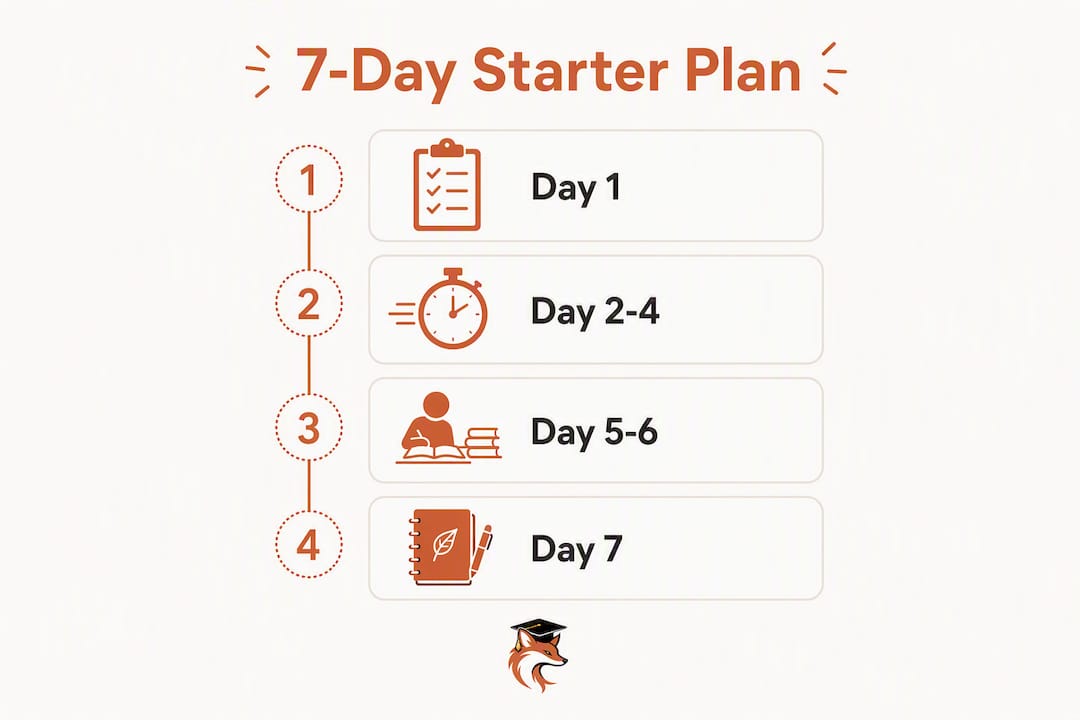
Days 2–4: Hold a 20–30 minute practice session each evening. Set a timer, work on one subject, and do a two-minute check-in afterward: “How long did that actually take?” Update the shared calendar together each night.
Days 5–7: Introduce backward planning for one upcoming assignment. Start from the due date and work backward to today, assigning small chunks to specific days. On Day 7, hold a five-minute weekly review: what worked, what did not, and what needs adjusting.
Two-minute launch conversation (use this script):
Parent checklist for the week:
- [ ] Paper agenda or wall calendar visible in the study space
- [ ] Timer accessible (phone, kitchen timer, or a visual sand timer)
- [ ] Shared calendar updated each evening
- [ ] One brief check-in per night, two minutes maximum
Pro Tip: Roots to Routes notes that students who learn analog planning before switching to digital tools develop far more accurate time estimates. Resist the urge to jump straight to an app.
Why time management predicts your teen’s grades
Time management is not simply a study habit. It is an executive function, a set of brain-based skills governing planning, task initiation, and self-monitoring. Longitudinal research published in Frontiers in Education finds that stronger EF skills in early adolescence predict higher GPA and better wellbeing across an eight-year period, and that early intervention can genuinely change developmental trajectories.
“Executive functioning difficulties are often mistaken for laziness or a lack of motivation. In reality, these are neurodevelopmental challenges that respond well to targeted support and early assessment.”
— Dr. Marlene Taube-Schiff, as cited by Forward Thinking Psychological Services
That distinction matters practically. A teen who “can’t get started” on an essay may not be unmotivated; they may genuinely struggle with task initiation, a specific EF deficit. Treating it as a character flaw delays the help they need.
Sleep compounds the problem. Research summaries indicate adolescents need 8–10 hours of sleep per night, yet many average closer to six hours and fifteen minutes on school nights, which impairs EF and concentration. Chronic sleep shortfall directly impairs attention, working memory, and the very EF skills you are trying to build.
Key EF skills that time-management practice targets:
- Task initiation: getting started without repeated prompting
- Time estimation: accurately predicting how long work will take
- Planning and prioritisation: sequencing steps toward a goal
- Cognitive flexibility: adjusting when a plan changes
Six techniques that actually work for teens
Each method below includes a one-sentence definition, three steps, and a real homework example. Introduce one or two at a time; teaching too many at once reliably causes failure.
Time blocking and the Pomodoro method
Assign specific time slots to specific tasks. Set a 25-minute timer, work on one subject only, then take a five-minute break. Repeat. Example: Monday 4:00–4:25 PM = math problems only.
Backward planning
Start from the due date and work backward, assigning each step to a specific day. Example: essay due Friday → outline Wednesday → research Tuesday → topic confirmed today.
The Eisenhower matrix
Sort tasks into four boxes: urgent and important (do now), important but not urgent (schedule), urgent but not important (delegate or minimise), neither (drop). Example: a test tomorrow is urgent and important; reorganising a binder is neither.
The two-minute rule
If a task takes two minutes or less, do it immediately rather than scheduling it. Example: writing down a homework assignment, sending a question to a teacher.
Visual timers
A sand timer or a visual countdown app makes time physically visible, which helps teens who struggle with “time blindness.” Place it on the desk during every study block.
A consistent daily routine
A predictable after-school sequence (snack → 10-minute break → homework block → dinner) removes the daily decision of when to start, which is often where procrastination hides.
| Technique | Best for | Weakest fit |
|---|---|---|
| Time blocking / Pomodoro | Long study sessions, procrastination | Very short tasks |
| Backward planning | Multi-step projects, exam prep | Single-night homework |
| Eisenhower matrix | Overwhelm, priority confusion | Routine daily tasks |
| Two-minute rule | Small tasks piling up | Complex assignments |
| Visual timer | Time blindness, task initiation | Teens who find it distracting |
When to seek more help: red flags parents should know
Six to eight weeks of consistent, supported practice is a reasonable window for mild struggles before concluding a plan is not working. If your teen shows the following signs, a shorter timeline and a professional referral make more sense.
Red flags that suggest deeper EF difficulties:
- Chronic missed deadlines despite reminders and a clear plan
- Severe time blindness (genuinely cannot estimate how long tasks take, even after practice)
- Consistent inability to initiate work, even on subjects they enjoy
- Rising anxiety, school avoidance, or grades falling across multiple subjects simultaneously
Referral steps, in order:
- Contact the school’s resource teacher or guidance counsellor to document the pattern.
- Request a psychoeducational or neuropsychological assessment if difficulties persist.
- Pair professional assessment with targeted tutoring that embeds EF practice into real assignments, not generic skill drills.
Budget guidance for Quebec families: Individual tutoring sessions in Quebec vary in cost depending on format and provider. Psychoeducational assessments through private practitioners generally cost more and are not covered by the provincial health plan, though some school boards may offer them at no cost. Confirm current availability with your school team.
For students with ADHD or related profiles, specific adaptations to these techniques can make a significant difference.
How to coach your teen without taking over
The goal is autonomy, not compliance. These approaches build ownership rather than dependency.
Scripted phrases that guide without directing:
- “Which part of this would you like to tackle first?”
- “How long do you think that section will take? Let’s time it and see.”
- “What would make tomorrow’s session easier?”
Three-step nightly review routine (five minutes total):
- Ask: “What did you finish today?” (acknowledge it)
- Ask: “What’s the priority for tomorrow?” (let them answer)
- Update the shared calendar together
Parent checklist:
- [ ] Model your own planning (let your teen see you use a calendar or to-do list)
- [ ] Set environmental supports: a consistent study space, phone in another room during homework
- [ ] Resist completing tasks for them, even when it would be faster
- [ ] Use praise tied to effort and process, not just outcomes: “You stayed focused for the full 25 minutes.”
Pro Tip: Schedule your check-ins to decrease in frequency as your teen meets small milestones. Moving from nightly to every other night to twice a week signals trust and builds independence. Allo Prof and Quebec educators consistently recommend this gradual release approach.
For more on motivating a teenager to study, Réussite A+ has a dedicated guide for Quebec parents.
How personalised tutoring builds skills that actually transfer
Practising time management in isolation rarely sticks. Research from KIPP and EF specialists confirms that embedding practice in actual homework and tutoring sessions is what produces transfer to real academic work.
A Réussite A+ session is structured to do exactly that:
- 5-minute check-in: What is due this week? What felt hard last time?
- 20-minute timed focus block: Tutor models the technique, then the student applies it to their real assignment.
- 10-minute review: What took longer than expected? Adjust the plan.
- Micro-assignment: One small, backward-planned chunk to complete before the next session.
Explicit instruction in EF skills, when scaffolded and tied to reflection, measurably improves task completion and planning accuracy. Réussite A+ tutors are selected at the university level for both academic excellence and teaching ability, and every student’s progress is tracked session by session.
With more than 25 years of educational experience, over 3,500 students helped across Quebec, and a 99% client satisfaction rate, Réussite A+ brings that research to life in every session. Flexible online scheduling means your teen can practise these skills in their actual study environment, not a separate tutoring centre. Learn more about the advantages of online tutoring for Quebec families.
Key takeaways
EF-based time management skills are teachable and measurable, and consistent practice over 6–8 weeks produces real, trackable improvement in teens’ academic organisation.
| Point | Details |
|---|---|
| Start with one technique | Pick time blocking or backward planning and practise it in a real homework session this week. |
| Use a physical agenda first | Analog planning builds accurate time estimation before any app can help. |
| Watch for red flags | Chronic missed deadlines and rising anxiety after consistent support warrant a professional referral. |
| Coach, don’t control | Scripted questions and a nightly five-minute review build teen ownership over time. |
| Embed skills in real work | Tutoring that ties EF practice to actual assignments produces the strongest transfer to school performance. |
Réussite A+’s perspective on time management and teens
The most common mistake parents make is treating time management as a personality trait rather than a skill. After 25 years of working with Quebec students, we have seen this pattern repeatedly: a bright, capable teen labelled as “disorganised” or “unmotivated” who, with six to eight weeks of structured, embedded practice, transforms their relationship with schoolwork entirely.
What makes the difference is not the technique itself. It is the consistency of practice within real assignments, the gradual release of responsibility to the teen, and a trusted adult who notices progress and names it. That is precisely what Réussite A+ tutors are trained to do, session by session, with every student’s actual homework as the practice ground.
We have helped thousands of students across Quebec, and families report high satisfaction with the results. If your teen is struggling with organisation, focus, or getting started on work, a short consultation is the clearest next step.

Register for a tutoring session or explore our online tutoring and homework help to find the right fit for your child.
Useful sources
The following primary sources and Quebec resources informed this article. Save them for a referral conversation with your teen’s school team.
| Resource | Type |
|---|---|
| Journal of Educational and Developmental Psychology — EF and standardised exams | Peer-reviewed research |
| Frontiers in Education — Longitudinal EF and academic achievement | Peer-reviewed longitudinal study |
| Forward Thinking Psychological Services — EF and academic success | Clinical expert commentary |
| Allo Prof — How to help your teenager with time management | Quebec educational resource |
| Roots to Routes — How to manage time in high school | Practical Canadian student guide |
| KIPP — Teaching Adolescents to Become Learners | EF skill transfer research |
For professional assessment in Quebec, your first contact should be your teen’s school psychoeducator or guidance counsellor. Private neuropsychological assessments are available through licensed practitioners across the province. Réussite A+ can also provide an initial consultation to identify whether targeted tutoring is the right next step.
This article provides general educational information. For concerns about learning disabilities, ADHD, or significant academic difficulties, consult a qualified psychoeducator or neuropsychologist.
FAQ
How long does it take for teens to improve their time management?
For mild-to-moderate difficulties, expect 6–8 weeks of consistent, supported practice before seeing reliable changes in planning and task completion.
What is the best time management technique for a teenager?
Time blocking and backward planning are the most effective starting points because they work directly with real assignments and build accurate time estimation.
How can I tell if my teen’s struggles are more than procrastination?
Chronic missed deadlines despite reminders, inability to initiate work on subjects they enjoy, and rising anxiety across multiple subjects are signs that a professional EF assessment may be warranted.
Does online tutoring help with time management skills?
Yes, when sessions embed EF practice into real homework rather than teaching skills in isolation, research confirms that transfer to actual schoolwork is significantly stronger.
What Quebec resources can help my teen with organisation?
Allo Prof offers free parent guidance on teen time management, and Réussite A+ provides personalised online tutoring across Quebec that integrates EF coaching directly into each student’s homework sessions.