



For most Canadian families, the best summer tutoring format is personalised online one-to-one instruction delivered by a university-level tutor, with weekly sessions built around a diagnostic learning plan. This approach gives your child targeted support without the commute, the rigid schedule, or the one-size-fits-all curriculum that makes group programmes hit or miss. Réussite A+ offers exactly this model for elementary and secondary students across Quebec, with French and mathematics at the core.
Here is what a strong programme looks like before you commit to anything:
- Initial assessment: A diagnostic session identifies your child’s specific gaps before a single tutoring hour is spent.
- Measurable progress reporting: Parents receive regular updates, not just end-of-summer report cards.
- Consistent weekly cadence: Sessions with the same tutor build continuity and trust, which research links to better outcomes.
Ready to get started? Book your child’s assessment with Réussite A+ and have a personalised plan in place before July.
Table of Contents
- What do summer tutoring programme formats actually look like?
- Which grade levels and subjects benefit most from summer learning?
- How does a reputable programme actually work?
- How many sessions does your child actually need?
- What does summer tutoring cost in Canada?
- How do you choose the right summer tutoring programme?
- How do you sign up for summer tutoring in Canada?
- Key takeaways
- What parents often underestimate about summer tutoring
- Réussite A+ is ready for your child this summer
- Useful sources
- FAQ
What do summer tutoring programme formats actually look like?
Not every delivery model suits every family. The four main formats each come with real trade-offs.
| Format | Best for | Watch out for |
|---|---|---|
| Online one-to-one | Busy schedules, rural families, shy learners | Requires reliable internet and a quiet space |
| Online small group (2–4 students) | Social learners, tighter budgets | Less personalisation per session |
| In-centre / learning centre | Students who need a structured physical environment | Travel time, fixed scheduling |
| Intensive multi-week bootcamp | High-dosage catch-up in a short window | Can feel overwhelming without downtime built in |
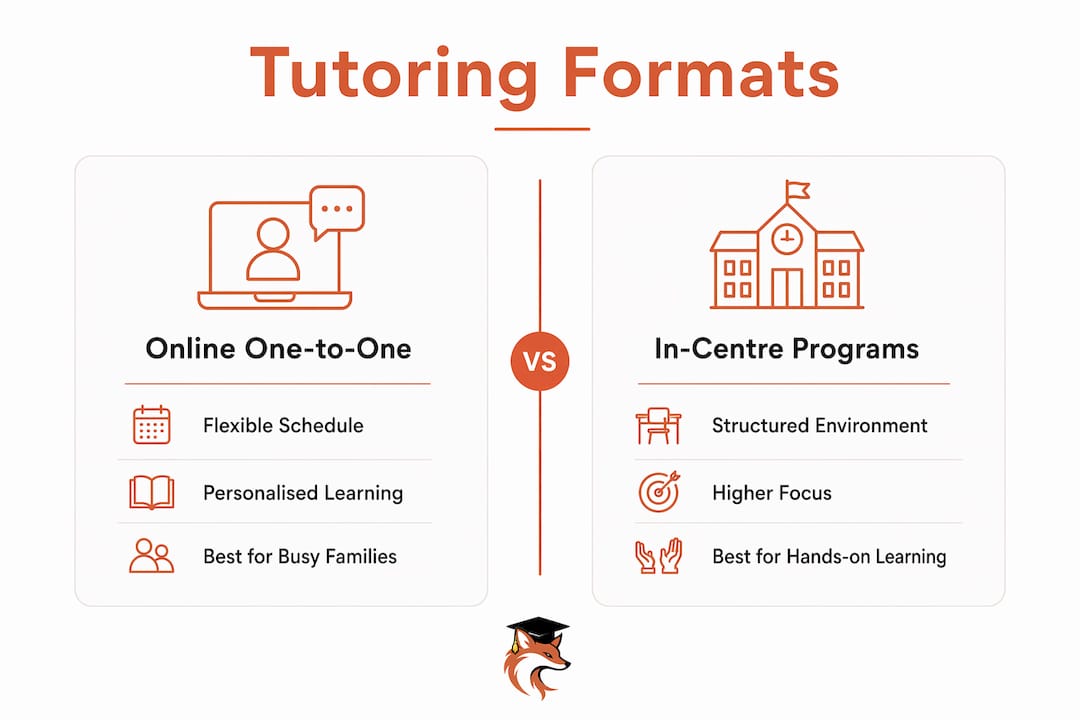
Online one-to-one is the most flexible option and the easiest to personalise. Your child works with the same tutor each week, sessions are recorded or summarised, and scheduling fits around summer travel. The comparison between online and in-person tutoring consistently shows that online delivery closes the gap with in-person results when the tutor is well-matched and the session structure is tight.

Small-group online sessions cost less per hour but dilute the tutor’s attention. They work well for previewing new material, where the student does not yet have gaps to close. For remediation, one-to-one is worth the extra cost.
In-centre programmes suit students who struggle to focus at home. The structured environment helps, but you are trading flexibility for consistency of place. Intensive bootcamps can produce rapid gains, but only when attendance is high and instruction quality is strong. A programme shorter than three weeks has not been found to generate measurable academic benefits.

Which grade levels and subjects benefit most from summer learning?
Grade band matters more than most parents realise. The right programme for a Grade 2 reader looks nothing like the right programme for a Grade 11 pre-calculus student.
- Kindergarten to Grade 2: Literacy foundations are the priority. Early-grade reading tutoring shows the strongest evidence base of any tutoring intervention, particularly when personalised to the child’s phonics and comprehension level.
- Grades 3–6: Fluency in reading and numeracy. Students who leave Grade 3 behind in reading rarely catch up without structured support. Mathematics fact fluency also solidifies here.
- Grades 7–9: Gap-closing and study skills. Middle-school students often carry compounding gaps from earlier grades. French grammar and algebraic thinking are the two subjects where summer work pays off most.
- Grades 10–12: Subject-specific advancement and entrance exam preparation. For cumulative subjects like Grade 10 mathematics, previewing the next course during summer is often more effective than trying to remediate an entire year’s gaps in eight weeks.
For students with learning differences or IEPs, ask any provider directly: Do your tutors have experience with my child’s specific profile? Can sessions be adapted in length, pacing, or format? A reputable programme will answer both questions with specifics, not generalities.
How does a reputable programme actually work?
The workflow at a well-run provider follows four clear steps.
- Diagnostic assessment. A 30–60 minute session (or a review of recent report cards and teacher notes) identifies the student’s current level and specific gaps. This step prevents wasting the first two sessions on material the child already knows.
- Personalised learning plan. The tutor maps learning objectives to the student’s pace, not the grade-level average. Materials are selected or created to match the plan.
- Weekly sessions with the same tutor. Session length typically runs 60 minutes for elementary students and 75–90 minutes for secondary. Tutor continuity matters: a student who works with three different tutors over a summer builds no relationship and retains less.
- Progress monitoring and parent reporting. Parents receive updates after each session block, not just at the end. Good providers share specific metrics: concepts mastered, areas still in progress, and recommended next steps.
A personalised learning plan built from a real diagnostic is the single biggest predictor of whether a summer programme produces lasting gains. Without it, tutors are guessing at what to teach, and families are paying for that guesswork.
Réussite A+’s enrolment and assessment process follows this exact sequence, with university-level tutors assigned based on subject match and student profile.
How many sessions does your child actually need?
Session count is where most parents either under-invest or over-schedule. Here is a practical framework:
- Remediation (closing gaps from the past year): 6–10 sessions, ideally spread over 6–10 weeks at one session per week.
- Previewing (getting ahead for September): 4–6 sessions, focused on the first units of the upcoming course.
- Exam preparation (secondary school entrance or provincial exams): 8–12 sessions with a structured mock-test component.
Structured, active learning time predicts better outcomes than hours logged passively. A 60-minute session where the tutor actively coaches, corrects, and adjusts is worth more than two hours of worksheet review. A peer-reviewed study of an 18-day summer reading programme found measurable spring-to-summer gains for Grades 2–5 when trained tutors delivered structured, small-group instruction. The key word is structured.
Weekly sessions are the right cadence for most families. A low-pressure weekly rhythm maintains momentum without burning out a child who also needs summer to be summer.
Pro Tip: Schedule sessions for Tuesday through Thursday mornings. Monday and Friday sessions have the highest cancellation rates, and morning slots produce better focus than late-afternoon ones.
What does summer tutoring cost in Canada?
Pricing varies widely by format, subject, and provider type. Here is a realistic snapshot of the Canadian market.
| Format | Typical hourly range | Notes |
|---|---|---|
| Online one-to-one (elementary) | $30–$40/hr | Lower end for newer tutors; higher for specialists |
| Online one-to-one (secondary) | $40–$60/hr | Subject complexity and tutor level drive the range |
| In-home tutoring | $50–$90/hr | Travel premium applies in most markets |
| IB / AP / entrance exam prep | $60–$90+/hr | Specialist knowledge commands a premium |
These ranges align with Canadian market data and regional pricing guides that show elementary rates starting around $25–$40 and high-school rates reaching $60 or more in major markets.
Beyond the hourly rate, ask about:
- Registration or assessment fees (common at structured programmes; typically $50–$150)
- Multi-session packages (often 5–10% less than pay-per-session)
- Group session discounts for siblings or small cohorts
Value is not the same as price. A provider who charges $65/hour and includes a diagnostic assessment, a written learning plan, and bi-weekly parent updates delivers more than one who charges $40 and shows up with a textbook.
How do you choose the right summer tutoring programme?
Start with your child’s specific goal, then work backwards through these criteria.
Decision criteria:
- Goal clarity (catch-up, preview, or exam prep)
- Tutor qualifications and subject match
- Assessment process before sessions begin
- Progress reporting frequency and format
- Scheduling flexibility and session continuity
- Language of instruction (French, English, or bilingual)
- Total cost including fees
Ten questions to ask any provider:
- How do you assess my child before the first session?
- Will my child work with the same tutor every week?
- What qualifications do your tutors hold?
- How do you build the learning plan, and can I see a sample?
- How often will I receive a progress update?
- What does a typical session look like, step by step?
- What is your cancellation and rescheduling policy?
- Do you have experience with students who have learning differences?
- What results have students at my child’s grade level typically seen?
- What happens if the tutor match is not working?
Red flags to walk away from:
- No diagnostic before sessions start
- Vague answers about tutor credentials (“experienced professionals”)
- Guaranteed grade improvements stated as a promise
- No written cancellation or refund policy
- Tutor rotation every few sessions with no explanation
How do you sign up for summer tutoring in Canada?
Timing matters. High-demand weeks in July fill quickly, and the best tutors book out by late May.
- Decide on your goal and budget before contacting any provider.
- Book an initial assessment as early as April or May for July start dates.
- Review the learning plan the provider produces from the assessment before committing to a package.
- Confirm scheduling details: session days, times, tutor name, and what happens if a session is cancelled.
- Prepare materials for the first session: recent report cards, any teacher notes, and a list of topics your child found difficult last year.
- Verify the refund policy in writing before paying any registration or package fee.
Before the first session, have your child’s most recent report card and one or two recent tests ready. A good tutor will review them before the session, not during it. You can also pair tutoring with summer learning activities at home to reinforce what is covered in sessions.
Key takeaways
Personalised online one-to-one tutoring with a university-level tutor, a diagnostic assessment, and weekly sessions is the most effective summer tutoring format for the majority of K–12 students in Canada.
| Point | Details |
|---|---|
| Choose the right format | Online one-to-one suits most families; small-group works for previewing on a tighter budget. |
| Session count by goal | Plan 6–10 sessions for remediation, 4–6 for previewing, and 8–12 for exam prep. |
| Prioritise quality over hours | Structured, active sessions with feedback outperform passive review regardless of total hours. |
| Budget realistically | Online secondary tutoring typically runs $40–$60/hr in Canada; elementary rates are $30–$40/hr. |
| Réussite A+ | Offers personalised online tutoring in French and mathematics for Quebec K–12 students, with university-level tutors and a diagnostic-first enrolment process. |
What parents often underestimate about summer tutoring
The most common mistake is treating summer tutoring as a last-minute rescue. Parents call in late July, want results by late August, and are surprised when six sessions do not undo eight months of accumulated gaps. The research is clear: programmes shorter than three weeks rarely produce lasting academic gains. What actually works is starting early, keeping sessions consistent, and giving the tutor enough time to build a real relationship with the student.
There is also a tendency to equate more hours with more progress. A child who sits through four sessions a week but is disengaged will retain less than one who has a single focused session with a tutor who knows their learning profile. Tutoring yields the highest returns when it is personalised to how a specific student learns, not when it simply adds more time on task.
The other thing worth saying plainly: summer tutoring is not only for students who are struggling. Some of the most meaningful gains come from students who are doing fine but want to get ahead. Previewing Grade 10 mathematics in August, for example, can change a student’s entire experience of September.
Réussite A+ is ready for your child this summer
Réussite A+ gives Quebec families something most providers do not: a fully personalised online tutoring programme in French and mathematics, delivered by university-level tutors who are matched to your child’s exact level and learning style. With more than 25 years of experience and a 99% client satisfaction rate across more than 3,500 students, the results are consistent.

Every student starts with a diagnostic assessment that shapes a custom learning plan. Sessions run on a schedule that fits your summer, not the other way around. Parents receive regular progress updates so there are no surprises in September. Whether your child needs to close gaps, preview the next grade, or prepare for a secondary school entrance exam, Réussite A+ has a programme for it.
Register your child today or explore the full range of online tutoring services to find the right fit for your family.
Useful sources
- Advancing Student Learning Through Voluntary Academic Summer Learning Programs (NCES) — Federal design principles for effective summer programmes, including evidence on duration, class size, and productive academic time.
- Design Principles for Accelerating Student Learning With High-Impact Tutoring (EdResearch for Action) — Research brief on what makes tutoring effective, including session frequency, group size, and personalisation.
- Effects of a summer tutoring programme on foundational skills and reading comprehension in grades K–5 (Taylor & Francis) — Peer-reviewed study showing measurable gains from an 18-day structured summer reading programme.
- Tutoring Pre K–12: Evidence and Resources (J-PAL) — Overview of tutoring research across grade levels, including virtual and in-person models.
- Breaking down the cost of private tutoring in Canada (TutorOne) — Canadian market pricing breakdown by provider type and subject.
- Summer tutoring guidance for high school math and science (Heywood Academies) — Practical session-count and cadence guidance from a regional Canadian provider.
- Summer learning loss prevention: a parent’s guide (Réussite A+) — Research-based strategies for maintaining and building skills over the summer months.
- Is tutoring worth it? Real experiences and Canadian insights (Réussite A+) — Overview of session frequency, outcomes, and what Canadian families report about tutoring value.
FAQ
How much does private tutoring cost in Canada?
Online one-to-one tutoring typically runs $40–$60 per hour for secondary students and $30–$40 for elementary, with specialist or exam-prep sessions reaching $90 or more. Many providers also charge a one-time registration or assessment fee.
Is summer tutoring better than summer school?
Summer tutoring is personalised to your child’s specific gaps and schedule, while summer school follows a fixed class curriculum. For targeted remediation or previewing, one-to-one tutoring generally produces stronger, individual results.
How many tutoring sessions does my child need over the summer?
Plan 6–10 sessions for remediation and 4–6 for previewing new material, delivered weekly. A consistent weekly cadence maintains progress without overwhelming a child who also needs rest.
Can Réussite A+ help my child prepare for secondary school entrance exams?
Yes. Réussite A+ offers structured exam preparation programmes in French and mathematics for students targeting Quebec secondary school entrance examinations, with university-level tutors and a diagnostic-first approach.
What grade levels does online summer tutoring serve?
Reputable online programmes serve students from Kindergarten through Grade 12. Réussite A+ works with both elementary and secondary students, tailoring sessions to the specific curriculum and learning needs of each grade band.