


Executive function skills are the brain processes that help you plan, start, regulate and finish goal-directed tasks. Think of them as the brain’s management system — the cognitive skills that sit behind every homework assignment, work deadline and daily routine. The Canadian Psychological Association confirms that structured supports like visual checklists and predictable routines are among the most effective first steps for strengthening these skills.
If your child is struggling, start here:
For parents and teachers: Build one consistent daily routine around a single transition (for example, a three-step after-school checklist posted on the fridge:
snack
homework
free time). Predictability reduces the cognitive load that weak executive function places on children.
For adults: Pick one external memory tool today — a paper planner, a phone calendar with alerts, or a sticky-note board — and commit to it for two weeks before adding anything else.
LD@School, a Canadian educator resource, and the Learning Disabilities Association of Ontario (LDAO) both ground their guidance in the same principle: simple, consistent supports beat complex systems. Réussite A+ has built its tutoring methodology around exactly this evidence, helping many Quebec students build the habits that underpin lasting academic success.
Table of Contents
- What are the core executive function skills?
- How does executive function develop across the lifespan?
- What are the signs of weak executive function in children and adults?
- What commonly affects executive function?
- How is executive function assessed in Canada?
- What are the most effective ways to improve executive function?
- How do you apply these strategies at home, in the classroom and at work?
- When should you seek professional help in Canada?
- How personalised tutoring supports executive function in students
- Key takeaways
- Réussite A+ personalised tutoring for students with EF challenges
- Trusted sources for further reading
- FAQ
What are the core executive function skills?
The research community generally organises executive function around three core processes, each of which shows up in recognisable ways at school, at home and at work.
Working memory
Working memory holds information in mind long enough to use it. A student listening to a three-step math instruction while writing down step one is using working memory. Research shows most people can hold roughly four chunks of information at once, which is why long verbal instructions so often fall apart for children with weak working memory.

Inhibitory control
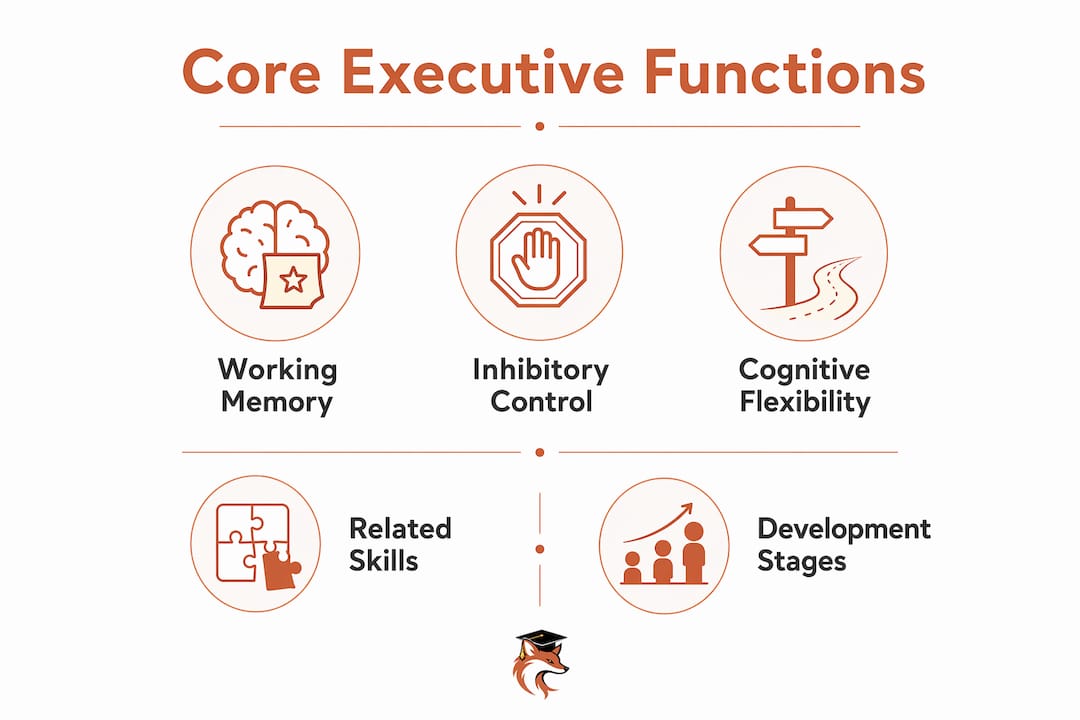
Inhibitory control is the ability to pause, filter out distractions and override an impulse. A child who raises her hand instead of shouting out an answer is exercising inhibitory control. So is an adult who resists checking social media during a meeting. Without it, attention scatters and impulsive responses take over.

Cognitive flexibility
Cognitive flexibility lets you shift between tasks, perspectives or rules without getting stuck. When a teacher changes the schedule unexpectedly and a student adapts without a meltdown, that is cognitive flexibility at work. It is also what allows a writer to abandon a paragraph that is not working and try a different approach.
Related skills that build on the core trio
Planning, organisation, task initiation, self-monitoring and emotional regulation are not separate abilities so much as applications of the core three. Planning draws on working memory and cognitive flexibility together. Task initiation requires inhibitory control to suppress avoidance. Self-monitoring asks a student to hold a goal in mind (working memory) while checking current behaviour against it. The Harvard Center on the Developing Child uses the phrase “air traffic control” to describe how these skills coordinate incoming demands — a metaphor that resonates with parents and teachers because it captures both the complexity and the real cost of a system under strain.
How does executive function develop across the lifespan?
Executive function does not arrive fully formed. It builds gradually from infancy through to the mid-twenties, with different skills coming online at different stages. Understanding this timeline helps parents and teachers set realistic expectations and avoid labelling a child as lazy when the real issue is a developmental mismatch between task demands and neurological capacity.
Infancy and preschool (birth to age 5): The foundations of inhibitory control and working memory emerge early. Toddlers begin to follow simple two-step instructions and wait briefly for a reward. Play-based activities — simple games with rules, call-and-response songs — are the natural training ground at this stage.
Elementary years (ages 6–12): This is the period of most rapid EF gains. Children develop the ability to plan multi-step tasks, shift attention between subjects and begin monitoring their own work. By Grade 3 or 4, most children can follow a four-step homework routine with moderate adult support. Classroom structure matters enormously here; LD@School notes that posted daily agendas and consistent lesson structures significantly reduce the cognitive demands on students whose EF is still developing.
Adolescence (ages 13–17): EF continues to refine, but the prefrontal cortex — the brain region most responsible for these skills — is still far from mature. Teenagers can plan complex projects but often struggle with emotional regulation under stress and with long-horizon goal-setting. This is normal, not a character flaw.
Young adulthood (ages 18–25): Full EF maturity typically arrives in the mid-twenties. Until then, supports should scaffold tasks and then fade as skills internalise — not be removed abruptly because a student has reached a certain age or grade.
Older adulthood: Processing speed and working memory capacity tend to decline gradually with age, though the rate varies widely. Regular physical activity, social engagement and sleep quality all influence how well EF holds up over time.
The key takeaway for families: difficulty with executive function in childhood often reflects a developmental mismatch, not a permanent deficit. Supports provided today build the neural pathways that will eventually allow independent performance.
What are the signs of weak executive function in children and adults?
Recognising the signs is the first step toward getting the right support. The lists below are observational guides, not diagnostic tools. If several signs appear consistently across settings, that is a signal to seek a formal assessment rather than to self-diagnose.
Signs in children (classroom and home)
- Frequently loses track of multi-step instructions and needs them repeated
- Has difficulty starting tasks independently, even when they understand what to do
- Rushes through work without checking for errors
- Struggles to transition between activities without significant prompting
- Forgets to bring home assignments or materials despite reminders
- Has emotional outbursts when routines change unexpectedly
- Cannot prioritise which homework to do first
- Produces work that is inconsistent with their apparent ability
These patterns align with the HealthyMindsBC guidance on observable EF behaviours, which highlights difficulty retaining what was just heard, following step sequences and switching focus as the most common classroom presentations.
Signs in adults (work, home and study)
- Chronically misses deadlines despite good intentions
- Starts multiple projects and finishes few
- Relies heavily on others to initiate or organise tasks
- Loses important items (keys, documents, phone) regularly
- Feels paralysed when facing a large or ambiguous task
- Has difficulty managing emotions under pressure
- Struggles to adapt when plans change at short notice
A note on overlap: These signs overlap significantly with ADHD, learning disabilities, anxiety and the effects of chronic stress. That overlap is exactly why a checklist cannot replace a proper assessment. Use these observations to guide a conversation with a professional, not to arrive at a conclusion.
What commonly affects executive function?
Executive function is sensitive to both biological and environmental factors. Several conditions and circumstances are known to weaken EF in predictable ways.
ADHD is the condition most closely associated with EF challenges. Inhibitory control, working memory and cognitive flexibility are all affected, which is why students with ADHD often struggle with task initiation, sustained attention and emotional regulation simultaneously. Medication can reduce some symptoms, but it does not teach EF skills directly — explicit strategy instruction is still needed.
Learning disabilities (such as dyslexia or dyscalculia) often co-occur with EF weaknesses, particularly in working memory and processing speed. The cognitive effort required to decode text or process numbers can leave fewer resources available for planning and self-monitoring.
Traumatic brain injury (TBI) and stroke can impair EF acutely, depending on the location and severity of injury. Frontal lobe damage in particular tends to affect planning, inhibition and cognitive flexibility. Recovery is possible but often requires structured rehabilitation.
Dementia progressively erodes EF, typically beginning with planning and cognitive flexibility before affecting more basic functions. Early-stage supports focus on externalising memory and maintaining predictable routines.
Sleep deprivation has an immediate and measurable impact on working memory and inhibitory control. Even one night of poor sleep reduces a child’s ability to regulate attention and emotion the following day.
Chronic stress and adverse childhood experiences (ACEs) are particularly important in the Canadian school context. Research from the University of Toronto shows that adversity and unreliable early environments impair inhibitory control and emotion regulation. Trauma-informed supports — validation, predictable routines and trustworthy relationships — are not optional extras for affected students; they are prerequisites for EF strategy uptake.
Mood disorders and anxiety consume working memory and cognitive flexibility, leaving less capacity for planning and task initiation. A student who appears disorganised may be managing significant internal distress.
Co-occurring conditions are the rule rather than the exception. A child with ADHD often also has a learning disability and elevated anxiety. Assessment matters because the combination shapes the intervention.
How is executive function assessed in Canada?
There is a meaningful difference between a quick screening and a full neuropsychological assessment. Knowing which you need saves time and money.
| Assessment type | Purpose | Who administers | Typical turnaround | What it answers |
|---|---|---|---|---|
| Parent/teacher checklist (e.g., BRIEF-2) | Flags EF concerns across settings | Teacher, parent, or school psychologist | 1–2 weeks | “Does this child show EF difficulties at home and school?” |
| School team review | Identifies need for in-school accommodations | Resource teacher, school psychologist | 2–6 weeks | “What classroom supports does this student need now?” |
| Paediatrician or GP assessment | Rules out medical causes; initiates referrals | Paediatrician or family doctor | Varies by wait time | “Is there a medical explanation? Who should assess further?” |
| Occupational therapy (OT) assessment | Evaluates daily living skills and sensory-motor contributions to EF | Registered occupational therapist | 4–8 weeks (private); longer publicly | “How do EF challenges affect self-care, school tasks and routines?” |
| Neuropsychological assessment | Comprehensive cognitive profile including EF subtests | Registered psychologist or neuropsychologist | 6 weeks privately; 1–2 years publicly | “What is the full cognitive profile and what are the specific EF deficits?” |
Practical Canadian pathways: Start with your child’s school team or family doctor. In most provinces, the school psychologist can administer the BRIEF-2 (Behaviour Rating Inventory of Executive Function) at no cost and use the results to put accommodations in place quickly. For a comprehensive diagnosis, a referral to a paediatrician or a private neuropsychologist is typically the faster route. Publicly funded neuropsychological assessments through children’s hospitals or regional health authorities exist in most provinces but carry significant wait times. Private assessments in Canada generally range from several hundred to several thousand dollars depending on the scope and provider.
Pro Tip: Ask the school team for a BRIEF-2 before pursuing a private assessment. The results often provide enough information to begin targeted supports immediately, and they give a private assessor useful baseline data if a full evaluation is later needed.
What are the most effective ways to improve executive function?
The evidence is clear: executive function responds to practice, structure and explicit instruction. There is no single intervention that works for everyone, but several strategies have strong support across age groups.
The core toolkit
Structured behavioural reinforcement means consistently rewarding the use of a strategy (checking a checklist, using a timer) rather than just the outcome. Praise the process, not just the grade.
Visual supports externalise memory and reduce the cognitive load of tracking multiple demands. Checklists, visual timers (like Time Timer), posted agendas and colour-coded planners all serve this function. The Canadian Psychological Association identifies visual supports as among the most effective interventions for students with EF challenges.
Predictable routines are more powerful than complex organisational systems. A student who knows exactly what happens after the bell rings uses far less cognitive energy than one who must figure it out each time. Frequent protocol changes are exhausting for students with EF deficits.
Task breakdown and frontloading address the most common barrier: getting started. HealthyMindsBC recommends providing an explicit checklist or a visual “first-then” plan before a large task begins. The goal is to remove the ambiguity that triggers avoidance. Breaking a project into chunks also respects the limits of working memory — most people can hold roughly four chunks at once, so a ten-step project needs to be presented in stages.
Goal-setting and self-monitoring teach students to track their own progress. Simple tools like a daily “did I do it?” checklist or a weekly reflection prompt build the metacognitive habits that underpin independent learning.
Do this today
For parents and teachers:
- Post a three-step after-school routine in a visible spot and review it with your child for five minutes tonight
- Replace verbal reminders with a written checklist for one recurring task (packing a school bag, completing homework)
- Use a visual timer for homework blocks to make time concrete
For adults:
- Choose one task you have been avoiding and write down only the first two physical actions needed to start it
- Set a single calendar alert for tomorrow’s most important commitment
- Spend two minutes at the end of each workday reviewing what was completed and what carries forward
Realistic expectations: EF skills develop slowly. Research from LD@School emphasises that supports should scaffold tasks and then fade as skills internalise — a process that typically takes weeks to months, not days. Consistency matters more than intensity. The LDAO recommends embedding strategy instruction in curriculum rather than treating it as a separate add-on, because skills learned in context transfer more reliably.
How do you apply these strategies at home, in the classroom and at work?
Knowing the strategies is one thing. Translating them into a Tuesday morning is another. Here are setting-specific templates you can adapt immediately.
At home
- Create a visual schedule for the after-school block. Use pictures for younger children, written steps for older ones. Post it at eye level and review it together for the first two weeks until it becomes automatic.
- Set up a homework station with everything already in place. Pencils, eraser, ruler, and a checklist of what needs to be done. Reducing the setup friction lowers the barrier to starting. A 15-minute homework organisation routine is enough to establish this habit.
- Use a “first-then” board for resistant children. “First: read for 20 minutes. Then: screen time.” This makes the sequence visible and reduces negotiation.
- Script the transition, not just the task. Instead of “go do your homework,” try “it’s 4:30, which means it’s homework time — what’s the first thing on your list?” The question prompts self-monitoring rather than dependence on adult direction.
- Celebrate strategy use, not just results. When your child uses the checklist without being reminded, name it: “You checked your list yourself — that’s exactly the habit we’re building.”
In the classroom
- Post the daily agenda visibly and refer to it at each transition. This single habit reduces anxiety and EF load for the whole class, not just students with identified challenges. LD@School identifies posted agendas as one of the highest-impact, lowest-cost classroom supports available.
- Give advance transition warnings. “In five minutes we’re moving to math” gives students with cognitive flexibility challenges time to mentally shift, rather than being caught off guard.
- Embed EF strategy instruction in subject content. Teach students to use a graphic organiser during a writing lesson, not in a separate “study skills” class. The LDAO is clear that strategies learned in context transfer more reliably than those taught in isolation.
- Use trauma-informed framing for students affected by adversity. Validate the emotional experience before redirecting to the task. “I can see this feels hard. Let’s look at step one together.” Predictable routines and trustworthy relationships are the foundation on which EF strategies can actually take hold.
- Provide project planners and exemplars for every multi-step assignment. Do not assume students know how to break down a task. Show them the first two steps explicitly before asking them to continue independently.
In the adult workplace
- Externalise your memory completely. Use a single trusted system — Microsoft Outlook tasks, a paper notebook, or a dedicated app — and capture every commitment the moment it is made. The goal is to free working memory for thinking, not tracking.
- Chunk large projects into calendar blocks. Assign specific blocks of time to specific sub-tasks, not just to “work on project X.” Ambiguity is the enemy of initiation.
- Use a “shutdown ritual” at the end of each workday. Review open tasks, set tomorrow’s top priority, and close all tabs. This externalises the mental list that otherwise runs in the background and disrupts sleep.
- Negotiate environmental adjustments where possible. Noise-cancelling headphones, a dedicated focus block in the calendar, or a standing agreement with colleagues about interruption-free hours are all reasonable accommodations that reduce EF load without requiring a formal diagnosis.
When should you seek professional help in Canada?
Strategies help most people, but persistent or severe EF challenges usually need professional input. The table below outlines who does what and what to expect from each.
| Professional | Typical contribution | Approximate timeline |
|---|---|---|
| Family doctor / paediatrician | Rules out medical causes; refers for ADHD assessment or neuropsychological testing | 1–4 weeks for initial appointment |
| School psychologist | Administers BRIEF-2 and cognitive screens; recommends in-school accommodations | 2–8 weeks depending on school board |
| Registered psychologist / neuropsychologist | Full cognitive and EF assessment; diagnosis; detailed recommendations | 6 weeks privately; 1–2 years publicly |
| Occupational therapist (OT) | Targets daily living skills, sensory processing and practical EF routines | 4–12 weeks privately |
| Educational psychologist | Bridges assessment findings and classroom practice; supports IEP development | Varies by school board |
| Special education teacher | Implements accommodations and modified instruction within the classroom | Ongoing, school-based |
| Tutor or academic coach | Practises EF strategies in the context of real schoolwork; builds habits | Ongoing; gains typically visible in 4–8 weeks |
On medication: For children and adults with ADHD, medication prescribed by a paediatrician or psychiatrist can reduce the severity of EF symptoms, particularly inattention and impulsivity. It is not a substitute for skill-building. The most effective outcomes typically combine medication with explicit EF strategy instruction.
Questions to ask any professional:
- What specific EF skills are you assessing, and how?
- What will the report recommend in practical terms for school or work?
- How will we know if the intervention is working?
- What publicly funded options are available for follow-up support?
Publicly funded vs. private in Canada: School-based supports (resource teachers, school psychologists, special education) are publicly funded in every province. Neuropsychological assessments through children’s hospitals or regional health authorities are covered but carry long wait times. Private assessments and private OT are not covered by provincial health plans in most provinces, though some extended health benefits plans include partial coverage. Families in Quebec can access some services through the CLSC network, though availability varies by region.
How personalised tutoring supports executive function in students
Personalised tutoring does something that large-classroom instruction struggles to replicate: it creates a consistent, low-pressure environment where EF strategies can be practised repeatedly on real academic content. NILD Canada notes that tutors can scaffold self-monitoring and goal-directed persistence in ways that are simply harder to deliver when one teacher is managing 25 students.
The mechanism is straightforward. A tutor working one-on-one can model the use of a graphic organiser during a French writing task, prompt the student to check their checklist before submitting, and adjust the level of scaffolding session by session as the student internalises the habit. This is what NILD Canada describes as continuous progress monitoring tied to individualised learning plans — the same methodology Réussite A+ uses across its tutoring programmes.
In practice, students working with Réussite A+ tutors on math and French are simultaneously practising task initiation (starting the problem set without prompting), working memory (holding a multi-step procedure in mind), and self-monitoring (checking answers before moving on). These are not separate “EF exercises” — they are the natural demands of academic work, made manageable through explicit scaffolding and consistent feedback. Parents typically report that within four to eight weeks of regular sessions, their child begins applying the same habits independently at home: checking their own work, using their planner without reminders, and starting homework with less friction.
The LDAO is explicit that EF instruction works best when embedded in curriculum rather than delivered as a standalone programme. Réussite A+’s approach aligns directly with this: every session in French or math is also a session in the cognitive habits that make academic success possible. For students preparing for Quebec secondary school entrance exams, where time management and sustained attention are tested as much as content knowledge, this dual focus is particularly valuable. You can explore how online tutoring builds exam-ready skills for more on how this plays out in practice.
Key takeaways
Executive function skills are teachable, and the most effective supports are simpler than most families expect: consistent routines, visual tools and explicit strategy practice embedded in real tasks.
| Point | Details |
|---|---|
| Start with one routine | A single predictable daily routine reduces EF load more reliably than any complex organisational system. |
| Visual tools externalise memory | Checklists, timers and posted agendas free cognitive capacity for actual learning and work. |
| EF matures in the mid-twenties | Difficulty in childhood often reflects a developmental mismatch, not a permanent deficit or lack of effort. |
| Seek assessment when red flags persist | A school-based BRIEF-2 screening is a low-cost first step before pursuing private neuropsychological testing. |
| Réussite A+ embeds EF practice in tutoring | Personalised sessions in French and math simultaneously build task initiation, working memory and self-monitoring habits. |
What Réussite A+ sees in the first weeks of tutoring
When a student arrives at Réussite A+ struggling with organisation or task initiation, the first thing we notice is rarely a gap in knowledge. More often, it is a gap in process: the student does not know how to start, how to check their own work, or how to manage a 45-minute homework block without losing focus. Our tutors address this directly from the first session, using graphic organisers, visual timers and step-by-step checklists embedded in the actual French or math content the student is working on. By weeks four to eight, most families report a shift: the child is using the checklist without being asked, starting homework with less resistance, and carrying the habit into subjects their tutor does not even cover. That transfer is the real goal. It tells us the strategy has moved from something the tutor provides to something the student owns.
Réussite A+ personalised tutoring for students with EF challenges
Students who struggle with planning, task initiation or self-monitoring often need more than a good teacher. They need consistent, individualised practice in a low-stakes environment where strategies can be tried, adjusted and repeated until they stick. That is exactly what Réussite A+ provides.

Every student at Réussite A+ receives a personalised learning plan built around their specific strengths and challenges, delivered by a university-level tutor selected for both academic excellence and teaching ability. Sessions in French and math are structured to practise EF habits — using checklists, breaking tasks into steps, monitoring progress — as a natural part of the academic work, not as a separate programme. Progress is tracked continuously, and plans are adjusted as the student develops. With more than 25 years of experience and a 99% client satisfaction rate, Réussite A+ has helped more than 3,500 Quebec students build the skills they need to succeed at school and beyond.
Whether your child needs to catch up, prepare for a secondary school entrance exam, or simply build more reliable study habits, Réussite A+ offers flexible online scheduling and affordable pricing to fit your family’s needs. Register for tutoring or explore the full range of online tutoring and homework support to find the right fit for your child.
Trusted sources for further reading
These resources are the most reliable starting points for parents, teachers and adults who want to go deeper on executive function assessment, strategies and Canadian supports.
Harvard Center on the Developing Child — A Guide to Executive Function: The clearest plain-language overview of what EF is, why it matters and how it develops. Excellent for sharing with family members who are new to the topic.
Canadian Psychological Association — Psychology Works Fact Sheet: Executive Functioning: A concise, clinician-reviewed summary of EF challenges and evidence-based interventions. Authoritative and Canadian.
LD@School — Understanding and Supporting Executive Function: The most practical Canadian classroom resource available. Covers scaffolding, routines, visual supports and the developmental timeline in teacher-friendly language.
LDAO — Improving Executive Function Skills: Focused on curriculum-embedded instruction and strategy teaching. Useful for both teachers and parents supporting students with learning disabilities.
HealthyMindsBC — Executive Function Guidance: A practical provincial guide covering observable signs, frontloading strategies and visual supports. Applicable across Canada despite its BC origin.
NILD Canada — Empowering Students with Executive Functions: Focused on how tutoring and individualised instruction can target EF skills directly. Useful for families considering academic support.
NIH/PMC — Executive Functions (Miyake et al.): The peer-reviewed academic foundation for the three-component model of EF (working memory, inhibitory control, cognitive flexibility). For readers who want the science behind the strategies.
University of Toronto — Executive Functions in the Elementary Classroom: Canadian academic research on trauma-informed EF supports and the role of classroom environment. Particularly relevant for teachers working with students affected by adversity.
Réussite A+ — Strategies to Help Struggling Students Succeed: A practical companion resource covering classroom and home strategies that complement the EF supports described in this article.
FAQ
What are the core executive function skills?
The three core executive function skills are working memory, inhibitory control and cognitive flexibility. Related skills — including planning, organisation, task initiation, self-monitoring and emotional regulation — build directly on this core trio.
What are the signs of poor executive function?
Common signs include difficulty starting or prioritising tasks, frequently forgetting instructions, trouble following multi-step sequences, emotional outbursts when routines change, and chronic disorganisation at home or school. These signs appear across settings and persist over time when EF is genuinely weak.
How do you improve poor executive function?
The most effective approaches combine visual supports (checklists, timers), predictable routines, task breakdown and explicit strategy instruction embedded in real academic or work tasks. Consistent practice over weeks to months is needed for strategies to internalise.
How many executive function skills are there?
Definitions vary across researchers and frameworks. Most models identify three core skills — working memory, inhibitory control and cognitive flexibility — with several related or higher-order skills built on top of them, including planning, organisation, task initiation, self-monitoring and emotional regulation.
Can tutoring help with executive function challenges?
Yes. Personalised tutoring creates a consistent environment for practising EF strategies — such as using checklists, breaking tasks into steps and monitoring progress — embedded in real academic content. Réussite A+ structures every French and math session to build these habits alongside subject knowledge.