




Three actions move the needle faster than anything else when you want to help your Grade 5 child improve: set up a simple daily planner, build short focused study sessions into the afternoon routine, and book a check-in with the teacher. Most families see a noticeable shift in organisation and confidence shortly after starting all three consistently.
Start this week — your quick checklist:
- Planner in the backpack today. A small agenda or notebook where your child writes down every assignment, test date, and project deadline. A short daily review at the end of each school day is all it takes.
- One 15–20 minute study block after school. Pick a consistent time, remove screens, and focus on one subject. Short, regular sessions beat marathon cramming for retention every time.
- Email or call the teacher this week. Ask for the class evaluation plan (in Quebec, this is the Normes et modalités document) and one specific area where your child could improve right now.
These three steps cost nothing and take less than an afternoon to put in place. Provincial guidance across Canada, including Quebec’s competency-based evaluation system and Ontario’s Growing Success framework, consistently shows that organisation and work habits are assessed alongside subject marks — so improving them lifts grades even before deep content gains kick in. Réussite A+ has seen this pattern among many students: those whose home routines get structured first tend to improve fastest.
Table of Contents
- 1. Top practical strategies that actually move a Grade 5 student’s grades
- 2. A sample daily and weekly study schedule for Grade 5
- 3. How teachers in Canada grade Grade 5 work — and what they actually assess
- 4. When should you get extra help, and what does it cost?
- 5. Practical at-home activities for reading and math in Grade 5
- Key takeaways
- What actually works — and what most parents overlook
- Réussite A+ offers personalised Grade 5 tutoring across Quebec
- Useful sources and further reading
- FAQ
1. Top practical strategies that actually move a Grade 5 student’s grades
The strategies below are ranked by impact. Work through them in order rather than trying everything at once.
1. Set up a planner and use it daily.
Your child writes down every assignment and test the moment it is assigned. Review it together each evening — this takes two minutes and prevents the Sunday-night panic. A parent’s guide to study habits for elementary students recommends treating the planner as the single most important school supply.

2. Participate actively in class and take brief notes.
Encourage your child to raise their hand at least once per lesson and jot down key words or diagrams. Active participation signals engagement to the teacher and reinforces memory at the same time.
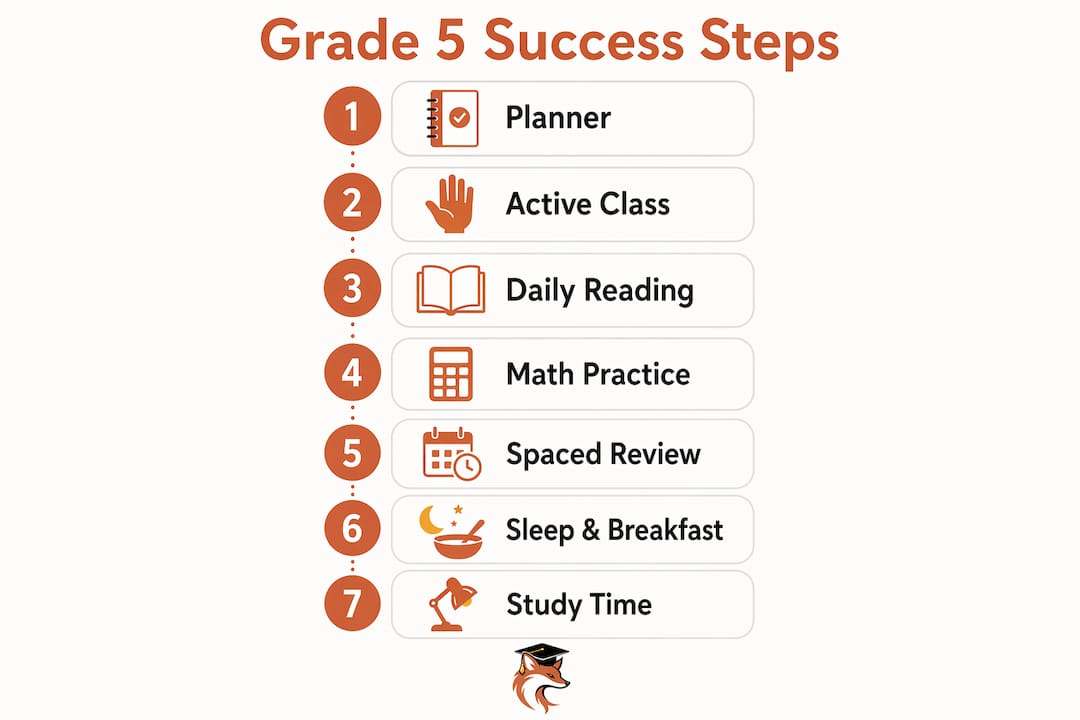
3. Build a daily reading habit of 15–20 minutes.
Reading anything — a novel, a magazine, a graphic novel — builds vocabulary, comprehension, and writing fluency. At this stage, reading for learning accelerates, so the habit matters more than the specific book.
4. Practice math for 10–15 minutes every day.
Short, targeted math practice is more effective than one long weekly session. Focus on the current unit, then circle back to one earlier topic each week for spaced review.

5. Use spaced review instead of cramming.
Spaced practice consistently outperforms last-minute study for long-term retention. Reviewing material two days after learning it, then again a week later, locks it in far more reliably.
6. Prioritise sleep and a decent breakfast.
A tired, hungry Grade 5 student cannot focus, no matter how good the study plan is. Most children of this age need sufficient sleep, typically around nine to eleven hours, to support focus and learning. A protein-rich breakfast — eggs, yogurt, peanut butter on toast — sustains concentration through the morning.
7. Protect study time without cutting extracurriculars.
Sports, music, and social activities matter for motivation and wellbeing. The key is scheduling: block homework time before the activity on busy days, not after, when energy is lowest. Even 20 focused minutes before hockey practice beats 45 distracted minutes at 9 PM.
Pro Tip: Ontario’s Growing Success framework advises parents to ask teachers to share the success criteria for upcoming tasks — the specific qualities of a strong response. When your child knows exactly what “good” looks like before starting an assignment, the work improves noticeably. Ask the teacher: “What does a Level 3 or 4 response look like for this project?”
2. A sample daily and weekly study schedule for Grade 5
Consistency matters more than duration. A 20-minute session every day outperforms a two-hour session once a week, and micro-learning — brief, focused practice with spaced repetition — is one of the most practical techniques for busy families.
Sample weekday schedule
| Time | Activity | Duration |
|---|---|---|
| 3:30–3:45 PM | Snack + decompress (no screens) | 15 min |
| 3:45–4:00 PM | Homework (current assignments) | 20 min |
| 4:00–4:10 PM | Short break — move around | 5 min |
| 4:10–4:25 PM | Targeted study (math or French) | 15 min |
| 4:25–4:30 PM | Review planner, pack bag for tomorrow | 5 min |
| 8:00–8:15 PM | Independent reading before bed | 20 min |
Weekly rhythm
- Monday–Thursday: Follow the weekday schedule above.
- Friday: Lighter review only — 10 minutes going over the week’s key concepts.
- Saturday or Sunday (one session): 30–40 minute review of the week’s material, plus a look ahead at upcoming tests or projects.
- One parent check-in per week: Five minutes reviewing the planner together and noting any upcoming evaluation dates.
Adapting the schedule:
- Limited quiet space at home: A library visit once or twice a week works well. Many Quebec public libraries have quiet study areas open after school.
- Younger Grade 5 children (age 9–10): Keep sessions to 15 minutes with a movement break between each block.
- Older or more independent Grade 5 children (age 11): They can manage a 25–30 minute block before a break, and benefit from setting their own timer.
3. How teachers in Canada grade Grade 5 work — and what they actually assess
Understanding how your child is evaluated is one of the most underused tools parents have. In Quebec, Grade 5 assessment is competency-based: teachers evaluate not just what a child knows, but how well they apply knowledge in real tasks called situations d’apprentissage et d’évaluation (SAEs).
Quebec’s evaluation year is typically divided into three reporting stages. A common weighting structure, as seen in school Normes et modalités documents for 2025–2026, is approximately 20% for Stage 1, 20% for Stage 2, and 60% for Stage 3. That final stage carries the most weight, so a slow start is recoverable — but a weak finish is not.
Subject competencies are also broken down within each area. In some French programmes, for example, reading accounts for 40% of the French mark, writing for 40%, and oral communication for 20%, as outlined in competency weighting documents. Knowing this helps you direct home practice toward the highest-value skills. For a deeper explanation of how to read your child’s report card, the Réussite A+ guide on Quebec primary report cards is a practical starting point.
Beyond subject marks, learning skills and work habits — responsibility, organisation, independent work, collaboration, initiative, and self-regulation — are assessed separately across Canadian provinces and appear on every report card. Improving these habits often produces grade gains before deep content mastery catches up.
Checklist: what to request from your child’s school
- The class Normes et modalités document (Quebec) or equivalent evaluation plan
- Stage or term dates and their percentage weightings
- Competency breakdowns by subject
- Criteria for each competency level (what Level 3 looks like versus Level 4)
- Scheduled communication points (parent-teacher meetings, progress reports)
Questions to ask the teacher at your next meeting:
- “Which competency is my child finding most difficult right now?”
- “What does a strong response look like for the current unit?”
- “Are there specific learning skills on the report card I should focus on at home?”
- “When is the next major evaluation, and what will it cover?”
Pro Tip: Ask the teacher for the success criteria before a major project or test, not after. Teachers who use co-constructed criteria — where students help define what “good” looks like — produce stronger results, as Ontario’s Growing Success framework documents. Getting that criteria sheet early gives your child a concrete target.
4. When should you get extra help, and what does it cost?
Most Grade 5 students hit a rough patch at some point. The question is whether it is a temporary dip or a signal that something more structured is needed.
Step-by-step decision guide:
- Weeks 1–2: A new unit feels hard. Normal. Keep the daily routine, review the planner, and check in with the teacher.
- Weeks 3–4: Homework takes much longer than expected, your child is frustrated most evenings, or a test comes back significantly below their usual level. Time to contact the teacher and ask for specific feedback.
- Weeks 4–6: Patterns persist across more than one subject, or you notice behaviour changes (avoidance, anxiety, loss of motivation). Consider requesting a meeting to discuss in-school support options.
- Beyond 6 weeks: Repeated low results, missed learning outcomes, or a child who says they “just don’t get it” despite consistent effort at home. This is when targeted tutoring typically produces the fastest improvement.
Signs that suggest a child may need extra support are covered in detail in the Réussite A+ guide on recognising when a child needs help.
School-based options to try first:
- Request time with the resource teacher or learning support specialist.
- Ask for an in-class differentiation plan or modified task support.
- Many Quebec schools offer brief after-school homework help clubs — ask the office.
What quality tutoring looks like:
A good tutoring programme starts with an assessment of where the gaps actually are, not just the subject that feels hard. It then builds a personalised plan, tracks progress across sessions, and adjusts as the child improves. Weekly sessions of about an hour to an hour and a half frequently serve as a starting point for Grade 5 students, with adjustments as needed before major evaluations.
Timeline to expect:
- School support alone: Visible improvement in organisation and confidence within 4–6 weeks; content gains typically show on the next report card.
- Weekly tutoring: Many families notice a shift in attitude and homework completion relatively quickly, and measurable grade improvement usually follows after a period of consistent tutoring.
5. Practical at-home activities for reading and math in Grade 5
The best at-home practice does not feel like extra school. It feels like a conversation, a game, or a useful task.
Reading comprehension activities:
- Daily summarising: After your child reads for 15 minutes, ask them to tell you what happened in three sentences. This builds the summarising skill directly assessed in Quebec French competencies.
- Prediction game: Pause mid-chapter and ask, “What do you think happens next, and why?” Prediction activates inference skills without a worksheet in sight.
- Book talk prompts: “Who was the most interesting character and what would you have done differently?” These open-ended questions build the oral communication competency.
Grade 5 math activities:
- Real-world word problems: Grocery shopping is a natural math lesson. Ask your child to estimate the total before checkout, then check. Estimation and mental math are core Grade 5 skills.
- Measurement tasks: Have them measure a room, calculate the perimeter, or double a recipe. These tasks connect abstract concepts to real situations.
- Reasoning out loud: When your child solves a problem, ask them to explain their steps. Verbalising a process deepens understanding and mirrors how Quebec math competencies are assessed.
Technology and apps:
For short, guided digital practice, Réussite A+ maintains a curated list of online revision resources for French and math that are age-appropriate for elementary students. Limit app time to 10–15 minutes per session and pair it with a brief conversation about what your child practised.
Pro Tip: Chores are a low-pressure learning opportunity. Sorting laundry by colour and size builds classification thinking. Cooking involves fractions, measurement, and sequencing. These connections are not forced — they are genuinely how mathematical reasoning develops in context.
Key takeaways
Consistent daily organisation, short focused study sessions, and open communication with the teacher are the three changes that produce the fastest grade improvement for Grade 5 students.
| Point | Details |
|---|---|
| Start with the planner | A daily agenda reviewed each evening prevents missed deadlines and builds the organisation habit teachers assess. |
| Short sessions beat long ones | Daily 15–20 minute study blocks with breaks improve retention far better than infrequent marathon sessions. |
| Understand Quebec grading | Stage 3 typically carries about 60% of the year’s weight, while Stages 1 and 2 each account for about 20%, as shown in common Quebec school evaluation plans. A slow start is recoverable if effort increases before the final term. |
| Know when to escalate | If struggles persist beyond 4–6 weeks despite consistent home effort, school support or weekly tutoring is the logical next step. |
| Réussite A+ for personalised support | With 25+ years of experience and a 99% satisfaction rate, Réussite A+ offers tailored online tutoring in French and math for Quebec Grade 5 students. |
What actually works — and what most parents overlook
The conventional advice for helping a Grade 5 child improve focuses almost entirely on content: more math practice, more reading, more review. That is not wrong, but it misses the bigger lever.
Across Canadian provinces, report cards assess learning skills and work habits alongside subject marks. Responsibility, organisation, and independent work are graded separately, and they influence how teachers perceive a student’s overall progress. A child who hands in work on time, comes prepared, and asks for help when stuck will almost always receive more descriptive feedback from their teacher — and that feedback is what drives real improvement.
The parents who see the fastest results are not the ones who hire a tutor on day one. They are the ones who spend the first two weeks fixing the routine: planner in use, consistent study time, screens off during homework, and one honest conversation with the teacher. The content gaps close much faster once the structure is in place.
Stress is the other underestimated factor. A child who is anxious about grades tends to avoid the work, which widens the gap. Short breaks and manageable study blocks reduce that anxiety more effectively than pressure to study longer. Celebrate small wins — a completed planner page, a problem solved independently, a paragraph written without prompting. These moments build the confidence that makes the harder work feel possible.
Réussite A+ offers personalised Grade 5 tutoring across Quebec
For families who have tried the home routines and still see their child struggling, personalised tutoring is the clearest path forward. Réussite A+ provides online homework help and tutoring in French and mathematics for elementary students across Quebec, with every session built around that child’s specific gaps, learning pace, and goals.

Every tutor is selected at the university level for both academic excellence and teaching ability. Sessions are flexible, scheduled online, and supported by a customised learning plan that is adjusted as your child progresses. With more than 25 years of educational experience, over 3,500 students helped, and a 99% client satisfaction rate, Réussite A+ has a track record that speaks clearly. Whether your child needs targeted review before Stage 3 evaluations, confidence-building in math, or preparation for secondary school entrance exams, the programme is built to fit. To get started, visit the registration page and book your child’s first session.
Useful sources and further reading
These resources are reliable, Canada-focused, and free to access.
Quebec-specific evaluation and curriculum:
- Normes et modalités, Dollard-des-Ormeaux (2025–2026) — a real example of a Grade 5 evaluation plan showing stage dates and weightings. Bring this to your teacher meeting as a reference.
- Normes et modalités, La Petite-Patrie — shows subject competency breakdowns including reading, writing, and oral communication percentages.
- Quebec elementary programme explained (Réussite A+) — plain-language overview of how Quebec primary evaluation works, written for parents.
- Understanding your child’s Quebec primary report card (Réussite A+) — step-by-step guide to reading competency marks and learning skills on the bulletin.
Study habits and routines:
- Kids Help Phone: study habits guide — practical, student-friendly advice on scheduling, breaks, and managing study stress.
- Study habits for elementary students: A parent’s guide (Réussite A+) — covers homework routines, planner setup, and how to structure the after-school block.
Provincial curriculum context:
- Grade 5 overview, Manitoba Education — a useful reference for parents who want to see what a typical Grade 5 curriculum covers across subject areas.
- Growing Success, Ontario Ministry of Education — the foundational document on assessment for learning, learning skills, and descriptive feedback in Ontario schools.
Online practice resources:
- Top 5 online resources for French and math revision (Réussite A+) — curated, age-appropriate tools for short daily practice sessions.
- Subjects that most often need extra support: a parent’s guide (Réussite A+) — helps you identify which subjects to prioritise and when to consider tutoring.
FAQ
How do you help a Grade 5 child get better grades?
Start with three changes: a daily planner, a consistent 15–20 minute study block after school, and a teacher check-in to understand where the gaps are. Most families see improved organisation and confidence within 2–6 weeks.
Is Grade 5 hard for most kids?
Grade 5 is a genuine step up — reading becomes more analytical, math introduces fractions and multi-step problems, and written work grows longer. It is manageable with consistent daily practice, but many children benefit from extra support in at least one subject.
What grade level should a 5th grader be working at?
In Canada, Grade 5 students are typically 10–11 years old and working at the end of Cycle Two in Quebec’s competency-based programme. Provincially, Grade 5 sits in the middle of elementary school, bridging foundational skills and the more independent learning expected in secondary school.
How do you become a top student in elementary school?
Consistent daily habits matter more than raw ability: using a planner, participating in class, reviewing material regularly rather than cramming, and asking for help early. Learning skills like organisation and responsibility are assessed on Canadian report cards alongside subject marks, so building those habits pays off directly.
When should a Grade 5 parent consider tutoring?
If your child’s struggles persist across more than 4–6 weeks despite a consistent home routine and teacher communication, targeted tutoring is a practical next step. Réussite A+ offers personalised online sessions in French and math for Quebec elementary students, with progress monitoring built into every programme.