




Tutoring is worth it for most Canadians who approach it with the right expectations. The hourly income beats most gig work, the schedule is genuinely flexible, and the personal satisfaction of watching a student click with a concept is hard to replicate elsewhere. That said, income is not automatic, clients require active effort to find and keep, and the stress of inconsistent bookings catches many new tutors off guard. Whether tutoring is right for you depends on your subject expertise, your tolerance for self-marketing, and how realistically you size up the Canadian market you are entering.
Quick snapshot: tutoring as a side income or career in Canada
- Strong earning potential: Tutors in academic subjects typically earn competitive hourly rates on platforms, with independent specialists earning higher fees
- Flexible but not passive: You set your own hours, but filling those hours takes real marketing effort
- Satisfaction is real: Helping a student finally grasp a concept they have struggled with for months is consistently cited as the top non-financial reward
- Income scales with expertise: The more specialized your subject, the more you can charge and the less competition you face
- Challenges exist: Client reliability, late payments, and platform commission cuts are the most common frustrations
- Legal obligations apply: Self-employed tutors in Canada must declare income and may need to register for GST/HST
Is tutoring worth it financially? Earnings and rates for Canadian tutors
The earning range in Canadian tutoring is wide, and where you land depends heavily on your credentials and whether you work through a platform or independently.
Platform-based tutors typically earn competitive hourly rates but pay a commission to the platform. Independent tutors keep their full fee and commonly charge higher rates for general academic subjects. Professionals with licensed credentials, such as accountants offering CPA exam prep or nurses tutoring nursing students, command premium rates.
A realistic side income scenario involves multiple regular students paying moderate hourly rates, resulting in a meaningful monthly income for a modest weekly time commitment.
| Scenario | Hourly Rate | Monthly Hours | Est. Monthly Income |
|---|---|---|---|
| Platform tutor (general subjects) | $25–$60 | 20–30 | $500–$1,800 |
| Independent tutor (academic subjects) | $40–$100 | 20–30 | $800–$3,000 |
| Specialist / exam prep (independent) | $75–$150 | 15–25 | $1,125–$3,750 |
| Licensed professional tutor | $75–$150 | 10–20 | $750–$3,000 |
Startup and ongoing costs to factor in:
- Materials and workbooks: typically low, often under $100 to start
- Marketing: a basic website, social media presence, or local advertising
- Platform registration fees: vary by platform; some are free to join
- Home office setup for online sessions: webcam, reliable internet, a whiteboard app
- Professional development: optional but valuable for specialized subjects
Tax and legal considerations for Canadian tutors:
- All tutoring income must be declared as self-employment income on your Canadian tax return
- If your gross income exceeds $30,000 in a calendar year, you are required to register for a GST/HST account
- You can deduct legitimate business expenses, including a portion of your internet bill, materials, and marketing costs
- Keeping clean records from day one saves significant stress at tax time
Setting your rate is one of the most consequential decisions you will make. Too low and you signal poor quality; too high before you have reviews and you struggle to attract your first clients. Research what tutors with similar backgrounds charge in your region, start near the midpoint, and raise your rate by $10–$15 once you have five to ten positive reviews.
What tutors actually experience: stress, satisfaction, and scheduling realities
The personal side of tutoring is where Reddit conversations get honest fast. The rewards are real, but so are the headaches.

Flexible scheduling is the most consistently praised feature. You choose your hours, work from home, and take on only as many students as your life allows. For parents, students, or professionals with a day job, that control over time is genuinely valuable. The flip side is that “flexible” can quietly become “unpredictable” when clients cancel last minute or disappear after a few sessions.
Common challenges tutors report:
- Clients who cancel without notice, especially around exam season when urgency drops
- Inconsistent payments, particularly with independent clients who pay session by session
- The emotional weight of a student who is not progressing despite your best efforts
- Balancing tutoring with a full-time job or studies, especially during busy academic periods
- Platform frustrations: limited rate flexibility, algorithm-driven client matching, and slow dispute resolution
What makes it rewarding:
- Watching a student’s confidence grow over weeks or months
- Building genuine relationships with families who trust your expertise
- The intellectual engagement of explaining complex material clearly
- Earning more per hour than most part-time or gig work without leaving home
One hour of tutoring per week is often not enough for students tackling complex subjects or preparing for high-stakes exams. More frequent sessions produce better results, which also means more consistent income for you as the tutor. Framing this honestly with new clients sets better expectations on both sides.
Pro Tip: Build a simple cancellation policy from the start. A 24-hour notice requirement, with the session fee charged for late cancellations, protects your income and filters out clients who are not genuinely committed.
Platforms versus independent tutoring: which model fits you?
This is the decision that shapes your income ceiling, your workload, and your long-term trajectory as a tutor.
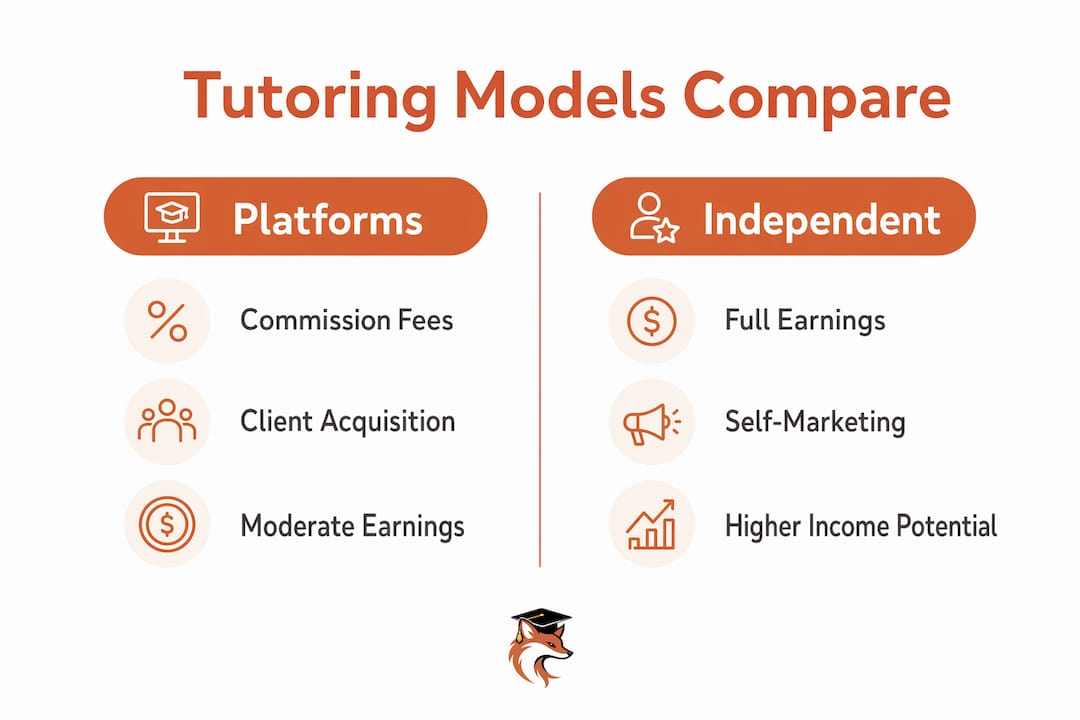
Platforms handle client acquisition, scheduling, and payment processing, which removes a lot of friction for new tutors. The trade-off is a commission of 20–40% and limited control over your rate. You are also building someone else’s platform rather than your own brand. For tutors just starting out, platforms offer a lower-risk entry point with built-in visibility.
Independent tutoring flips that equation. You keep 100% of your fee, set your own rates, and build a reputation that compounds over time. The challenge is that you are also your own marketing department, your own scheduler, and your own accounts receivable team.
Advantages of platforms:
- Immediate access to a client pool without marketing effort
- Payment handled by the platform, reducing collection risk
- Scheduling tools and session management built in
- Useful for building early reviews and experience
Advantages of going independent:
- Full fee retention, no commission cuts
- Freedom to set rates based on your expertise and market
- Ability to build a personal brand that generates referrals
- Long-term clients who return season after season
The most financially successful tutors in Canada tend to start on platforms to build reviews and experience, then transition to independent work as their reputation grows. Word of mouth remains one of the most effective client acquisition channels. A clear, specific offer shared in a Facebook parent group or on a neighborhood app reaches exactly the audience you need, and a referral from one satisfied family carries more weight than any platform listing.
Specializing in high-demand subjects like calculus, physics, or Quebec secondary school entrance exam preparation allows you to command premium rates and attract clients who stay for the long term, not just a week before a test.
What Réussite A+ shows about tutoring done right in Canada
Réussite A+ has spent more than 25 years refining what effective tutoring actually looks like for Quebec students. With over 3,500 students tutored and a 99% client satisfaction rate, the organization offers a clear model of what separates results-driven tutoring from generic academic support.
Every student at Réussite A+ receives a personalized learning plan built around their specific strengths, gaps, and pace. Tutors are selected at the university level for academic excellence and teaching ability, not just subject knowledge. Progress is monitored continuously, so adjustments happen before a student falls further behind rather than after.
Tutoring offered three or more times a week is almost twice as effective as tutoring offered on a weekly basis or less.
This finding from a national review of tutoring evidence aligns directly with how Réussite A+ structures its programs. Frequency matters as much as quality. A student who sees their tutor once a week for a month gains far less than one who has three focused sessions per week over the same period.
Réussite A+ specializes in French and mathematics, the two subjects that most directly affect Quebec secondary school entrance exam outcomes. Families across Quebec rely on this focused approach to prepare students for competitive admissions, and the exam success rates reflect that consistency.
Pro Tip: If you are building your own tutoring practice, take a page from this model: specialize in two or three subjects rather than offering everything, and build a structured progress-tracking system. Clients stay longer when they can see measurable improvement.
For families in Quebec looking for this kind of structured, personalized support, Réussite A+ offers online tutoring and homework help starting at rates accessible to families, with flexible scheduling that fits around school and family life.

Key Takeaways
Tutoring in Canada is financially and personally worthwhile when you specialize, build your own client base, and commit to consistent, high-frequency sessions.
| Point | Details |
|---|---|
| Earnings scale with expertise | Independent specialists earn $75–$150 per hour; platform tutors typically earn $25–$80 per hour. |
| Frequency drives results | Tutoring three or more times per week is nearly twice as effective as weekly sessions. |
| Platforms vs. independent | Platforms offer easy entry but take 20–40% commission; independent tutoring retains full fees. |
| Tax obligations are real | Canadian tutors must declare self-employment income and register for GST/HST above $30,000 annually. |
| Réussite A+ proves the model | Over 3,500 students helped, 99% client satisfaction, built on personalized and frequent instruction. |
FAQ
Is $30 an hour for tutoring good pay in Canada?
It depends on your experience and subject. For a new tutor or a general elementary subject, $30 per hour is a reasonable starting point; tutors with credentials or specialized subjects typically earn $40–$100 per hour independently.
Is AI replacing math tutors?
Not yet. AI tools provide useful practice and instant feedback, but human tutors remain essential for personalized guidance, identifying learning gaps, and adapting explanations in real time, especially in complex subjects like calculus or physics.
Is one hour of tutoring a week enough?
For most students working on complex material or exam preparation, one hour per week is not enough. More frequent sessions, ideally three or more per week, produce significantly better academic outcomes.
Is tutoring worth the money as a side income in Canada?
Yes, for most people with subject expertise. Tutors with 8–10 regular students at $40–$60 per hour typically earn $1,900–$2,400 per month from 4–5 hours of tutoring per week, making it one of the stronger hourly side incomes available in Canada.