




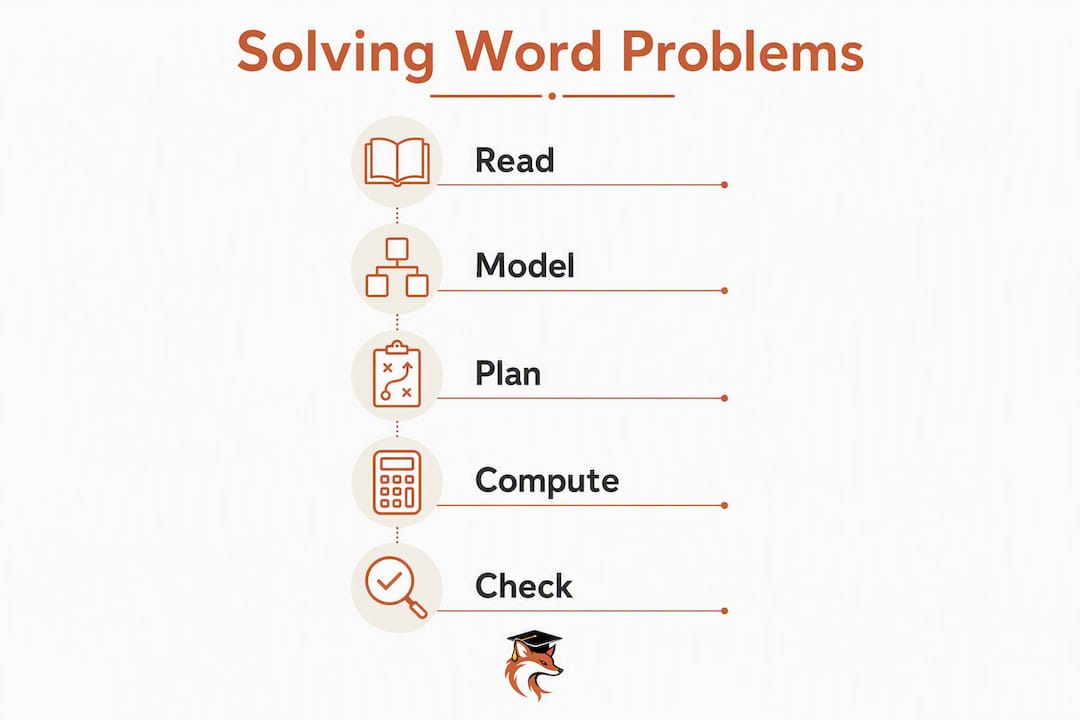
The most reliable way to solve math word problems is to use one consistent attack strategy every time: Read for meaning → Build a model → Plan → Compute → Check. Before touching a pencil to numbers, students who follow this routine make far fewer errors than those who scan for keywords and guess an operation.
Your three-step pre-calculation checklist:
- Read the whole problem once for the story, then again for the question.
- Identify what type of problem it is (combining, comparing, changing, or grouping).
- Sketch or label a quick model before writing any equation.
That’s it. Everything else in this guide builds on those three habits.
Table of Contents
- What is the best step-by-step strategy for solving word problems?
- How does schema instruction help students categorise problems?
- How do visual representations make word problems easier?
- Annotation routines and popular acronyms: what actually helps
- How should teachers model thinking aloud and scaffold for struggling learners?
- Worked examples from simple to multi-step problems
- How do you design practice that builds real progress?
- How can parents and tutors help at home without taking over?
- What does the research say about these strategies?
- How do you spot and ignore irrelevant information in a problem?
- How do you tell additive and multiplicative problems apart?
- Why does math vocabulary matter so much in word problems?
- Key takeaways
- Why Réussite A+ teaches word problems this way
- Réussite A+ tutoring: personalised support for word problems
- Useful sources
- FAQ
What is the best step-by-step strategy for solving word problems?
Attack strategies give students a reliable entry point for every problem and limit the temptation to grab numbers and guess an operation. The five-step routine below works from Grade 2 through Grade 8.
- Read for meaning. Read the whole problem without a pencil. Ask: “What is happening in this story?” Ignore numbers on the first pass. Read it a second time to find the question.
- Build a model. Draw a bar model, number line, or quick sketch that shows the relationships in the problem. Label every part with words, not just numbers.
- Plan the solution. Decide which operation (or operations) the model calls for. Write the equation shell before filling in numbers.
- Compute. Do the arithmetic carefully. Keep units visible throughout.
- Check and write an answer sentence. Estimate first: does your answer land in a reasonable range? Write a complete sentence (“There are 24 students in the class.”) and confirm the units match the question.
Why each step matters: Steps 1 and 2 build the “situation model” — the mental picture of what is actually happening. Research shows that constructing a situation model is what separates strong word-problem solvers from students who rely on arithmetic skill alone. Steps 3 through 5 translate that picture into math and verify the result.
Student self-talk script:
Pro Tip: For students who freeze at Step 1, try covering the numbers with a finger and reading only the words first. This forces the brain to process the situation before the arithmetic, which is exactly the order that reduces errors.

How does schema instruction help students categorise problems?
Schema instruction teaches students to recognise the underlying structure of a problem and apply a matching diagram and equation template. It outperforms keyword rules because keywords mislead (“more” can signal addition or comparison), while structure never lies.

The main schema types:
Additive schemas:
- Total/Combine: Two or more parts join to make a whole. Template: Part + Part = Total.
- Change: A quantity increases or decreases over time. Template: Start ± Change = Result.
- Difference/Compare: Two quantities are compared. Template: Larger − Smaller = Difference.
Multiplicative schemas:
- Equal Groups: A number of groups, each with the same size. Template: Groups × Size = Total.
- Rate/Proportion: A unit rate applied across a quantity. Template: Rate × Quantity = Total.
Mapping a problem to a schema (teacher model):
- Text: A quantity decreases. → Schema: Change.
- Diagram: A bar labelled 14, with a section of 6 shaded and a question mark for the remainder.
- Equation: 14 − 6 = ?
- Answer: 8 stickers.
Combined with graphic organisers, schema instruction substantially boosts reasoning for both general classrooms and students with learning disabilities.
Pro Tip: Post a schema anchor chart in the classroom with one diagram template per type. Before students write any equation, ask them to point to the matching schema. This single habit reduces operation errors dramatically.
How do visual representations make word problems easier?
Visual models reduce working-memory load by moving relationships out of the student’s head and onto the page. Integrated visuals and worked examples improve learning precisely because they free up mental space for reasoning rather than holding information.
When to use each tool:
- Bar models: Best for additive and multiplicative schemas. Draw a long bar for the whole; divide it into labelled parts. Works from Grade 2 onward.
- Number lines: Best for change and comparison problems, fractions, and negative numbers. Useful when direction (forward/backward) matters.
- Tables: Best for rate, ratio, and multi-step problems where two quantities vary together.
- Pictorial drawings: Best for early elementary students who need a concrete anchor before moving to abstract bars.
Three short worked visual examples:
Example 1 — Bar model (Combine):
Example 2 — Number line (Change):
Example 3 — Table (Rate):
| Hours | Distance |
|---|---|
| 1 | 60 km |
Common visual mistakes to avoid:
- Mismatched units in bar segments (mixing kilometres and metres in the same bar without converting).
- Drawing a bar for the unknown instead of a question mark — students sometimes invent a size for the unknown, which biases their calculation.
- Orienting a number line vertically when the problem describes horizontal movement, which adds confusion rather than clarity.
Annotation routines and popular acronyms: what actually helps
Annotation gives students a physical routine to slow down and extract information. The key is to pair annotation with model-building, not replace it.
Common acronyms and what each step does:
| Acronym | Steps | Best for |
|---|---|---|
| C.U.B.E.S. | Circle numbers, Underline the question, Box key words, Evaluate/draw, Solve | Grades 2–5 |
| R.U.N.S. | Read, Underline, Name the problem type, Solve | Grades 3–6 |
| K.N.O.W.S. | Know (what info is given), Need to find, Organise, Work, Solve/check | Grades 4–8 |
| RCUBES | Read, Circle, Underline, Box, Evaluate, Solve | Grades 2–5 |
Pros and cons of keyword-based steps:
- Pro: Quick to teach; gives anxious students a starting ritual that reduces panic.
- Con: “Box the keyword” steps can backfire when a word like “more” appears in a comparison problem but the operation is subtraction. Students who box “more” and automatically add will get the wrong answer.
The fix is straightforward: replace “Box the keyword” with “Draw the model.” Once a student has a diagram, the correct operation becomes visible rather than guessed. Avoiding keyword-only strategies and teaching model-building instead is one of the most consistent recommendations in current word-problem research.
Annotation routine (three steps any student can use):
- Underline the question sentence.
- Circle every number and its unit.
- Cross out any information the question does not ask about.
How should teachers model thinking aloud and scaffold for struggling learners?
Consistent modelling of one attack strategy, rather than switching between methods, helps students internalise the routine faster. The goal is to make invisible thinking visible.
Sample teacher think-aloud script:
Scaffold checklist for students with learning difficulties or emergent bilinguals:
- Provide a printed schema diagram with labelled slots (students fill in numbers, not draw from scratch).
- Pre-teach three to five key vocabulary words before the lesson (e.g., “altogether,” “remaining,” “per”).
- Allow students to retell the problem in their own words before drawing.
- Use sentence frames: “This is a ___ problem because ___.”
- Gradually remove the diagram template as students gain confidence (faded support).
- For emergent bilinguals, pair the written problem with a simple illustration or manipulative.
10–15 minute lesson microcycle (repeatable):
- (2 min) Warm-up: One estimation question — “Is the answer closer to 10 or 100? How do you know?”
- (4 min) Teacher think-aloud: Model one new problem using the full attack strategy.
- (4 min) Guided practice: Students work one problem with a partner; teacher circulates and prompts with schema questions.
- (3 min) Exit ticket: Students solve one problem independently and write an answer sentence.
Explicit instruction must be sustained across the year and should include vocabulary teaching, varied problem types, and culturally responsive supports for emergent bilinguals.
Worked examples from simple to multi-step problems
Studying worked examples before attempting problems independently reduces errors and builds schema recognition. Work through these with students before assigning independent practice.
Example 1 — Early elementary (Combine, Grade 2):
- Schema: Total/Combine.
- Diagram: [8 boys | 5 girls] = ?
- Equation: 8 + 5 = ?
- Calculation: 13.
- Check: “13 children is more than 8 and more than 5 — that makes sense.” Answer sentence: “There are 13 children at the park.”
Example 2 — Compare (Grade 3):
- Schema: Difference/Compare.
- Diagram: Lena [17 ], Omar [9 | ?], difference = ?
- Equation: 17 − 9 = ?
- Calculation: 8.
- Check: “8 is less than 17 — reasonable.” Answer sentence: “Lena has 8 more cards than Omar.”
Example 3 — Change (Grade 3):
- Schema: Change (decrease).
- Diagram: Start [24] → Change [−7] → Result [?]
- Equation: 24 − 7 = ?
- Calculation: 17.
- Check: “17 is less than 24 — correct direction.” Answer sentence: “There are 17 books on the shelf.”
Example 4 — Multi-step (Grade 5):
- Schema: Change (two decreases). Note: 3 dozen = 36.
- Diagram: 48 → −36 → 12 → −4 → ?
- Equations: 48 − 36 = 12; 12 − 4 = 8.
- Calculation: 8.
- Check: “8 is much less than 48 — two subtractions, makes sense.” Answer sentence: “The baker has 8 muffins left.”
Example 5 — Rate/Proportion (Grade 7):
- Schema: Rate. Convert: 30 min = 0.5 hr; rate = 15 ÷ 0.5 = 30 km/h.
- Table: 1 hr = 30 km; 2 hr = 60 km.
- Equation: 30 × 2 = 60.
- Calculation: 60 km.
- Check: “60 km in 2 hours at 30 km/h — units match.” Answer sentence: “The cyclist will ride 60 km in 2 hours.”
Post-solve answer-check checklist:
- Does the answer make sense given the story?
- Did you label the units?
- Did you write a complete answer sentence?
- Is the answer reasonable compared to your estimate?
How do you design practice that builds real progress?
Short, frequent practice beats long, infrequent sessions. Spacing and interleaving — mixing problem types across sessions rather than blocking one type per day — builds stronger schema recognition over time.
Sample 4-week micro-plan:
- Week 1: Worked examples only (teacher-modelled). One schema type per session. Students annotate and label, but do not solve independently.
- Week 2: Guided practice. Students solve with a partner using printed schema diagrams. Teacher circulates with prompting questions.
- Week 3: Mixed-schema practice. Two problem types per session. Students choose their own diagram. Teacher fades prompts.
- Week 4: Independent practice + weekly mixed review. One 10-minute independent set plus a 5-minute mixed-schema exit ticket.
Spacing principles:
- Aim for 10–15 minutes of word-problem practice daily rather than one long weekly session.
- Every Friday, include a two-question mixed-schema review covering types from earlier in the week.
Quick formative-check templates:
- 3-minute exit ticket: One problem, student writes equation and answer sentence. Teacher checks schema choice, not just the final number.
- Two-question fluency check: One familiar schema type + one new type. Tracks whether students transfer skills.
- Explain-it-back: Student reads a solved problem and explains in one sentence why that operation was chosen.
Setting measurable micro-goals for each practice week helps students and parents track progress concretely rather than waiting for a test result.
How can parents and tutors help at home without taking over?
The most helpful thing a parent can do is ask questions, not provide steps. Text comprehension and oral language are strong predictors of word-problem success, which means reading and talking about problems at home genuinely moves the needle.
Parent prompting script (use these instead of showing the solution):
- “Can you tell me the story in your own words?”
- “What is the question actually asking?”
- “Can you draw a picture of what’s happening?”
- “Does your answer make sense? Is it bigger or smaller than you expected?”
- “What would happen if the number changed to 10? Would your answer go up or down?”
Short home-practice activities:
- Explain-in-your-own-words: Read a problem aloud together. Child retells it without looking. This builds the situation model before any math begins.
- Draw-it routine: Child draws the problem as a quick sketch or bar model before writing numbers. Takes 60 seconds and cuts careless errors.
- Estimation game: Before calculating, both parent and child guess the answer range. Compare after. This builds number sense and reasonableness checking.
- Real-life problems: Use grocery receipts, recipes, or sports scores to create one-question problems. Familiar contexts lower anxiety and build schema recognition naturally.
Balancing calculation and language work: Spend roughly equal time on reading the problem carefully and doing the arithmetic. A child who calculates quickly but misreads the question will still get the wrong answer. If your child struggles more with reading the problem than with the math, language and math instruction go hand in hand and deserve equal attention at home.
For parents wondering when extra support makes sense, the signs a child needs academic support guide offers a clear checklist.
What does the research say about these strategies?
The evidence base for structured word-problem instruction is strong and consistent across grade levels.
Statistic callout: A 2024 meta-analysis pooling data from 20,456 students found that structured, evidence-based word-problem interventions produce an average effect size of g = 0.95 — a large positive effect on elementary students’ solving skills.
An effect size of 0.95 is substantial. In practical terms, it means students receiving structured instruction consistently outperform peers in control conditions by nearly a full standard deviation.
What the research supports:
- Schema instruction improves accuracy and reduces cognitive load by giving students a consistent diagram and equation template for each problem type, rather than relying on surface-level keyword cues.
- Explicit modelling (teacher think-alouds, faded support) helps students with learning disabilities and general classroom learners alike, particularly when combined with graphic organisers.
- Reducing working-memory load through diagrams and overt cues benefits students with working-memory difficulties, who are disproportionately affected by the dual demands of reading and calculating simultaneously.
- Language-focused instruction improves word-problem outcomes more than calculation drills alone, because word-problem success depends heavily on text comprehension and constructing an accurate situation model.
- What Works Clearinghouse guidance confirms that explicit, systematic instruction with dedicated time for word problems and language bridging produces the most consistent gains.
How do you spot and ignore irrelevant information in a problem?
Some word problems include numbers or details that are not needed to answer the question. These “distractor” elements are deliberate — they test whether students understand the problem structure, not just whether they can calculate.
The most effective approach is to teach “controlled attention”: the deliberate habit of reading the question first, then deciding which information the question actually requires. Students who read the question last tend to grab every number they see.
A three-step filtering routine:
- Read the question sentence first and underline it.
- Go back through the problem and circle only the numbers the question needs.
- Cross out any number or detail the question does not mention.
Practice this with problems that contain one extra number. For example: “A store has 30 red shirts, 18 blue shirts, and 12 pairs of jeans. How many shirts are there in total?” The 12 pairs of jeans is a distractor. Students who cross it out before calculating are far less likely to include it.
How do you tell additive and multiplicative problems apart?
This distinction trips up students at every grade level, and the confusion usually comes from surface features rather than structure.
Additive problems involve combining, separating, or comparing quantities of the same unit. The key question is: “Am I joining or removing parts of the same thing?” If yes, the operation is addition or subtraction.
Multiplicative problems involve equal groups, rates, or scaling. The key question is: “Is one quantity repeated a certain number of times, or does one quantity describe a rate per unit?” If yes, the operation is multiplication or division.
A reliable classroom test: ask students to draw the problem. An additive situation produces a bar with parts. A multiplicative situation produces rows of equal groups or a rate table. The diagram reveals the structure before the student commits to an operation.
One common confusion point: the word “times” does not always signal multiplication, and “each” does not always signal division. Teach students to draw first, label second, and choose the operation last.
Why does math vocabulary matter so much in word problems?
Language complexity, not math difficulty alone, often explains why some problems feel harder than others. A student who does not know what “remaining,” “per,” or “in total” means will struggle even when the arithmetic is simple.
Language comprehension is a strong predictor of word-problem success, which means vocabulary instruction is math instruction, not a detour from it.
Practical vocabulary strategies:
- Before each new schema type, pre-teach three to five signal words associated with it (e.g., for Compare problems: “more than,” “fewer than,” “difference,” “how many more”).
- Create a classroom word wall organised by schema type, not alphabetically. Students can scan it when they identify a problem type.
- Use “word sorts”: give students a list of math vocabulary words and ask them to sort the words by which operation or schema they suggest. This builds flexible understanding rather than rigid keyword matching.
- For emergent bilinguals, pair each vocabulary word with a simple illustration and a sentence frame. A student who can say “There are __ more __ than __” has the language scaffold to construct the comparison schema.
Reading the problem aloud together, then paraphrasing it in simpler language, is one of the fastest ways to close the vocabulary gap at home or in a tutoring session. Integrating language and math learning techniques consistently produces stronger gains than treating them as separate subjects.
Key takeaways
The most effective word problem strategies combine a consistent attack routine (Read → Model → Plan → Compute → Check) with schema instruction and visual representations, supported by language comprehension work.
| Point | Details |
|---|---|
| Use one attack routine | Read → Model → Plan → Compute → Check every time; consistency builds automaticity faster than switching methods. |
| Teach schemas, not keywords | Categorise problems by structure (Combine, Change, Compare, Equal Groups, Rate) and match a diagram template to each type. |
| Draw before you calculate | Bar models, number lines, and tables reduce working-memory load and make the correct operation visible. |
| Language is math | Vocabulary instruction and reading comprehension work improve word-problem outcomes more than extra calculation drills. |
| Réussite A+ personalised support | Réussite A+ builds schema knowledge and attack strategy habits into every student’s customised tutoring plan. |
Why Réussite A+ teaches word problems this way
After more than 25 years working with elementary and secondary students across Quebec, one pattern stands out clearly: students who struggle with word problems are almost never struggling with arithmetic. They are struggling with comprehension, structure, and knowing where to begin. That is precisely why the attack strategy and schema approach sit at the centre of how Réussite A+ tutors teach math.
Every tutoring plan at Réussite A+ is built around a student’s specific difficulty profile. A child who freezes at the reading step gets different scaffolding than one who draws the model correctly but chooses the wrong operation. Personalised instruction means the strategy is always matched to the learner, not the other way around. With a 99% client satisfaction rate and more than 3,500 students helped, the approach speaks for itself.
Réussite A+ tutoring: personalised support for word problems
Students who practise the attack strategy and schema approach with a knowledgeable tutor progress faster than those working alone, because a tutor can catch the exact moment a student’s model goes wrong and redirect before a bad habit forms.
Réussite A+ offers personalised online tutoring and homework help for elementary and secondary students throughout Quebec, with every session built around the student’s individual learning plan. University-level tutors guide students through schema identification, model-building, and the full attack routine until the process becomes second nature. With flexible scheduling and a proven methodology behind every session, families get targeted support without the guesswork of generic worksheets.
Ready to see the difference a structured, personalised approach makes? Enrol your child today and get started with a plan designed around their specific needs.
Useful sources
- The effectiveness of mathematical word-problem solving interventions (meta-analysis, 2024) — Primary source for the g = 0.95 effect size; essential reading for educators designing intervention programmes.
- IRIS Center: Schema instruction for math problem solving — Practical classroom guide to schema types, diagram templates, and implementation steps.
- Effective word-problem instruction using schemas (PMC) — Research review supporting schema-based instruction for students with learning disabilities and general classrooms.
- Text comprehension and oral language as predictors of word-problem solving (PMC) — Demonstrates why language comprehension instruction belongs inside math lessons.
- Word problem solving and situation models (Frontiers in Psychology) — Explains the situation-model construct and why arithmetic skill alone is insufficient.
- Improving language comprehension to enhance word-problem solving (PMC) — Randomised controlled trial embedding language comprehension instruction within schema-based intervention.
- Attack strategies for word problems (The Reading Teacher) — Justifies consistent attack routines and sustained vocabulary instruction across the school year.
- Working memory and word-problem performance gap (2024 study) — Supports overt cueing and diagramming for students with working-memory difficulties.
FAQ
What are the five steps for solving a word problem?
The five steps are: Read for meaning, Build a model (draw a diagram), Plan the solution (write the equation shell), Compute, and Check with an answer sentence. This routine, sometimes called an attack strategy, gives students a reliable entry point for every problem type.
What is schema instruction in math?
Schema instruction teaches students to identify the underlying structure of a word problem — such as Combine, Change, Compare, Equal Groups, or Rate — and apply a matching diagram and equation template. Research shows it outperforms keyword-based approaches because structure is consistent even when surface language is misleading.
What are some examples of word problems by type?
A Combine problem: “8 boys and 5 girls are at the park — how many children altogether?” A Compare problem: “Lena has 17 cards and Omar has 9 — how many more does Lena have?” A Rate problem: “A cyclist rides 30 km per hour — how far in 2 hours?” Each type calls for a different diagram and equation template.
How can parents help with word problems at home?
Ask guiding questions rather than providing steps: “Can you tell me the story in your own words?” and “Can you draw what’s happening?” are more effective than showing the solution. Oral language and reading comprehension are strong predictors of word-problem success, so talking through problems together genuinely helps.
Does Réussite A+ help students with math word problems?
Yes. Réussite A+ builds schema knowledge and the attack strategy routine into every student’s personalised tutoring plan, with university-level tutors who identify exactly where a student’s process breaks down and provide targeted scaffolding to correct it.