



Tutoring is private academic help delivered by someone with stronger subject expertise, usually one-on-one or in a small group, meant to clarify and reinforce what a classroom moves past too quickly. Done well, it produces measurable learning gains and a real boost in confidence. The size of that gain depends heavily on format, frequency, and who’s teaching, which is exactly what the checklist below will help you sort through.
TL;DR:
- Effective tutoring yields an average improvement of around 0.37 standard deviations, which can noticeably boost a student’s class ranking and test scores.
- The most impactful results come from programs with frequent sessions led by tutors who possess strong subject knowledge and use personalized learning plans.
- Online tutoring can match in-person success when session ratios stay small, providing flexible scheduling that benefits busy families and remote students.
- Starting tutoring early, especially when skill gaps are obvious or grades decline, maximizes gains and prevents long-term learning difficulties.
- Selecting a tutor requires verifying subject expertise, teaching approach, progress measurement methods, and avoiding vague or inconsistent scheduling claims.
Table of Contents
- What are the key benefits of tutoring?
- How much does tutoring actually improve grades?
- What types of tutoring formats are available?
- Who benefits most from tutoring, and when should it start?
- How do you choose an effective tutor?
- What should tutoring cost, and what happens in the first month?
- What does high-quality tutoring look like in practice?
- When should tutoring be short-term versus ongoing?
- Ready to see what personalised tutoring can do for your child?
- Sources
- FAQ
What are the key benefits of tutoring?
The most obvious payoff is remediation. A student who never quite grasped fractions or French verb conjugation gets a second, more patient explanation, targeted at the exact gap holding them back. But the benefits run wider than the report card.
Good tutoring builds transferable skills: how to plan study time, break down a word problem, and check your own work before handing it in. It also chips away at exam anxiety. A student who walks into a math test having already solved twenty similar problems with a tutor feels less panic and more control.
- Faster closing of specific knowledge gaps rather than generic review
- Stronger study habits and time management that carry into other subjects
- Reduced test anxiety and improved motivation, reported widely by parents and students in qualitative research
- Bigger gains when sessions are frequent and the tutor has real subject depth, not just goodwill
None of this happens automatically. A single session before a big test helps a little. A structured plan spread over weeks, with a tutor who actually knows the French tutoring for dyslexia curriculum or the math syllabus cold, helps a lot more.
How much does tutoring actually improve grades?
The honest answer: it depends on the program, but the average effect is real and worth knowing in numbers. A systematic review and meta-analysis of preK to 12 tutoring experiments found a pooled effect size of roughly 0.37 standard deviations across dozens of rigorous studies.
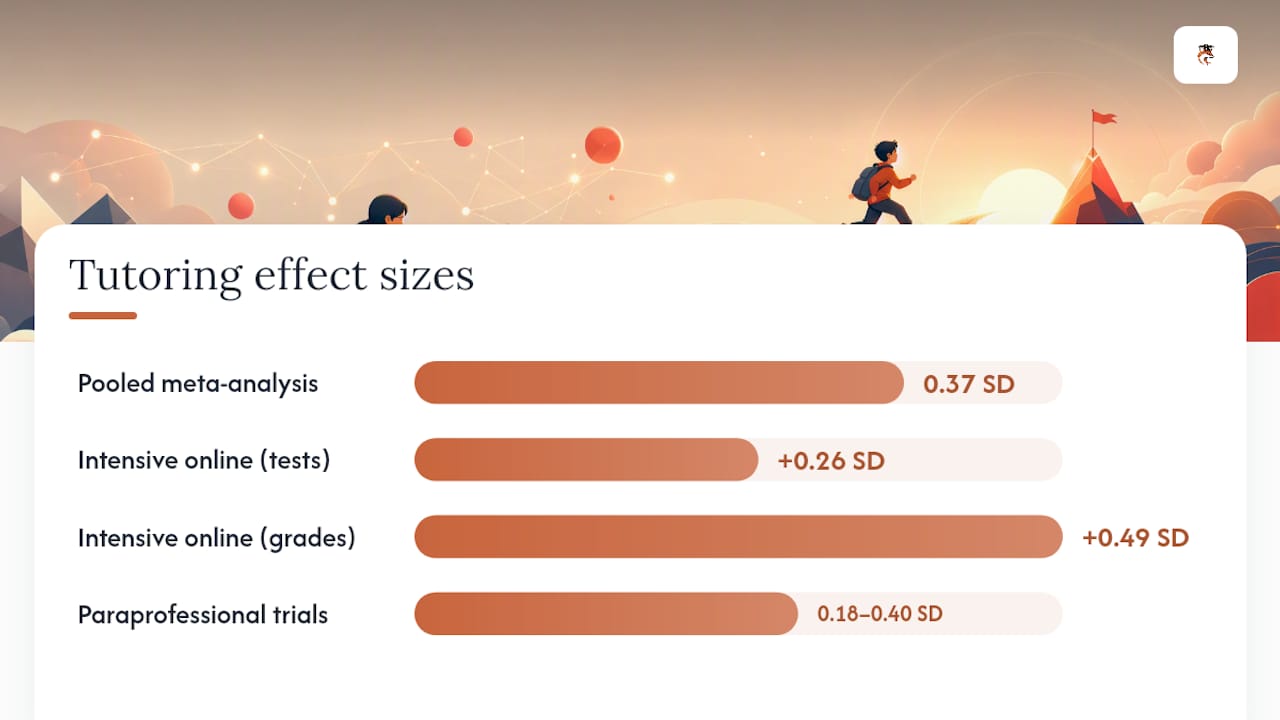
In practical terms, an effect of 0.37 SD is enough to move an average student noticeably up the class ranking, comparable to jumping several percentile points on a standardized test.
A more targeted trial backs this up in a subject parents worry about most. An eight-week intensive online math tutoring program using a two-student-to-one-tutor ratio produced a +0.26 SD gain on standardized test scores and +0.49 SD on end-of-year math grades. Other randomized trials using paraprofessional tutors found gains in the 0.18 to 0.40 SD range that held up in later years.

Not every arrangement works this well. Some observational studies find mixed results, because outcomes depend on a student’s starting point, the subject, session length, and whether the tutor actually knows how to teach, not just how to explain. That’s the case for treating tutor selection as seriously as you’d treat picking a doctor.
What types of tutoring formats are available?
Format changes both cost and outcome, so matching it to your goal matters more than most parents assume going in.
- One-on-one gives maximum customisation and the fastest pace adjustment, but costs the most per hour.
- Small groups of two to four students cost less per student and still allow targeted feedback, especially effective for math intervention programs.
- Peer tutoring works well for practice and confidence-building, though it rarely substitutes for expert instruction on a genuine skill gap.
- Online tutoring removes geography and scheduling barriers entirely and, when session ratios stay small, can match in-person results while adding flexibility for busy families.
The right choice usually comes down to budget, the specific subject, and whether your child needs deep customisation or just steady, structured practice.
Who benefits most from tutoring, and when should it start?
Younger students and those with clear, identifiable skill gaps tend to see the largest average gains, partly because early misunderstandings compound if left alone. A grade three student who never mastered regrouping in subtraction will struggle with every multi-digit problem after that, so catching it early saves years of frustration.
Consider starting tutoring if you notice falling grades over two or more reporting periods, the same mistake showing up repeatedly on homework, or visible anxiety before tests. Tutoring also earns its cost around exam preparation, summer catch-up before a new school year, and ongoing enrichment for a student who’s doing fine but wants to go further.
How do you choose an effective tutor?
Not all tutors teach the same way, and the difference between a good match and a wasted budget usually comes down to a handful of concrete checks.
- Verify subject knowledge, not just a friendly personality. Ask about their educational background and specific experience with your child’s grade level or exam.
- Ask how they build independence. A strong tutor teaches strategies for tackling new problems alone, not just answers for tonight’s homework, a key marker of teaching quality.
- Ask how progress gets measured. Look for concrete markers such as practice quiz scores, error-pattern tracking, or a personalized learning plan reviewed regularly.
- Ask about trial sessions and cancellation terms before committing to a package.
- Watch for red flags: a tutor who does the work instead of teaching it, vague claims like “they’re doing great” with no specifics, or scheduling that changes week to week without explanation.
Pro Tip: Ask to see a sample lesson plan from the first two weeks. A tutor who can’t describe a concrete starting point for your child probably hasn’t assessed them properly yet.
What should tutoring cost, and what happens in the first month?
Pricing models vary: some tutors charge a flat hourly rate, others sell multi-session packages, and many programs add a one-time assessment fee before regular sessions begin. Exam preparation and intensive catch-up work usually run at a higher weekly frequency than long-term skill-building, which might need only one or two sessions a week.
In the first six to eight weeks, watch both grades and behaviour at home. Clearer homework performance, less hand-holding on assignments, and a calmer attitude toward the subject are early signs things are working. If neither cognitive nor confidence markers move in that window, it’s worth adjusting the approach rather than waiting it out.
What does high-quality tutoring look like in practice?
Réussite A+ has spent more than 25 years refining what a well-run tutoring program actually requires: tutors selected at the university level for subject mastery and teaching skill, individualised learning plans built around each student’s pace, and consistent progress monitoring rather than guesswork.
Every student works from a customised plan focused on French and Mathematics, with flexible online scheduling designed to fit real family routines rather than force families to fit the schedule.
The results show up in the numbers that matter to parents: more than 3,500 students supported, a 99% client satisfaction rate, and consistently strong outcomes for students preparing for Quebec secondary school entrance examinations. That combination of qualified tutors, structured plans, and measured follow-up is what separates programs that produce lasting gains from ones that just fill an hour.
When should tutoring be short-term versus ongoing?
Tutoring works best when it aims at independence, not permanence. A short, focused intervention makes sense for a single skill gap or an upcoming exam. Ongoing support fits a student building foundational confidence over a full school year. One family we’ve seen through this pattern started with eight weeks of exam prep and ended up scaling back to monthly check-ins once grades stabilized. The goal was never to keep tutoring forever. It was to make it unnecessary.
— Réussite A+
Ready to see what personalised tutoring can do for your child?
Réussite A+ is the option for families in Quebec who want tutoring built around their child specifically, not a generic worksheet package. Every student gets a personalised learning plan in French or Mathematics, built and adjusted by a university-level tutor who tracks progress instead of guessing at it, delivered on a schedule flexible enough to work around hockey practice, dance class, or a parent’s shift work.
Whether your child needs to catch up before entrance exams, close a specific skill gap, or simply build stronger study habits for the year ahead, the 7 advantages of online tutoring with Réussite A+ outlines exactly what a session looks like. Ready to get started? Register for tutoring and academic support and a plan can be built around your child’s actual needs within days.
Sources
- The impressive effects of tutoring on PreK-12 learning: a systematic review and meta-analysis (NBER working paper no. 27476)
- Experimental evidence from an intensive online math tutoring programme (ScienceDirect)
- The quality and effectiveness of one-to-one private tuition in England (UCL thesis)
FAQ
What does tutoring mean?
Tutoring means private or small-group academic instruction from someone with stronger subject expertise, focused on clarifying concepts and building independent skills rather than completing schoolwork for the student.
How much does a tutor cost per hour?
Rates vary by region, subject, and format, with common billing models including a flat hourly rate, multi-session packages, or an initial assessment fee followed by regular session fees; ask any provider for their exact pricing structure before booking.
How much do private tutors usually charge overall?
Total cost depends on session frequency and duration. Intensive exam prep with multiple weekly sessions costs more overall than a once-weekly ongoing support plan, even if the hourly rate is similar.
Is private tutoring legal?
Yes, private tutoring is a legal, widely used educational service across Canada, offered by independent tutors, tutoring companies, and school-affiliated programs alike.
Does online tutoring work as well as in-person tutoring?
Research on intensive online math programs shows gains comparable to in-person formats when student-to-tutor ratios stay small, with the added benefit of flexible scheduling and no geographic limits.