


Semi private tutoring gives your child focused teacher attention alongside a peer to practise with, usually at a lower hourly cost than one on one lessons. It works well for students preparing for exams, catching up on specific skills, or building confidence through homework support. Most families see progress in academic performance, classroom participation, and their budget within a few months of starting.
TL;DR:
- Semi private tutoring is most effective for students facing exam preparation, needing reinforcement, or developing language skills, rather than those with significant learning gaps.
- Sessions typically last one to two hours, with two to three students working alongside a qualified tutor, offering personalized guidance at a lower cost than private lessons.
- Progress can often be seen within a few weeks through improved homework completion, better test scores, and increased confidence, especially when tracking and curriculum alignment are maintained.
- Effective programs rely on consistent, curriculum-linked sessions with differentiated tasks, and switching to a different format may be necessary if goals are not met after three to six sessions.
- Cost generally ranges from $30 to $35 per hour at Réussite A+, with ongoing evaluation advised to ensure the tutoring continues to meet the student’s needs.
Table of Contents
- 1. Academic gains from semi private tutoring
- 2. Social and classroom skills gained in small groups
- 3. How semi private tutoring works in practice
- 4. Who benefits most from semi private tutoring
- 5. How to choose a quality semi private tutoring programme
- Our approach to semi private sessions at Réussite A+
- Try semi private tutoring with Réussite A+
- Sources
- FAQ
1. Academic gains from semi private tutoring
A tutor working with two or three students can still teach with real precision. Sessions typically open with a short, focused mini lesson, move into differentiated tasks so each student practises at their own level, and close with quick individual check-ins to confirm the concept stuck. That structure lets your child get corrected in the moment instead of waiting for a report card to reveal a gap.
This approach mirrors what education guidance recommends for literacy and numeracy support. Effective programming relies on differentiated instruction, frequent interaction, and scaffolded tasks tied to ongoing assessment, which is exactly how a well run semi private group operates: the tutor adjusts the pace for each student while keeping the lesson anchored to what the class is actually covering.
Small group tutorial support works best when it stays linked to the curriculum and is delivered regularly, according to guidance on programming for students needing reinforcement. This matters because a tutor who drifts from what your child is learning in class creates two parallel tracks instead of one reinforced path.
Parents generally notice progress in stages:
- Within the first few weeks, homework gets finished with fewer reminders and less frustration.
- Within a month or two, quiz and test marks start to reflect the concepts practised in sessions.
- By exam season, your child walks in having already solved similar problems several times over.
Progress monitoring matters as much as the teaching itself. A tutor who tracks what was covered, what still needs work, and how quickly your child is absorbing new material can adjust the plan before a small gap becomes a bigger one. Programs built around university level tutors and structured progress tracking give parents visibility into that process rather than leaving them to guess from a report card twice a year.
2. Social and classroom skills gained in small groups
Learning next to another student changes how a child engages with material. Hearing a peer explain their thinking, or stumble on the same question you did, takes the pressure off getting everything right the first time. That low stakes environment is where a lot of real learning happens.
Semi private groups create natural opportunities for peer modelling and collaborative problem solving. A student who hesitates to ask a question in a full classroom will often ask it in a group of two or three, and hearing a classmate work through a similar mistake builds the confidence to try again. Guidance for supporting language learners notes that frequent peer interaction and curriculum linked small group instruction help build both confidence and academic risk taking, which matters well beyond language acquisition.
For English language learners specifically, the same guidance points to a few consistent patterns:
- Frequent, structured interaction with peers speeds up comfort with academic vocabulary.
- Occasional use of a student’s first language as a scaffold supports the transfer of concepts already understood.
- Guided practice in a small group builds the confidence needed to participate in a full class discussion.
A tutor might run a short paired explanation exercise, where each student summarizes a concept back in their own words before moving to independent practice. It sounds simple, but saying something out loud to a peer catches gaps that silent reading never reveals.
Pro Tip: Ask your child to explain a lesson to you the same way they explained it to their tutoring partner. If they can teach it, they’ve actually learned it.
3. How semi private tutoring works in practice
Most semi private programs group two to three students with one tutor, which keeps the ratio close enough to individual attention without the cost of private lessons. Sessions usually run somewhere between one and two hours, once or twice a week, though intensive formats exist for exam preparation periods.
A typical session follows a predictable rhythm:
- The tutor runs a brief diagnostic check to see what each student remembers from the last session.
- A focused teaching segment introduces or reinforces the concept for the day.
- Students move into guided practice, working through problems together or side by side.
- The tutor does rapid individual checks, correcting each student’s work before moving on.
- A short wrap up confirms what was covered and what homework or practice follows.
Within that structure, tutors differentiate by giving each student slightly different problems at the right difficulty level, even while covering the same core concept. This keeps the group moving together without holding anyone back or leaving anyone behind.
Online delivery adds a few practical considerations: a stable internet connection, a shared digital whiteboard or document, and a quiet space free of interruptions. Families weighing formats often compare online and in person tutoring before settling on what fits their schedule, since online sessions tend to offer more flexible timing without sacrificing the small group structure.

4. Who benefits most from semi private tutoring
Semi private tutoring tends to suit students who are already making reasonable progress but need reinforcement, structure, or exam focused practice rather than a full academic rebuild. It also works well for motivated students who genuinely learn from hearing a peer’s explanation.
Students who tend to see strong results include:
- Those preparing for entrance exams or year end tests who benefit from repeated, structured practice under mild time pressure.
- Students who understand a subject reasonably well but need consistent reinforcement to stop small errors from becoming habits.
- English language learners, who benefit from the frequent peer interaction and curriculum linked instruction that supports both confidence and language transfer.
- Students working on early literacy skills, where scaffolded, frequent practice in a small group builds fluency faster than isolated homework help.
Some situations call for a different format. A child with a significant, specific learning gap, or one who needs intensive individualized support, often does better one on one, where every minute of the session is built around their needs alone. On the other end, a student mainly looking for social exposure to a subject, without needing much correction, might do just as well in a larger group class at a lower cost. Matching the format to the actual need, rather than defaulting to whatever sounds most personalized, is what makes the investment worthwhile.
5. How to choose a quality semi private tutoring programme
Not every program that calls itself “semi private” delivers the same thing. Before committing, it helps to ask a few direct questions and watch for a few warning signs.
Questions worth asking any provider:
- What are the tutors’ qualifications, and are they matched to the subject and grade level?
- Will the group size and the same peers stay consistent from session to session?
- Is there a written lesson plan or curriculum alignment for each session?
- Can you see a sample progress report or update after a few sessions?
- What is the cancellation and tutor replacement policy if a session needs to change?
On pricing, semi private sessions generally cost less per student than one on one lessons while still delivering focused attention, with providers commonly grouping two to three students per tutor to balance cost against personalized coaching. Some charge per session, others sell packages with a lower effective rate, so it is worth comparing both against your expected frequency.
A few red flags are worth watching for: vague or absent progress updates, a group composition that changes week to week, or a “semi private” group that quietly grows past three or four students. Any of these dilute the personalized attention you are paying for.
Pro Tip: Treat the first three to six sessions as a trial. If homework completion, marks, or your child’s confidence hasn’t shifted by then, it’s worth revisiting the fit rather than waiting out the term.
Our approach to semi private sessions at Réussite A+
We built our semi private format around a simple idea: personalized instruction should not require a private lesson price tag. Every student starts with a diagnostic assessment, and every tutor is selected at the university level for both subject mastery and the ability to teach it clearly to more than one student at a time.
Over many years, tutoring providers offering semi private formats have worked with many students and aim to maintain high client satisfaction through methodologies built on differentiated tasks and continuous progress monitoring rather than a fixed script. For exam preparation and for English language learners, we lean on the same principles the research supports: frequent, curriculum linked practice, scaffolding where a student needs it, and enough repetition that skills actually stick before test day.
A first meeting typically starts with a diagnostic assessment, followed by a plan built around the student’s specific gaps and goals.
— Réussite A+
Try semi private tutoring with Réussite A+
If a student needs more than homework help but doesn’t require a full one on one program, regular semi private sessions can fill that gap. Plans typically start with a diagnostic assessment, involve a tutor with relevant qualifications, and adjust as the student’s needs evolve.
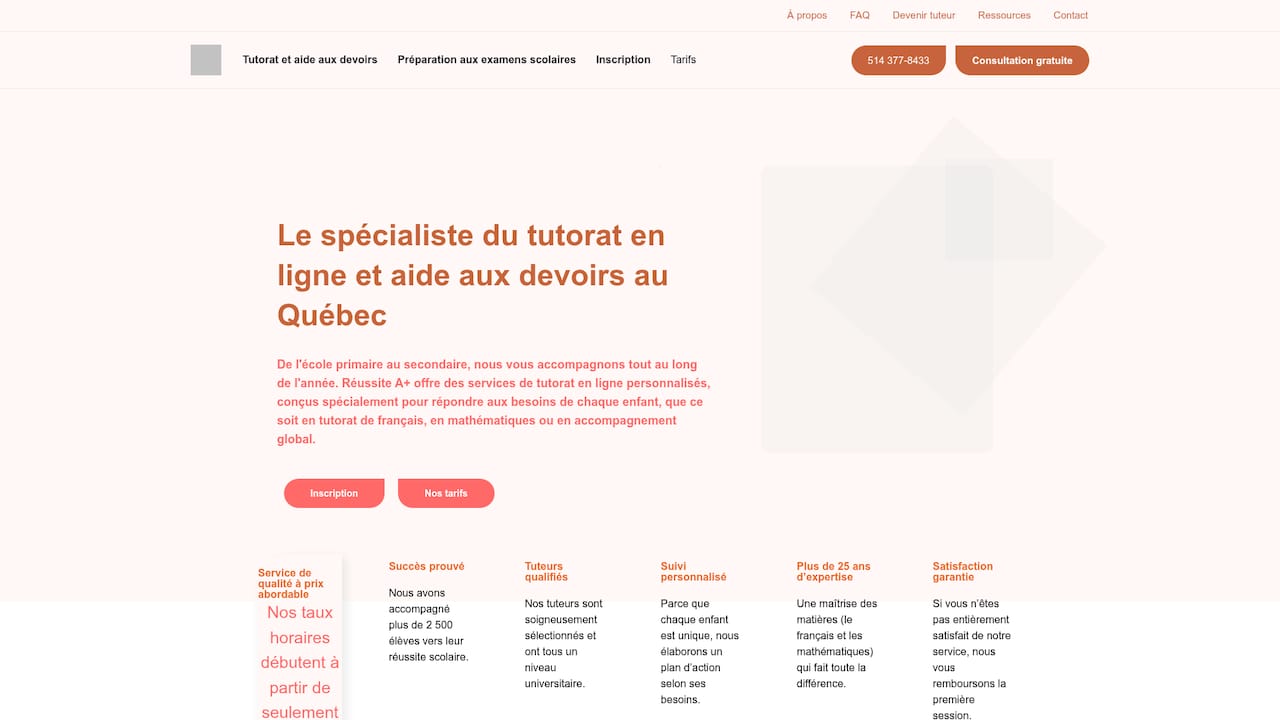
Families preparing for entrance or year end exams often start with our exam preparation sessions, while those looking for ongoing subject support tend to begin with a regular session. Registration includes a one time $65 fee, and hourly rates for both formats run $30 to $35. If you would rather start with flexible, on demand help, our homework support sessions are a lower commitment way to see how our tutors work with your child before moving to a regular schedule.
FAQ
What are the benefits and drawbacks of tutoring?
Tutoring can improve grades, build confidence, and give a student focused practice on exactly what they’re struggling with, especially when sessions are tied to what’s being taught in class. The main drawback is cost and time commitment, and quality varies a lot between providers, so checking tutor qualifications and progress tracking before committing matters.
Is private tutoring worth it?
Private, one on one tutoring is worth it for students with significant or highly specific learning gaps who need every minute of a session built around them alone. For students who are broadly on track but need reinforcement or exam practice, a semi private format often delivers similar academic gains at a lower hourly cost.
Is being a tutor a good side hustle?
Tutoring can work as a side income for someone with strong subject knowledge and the patience to teach it clearly, since demand for academic support is steady across most school subjects. Success as a tutor depends more on teaching ability and reliability than on subject expertise alone.
How much do semi private tutoring sessions typically cost?
Semi private tutoring generally costs less per student than private one on one lessons because the tutor’s time is shared between two or three students. At Réussite A+, both regular and exam preparation sessions run $30 to $35 per hour, with a one time $65 registration fee.
Who benefits most from semi private tutoring?
Students preparing for exams, those needing consistent reinforcement rather than a full rebuild of a subject, and English language learners tend to see the strongest results in a semi private format. Students with major, specific learning gaps often do better with one on one instruction instead.