



A Quebec report card shows competency-level results, a subject mark, the class group average, and, in secondary school, credits earned per course. Marks combine across the school year using a standard weighting: Term 1 counts for 20%, Term 2 for 20%, and Term 3 carries 60% of the final grade, unless a ministerial exam applies. The Ministère’s own pages and Alloprof remain the two best places to confirm exact wording for your child’s level.
TL;DR:
- Term 3 accounts for 60% of the final grade, making its results more influential than Terms 1 and 2 combined.
- Credits earned in secondary school are crucial for diploma eligibility, and a mark below 60% results in no credit for that term.
- Ministerial exams, scheduled mainly in June, can significantly alter final grades by blending or replacing part of the weighted average.
- Competency comments and trend analysis provide more insight into future performance than the subject percentage alone.
- Rankings evaluate school-level performance and do not reflect individual student aptitude or specific classroom fit.
Table of Contents
- What appears on a Quebec report card by level
- Term dates and why term 3 carries the most weight
- How ministerial exams change the final mark
- Reading competencies, marks and the group average correctly
- A worked example: from term marks to final grade
- What school rankings measure, and what they miss
- Your action plan after reading the report card
- How Réussite A+ tutors use report-card data
- Why most report-card advice misses the point
- If you want tailored help: tutoring built around your child’s report card
- Sources
- FAQ
What appears on a Quebec report card by level
The report card system in Quebec changes format depending on your child’s grade, but every version is built from the same legislated schedule. The Basic School Regulation sets out required elements in Schedules IV through VII, and the final report card of the year must contain every element listed for that level.
- Preschool: narrative observations on overall development, often paired with a simple legend or scale rather than numeric marks.
- Elementary: a row per competency (for example, “writes texts” or “solves a situational problem”), a subject mark as a percentage, and the group average for comparison.
- Secondary: competencies organized by cycle, subject marks, group averages, and, critically, the number of credits earned for each passed course.
Passing grade across levels sits at 60%. In secondary school, credits are what actually accumulate toward a diploma, so a subject mark below 60% means no credit that term, regardless of how close the number looks.
Term dates and why term 3 carries the most weight
Report cards go home three times a year, and official guidance points to consistent target windows for each one. A Western Quebec informational document lists common issuance dates as examples of the pattern schools tend to follow:
- Term 1 report card, distributed around November 20, reflecting roughly the first ten weeks of class.
- Term 2 report card, around March 15, covering the winter stretch.
- Term 3 report card, around July 10, which is the final and most complete one of the year.
The 20/20/60 split means Term 3 alone outweighs the first two terms combined. That is by design: only the final report card is legally required to contain every mandated field, which is why a shaky Term 1 mark rarely predicts the outcome on its own. Semestered secondary programs and occasional local adjustments (as seen during pandemic years) can shift exact dates, so always check your school’s calendar rather than assuming these dates apply universally.
How ministerial exams change the final mark
Not every grade sits a government exam, but the ones that do can shift a final mark considerably. Ministerial examinations are mandatory at specific points in a student’s schooling:
- Grade 6, as part of elementary-cycle evaluation.
- Secondary IV and V, most notably in subjects tied to graduation requirements.
- Grade 4 and Secondary II in French-language schools, where additional provincial checkpoints apply.
Statistic callout: Term weighting normally follows the 20/20/60 split, but when a ministerial exam applies to a subject, its result is blended into or substituted for part of that calculation according to provincial rules, and the shift from the simple weighted average can be substantial enough to change a final grade.
Exams are typically scheduled in June, with makeup sessions sometimes offered in August or January for students who need to retake one. For Secondary IV and V students, exam results tie directly to credit eligibility, which in turn affects diploma timelines. Our ministerial exam study guide breaks down preparation timelines by subject if your child is heading into one of these grades.
Reading competencies, marks and the group average correctly
A raw percentage tells you less than the competency line above it. Quebec’s academic evaluation model names the exact skill being assessed, so “solves a situational problem” or “communicates using mathematical language” points to precisely what your child needs to practise, rather than a vague sense of “needs work in math.”
Cross-curricular competencies and teacher comments, included in Terms 1 and 3, often say more about a child’s trajectory than the mark itself. Look for consistent notes about organizing work, exercising critical judgment, or collaborating with peers. These patterns tend to predict future performance better than a single term’s percentage.
The group average deserves a specific caution: it exists to give context, not to set a target. A student sitting above or below it is not automatically ahead or behind in any meaningful sense if the class itself is unusually strong or weak that term.
Bring these to a parent-teacher meeting:
- The last two report cards, side by side.
- A list of which competencies dropped, not just which subject mark did.
- Specific homework samples tied to a competency you want explained.
Pro Tip: Ask the teacher which competency, specifically, is dragging down the subject mark. A subject grade can hide one weak competency buried under two strong ones, and that is the one worth targeting at home.
A worked example: from term marks to final grade
Here is how the 20/20/60 rule plays out with real numbers for a Secondary III math class, assuming no ministerial exam applies:
| Term | Weighting | Subject mark |
|---|---|---|
| Term 1 | 20% | 68% |
| Term 2 | 20% | 74% |
| Term 3 | 60% | 82% |
If a ministerial exam applied to this course, that 77% would not stand alone. The exam result gets folded in or substituted according to provincial calculation rules, which is why two students with identical term marks can end up with different final grades once exam season passes.
What school rankings measure, and what they miss
Provincial school rankings work at the school level, not the student level, and that distinction matters when you’re using one to make a decision. The Fraser Institute’s Report Card on Quebec’s Secondary Schools scores schools using test-based indicators and other measurable outcomes, giving families a comparative snapshot across the province.
- Rankings measure aggregate results, graduation indicators, and test performance, not your specific child’s fit.
- Socioeconomic context and program mix can skew scores in ways a single number won’t reveal.
- A high-ranked school with no music program is a poor match for a musically driven kid, no matter what the score says.
Use ranking data the way you’d use a neighbourhood review: informative, never decisive. Pair it with your own school ranking research and your child’s actual report card before choosing a school or program stream.
Your action plan after reading the report card
A report card is only useful if it changes what happens at home next week. Here’s a sequence that works:
- Verify the numbers first. Check that the subject mark matches what you’d expect from homework and quiz results already seen; errors in transcription happen more than schools like to admit.
- Read every comment, not just the marks. Competency and cross-curricular notes often flag the real issue before the percentage does.
- Build one small SMART goal per weak competency. Something like “practise fraction word problems, 15 minutes, four nights a week” beats “do better in math.”
- Track trend, not snapshot. A decline from Term 1 to Term 3, or a competency that stays weak across all three terms, is the real warning sign, not a single low mark.
- Escalate when patterns repeat. If a competency stays flagged term after term, or a ministerial exam is approaching with no improvement in sight, that’s the moment to bring in outside support.
Before a parent-teacher meeting, gather the last two report cards, a few homework samples, and a short list of specific questions tied to competencies, not just grades.
Pro Tip: Set a 48-hour rule: review the report card in detail within two days of receiving it, while the teacher’s comments are still fresh enough to ask follow-up questions by email. Our primary report card guide walks through age-specific follow-up questions if your child is still in elementary school.
How Réussite A+ tutors use report-card data
Réussite A+ has spent more than 25 years turning report-card details into targeted study plans, and that history shapes how tutors read a bulletin. Rather than reacting to a single subject mark, tutors trace which competency is actually underperforming and build sessions around it.
Across more than 3,500 students supported to date, the pattern holds: a math mark that looks flat often traces back to one specific competency, like problem-solving under time pressure, once a tutor breaks down the report card line by line. That diagnostic step, paired with ongoing tracking, is part of why Réussite A+ maintains a 99% client satisfaction rate. Plans get built around the same ministerial competencies schools already assess, so exam prep and everyday tutoring pull in the same direction.
Why most report-card advice misses the point
Most guidance on reading a Quebec report card stops at explaining the percentages. That’s the easy part. The harder, more useful skill is learning to read competency comments and term-to-term trends as signals, because the raw mark on a Term 1 or Term 2 report card is legally allowed to be incomplete.
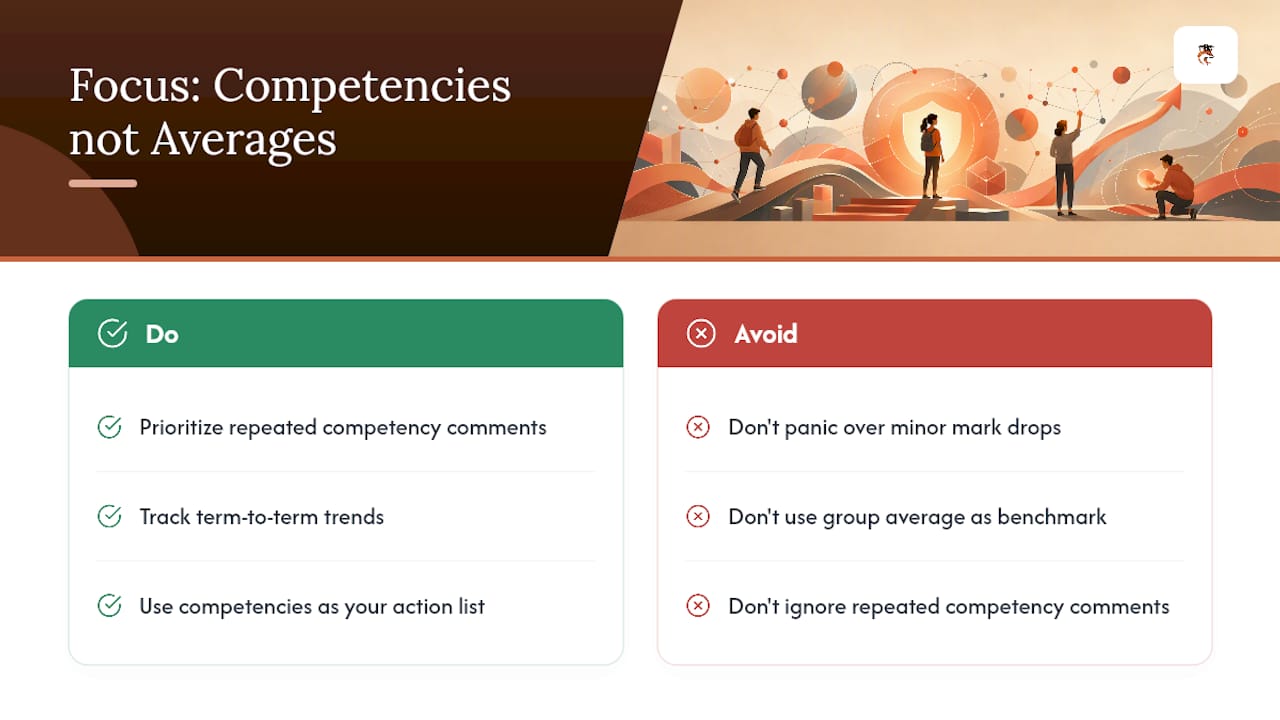
Conventional advice tends to treat every drop in a mark as urgent. It isn’t. A flat competency comment repeated across three straight terms, on the other hand, deserves real attention even if the subject mark itself looks fine. That’s the distinction most explainers skip.
If there’s one priority to take from this, it’s to stop treating the group average as a benchmark and start treating competency lines as your action list. The subject mark tells you where a child landed. The competency rows tell you why, and why is the only part you can actually do something about between now and the next report card.
— Réussite A+
If you want tailored help: tutoring built around your child’s report card
Once you’ve identified which competency is dragging down a mark, the next step is deciding how much support to bring in. Réussite A+ builds math and French tutoring plans directly around report-card findings: competency-targeted sessions, progress tracking between terms, and ministerial exam preparation timed to your child’s actual grade level.

Every plan starts with a look at your child’s most recent report card, not a generic placement test, so the first session already targets the right competency instead of guessing at grade level. Sessions run online with university-level tutors, and scheduling stays flexible around your family’s week rather than a fixed classroom slot. If a report card flagged a specific gap this term, book a session through our tutoring page and get a plan built around that exact competency before the next term’s marks lock in.
Sources
- Report Card weightings and wording (Gouvernement du Québec)
- Understanding your child’s report card | Alloprof
- Basic school regulation (schedules for report cards) | Légis Québec
- Report Card on Quebec’s Secondary Schools 2025 | Fraser Institute
FAQ
What is grade 10 called in Quebec?
Grade 10 corresponds to Secondary IV in Quebec’s high school system, the second-to-last year before graduation and the year several ministerial exams become mandatory.
What is included in a report card?
A Quebec report card includes competency-level results, a subject mark as a percentage, the class group average, and, in secondary school, the credits earned for each passed course.
Which high school in Quebec is considered the best?
There is no single “best” school; the Fraser Institute’s Report Card on Quebec’s Secondary Schools ranks schools using test-based indicators, but fit depends on program offerings and your child’s individual needs as well.
What is grade 11 in Quebec?
Secondary V is the final year of high school, where ministerial exam results carry significant weight toward the final mark and diploma eligibility.