



For any right triangle, a² + b² = c², where a and b are the two legs and c is the hypotenuse, the side opposite the 90° angle. This formula only applies when one angle measures exactly 90 degrees, and c is always the longest side. Its converse works the other way too: if a² + b² = c² holds for a triangle’s three sides, that triangle must be right-angled.
TL;DR:
- The Pythagorean theorem only applies to right triangles with a hypotenuse longer than both legs, and its converse confirms a right angle if the relation holds.
- The area proof and similar triangles proof reveal the geometric and proportional reasoning behind the formula, demonstrating its universality for all right triangles.
- The formula’s application extends beyond flat triangles into three-dimensional space, useful in distance calculations on coordinates, in physics, and engineering contexts.
- Correctly identifying the hypotenuse and constructing the right triangle in problems is essential, along with confirming the right angle before applying the formula.
- Memorizing common triples like 3, 4, 5, and understanding how to calculate missing sides or the hypotenuse can prevent errors and improve problem-solving speed.
Table of Contents
- What the formula means and how the terms fit together
- A visual proof using four triangles inside a square
- A second proof through similar triangles
- Using the converse to check for a right angle
- Worked examples: finding a hypotenuse and a missing leg
- Where this formula actually shows up outside math class
- Practice problems to test what you have learned
- Using calculators and diagrams without losing the skill
- How Réussite A+ approaches teaching the Pythagorean theorem
- Where the theorem came from
- Extending the theorem beyond flat triangles
- When the formula does not apply
- How the theorem connects to the distance formula and beyond
- What actually matters when learning this theorem
- Sources
- FAQ
What the formula means and how the terms fit together
The letters in a² + b² = c² are not interchangeable. The two legs, a and b, are the sides that form the right angle. The hypotenuse, c, sits opposite that angle and is always the longest side in the triangle, a point confirmed in curriculum guidance from OISE. Mixing up which side is which is the most common error students make when they start applying the formula.
A few consequences follow directly from the structure of the equation:
- c is always largest: since c² equals the sum of two positive squares, c must exceed both a and b individually.
- Side lengths stay positive: lengths cannot be negative, so once you solve for a squared value, you take the positive square root only.
- Any two known sides determine the third: give the formula two of the three lengths, and it hands back the missing one.
The theorem also does practical work outside the classroom. Curriculum materials frame it as an indirect measurement tool: instead of physically measuring a diagonal distance, you calculate it from two perpendicular lengths you already know. That framing matters because it is the reason the theorem shows up again and again in construction, design, and navigation problems rather than staying confined to geometry worksheets.
A visual proof using four triangles inside a square
One of the clearest ways to see why a² + b² = c² works is to stop thinking in equations for a moment and look at areas instead. The dissection proof documented by Meade’s geometry proofs collection builds a big square out of four identical right triangles plus a smaller square in the middle, then counts the same total area two different ways.
Here is how it comes together:
- Draw a large square with side length (a + b). Its total area is (a + b)².
- Inside that square, arrange four congruent right triangles, each with legs a and b and hypotenuse c, so their right angles point outward toward the corners of the big square.
- The four triangles leave a smaller square in the middle, tilted at an angle, with side length c. Its area is c².
- Each triangle has area equal to half of a times b, so the four together cover 2ab of area.
- Add up the pieces: the big square’s area equals the tilted square’s area plus the four triangles’ area, so (a + b)² = c² + 2ab.
- Expand the left side: a² + 2ab + b² = c² + 2ab.
- Subtract 2ab from both sides, and you are left with a² + b² = c².
That last step is the payoff. The same total area, counted two different ways, forces the relationship to hold for every right triangle, not just the one you happened to draw. This is exactly the area-accounting derivation that mathematics educators favour precisely because a student can build it with paper cutouts and verify the cancellation by hand rather than taking it on faith.
Pro Tip: Sketch the big square first, mark side (a + b) on two adjacent edges, then rotate one triangle at a time into each corner. Getting the orientation right on paper makes the “why” click faster than reading the algebra alone.
A second proof through similar triangles
The dissection proof appeals to spatial intuition. A different proof, built on similar triangles, appeals to proportional reasoning instead, and it is worth knowing both because they train different mathematical instincts.
Start with a right triangle with legs a and b and hypotenuse c. Drop a perpendicular line from the right angle down to the hypotenuse, splitting the original triangle into two smaller triangles. Each of these smaller triangles shares an angle with the original triangle and also contains the newly formed right angle, which means all three triangles, the original and the two smaller ones, are similar to each other.
That similarity produces two proportional relationships:
- The segment of the hypotenuse adjacent to leg a, divided by a, equals a divided by c.
- The segment of the hypotenuse adjacent to leg b, divided by b, equals b divided by c.
Rearranging each proportion gives a² equal to c times the first hypotenuse segment, and b² equal to c times the second hypotenuse segment. Since those two segments together make up the entire hypotenuse c, adding the two equations gives a² + b² equal to c times (the sum of both segments), which is just c times c, or c².
The learning value here goes beyond a second way to reach the same formula. This proof shows how similarity, a topic students often treat as separate from algebra, converts directly into the algebraic identity they already know. Once a student sees that connection, proportional reasoning stops feeling like a standalone unit and starts looking like a tool that shows up inside other proofs too.
Using the converse to check for a right angle
The Pythagorean theorem also runs in reverse. According to the converse stated in CK-12’s algebra resource, if the three side lengths of a triangle satisfy a² + b² = c², the triangle must contain a 90° angle, even if you never measured the angle directly. That makes the formula a classification tool as well as a calculation tool.
The test procedure is short:
- Order the three side lengths from smallest to largest and call the largest one c.
- Square each of the three lengths.
- Add the squares of the two smaller sides together.
- Compare that sum to the square of the largest side.
- If the two values match, the triangle is right-angled; if they do not match, it is not.
Try it on a triangle with sides 7, 8, and 12. Ordering gives c equal to 12, with legs 7 and 8. Squaring gives 49, 64, and 144. Adding the two smaller squares gives 113, which does not equal 144. This triangle fails the test, so it is not right-angled, even though the side lengths look plausible at a glance. That is exactly the kind of check worth running before you assume a shape in a word problem or a construction plan has a right angle just because it looks close.
Worked examples: finding a hypotenuse and a missing leg
Two calculations come up over and over: finding the hypotenuse when both legs are known, and finding a missing leg when the hypotenuse and one leg are known. Both follow directly from a² + b² = c², just rearranged differently.
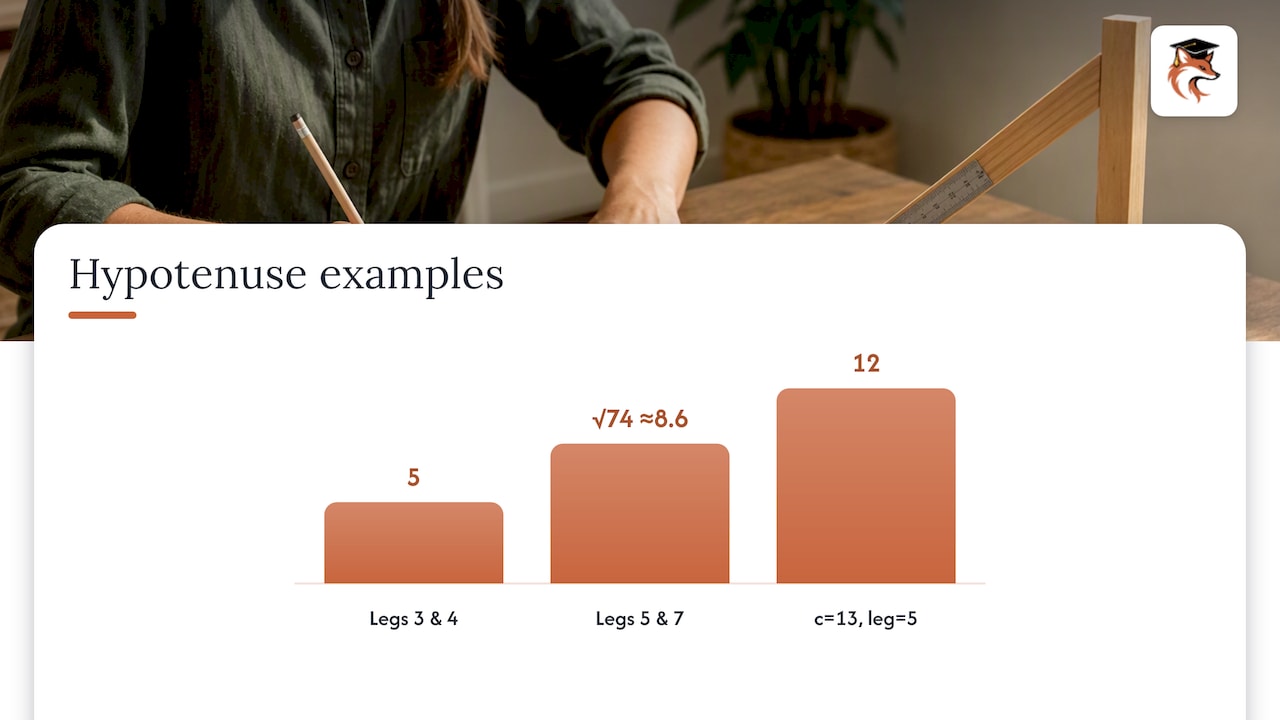
For the classic case, take legs of 3 and 4. Squaring gives 9 and 16, which add to 25. Taking the square root gives c equal to 5, a clean integer that shows up so often in textbooks it is worth memorizing as a shortcut for spotting right triangles.
Not every example lands on a whole number. Take legs of 5 and 7. Squaring gives 25 and 49, adding to 74. The square root of 74 does not simplify to a whole number, so the exact answer stays in radical form as c equal to the square root of 74, which is approximately 8.6 when rounded to one decimal place.
Finding a missing leg works the same way, just rearranged. If c equals 13 and one leg equals 5, subtract the known leg’s square from the hypotenuse’s square instead of adding: 169 minus 25 equals 144, and the square root of 144 is 12, giving the second leg.
A common Pythagorean triple worth remembering: the set 3, 4, 5 (and its multiples like 6, 8, 10) satisfies a² + b² = c² with whole numbers, which is why it appears constantly in textbook problems and quick mental checks, as documented across proof and triple catalogues.
A few habits keep these calculations accurate:
- Square first, then add or subtract: doing the arithmetic in the wrong order is the most common source of mistakes.
- Keep exact radical form until the final step: rounding early compounds errors in multistep problems.
- Check what your teacher or exam expects: some ask for exact radical answers, others want a decimal rounded to one or two places, and the instructions usually say which.
Where this formula actually shows up outside math class
The theorem earns its place in the curriculum because it solves a real problem: converting two perpendicular measurements into one direct distance without physically measuring that distance. Curriculum guidance points to construction, surveying, and accessibility design as recurring contexts where this comes up.
A few concrete cases:
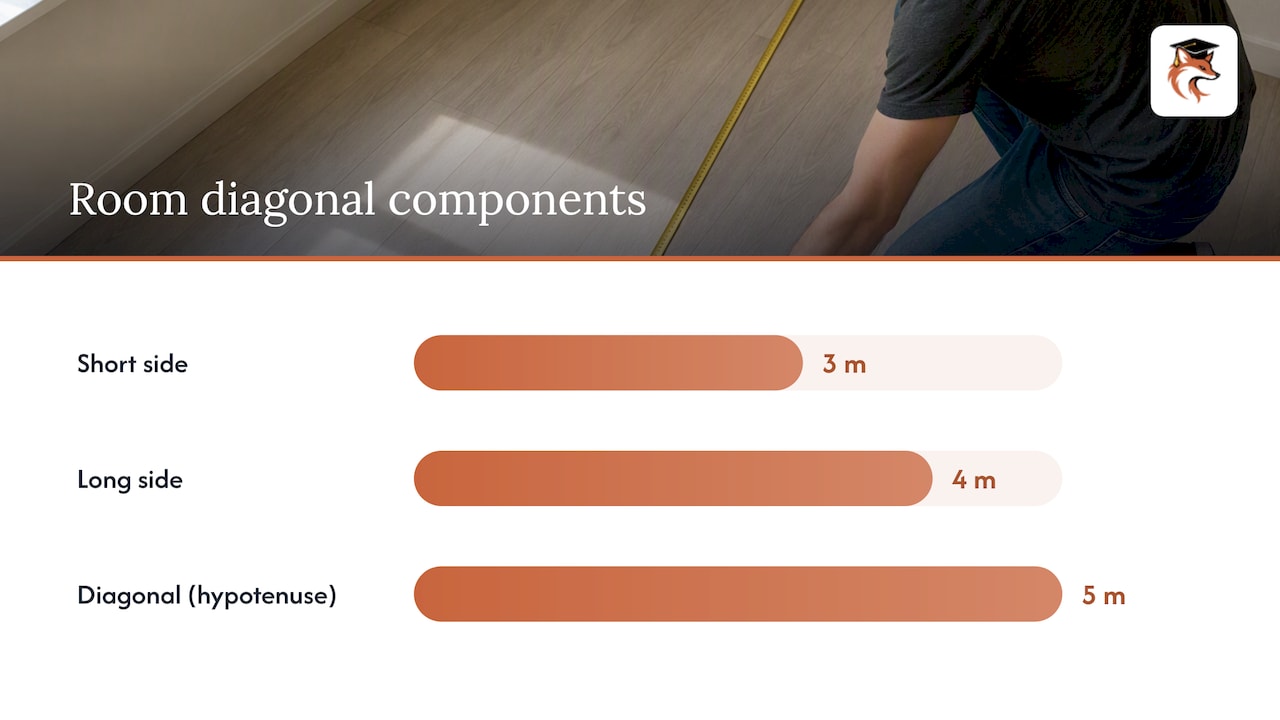
- Finding a room’s diagonal: if a room measures 4 metres by 3 metres, the diagonal distance across it is the square root of (4² + 3²), or 5 metres, useful when checking whether a large piece of furniture will fit through a diagonal path.
- Sizing a wheelchair ramp: given a fixed horizontal run and a required vertical rise, the ramp’s actual length along the slope is found the same way, which matters for meeting slope requirements.
- Distance between two points on a coordinate plane: for points at (x1, y1) and (x2, y2), the distance between them equals the square root of (x2 minus x1)² plus (y2 minus y1)², which is the Pythagorean theorem applied to the horizontal and vertical differences between the points.
The idea extends cleanly into three dimensions as well. For two points in 3D space, the distance formula becomes the square root of (Δx)² plus (Δy)² plus (Δz)², adding a third perpendicular component to the same underlying logic. This version comes up in physics problems and any situation involving height along with horizontal position, such as calculating the straight-line distance to a point on a rooftop.
Pro Tip: When a word problem describes a ladder against a wall, a shadow cast by a pole, or a shortcut cutting across a rectangular park, sketch the right triangle first. Once the diagram is on paper, the formula tells you which side to solve for.
Practice problems to test what you have learned
Try each problem before checking the solution underneath it. Working through the steps yourself, even if you get stuck partway, builds the pattern recognition that speeds up test performance more than reading solved examples ever does.
Find the hypotenuse. A right triangle has legs of 6 and 8. What is the length of the hypotenuse?
Solution: Square both legs to get 36 and 64, then add them for 100. The square root of 100 is 10, so the hypotenuse measures 10.Find a missing leg. A right triangle has a hypotenuse of 15 and one leg of 9. What is the length of the other leg?
Solution: Square the hypotenuse and the known leg: 225 and 81. Subtract 81 from 225 to get 144, and the square root of 144 is 12.Classify the triangle. A triangle has sides 9, 12, and 15. Is it a right triangle?
Solution: Order the sides so c equals 15. Square all three: 81, 144, and 225. Add the two smaller squares, 81 plus 144, to get 225, which matches c². The triangle is right-angled.Classify a second triangle. A triangle has sides 5, 6, and 8. Is it a right triangle?
Solution: Order the sides so c equals 8. Square all three: 25, 36, and 64. Add the two smaller squares, 25 plus 36, to get 61, which does not match 64. This triangle is not right-angled.Coordinate distance. Find the distance between the points (1, 2) and (4, 6).
Solution: Subtract the coordinates: Δx equals 3 and Δy equals 4. Square each difference, 9 and 16, add them for 25, and take the square root to get a distance of 5.
Notice that problem 5 uses the exact same structure as problem 1, just with the legs relabelled as horizontal and vertical distances. Once that pattern is visible, coordinate geometry problems stop feeling like a separate topic from triangle problems.
Using calculators and diagrams without losing the skill
A calculator can confirm an answer in seconds, but it cannot tell you which numbers to plug in or whether your setup matches the problem. Knowing both matters, especially on tests where calculators are not always allowed.
A standard calculator or online tool for this formula needs three inputs: the two known side lengths and which side (leg or hypotenuse) is missing. Enter the two known values, and the tool squares them, adds or subtracts as appropriate, and returns the square root, sometimes as an exact radical and sometimes as a rounded decimal.
A few pitfalls trip up students even when the tool itself works correctly:
- Entering values in the wrong slot: mixing up which input is the hypotenuse versus a leg produces a wrong answer even though the arithmetic is correct.
- Rounding too early: some tools round intermediate steps automatically, which can shift the final digit compared to keeping exact radical form throughout.
- Misreading radical output: a result like “the square root of 74” is exact, while “8.6” is an approximation; know which one your assignment expects before you copy an answer down.
The most useful habit is to solve the problem by hand first, then use a calculator only to check the result. That order builds the skill; reversing it, leaning on the tool from the first step, tends to leave the underlying pattern unlearned by test day.
How Réussite A+ approaches teaching the Pythagorean theorem
Our approach to teaching geometry, and math generally, emphasizes personalized pacing, explanations of proofs step by step, and monitoring student progress to adjust practice focus according to individual needs rather than relying on generic worksheets.
Parents looking for structured support with geometry, or with math more broadly, can start with a regular tutoring session or explore homework help for more immediate support with current assignments.
Where the theorem came from
The relationship between a right triangle’s sides carries Pythagoras’s name, but evidence of the underlying pattern predates him by centuries. Babylonian clay tablets show numeric examples of the relationship being used well before Pythagoras is believed to have lived, and similar patterns appear in early Chinese and Indian mathematical texts. What historians generally credit to Pythagoras, or to the school of thinkers associated with his name, is not the discovery of the numeric pattern itself but one of the earliest known general proofs, an argument meant to hold for every right triangle rather than just the specific cases recorded on older tablets.
That distinction matters for understanding what “Pythagorean theorem” actually names. The theorem is not simply the observation that 3, 4, and 5 fit a right triangle, a fact multiple ancient cultures had already noticed. It is the general proof that the relationship holds for any right triangle, regardless of the specific lengths involved. Over the centuries since, mathematicians have produced dozens of independent proofs using algebra, geometry, and calculus, a testament to how many different mathematical tools can arrive at the same conclusion. That range of proofs is also why the theorem remains a fixture in geometry curricula: it is one of the clearest examples of how a single true statement can be reached from several completely different directions.
Extending the theorem beyond flat triangles
The version of the theorem taught in most classrooms, a² + b² = c², assumes flat, two-dimensional Euclidean geometry, where the angles of a triangle always add up to 180°. That assumption does not hold everywhere. On a curved surface, such as the surface of a sphere, triangles behave differently, and the simple squared-sides relationship no longer applies in its original form. Non-Euclidean geometries, the mathematical study of curved or otherwise non-flat spaces, require adjusted versions of the relationship to describe distances correctly.
Closer to everyday use, the theorem extends smoothly into three dimensions. Instead of two perpendicular components, a, and b, a 3D version accounts for three: length, width, and height. The distance between two points in space becomes the square root of the sum of three squared differences rather than two, following the same logic as the flat version but with one more perpendicular direction added in. This 3D form comes up in physics, engineering, and any problem involving a straight-line distance that includes elevation or depth alongside horizontal position.
Both extensions matter for the same reason: they show that a² + b² = c² is a special case of a broader idea about how perpendicular distances combine, rather than an isolated fact that only works for triangles drawn on paper.
When the formula does not apply
The theorem’s power comes with a strict condition attached: it only works for right triangles. If none of the triangle’s three angles measures exactly 90 degrees, a² + b² = c² simply does not hold, and applying it anyway produces a wrong answer, not an approximate one.
This is where the converse becomes useful as a safeguard. Before applying the formula to solve for a missing side, it is worth confirming, or at least strongly suspecting from context, that the triangle actually contains a right angle. Word problems sometimes state this directly (“a right triangle has legs of…”) and sometimes only imply it through a diagram showing a perpendicular wall, a vertical pole, or a square corner.
A second limitation involves units. The formula assumes all three sides are measured in the same unit; mixing metres and centimetres without converting first produces a numerically correct but practically meaningless result. And while the flat, two-dimensional version taught in most courses assumes standard Euclidean geometry, that assumption breaks down on curved surfaces, which is why the theorem’s reach, while broad, is not universal across every mathematical context.
How the theorem connects to the distance formula and beyond
The Pythagorean theorem is not an isolated fact sitting apart from the rest of geometry. It is the foundation underneath one of the most frequently used tools in coordinate geometry: the distance formula. When you calculate the distance between two points on a graph using the square root of (Δx)² plus (Δy)², you are applying the exact same relationship as finding a hypotenuse, just with the legs relabelled as horizontal and vertical coordinate differences instead of physical triangle sides.
That connection extends further into other areas of geometry and algebra. The equation of a circle, for instance, relies on the same squared-distance logic: every point on a circle sits at a fixed distance from the centre, and that fixed distance is calculated using the same relationship. Trigonometric identities, particularly the fundamental identity linking sine and cosine, also trace back to the same right-triangle relationship, since sine and cosine are themselves defined as ratios of a right triangle’s sides.
Seeing these connections helps explain why the theorem shows up across so many strands of a typical math curriculum rather than staying confined to a single geometry unit. A student who understands it purely as an isolated formula for triangle sides misses how much of later coordinate geometry, trigonometry, and even some calculus concepts quietly depend on the same underlying idea.
What actually matters when learning this theorem
Most students treat the Pythagorean theorem as a formula to memorize and move past quickly, and that is where the trouble starts later. The formula itself takes thirty seconds to learn. What takes longer, and what actually prevents mistakes on tests, is recognizing when a problem hides a right triangle inside a word problem, a coordinate pair, or a diagram that never says “right angle” out loud.
The converse gets underused for the same reason. Students learn it as a separate fact rather than as the safety check it actually is, the step that confirms a formula applies before they spend three lines of algebra applying it to a triangle that was never right-angled to begin with.
If there is one thing worth prioritizing over drilling more practice problems, it is spending real time on one proof, either the dissection or the similarity argument, until it makes sense without looking at notes. A student who understands why the formula works spots its disguised appearances in coordinate geometry, trigonometry, and word problems far more reliably than one who only memorized the equation.
— Réussite A+
Sources
The explanations, proofs, and classroom framing in this article draw on a small set of resources worth consulting directly for assignment work or deeper study.
- Pythagorean theorem (OISE lesson plans)
- Pythagorean theorem and its converse (CK-12 FlexBook)
- Geometry proofs and the four-triangle dissection (Meade)
Checking a curriculum page against your own course outline is a reasonable habit before an assignment is due, since terminology and expected notation can vary slightly between resources.
FAQ
What is the Pythagorean theorem in simple terms?
It is a rule for right triangles stating that the square of the hypotenuse equals the sum of the squares of the other two sides, written as a² + b² = c². The hypotenuse is the longest side, sitting opposite the 90° angle, and the rule only holds when that right angle is actually present.
What is the hardest theorem in math?
There is no single agreed-upon “hardest theorem,” since difficulty depends on the mathematical field and a learner’s background; some famously difficult results, like Fermat’s Last Theorem, took centuries to prove. The Pythagorean theorem, by contrast, is considered one of the more accessible foundational results, with dozens of relatively simple proofs.
What is the difference between Pythagoras and Pythagoras theorem?
Pythagoras was an ancient philosopher and mathematician associated with a school of thought in ancient Greece, while the “Pythagorean theorem” refers specifically to the mathematical relationship a² + b² = c² for right triangles. The theorem carries his name because of an early general proof historically attributed to his school, though the underlying numeric pattern was known in other ancient cultures before him.
How do you use the Pythagorean theorem step by step?
Identify the right triangle’s two legs and hypotenuse, then decide which side is missing. Square the two known sides, add them if solving for the hypotenuse or subtract if solving for a leg, and take the square root of the result to get the missing length.
How can I get extra help mastering this theorem?
Working through both proofs by hand, then practising graduated problems from basic calculations to classification and coordinate distance, builds lasting understanding. Structured support, such as regular math tutoring sessions or exam preparation programs, can help students who need more guided practice before a test.