


Start your application today: gather your child’s report cards and birth certificate, book an open house or submit an inquiry form, and set aside time for interview or assessment preparation. Under Quebec rules, private schools must issue a formal educational services contract once your child is accepted, and registration fees are capped at $200. Here’s the immediate action list:
- Attend an open house or submit an online inquiry form at your target schools
- Prepare a long-form birth certificate, proof of residency, and your child’s last two years of report cards
- Budget for a file-opening fee and a possible assessment fee
- Complete the interview or entrance test, then wait for the acceptance decision and signed contract
Montreal private school admissions run on tighter timelines than most parents expect, and schools weigh fit as heavily as marks. The sections below walk through documents, fees, assessments, and how to prepare a child who’s applying for the first time.
Key Takeaways
Successful Montreal private school admissions depend on early document preparation, understanding capped fees, and consistent academic support rather than last-minute test cramming.
| Point | Details |
|---|---|
| Start documents early | Gather a long-form birth certificate, proof of residency, and two years of report cards before applying. |
| Budget for standard fees | Expect a file-opening fee and a possible assessment fee, and a registration fee capped at $200. |
| Ask about accommodations upfront | Contact the admissions office before applying if your child needs testing or learning accommodations. |
| Treat fit as decisive | Interviews assess whether your child’s personality and habits match the school’s culture, not just grades. |
| Prepare French and math steadily | Focused, ongoing tutoring in weak subjects raises both assessment results and report-card consistency. |
Table of Contents
- Special-needs accommodations and how to ask about them
- Verified Montreal private schools to know
- Bilingual versus immersion: what’s the real difference?
- What matters beyond grades and test scores
- Handling a waitlist or an initial rejection
- Getting your child ready without the pressure cooker
- Where to verify dates, fees, and requirements
- Ready your child, not just your paperwork
- Sources
- FAQ
Special-needs accommodations and how to ask about them
Contact the admissions office before you submit anything else if your child has a diagnosed learning difference, a physical accommodation need, or an individualized education plan from their current school. Schools handle this at the intake stage, not after acceptance, because testing formats and support resources need to be arranged in advance.
Ask directly whether the school offers extended time on entrance assessments, alternative testing formats, or in-class support staff. Some Montreal private schools work with outside resource teachers or rely on referrals from the local school service centre for more specialized placements, so it’s worth asking who actually delivers the support day to day, not just whether it exists on paper.
Bring documentation early: psychoeducational assessments, current individualized education plans, and any letters from your child’s current teacher describing accommodations already in place. Independent Schools Quebec notes that admissions offices generally prefer this conversation happen before the formal application, since it shapes how the assessment itself is administered.
Pro Tip: Ask the admissions office what percentage of accommodations are guaranteed once your child is enrolled versus reviewed year to year. Some schools reassess support annually, which affects long-term planning.
Don’t assume a school offers nothing just because its website is silent on special education. Many simply prefer to discuss individual cases directly rather than publish a generic policy.
Verified Montreal private schools to know
Montreal families researching private schools in Montreal have a genuinely wide range of options, from single-sex institutions to bilingual and faith-affiliated schools. Here’s a quick reference list of established Montreal private schools worth researching directly through their admissions pages:
- The Sacred Heart School of Montreal — English, all-girls, rolling admissions for Grades 7 to 11
- The Study — English, all-girls, elementary through secondary
- Lower Canada College — English, co-ed, kindergarten through Secondary 5
- St. George’s School of Montreal — English, co-ed, uses CAT testing for Grade 7 entry
- Centennial Academy — English, co-ed, known for learning-difference support
- Selwyn House School — English, all-boys, elementary through secondary
- Miss Edgar’s and Miss Cramp’s School (ECS) — English, all-girls, five-step admissions process
- Collège de Montréal — French, co-ed, one of the city’s oldest institutions
- Solomon Schechter Academy — English/Hebrew, Jewish day school, elementary
Each school sets its own fees, deadlines, and assessment style, so treat this list as a starting point rather than a final shortlist. Réussite A+ maintains a more detailed guide to Montreal private schools if you want deeper comparisons before booking tours.
Bilingual versus immersion: what’s the real difference?
Parents often use “bilingual” and “immersion” interchangeably, but they describe different instructional models with real consequences for admissions testing. A bilingual private school teaches roughly equal blocks of instruction in English and French across the week, and entrance assessments typically test both languages at grade-appropriate levels.
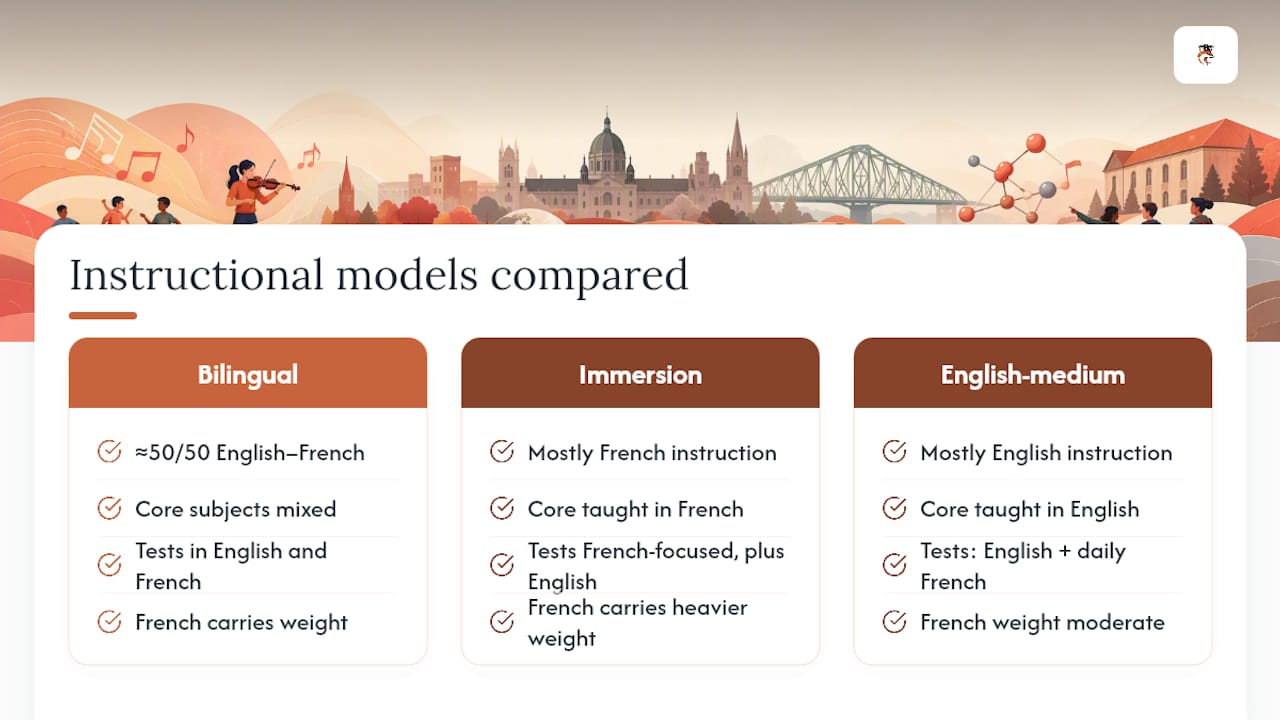
French immersion, by contrast, delivers most or all academic content in French, even for students whose home language is English. The entrance bar for immersion programs tends to be steeper on the French side specifically, since the student will be learning math, science, and social studies in that language from day one.
English-medium private schools with a strong French-as-a-second-language track sit in between: French is taught daily as a subject, but the core curriculum runs in English. This matters at assessment time. A student applying to a bilingual or immersion program should expect a French oral and written component that carries real weight in the decision, not just a formality.
If your child’s French is the weaker subject, that’s worth addressing months before the application window opens rather than the week before testing. Réussite A+ has resources on oral French practice that many Montreal families use specifically to shore up this gap ahead of entrance assessments.
What matters beyond grades and test scores
Academic readiness gets a student through the door, but fit is what actually decides admission at most Montreal private schools. Admissions teams use the interview to gauge whether a child’s personality, work habits, and interests align with the school’s culture, not just their report card.
Extracurricular strength matters more at some schools than others. A school built around competitive athletics or a strong arts program will ask pointed questions about a child’s activities outside class, while a more academically focused institution may barely touch on it.
Religious affiliation shapes daily life at faith-based schools even when admission itself is open to families outside that faith. Ask directly how religious instruction is structured, whether it’s mandatory, and how much of the calendar it occupies before assuming a school’s affiliation is symbolic.
School culture is harder to research but worth the effort. Sit in on a class if the school allows it, talk to current parents if you know any, and pay attention to how staff describe discipline and communication style during the tour. A school that emphasizes independence might frustrate a child who thrives on structure, and vice versa, regardless of how strong either program looks on paper.
Handling a waitlist or an initial rejection
A waitlist placement isn’t a rejection. Most Montreal private schools keep waitlists active well into the summer as accepted families confirm or decline spots, and movement can happen right up to the first week of classes.
Call the admissions office directly rather than waiting for an update email. Ask where your child sits on the list, whether that position is likely to move, and whether submitting updated report cards or a brief letter of continued interest would help. Schools generally welcome this kind of follow-up; it signals genuine commitment rather than pestering.
If your child is rejected outright, ask for specific feedback. Some admissions offices will tell you plainly whether the decision came down to assessment results, space constraints, or fit, and that information is genuinely useful if you plan to reapply the following year. A rejection tied to one weak assessment area, often French or math, is addressable with focused work over the following months.
Formal appeals processes are rare at the private level in Quebec; most schools treat admission decisions as final for that cycle. The more productive path is usually reapplying the next year with a stronger file: improved grades, a completed entrance exam prep program, and, where relevant, documented extracurricular growth.
Getting your child ready without the pressure cooker
The strongest applications come from students who’ve built steady, consistent habits over months, not from a frantic week of cramming before the entrance test. Admissions guidance from schools like St. Thomas consistently points to the same thing: a calm, well-prepared student outperforms an anxious, over-drilled one, and consistent report cards across multiple years carry more weight than a single strong test day.
That said, targeted preparation genuinely helps, especially in French and math, the two subjects most Montreal entrance assessments lean on hardest. A short, focused push on a child’s specific weak spots, rather than a broad review of everything, tends to raise both assessment performance and the report-card consistency schools actually care about.
This is where working with a tutor who understands Quebec’s entrance exam formats pays off. Réussite A+’s exam preparation program is built around this exact gap. Sessions target the specific French or math concepts a student is missing, track progress against real school benchmarks, and keep the pressure low enough that a child walks into the assessment room prepared instead of anxious.
Keep the mindset light at home, too. Frame the process as a chance to show what your child already knows, not a test of their worth as a student.
Where to verify dates, fees, and requirements
Confirm every deadline and fee directly with the school before you rely on secondhand information, since amounts and cutoff dates shift year to year.
- The FEEP admissions guidance explains the legal admissions sequence and Quebec’s fee rules
- Individual school admissions pages, such as ECS, St. George’s, and The Sacred Heart School of Montreal, list exact fees and document checklists
- Réussite A+’s Montreal tutoring page for exam-prep support once your target schools are confirmed
Ready your child, not just your paperwork
Most admissions guides treat Montreal private school admissions as a documents-and-deadlines checklist, and that framing misses what actually decides outcomes. The interview and assessment matter more than parents expect walking in, because schools are genuinely screening for fit, not just verifying that grades meet a threshold.
Where conventional advice falls short is the test-prep timeline. Too many families start reviewing French or math with their child two or three weeks before an assessment, which raises anxiety without building real skill. The stronger approach, backed by how admissions offices themselves describe good candidates, is steady work over months that shows up naturally in report cards.
Prioritize your child’s weakest subject early, request accommodations conversations before you apply if they’re needed, and treat a waitlist as an active opportunity rather than a closed door. The families who navigate this well aren’t the ones with the thickest folder of documents. They’re the ones who started early and stayed calm.
Sources
- Admissions | Fédération des établissements d’enseignement privés du Québec
- Miss Edgar’s & Miss Cramp’s School | Applying to ECS
- Apply Grade 7 – St. George’s School of Montreal
- How To Apply: Application Process for Grades 7 to 11 | The Sacred Heart School of Montreal
FAQ
How much does it cost to apply to a private school in Montreal?
Expect a non-refundable file-opening fee, an assessment fee, and registration fees capped at a maximum amount under Quebec rules, as outlined by the FEEP.
What documents do Montreal private schools require?
Most schools ask for a long-form birth certificate, proof of residency, and the last two years of report cards, with an English eligibility certificate required where applicable, as detailed on St. George’s admissions page.
When should I start the private school application process?
Apply as early as possible since many Montreal schools, including The Sacred Heart School of Montreal, use rolling admissions where earlier applicants have better access to open spots.
What happens if my child is waitlisted?
Waitlists remain active well into summer as accepted families confirm spots elsewhere, so call the admissions office directly to check your child’s position and whether updated grades could help.
Do private schools accommodate learning differences?
Many do, but you need to raise it during the intake stage rather than after acceptance, providing psychoeducational assessments or current individualized education plans as described by Independent Schools Quebec.